← Apologetics Profile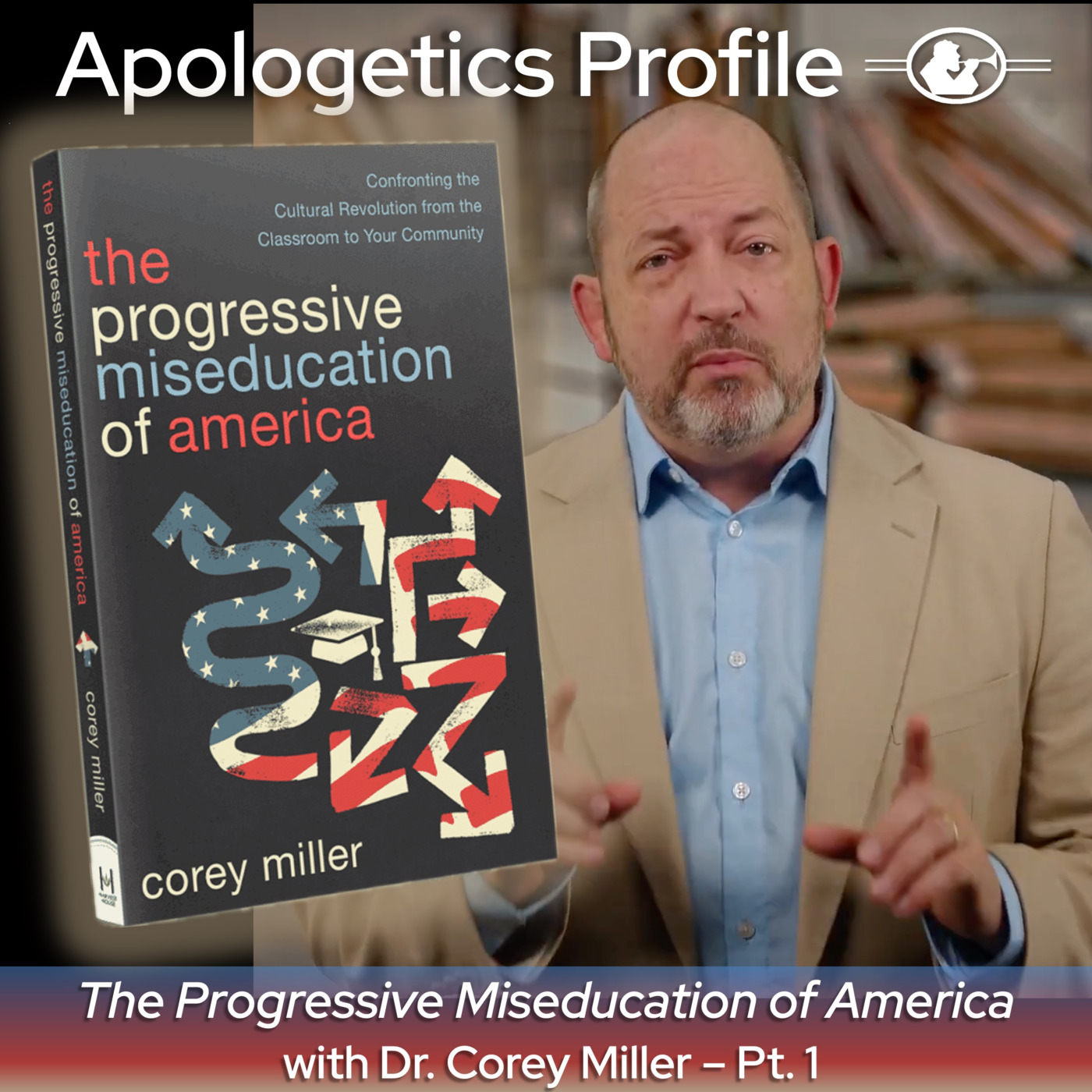
Apologetics Profile
Episode 340: The Progressive Miseducation of America with President and CEO of Ratio Christi Dr. Corey Miller - Part 1
00:44:19
While the Berlin Wall no longer divides Germany, the ideas that led to its construction are still...
Loading summary
Transcript59 lines
- [00:08]
Host/Announcer
Helping the body of Christ proclaim the truth of Christ in a post Christian world. This is apologetics profile.
- [00:21]
Narrator/Commentator
In the world of academia and political discourse today, the trenchant materialist ideas of 19th century German philosopher Karl Marx
- [00:33]
Interviewer
are
- [00:33]
Narrator/Commentator
once more having an enormous influence. Though many people may not even be aware of it. Karl Marx espoused a revolutionary materialist philosophy, a view of history not to be confused with scientific materialism. Though today these two philosophies have indeed converged on several levels. Marx's materialism was an economic philosophy, that is the problems in society, he believed, were because of economic inequality, a class struggle based on the control of economic production and distribution, a battle between the rich and poor, the haves and have nots, the bourgeoisie, the upper aristocratic class and the proletariat or working class. The proletariat, according to Marx, gradually arose sometime shortly after the Industrial Revolution began in earnest in Germany in the early to mid 19th century. Over time, the factory workers became more and more oppressed by the wealthy ruling classes, the bourgeoisie who owned the factories and pioneered the growth of industry. Culture then, as Marx saw it, was not as a result of competing beliefs or philosophies, but a struggle to control the production and distribution of material goods. Marx envisioned an economic utopia of sorts where the working class would rise up against the bourgeoisie and and eliminate the economic and class inequalities. Religion, as Marx viewed it, was a man made drug for numbing the struggles and afflictions of the working class. In Marx critique of G.W. f. Hegel's philosophy of right, he noted quote, the religious misery is in one the expression of the real misery and in one the protestation against the real misery. Religion is the sigh of the afflicted creature, the mind of a heartless world. As it is the mindless conditions, it is the opiate of the people. Modeling Hegelian dialectical tension between thesis and antithesis, Marx viewed history as a cycle of class struggles. In the opening of his Communist Manifesto, he proclaims, the history of all hitherto existing society is the history of class struggle. Marx later notes in that same opening chapter that hitherto every form of society has been based, as we have already seen, on the antagonism of oppressing and oppressed classes. He further believed that political power, properly so called, is merely the organized power of one class for oppressing another. Keep that in mind as we go through this week and next on Apologetics Profile. The solution, as Marx viewed it, consisted of the working class rising up through revolution to overthrow the bourgeoisie a revolution which sweeps away by force the old conditions of production and the conditions for the existence of class antagonisms and of classes generally, and will thereby have abolished its own supremacy as a class. In place of the old bourgeoisie society with its classes and antagonisms, we shall have an association in which the free development of each is the condition for the free development of all. Marx's Communism is an economic system at base. Begun in the Bolshevik single party Russian Revolution of 1917. It came to a sudden end in December of 1991 due largely to rampant economic stagnation and popular uprisings and disillusionment. The last Soviet president, Mikhail Gorbachev, turned over the reins of power to Russia's first modern president, Boris Yeltsin. As an economic system, Marxism has chiefly run its course. Yet Marx's ideas of class struggle and oppression are unfortunately still alive and well and fueling the tempestuous political fires of our time. Across the campuses of U.S. colleges and universities today, Marxism is not so much about economic inequality between classes, but any kind of perceived inequality which is often ambiguously defined. The oppressed classes in today's neo Marxian vernacular are minorities, LGTBQ, people of color, women, politically left leaning liberals, democrats, etc. Yet even these class distinctions themselves are artificially created and ambiguously defined by and within contemporary neo Marxist philosophies. By broad definition, if you are a republican, a conservative or a heterosexual, not a minority, or are white, or are particularly committed to a conservative ecclesiastical body of some kind, you are considered an oppressor. Our guest this week on Apologetics Profile, Corey Miller, president and CEO of the Campus Ministry Ratio Christi, has written an insightful new book called the Progressive Miseducation of America, which exposes the Marxist roots of contemporary neo Marxist philosophies that permeate our colleges and universities today. He notes that Marxist philosophies lie at the heart of what has popularly become known as cancel culture. If you are defined as an oppressor, you must be canceled. As Miller notes on page 39 of his book Question, there exists a campus cancel culture database. By far, most of these cancellations are happening to conservatives and Christians. The college Fix, who hosts the database, defines cancel culture as any effort by people or groups to identify someone or something as offensive or unacceptable and seek in some way to censor or punish the transgressor or item. Miller further outlines much of the baleful fruit of what he calls postmodern cultural Marxism. He addresses some key concepts of the movement, including critical theories, anti Racism, equity, virtue signaling, social justice, white guilt, systematic racism, cisgenderism, intersectionality and inclusivism. At the foundation of all of these ideas exists the Marxist worldview concept of class struggle between the oppressed and the oppressors. Miller notes that Christians should reject any interpretation of social justice predicated on the social construct of victim oppressor, which is a Marxist way of looking at the world. As we pick up here in Part one, I asked Cory about where he thought Christians should begin in dialoguing with people caught up in the Marxist zeitgeist of our time. Here is President and CEO of Ratio Christi, Corey Miller,
- [08:00]
Corey Miller
First Peter 3:15. It begins importantly with sanctify Christ as Lord in your heart. So that is first and foremost before we ever get onto the campus and start operating in conversational evangelism or polemics or apologetics. And then it says, be ready to give an answer for everyone who asks you for the reason. I point to my head, for the hope, I point to my heart. And then with gentleness and respect, I point to my hands. And so there we have the head, the hands and the heart, the fully orbed Christian in that verse. A lot of people engaged in apologetics ministry are just like Mr. Spock. They're just computers. They're living, walking computers, big logic bombs. But we in Ratio Christie want to have people with personalities. So we tell them to go to go to Walmart and buy yourself a personality if you don't have one, because we tend to attract a lot of people that are eggheads.
- [09:04]
Interviewer
Is that being gentle and reverent, Corey? Well, you are dealing with collegiate students, and that is a battlefield today. It's not just the kids, it's the universities and the ideas that are coming from the universities. So you're Ratio Christie's on the front line of these, of these things. And you are dealing with a lot of, as reading in your book, a lot of opposition on college campuses. You can get all kinds of college groups started and the universities don't care. You get distinctively deliberate about Christianity and suddenly people are canceling you left and right. Talk about a little bit about the experiences on that.
- [09:44]
Corey Miller
Even though this isn't part of our DNA, it's not one of our divisions. Within Ratio Christi we have several divisions, or what we would call branches. We joke and say we also have a legal division. And that's because we have had four federal victories, five appellate court victories, two SCOTUS assists. And before Joe Biden left office, we gave him the gift of a victory in the department of education. It was a four year legal draw out there. But I've got, I don't know, three to six cases of inquiry going on at any one time on these college campuses, which is surprising because we Christians started the universities and now the universities really don't want our presence. They want our children and they want our bucks, bodies and bucks, but they don't want us to be there to influence other people.
- [10:39]
Interviewer
I'm currently reading a Postmodernist just for recreational reading. Michel Foucault.
- [10:46]
Corey Miller
Michelle.
- [10:47]
Interviewer
Michelle.
- [10:47]
Corey Miller
She's a wonderful woman, Michel.
- [10:50]
Interviewer
And he said, let me get the quote here. I wrote it down, I didn't want to mess it up. But your book absolutely reminded me of this quote. The book I'm reading is called Madness and Civilization, A History of Insanity in the Age of Reason. And he has this quote, and I think it's apropos to the thesis of your book. He says learning becomes madness through the very excess of false learning. So it's not like learning isn't going
- [11:17]
Narrator/Commentator
on at school, but we're talking about
- [11:18]
Interviewer
the difference between truth and falsehood. And so he's, he's, he's saying basically madness. Learning becomes madness when you have a
- [11:26]
Narrator/Commentator
very excess of false learning.
- [11:29]
Interviewer
And so learning leads to this kind of. Well, as your book is describing, a kind of madness about truth and rel. Relativism and postmodernism and the obfuscation of plain and simple language like two plus two is four. I mean, Corey, what is going on on the campus? Is Foucault right in some sense?
- [11:51]
Corey Miller
Well, Foucault is very interesting. For one, there is no one on Google academic who even remotely comes close to him in terms of citations. He is without doubt the most cited scholar on Google Scholar.
- [12:07]
Interviewer
That's right.
- [12:08]
Corey Miller
And yet the guy was really a sicko. His most recent volume came out posthumously and it was seen that this guy used to take little immigrant kids, oh my gosh. And rape them on the gravestones and throw money at them.
- [12:26]
Interviewer
That is madness.
- [12:27]
Corey Miller
That is madness. And I think he, if I'm not mistaken, probably derived the title of that book from, with the respect of the civilization, from Freud on civilization and Discontent. So yeah, another Freudian Marxist that came along was Herbert Marcuse and wrote the book Eros and Civilization, A Philosophical Inquiry into Freud. And so what the Neo Marxist, the New Marxist movement was, was a, an amalgam of Freud and Marx applied to race, class, sex, gender, ethnicity, and so forth. Yes, that came out of the Critical, the Frankfurt School of critical theory down south was A guy in Italy named Antonio Gramsci who never got out of prison, but his prison notes got mediated into the English speaking world by a Marxist professor in my state of Indiana, at Notre Dame, of all places, by the name of Joseph Buttigieg, father of Mayor Pete. So Mayor Pete's homosexuality, he got a bigger education than most of us realize. It was queer theory, not just ordinary homosexuality, critical queer theory. And adjacent to what I would call the axis powers there of the German school of the critical theory, and the Italian one with Antonio Gramsci, about 15 years later came the founding of postmodernism, which was Foucault, Leotard, Derrida with deconstructionism, and once again, those postmodernists. You would think because postmodernism is characterized by relativism and skepticism, that they would be across the board, across the spectrum, politically left and politically right, but they're not. They're all uber left. They're all what we would call New Left. And as it happens, and I write about this in my book, they all happen to be members of the French Communist Party. They were Marxists, and so they're part of the New Left. And so all of those people are. The new amalgam would be postmodern cultural Marxism. And that is the current revolution that we are living under. And that has ensconced itself into our seminaries and then eventually come out into the political realm and the corporate world, K through 12 and even into our churches.
- [15:02]
Interviewer
Yeah, so I mentioned Foucault because he's the tip of the iceberg that has been growing for a century and a half or more. And it's not just. When you think of Marx, you think of Das Kapital, you think of the economy, you think of money, you think of class divisions of the bourgeoisie and the proletariat, but you don't think of sexuality. But yet when you look at critical Marx theory, when you look at what's in the university is today, as you do with Ratio Christie, you know that. Well, everybody knows what's going on with sexuality today, with the confusion over sexuality. But that just didn't happen overnight on Tick Tock during the pandemic. This has been brewing, going, we can go all the way back to Freud, maybe we can go even farther than that.
- [15:45]
Narrator/Commentator
How, how did we.
- [15:47]
Interviewer
Where, where, where was the convergence, Corey, of Marxist ideology and human sexuality confusion? Where did that start?
- [15:56]
Corey Miller
I mean, you've always had moral relativism around, right? And Foucault would say that, you know, truth is reducible. To power. Another postmodernist, Richard Rorty, would say, truth is what my peers will let me get away with. It's about language games, but truth is
- [16:13]
Interviewer
still a part of their vocabulary. If they want to be postmodern, the undercutting dialectical contradiction would be that they're trying to establish some kind of truth as they're deconstructing what we would traditionally call truth in the Judeo Christian West. Correct?
- [16:29]
Corey Miller
Yeah, I feel like I need to back up a little bit.
- [16:32]
Interviewer
Yeah, we're getting ahead of the train here.
- [16:34]
Corey Miller
So Foucault and Marcuse and other people, they are part of what I would call the second ideological revolution that's taken place in our universities since we started the universities in 1636 with Harvard, just six years after the Puritans landed in the New World and started Harvard. And their motto was Truth Veritas. But as Puritans, they had capital T, Truth or capital V. Veritas, the Latin term. All truth is God's truth. And they started the universities. We Christians started the universities. And that lasted about 200, 250 years up until 1840, when at that time, virtually every college president was also a member of the clergy. By 1880, the first revolution had begun. And the reason it did is because we had no PhD programs in America. So we sent our best and brightest overseas, mostly to Germany, which was the most formally educated country in the history of the world at the time. And out of Germany, what was happening is you had people like Immanuel Kant that you remember him by. You can't know ultimate reality. He's, you know, the culmination of the Enlightenment gave us agnosticism. It was a failed project. Then you have Schleiermacher, the father of modern liberal theology. Then you have Freud, you have Nietzsche, God is dead. You have Marx and Angles and so many Wittgenstein of language games. You have so many of this German ideology that our graduates would then graduate, they would go back to America, and they would take over at Princeton, Yale and Harvard and Columbia. And then we had to start the new version of the universities. Wheaton and Calvin, Westminster and Biola and so forth. Well, the dust was settling in the 1930s with that first revolution, which was dubbed the scientific naturalism. Marx was a product of that revolution, scientific naturalism. Marx was a modernist. In fact, his dissertation on dialectic materialism, he looked at two Greek philosophers, Epicurus and Democrates. And he was a materialist, he was a naturalist. It was the neo Marxist that then came along later. So the dust is settling in America. In the 1930s, they had taken over the scientific naturalists. And you can see it in the names of the disciplines. Politics, which was always part of ethics, called, you know, politics. The ethics for the, for the public good now is political science. Yeah, psychology, which means the sukhaology, or the study of the soul. No longer study of the soul. It's the study of the brain and the central nervous system or behavioral inputs and outputs. And so we renamed it the department of Psychological Sciences. Everything was about science. But in the 1930s, something nefarious was happening once again in Germany, leading one to ask, has anything good come out of Germany since the Reformation? And it was the second ideological revolution, and that was the Frankfurt school of critical theory that we have heard now about. Critical race theory, critical queer theory, critical gender theory, critical pedagogy, critical iceberg theory, you name it. If it's not critical thinking, run from it fast because it's Marx plus whatever else they're talking about. And so in the second revolution then these leaders were fundamentally Jewish and they were neo Marxists. That means mixing Freud with Karl Marx and applying it broadly to culture, to race, class, sex, gender, ethnicity.
- [20:24]
Interviewer
And this is paralleling along the lines of Social Darwinism in the early 20th century.
- [20:28]
Corey Miller
That's right, Social Darwinism. So even though Darwin wasn't in Germany, he was in the uk. Marx had migrated over there. There was dialogue, I believe that happened between Marx and Darwin. And so some of it came from the uk and you had British empiricism and other views that were happening at the same time. Science, logical positivism, the Vienna circle. But the post modern turn on this was that unlike modernity, which threw away anything that you couldn't reduce to physics or chemistry, that you couldn't scientize or naturalize, so to speak. So much for religion, so much for ethics, unless you could naturalize it somehow. So much for a lot of the humanities. Well, the postmodernists came along and said, hey, modernist, we agree with you against religion and against metaphysics and things outside of the sense perceptible realm.
- [21:29]
Interviewer
Against meta narratives, against metanarratives.
- [21:31]
Corey Miller
Metanarratives, grand theories. Yeah, explaining things.
- [21:35]
Narrator/Commentator
The early 20th century New Testament professor at Westminster Theological Seminary in Philadelphia, J. Gresham Machen, notes In his classic 1923 short book, Christianity and Liberalism, that liberalism, though a slippery term which often eludes concrete definitions, is largely predicated on an evisceration of the foundational truths of Christianity. Though it retains the language and terminology of traditional Christianity. Machen notes, Christianity is battling against a totally diverse type of religious belief which is only the more destructive of the Christian faith because it makes use of traditional Christian terminology. This modern non redemptive religion is called modernism or liberalism. Both names are unsatisfactory. The latter in particular is question begging. The movement designated as liberalism is regarded as liberal only by its friends. To its opponents it seems to involve a narrow ignoring of many relevant facts. And indeed the movement is so various in its manifestations that one may almost despair of finding any common name which will apply to all its forms. But manifold, as are the forms in which the movement appears. The root movement is one. The many varieties of modern liberal religion are rooted in naturalism, that is, in the denial of any entrance of the creative power of God as distinguished from the ordinary course of nature. In connection with the origin of Christianity, it is important to note that what Machen means here by naturalism isn't the traditional philosophical term. Rather, he means a man made religious and theological system which retains Christian vocabulary but rejects miracles, the divinity of Christ, his resurrection, the historicity of both the Old and New Testaments, inerrancy and infallibility, the Trinity, and many other core doctrines. In liberalism's attempt to reconcile Christianity with modern science, for example, Machen notes that it has really relinquished everything distinctive of Christianity. In trying to remove from Christianity everything that could possibly be objected to in the name of science. In trying to bribe off the enemy by those concessions which the enemy most desires, the apologist has really abandoned what he started out to defend. Of course, Machen, writing this in 1923, recognized that all of this was happening well before the turn of the 20th century, largely in part due to German higher criticism of the late 18th and early 19th centuries, a byproduct of the Enlightenment, scholars such as Frederick Schleiermacher, David Frederick Strauss and Ludwig Feuerbach began questioning the historicity of the Bible. Essentially, the collective conclusions of these scholars and their subsequent disciples up to the present day are that not much can be known about the historical Jesus, except that he most certainly was not God incarnate and that most of what comprises the Old and New Testaments was man made. The Bible is not actually God breathed history and inspiration. Many who espoused this theological liberalism retained their Christianity in name only, as Machen has noted. Consider the late evolutionary biologist JBS Haldane, a committed Marxist himself. Writing about Christianity in his 1927 book Possible Worlds and Other Essays, he exemplifies precisely what Machen had in mind regarding liberalism's emptying of Christianity, Haldane writes, the Christian saints believed God to be a person, though the Buddhists did not. Their lives were often, though not always, admirable, and their religious experience on the whole confirmed with their beliefs, but it does not follow that their beliefs were correct. If such a point of view is adopted, the literature of Christianity will come to be regarded as of mainly symbolic value you, but yet as showing forth a real experience which could perhaps have been expressed in no other way at the time when it was composed. An even larger proportion of the sayings of Jesus will be regarded as parables and therefore to be interpreted rather than dogmas, to be believed and then fitted, not without strain, to the rest of experience. Christians will learn to take many of the church's prohibitions no more seriously than St. Paul's veto on things strangled. They will regard their institutions rather as tokens of solidarity with the past and the future than as means of salvation. And they will rank theology with poetry, music, ritual, architecture, sculpture, and painting as an expression of religion but not its essence. This theological liberalism goes hand in hand with what we know to be postmodernism. In common with liberalism, postmodernism likewise is challenging to define. Yet there are distinctive characteristics that postmodern philosophies have in common. As Stuart Kelley and James Dew note In their 2017 book Understanding Postmodernism, postmodern philosophies generally espouse a suspicion of larger big picture worldviews or metanarratives, typically viewing such stories as a means of oppression, a Marxist influence. As we've already seen, truth is essentially a human construct, and language itself is insufficient for describing external reality. Postmodern philosophies have a distrust of historical methodologies, suggesting that the past is largely unknowable. Truth in a postmodern perspective is also seen as more of a therapeutic tool, as a coping mechanism, rather than something objectively real about the external world. As Corey here notes, these philosophies, both liberalism and postmodernism lead to a myriad of conflicting ideas and contradictions.
- [27:52]
Corey Miller
But touche, we think you're wrong also. In fact, there is no truth, not even scientific truth. And quickly you think, aha, we just caught you in a logical contradiction. There is no truth. Is that true? They're going to go with it and say, yeah, sure, right. Truth is reducible to power. Yeah, and this is where we're at today.
- [28:18]
Interviewer
And in the midst of that milieu that you've just described, philosophers also were thinking or rethinking the idea, since there's Hardly any ever cohesion among philosophers. Certain schools of philosophy differ about how we can know what we know they were. This idea was bubbling up that philosophy could actually find the holy grail of what they were looking for by examining definitions of words. That language became malleable to the extent of definitions and what authors mean. One of the hallmarks of postmodernism was that there's no authorial intent in texts speaking about the older text or biblical texts, that it's the reader who imparts meaning to a text. But this, this was an outgrowth of postmodernism that we see in modern deconstruction at universities and schools and online. People deconstructing their faith by means of. What is all this? It's just semantics, Right. Everything just reduces to how I'm defining my words. And this is where we are with pronouns and things of this nature. That's where all that madness comes out of. Correct. To some degree.
- [29:26]
Corey Miller
Sociologists today are apt to say that knowledge is a social construction of reality.
- [29:32]
Interviewer
Yeah.
- [29:32]
Corey Miller
And the postmodern spin on this is that words have power. Words are discourses, they are narratives that we use to construct the cultural reality. So Antonio Gramsci was the one, I believe, that came up with the idea of hegemonic narrative, hegemonic power. And it comes from exegesis, you know, the word exegesis, leading out. So we are leading the culture through the use of words. And so, yes, we will. These people will infiltrate a culture, an institution. They'll adopt common words, but they'll change the meanings. So like, love is love.
- [30:16]
Interviewer
This is what, this is what cults do, Corey. They come in, they use the same vocabulary, but different dictionary coming in. But the.
- [30:23]
Corey Miller
It's interesting Trojan horse.
- [30:25]
Interviewer
Absolutely. And the idea too, that the subtle idea was not so subtle, but we're going to use words. We are going to create culture by the hegemonic use of vocabulary. We are cultural creators. In other words, underneath all of that is we'll be like God. We are creating culture with the words that we are speaking, which is just like what we have in the Bible. Although we now have the postmodernists speaking reality into existence, which is what we're dealing with on the college campuses, right?
- [30:55]
Corey Miller
Yeah, that's right. No, no disagreements here. And the college campuses have. Have changed. You know, they. Again, for about 100 years, the. The reign of the scientific revolution was taking place. And that eventually bled down to the church and gave us liberal Protestant theology, and it gave us the social gospel. The second revolution bled down A bit quicker once it took root. And it gave us, instead of the social gospel, it gave us social justice. So now you start seeing churches that used to have compassion ministries or mercy ministries. They no longer even call them mercy ministries, they call them justice ministries. And it's not justice justice, like the classical understanding of justice, getting what you deserve. It's social justice, which is a sociological category framed by Marxist thoughts. From each according to their ability, to each according to their need, not just in economics, the economic redistribution of wealth, robbing from the rich and giving to the poor as though Robin Hood was a virtuous character. It's robbing from every subgroup identity. And we're all part of group identities and that's our primary identity, is our group identity, race, class, sex, gender, ethnicity and so forth. And because truth is reducible to power, this is all about power imbalances. And so they are trying to take from the haves and give to the have nots, take from the oppressors, the dominant group establishing the hegemonic narrative and control over the subordinate groups, trying to take from the victimizer and give to the victims. Until everybody shares all things in common equally. We all have the same $40,000 living wage. We no longer own private property. We all own all things in common. So this is Marxism, neo Marxism, postmodern, cultural Marxism. Call it what you want. Most people may not understand those terms, but they can always see maybe through some common terms like dei, which I would rather call die. Not just for cute rhetorical reasons, but I think it really matches philosophically. The D relates to what is real in metaphysics. The I relates to how we know woke in epistemology. And the E relates to the ethics in philosophy and that is reparations, social justice.
- [33:41]
Interviewer
Yeah, yeah, you, I know you've interacted with James Lindsay and Peter Boghossian, who about a decade or so ago, maybe a little bit more, came out as part of the, the tail end of the New Atheist movement. Peter wrote a book called A Manual for Creating Atheists and started a movement called Street Epistemology. James Lindsay wrote a book called Everybody's Wrong about God. Virulent anti theist rhetoric mirroring that of the New Atheists. But we had talked a little bit earlier this afternoon, you had told me something that I didn't know that Peter and Dawkins and a few other people got together and realized, have recently realized, that if they've taken out the gods of traditional Judeo Christianity, they weren't exactly prepared for what was going to fill the void. Once those.
- [34:36]
Corey Miller
Yeah, they knew something was coming.
- [34:37]
Interviewer
Something was coming, but they didn't know what it was. And you had just mentioned a minute ago where our value as human beings and our identity are under these ideologies. So if we are not created in the image of God, then our value under a neo Marxist paradigm would be in what we can contribute in our utility to society or to the paradigm or whatever it might be. Our value is determined by what we can do, and our identity is determined by the group to which we belong. Where our utility is being utilized in this, in these groups. But without the amagio dei, confusion just pours into human identity. How do you see the problem of human identity today with the young college kids?
- [35:21]
Corey Miller
Yeah, it's about, you know, the eradication of rigid. What do they call it? Individualism and the welcoming of the warmth of collectivism in New York. Mamdani. Right.
- [35:39]
Interviewer
Yeah.
- [35:40]
Corey Miller
The Muslim Marxist. So everybody is part of a collective, our primary identity. There are no natures. Right. There is no such thing as human nature per se. And our nature certainly isn't made in God's image, with our ultimate goal being conformed to the image of Christ. Our identity is formed by our group identity in classes that often intersect like race, class, sex, gender and so forth. But it's a. It's a collectivist view of the world. And sometimes I think it was a. I think it was a French Marxist who probably came up with the idea that you don't get an omelette without breaking eggs. And so sometimes there has to be violence in order for the good of the world.
- [36:34]
Interviewer
Yeah.
- [36:34]
Corey Miller
You know, take one for the team. Good for utopia.
- [36:37]
Interviewer
Yeah, yeah. And so revolution, if you have all these groups whose members are deriving their identity from the group, this would explain the violence that we have seen and the protests that we have seen. Because you are. You are clashing. You're competing with my. My interests. You're competing really, ultimately, you're trying to redefine me. I define me, my group define me, defines me. But if our groups clash ideologically, then the only way to solve that seems to be violence of some kind.
- [37:11]
Corey Miller
Yeah, we are social creatures. We are rational animals, as Aristotle would say. We are composites of body and soul. But as social creatures, we are always trying to belong to some tribe, to some group. And without God, where do you go to reference your identity? So you find some group identity for survival because you've got other groups that might be violent in wanting to attack you. So we exist in a culture right now that is called an assassination culture. I think it was in April that the New York Post gave that as the title for an article. And then we saw just prior to that December, just slightly more than a year ago, Luigi Mangione assassinate the president and CEO of United Healthcare. And what was amazing wasn't simply the brutality of the assassination, but the. What followed was the, the data showing how many people, how many girls swooned over this person like, like he was Elvis, a heroic character of sorts of. And the percentage of Gen Z that supported the assassin more than the assassinated was just absolutely mind blowing. And why that's important too. Everyone that was 45 and older, it was a very small number. But those 45 and under, especially in Gen Z, the number was enormous. I think it was in the high 30s if I remember correctly. And what that tells us is the closer you are to the epicenter of the university where ideas have consequences and bad ones have victims. That's what's happening. If there is no God, everything's permissible. Peter Singer, who wrote the book Not a Manual for Creating Atheists, but the Unsanctifying of Human Life, he believed that we no longer believe in God's existence. So there is no such thing as a sanctifier of human life. So there can be no such thing as the sanctity of human life. And this is why we're finding so much violence out there. The more and more we reject God, humans are just other animals and we need to collect and become part of the pack or the group for survival.
- [39:32]
Interviewer
The morality of the pause, the moral conscience is becoming number and number. It seems like, you know, with Charlie Kirk in Utah as well, the idea that I'm just going to kill my enemies, I'm just going to assassinate people I don't like. I'm going to take out people this way.
- [39:51]
Corey Miller
Well, yeah. And ironically it's because the new belief is that words are a form of violence.
- [39:59]
Interviewer
Yeah.
- [40:00]
Corey Miller
And on college campuses in a Yale study, I think like seven years ago, one third of college students believed that physical violence is justifiable if someone says bad words that are harmful to another person. And 66% said that something is harmful just whenever one considers it such. This is just craziness. But Charlie had to go, he had to die. Because what Charlie did was erase the existence of trans people. He virtually murdered trans people. And so they had to come along and assassinate him. And what was ironic is Charlie was out there being the exemplar of free speech and open dialogue, following what Peter Boghossian and I When we had a partnership and we went on speaking tour together, you know, the enemy of my enemy is my friend. And we were friends and allies on viewpoint diversity and the death of intellectual diversity in the university. And so we began our speaking tour together as allies at Utah State University, where Charlie Kirk's assassin first got his start in his college career. And then after going through three or four different universities, we finally landed at the university, Utah Valley University, where Charlie Kirk was assassinated for having disagreement. But what Peter Boghossian and I landed on was the neutral party, Voltaire, the deist, who used to say that, I may disagree with what you say, but I would defend to the death. You're right to say it. Stalin comes along, by contrast, and says something more like, ideas are more powerful than weapons. We don't allow our enemies to have weapons, so why should we let them have ideas? That's the heart of cancel culture. This is not liberalism. This is illiberalism. This is Marxism. And that's why you're starting to find this new alliance taking place between liberal atheists and conservative Christians. It's why Richard Dawkins now wants to consider himself a cultural Christian. Elon Musk, a cultural Christian. Jordan Peterson, an existentialist Christian. Tom Holland, an agnostic Christian. You know these new terms. Because what they've encountered now after the rise and fall of the new atheism, because they're now getting kicked out by the new revolutionaries, is that they don't like what they're seeing. On a macro level, before this, they were just trying to eliminate religion, thinking it was so bad, and they never realized how bad it could become without that. And so Dawkins loves when it comes to comparing to Islam or Marxism. He says, I'm on Team Christian every day. But what Dawkins likes is the fruit of Christendom. He doesn't like the root. And he thinks he can continue to buy these nice big juicy apples from the supermarket without realizing. No, they come from an apple tree.
- [43:22]
Host/Announcer
Apologetics Profile is a production of Watchmen Fellowship, a non profit Christian apologetics ministry focused on interfaith evangelism and discernment. For more information, visit our website@watchman.org that's watchman.org.
- [43:47]
Corey Miller
Sa.