← Apologetics Profile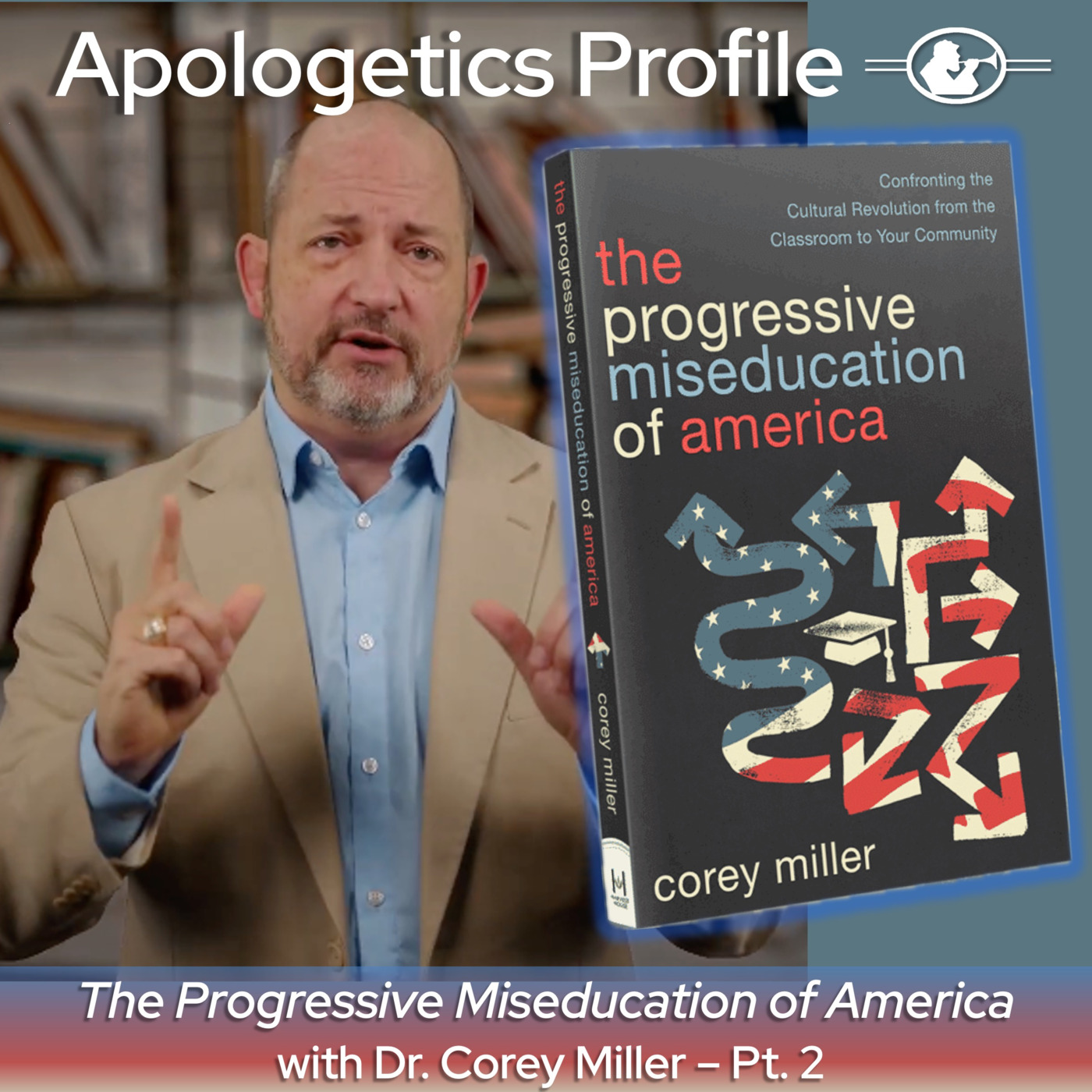
Apologetics Profile
Episode 341: The Progressive Miseducation of America with President and CEO of Ratio Christi Dr. Corey Miller - Part 2
00:38:08
This week we continue our conversation with President and CEO of Ratio Christi Dr. Corey Miller a...
Loading summary
Transcript51 lines
- [00:08]
Host
Helping the body of Christ proclaim the truth of Christ in a post Christian world. This is Apologetics Profile
- [00:19]
Narrator
Science it dominates our cultural discourse today, whether it be in astronomy, astrophysics, cosmology, biology, geology or paleontology. It seems that the most fundamental and basic way to understand stars, living things or rocks is through the methods, tools and assumptions of modern science. To suggest that there is anything beyond the physical cosmos, that there might be something supernatural behind everything we see, is anathema to most contemporary scientific hypotheses and explanations. Science, we are often told, is a detached, objective look at the facts about physical reality. It has the potential to solve problems through empirical observations and testing. Far and away removed from the emotive superstitions and subjectivity of religious feeling and belief, every facet of reality could potentially be subjected to this rigorous analytical, rational and thoroughly empirical way of knowing the world. Science could potentially usher in a future societal utopia built solely on the unassailable dogma of scientific fact.
- [01:27]
Interviewer
Fact.
- [01:27]
Narrator
In this spirit, the physical sciences have something in common with Marxist ideology. In Marxism, the centrality of a government sanctioned economy theoretically was supposed to alleviate class struggle by means of an equitable distribution of goods and services. Likewise, science could theoretically do the same in establishing undisputable truths about the nature of reality. The late British moral philosopher Mary Midgley, in her 1992 book Science as a Modern Myth and Its Meaning, noted that these scientific ideas are what made Marxism seem appropriate, a body of thought which was scientific because it officially owed nothing to feeling and was available to save the world. She noted, though, that even though Marx was not fundamentally addressing questions of science in his original theses, he nevertheless had made this claim to scientific status which was growing so important in his day. Midgley also observed that such an appeal to science was rooted in hope and had deeply religious connotations. Nevertheless, to combine the fundamental principles of Marxism with the rigors of empirical science seemed to many intellectuals to open an intellectual New Jerusalem, not just because it promised a millennium gained by conflict, but because it seemed to back this promise with scientific status. It seemed like a means of extending the reliability of science over the whole area of practical thinking, a way of spreading it that would be free from doubtful value judgments. Since the theory was impartial, nonsectarian, essentially scientific, the modesty of science was to be combined with the constructive achievement of a new and central moral insight. Last week on the profile we briefly mentioned JBS Haldane, an early 20th century evolutionary biologist who is also a committed Marxist. Haldane noted in a 1938 lecture given at the University of Birmingham. Marxism claims to apply scientific method in the field of politics and economics and to predict and to enable us to control the transformation of the world. Still further, because it extends scientific method into the human field, it throws a new light on science as a human activity, depending both on contemporary social and economic conditions and also on very general laws of human thought. It further lays down some principles which are said to hold throughout nature as well as applying to human activities. Now, this is not to say that all scientists today are openly and overtly embracing Marxism as Marx first envisioned it, but it is to point out that Marxist influences are still very much intertwined with much of what comprises the philosophical and metaphysical conclusions of scientists today. For example, much of anything pertaining to the cosmos or life within it, including our own, can theoretically be explained by science. Everything from DNA to distant galaxies has a scientific explanation, even morality and ethics. Everything theoretically can be reduced to its physical components with little or no need to invoke God. Christian philosopher James K.A. smith notes in his co authored 2018 book All Things Hold Together in Christ A Conversation of Faith, Science, and Virtue, that Christianity is often placed in the defensive mode against the cold hard facts of empirical science. Yet Smith notes that this is a false dichotomy which arises from a significant category mistake in the faith science dialogue. Smith writes, much of the science theology conversation has operated on the basis of a certain positivism vis a vis science and taken the findings of science as if they were pristine disclosures of nature. Thus we constantly encounter the familiar tropes we now know, science shows us what science says, and so on. This is the case whether we're talking about new atheists like Dawkins and Dennett or theological voices like Polkinghorne and McGrath. On both ends of the continuum, there is a similar assumption about the nature of science. It is either the pristine deliverer of the cold hard secular truth or the crystal clear lens for disclosing the message of the Book of nature. The dialogue tends to assume that theology is a kind of human cultural product, whereas science is merely the conduit for disclosing the cold hard realities of nature to which theology must answer, demure or affirm. After all, who's going to argue with nature? One of the most singular cold, hard secular truths of the Father findings of modern science of the universe, for example, is neatly summarized in science writer David Baker's 2022 book The Shortest History of Our Universe. Baker writes, bang about 13.8 billion years ago, a tiny hot white speck appeared. It was so small that at first it could not have been seen by the naked eye or anything except the most powerful of modern telescopes had they existed. This was the first appearance of the space time continuum and the extremely hot, densely packed energy within it. Nothing existed outside of it. This is but one example of how the historical dialectical materialism of Marx has engendered the philosophical materialism of contemporary science. As Smith noted previously, theology, now on the defensive, must somehow answer, demur or affirm this assumed fact of the universe, but not just the fact of the singularity itself, but the manifold secular assumptions behind it. Matter and energy are self generative. There are no gods, no theological disputations are even necessary. There are no emotions involved. There are no value judgments, no feelings, nothing at all outside the physicality of the cold, hard fact of this peculiar white hot singularity. But such conclusions are nevertheless theological in nature. To attempt to disavow or eliminate God or theology or the theologians from the picture altogether, one must first define what they mean by God and why theology should have no respectable place at the table. Assumptions and definitions that cannot be confirmed by empirical science. By the way, one can't do away with something you can't define or cannot define to the satisfaction of theologians. And even to claim that definitions of God are illogical is a theological claim that requires the claimant, in contradiction to his own assumptions, to define God. At the end of his book, Baker's unsettling conclusion about human beings in the universe is that we are mostly a biohazard, responsible for the mass extinctions of other living species. And if we don't somehow curb our reproduction, we will certainly be facing extinction ourselves. Herein is yet another fruit of Marxist ideology in a contemporary popular science book about the universe. A competition for resources. As the population grows, so the futuristic scenario goes, resources will become scarcer, classes will conflict. Thus we need a centralized solution that can only be achieved through science and technology. And today we are so conditioned by the widespread prevalence of science, we hardly bat an eyelash at hearing science popularizers and scientists themselves suggesting scientific solutions to virtually every problem we face today, even moral and ethical challenges. Here, on part two of our conversation with President and CEO of Ratio Christi Corey Miller, we will be further discussing the baleful influences of Marxist ideology in colleges and universities today, and how we might, as Christians, understand and engage with those who are caught in these ideological strongholds. And as we begin here in part two, I share with Corey how his book reminded me of some thoughts from Aldous Huxley's. Journey chilling sci fi classic. A Brave New World.
- [11:17]
Interviewer
In the opening chapter, there is the Central London Hatchery and Conditioning center where they raise human embryos and train them from, from birth all the way through adolescence in, in how to inculcate them into being numb and just placid and, you know, scary and, you know. Yeah. And what's trying to eliminate the, the penchant for violence and trying to even keel. It's a techno Marxism, as I call it. Everybody wants to be the same economically. Well, Huxley's brave new world. Everybody wants to be the same morally, intellectually, spiritually. We're all just going to numb everybody. And one of the things that the training center did to infants, and this is a pretty revealing, a little bit disturbing part of the book where they bring some infants into a room and they set books and flowers before them. And there's a moment where the children, the toddlers are like, ooh, books. And they're, they're happy. And then a nurse pulls a switch and there's loud sirens and wailing and lights and the kids start crying, right? They, so there's, they do this every day. They're associating a book with the sirens and screaming and the wailing and all of that. And then while that's going on and the flowers and the books are before them, a nurse pulls another switch and gives all the children mild electric shocks. So what ends up happening is they're
- [12:37]
Narrator
conditioning the children to dislike books and dislike flowers.
- [12:41]
Interviewer
They don't want them to appreciate or love or enjoy nature. And they don't. They're rooting out, to your point. They're rooting out the idea that ideas come from books. We want them to hate books. We don't want them to, we don't want to give them the weapons of ideas because we know how dangerous it is. And then he goes on to say, and I thought this was something very interesting as well, that, that if you should somehow happen to have something unpleasant happen to you as a young adult, there's always the soma, which is the drug of the new world to give you a holiday from the facts. And soma is this all encompassing soothing drug and Huxley calls it morality. Half your. You can get your half your morals from your bottle. This is Christianity without tears. He says everybody can be virtuous now with Somalia. And it just, it's just so prophetic to me to see how we are placating, how we are engaging with, with students and children and young minds today, making them hate books. Making them, you know, kind of just drugging them out in a sense, whatever, allowing them to define themselves however they wish. But it seems like Huxley and Orwell had a, had a, had a horrifying prophetic vision of where our society was going. How do you see that of those ideas? Are they extreme or do you see something like that in your. With kids you're talking to today on college campuses?
- [14:06]
Corey Miller
Yeah, we're certainly experiencing the dumbing down of America. You know, you think of other books like Neil Postman's Amusing Ourselves to Death, where on the front cover you have a family of four, mom and a dad and two kids, and there's a television in front of them and one of them has the remote and all four members of the family are decapitated. Amusing ourselves to Death.
- [14:32]
Interviewer
Right, right.
- [14:33]
Corey Miller
And it was about 30 years ago and a few months that Mark Noel wrote the book the Scandal of the Evangelical Mind. And he wrote it about, I don't know, five to 10 years following Alan Bloom's book the Closing of the American Mind. So this is, this is an American phenomenon, but it certainly is also a evangelical phenomena, the scandal of the evangelical mind. And Mark Noel wrote in his first line in that book, what the scandal was is there. There isn't much of an evangelical mind.
- [15:08]
Interviewer
Right, right.
- [15:09]
Corey Miller
The sad thing is that is just the opposite of what the first 1900 years of Christianity was about. It. You know, we were the ones who started the universities, not just the hospitals. We didn't just have fat hearts, but we had bright minds. And it's because this goes back to the DNA of our worldview. We, we have a worldview that begins with mind, not matter. And Jesus said that the purpose of life is to know God. And we don't have a faith tradition. We have a knowledge tradition. Knowledge is central to the Christian experience. And Jesus himself was called the Logos of God, the word of God, our word for logic. And so just like it's true to say God is love, it's true to say God is logic. And so for Christians, we have failed for a century in this country to follow Jesus. And what do I mean by that? Well, someone came up to Jesus, he just pulled one over on the Sadducees. And now the Pharisees thought they'd give themselves a shot. And they said, what's the greatest command? And he begins laying it out, and he says, love God with all your heart, soul and heart. No heart, soul and mind. And we have decapitated the mind ourselves. We have excommunicated the Life of the mind we live with within the menace of mindless Christianity today. And in my book, the Progressive Miseducation of America, I'm trying to lay out not only what happened and how it happened, that this is no longer Grandma's America, but how we can reclaim that level of salt and light that we need to transform lives, cultures and civilization like Jesus did in the West. And that is we need to repent and we need to start following Christ again with hands, heart, and yes, even
- [17:09]
Interviewer
head in our minds. There's a little scene in Animal Farm where farmer Jones, whose animals end up rebelling. They're the proletariat that's going to overthrow Jones and his neglect. Jones is a drunkard. He comes home one weekend completely drunk, lays down on his couch, and Orwell writes, Mr. Jones asleep on his couch drunk with, quote, the News of the World on his face. So you can see him laying on the couch with the glow of the television set on his face. And what's significant about that is he's drunk on the couch with the glow of the TV on his face. His animals begin the rebellion. This is how the rebellion starts. And so he goes out there with his farm hands and he tries to suppress the animals breaking into the feed bin. But the animals are surprised, even themselves, about how they uprise and chase Jones and all of his farmhands off the farm, and they have the whole farm to themselves. So in a sense to what you were just saying, Corey, I think that we are kind of asleep on the
- [18:07]
Narrator
couch with the glow of the TV on our face.
- [18:09]
Interviewer
And we did. The repentance would be, well, maybe we should turn off the TV and turn ourselves back to Jesus. I mean, that's what repentance is turning, right? So maybe we need to turn off certain things in the way the world is influencing us so we can turn to, like. I have a very difficult time reading. If I have a screen near me, television, phone, laptop, I have to be kind of removed from that in order to concentrate on being able to read. I came over here to the student center to get away from people in the screens in the room that I'm sharing so I can read and prepare for our interview. Because that is so distracting to me. And I can. It just draws you down into that. And I think to your point about how we repent, how we turn and train minds, reminds me of CS Lewis and the Abolition of Man. I know it's not a particularly Christian argument, but he's talking about our society of a men without chests that we've forgotten how to raise young men and women virtuously, going back to the old ideas of virtue. And so we need to instill in the concept of the loving God with all of our minds is a virtuous ethical and moral capacity to use knowledge correctly. Whereas in postmodernism, we're using it utilitarian, in a utilitarian sense. For whatever the paradigm, the dominant paradigm is, is there in on the college campuses today, are kids facing what's the main paradigm they're being told to obey? Is it whatever they want? Or.
- [19:41]
Corey Miller
I mean, in the hard sciences, that's one wing of the university. Scientific naturalism still tends to dominate, even though it has been infiltrated through die
- [19:53]
Interviewer
programs that came from the die for people that don't.
- [19:57]
Corey Miller
Okay, so as a philosopher, we recognize that there are three major branches of philosophy, and their technical terms are metaphysics, epistemology, and ethics. In common terms, that would be what is real? How do I know what is real? How should I then live based on what I know about reality? That's what philosophy is. It's the love of wisdom in all fields. But answering to those three questions, and in that order, and so we can explain what this social justice stuff is, what this woke stuff is, what this postmodern, cultural Marxist stuff is, what die is by starting with the D. Because it is fitting that it is part of the first branch of philosophy. When it comes to human relations, we are fundamentally in social binary group identities, male to female, rich to poor, black to white, gay and straight, trans and CIS and so forth. So when it comes to diversity, we want to identify all of the various juxtaposed subgroups of the haves and have nots, oppressor and oppressed groups. Then we move into the second branch of philosophy, and that's where the I comes in. Inclusivity and inclusivity, once again, it's a term we used to think meant one thing and now it means another. What it means, according to these academics that are trying to fob their worldview off on us subtly through these narratives, is we include, once we've identified all of those groups, oppressor and oppressed groups, victim and victimizer groups, have and have not groups we include and we platform and we exalt and we promote only those groups that are part of the ones who were oppressed, because only those oppressed groups truly know they have a special secret, esoteric kind of knowledge in virtue of their being part of the oppressed. They can see differently, they are enlightened differently they have awakened differently. They are woke. And so this is part of a certain specific part of epistemology that is valued for its standpoint, its social location among these group identities. And it's called standpoint theory. It was first used and developed in feminist theory, second wave feminism, by Sandra Harding. But Sandra Harding even claims that she got it from Marx. And so once again, you're including for your promotion and exaltation and to have a voice, a morally authoritative voice. Only those who are in the subordinate, oppressed groups. The rest of them, like the white male, cisgender, heteronormative.
- [23:07]
Interviewer
That would be the Christian bourgeoisie.
- [23:09]
Corey Miller
The bourgeoisie, the ruling class. Those people can listen, learn and lament because they can't truly know. At best, the white man can only be less white, as Robin d' Angelo used to say. So we exclude the oppressor group identities and let them listen, learn and lament and stew in their guilt because they'll probably never be forgiven. Forgiveness is not talked about here in social justice. And then what comes next is the third branch of philosophy. That's ethics. And that's where we say, look, if the ultimate problem to begin with is social oppression, then the solution is social liberation, social justice. It's righting the wrongs of this power imbalance. And that's where we liberate people and now execute reparations, revenge, payback. We don't know how long, but it's going to be a long purgatory if we can ever purge ourselves of those sins.
- [24:16]
Interviewer
Yeah, and it's the. It's the secular, critical version of the unforgivable, the unpardonable sin. You've blasphemed the spirit, not the Holy Spirit, but the spirit of the age. And that's unforgivable.
- [24:31]
Corey Miller
Inequality is unforgivable. That's the unpardonable sin. So inequality at that first level of the social binaries is injustice. Inequality entails injustice everywhere. It's that by definition. So it's not just oppression per se. It's oppression locked in and embedded in a certain worldview, a Marxist worldview. Inequality entails injustice every time.
- [25:02]
Interviewer
And so here we have new Marxian, post Marx, or what is it, Neo Marxism. Taking Marx's class distinction in social. In the economics realm, and applying it to gender, class, various social categories, various other social categories. But the strata of Marxism is ever present in those theories. Theory. Right, okay. And so you were talking about oppression. I wanted to kind of wrap up with this thought you had quoted in the back of your book. Is the Christian belief true? When you're offering a, you know, how do we promote Christianity? How do we take Christianity into this kind of a culture? You quote a theoretical physicist at Stanford University, Leonard Susskind. And this idea reminded me of, of getting rid of the ultimate oppressor. We've been talking a little bit about what happens when you get rid of God. But there's an active, a very proactive cadre of scientists and philosophers of science, or theoretical physicist or cosmologists who are actively, publicly spokespersons who write books at the popular level dismissing God as the origin of the universe. I want to quote what Susskind says. You quote what he says in the book here. It says that as I have repeatedly emphasized, there is no known explanation of the special properties of our universe other than multiverse. No explanation that does not require supernatural forces. What are the alternatives to multiverse? My own opinion is that once we eliminate supernatural agents, there is none that can explain the surprising and amazing fine tuning of the universe. So here it is, I mean in very plain language, that his aim isn't to understand the universe, his aim is to eliminate supernatural agents. This seems to be the rub of everything that we've been talking about.
- [26:52]
Corey Miller
Yeah, it's a philosophy, it's not science, it's scientism. And when we look at Marx and Freud, for example, they talked about, you know, the opium of the masses. So that belief in God was a figment of our imagination. For Marx it was external. It was brought on by social economic oppression. For Freud it was internal. It was some pathology that we had wish fulfillment for God. Neither of them offered arguments for God's non existence. They simply assumed that that had already been done and that God didn't exist and that we need to move on to the next step. Yeah, life without God.
- [27:34]
Interviewer
There was no scientific discovery that people went, aha, we've now seen that God doesn't exist. Here's the empirical evidence. That's not what happened. That's not what happened with Charles Darwin, that it's not what happened with Charles Lyell. They were just looking for a semantical structure, a different way of interpretation. The eisegesis of rocks. Reading into the rocks. Yeah, if the unbelief of the time,
- [27:55]
Corey Miller
if naturalism is true and nature is all that is, was or ever will be, it's all matter, then every explanation for every phenomenon, physical or psychological or whatever, has to have a biological, chemical or physical explanation. And of course the sociologists move that up and want to give a sort of a cultural explanation, but it's one in which they simply isajit. They impose their own viewpoints.
- [28:29]
Interviewer
Right. We're going to assume naturalism is true. And in light of our assumption of naturalism being true, we will interpret the fossil record, we will interpret the rocks, we will interpret the universe.
- [28:37]
Corey Miller
That's right.
- [28:37]
Interviewer
Yeah.
- [28:38]
Corey Miller
Yeah. And there's one other thing I would like to point out.
- [28:40]
Interviewer
Absolutely.
- [28:40]
Corey Miller
It's a contemporary phenomenon right now. People for the longest time didn't understand what woke was. It was like 9 11, no one knew what a Muslim was. And on 9 12, we began asking ourselves the question. On 9 13, we all started going to church, and 9 14, we forgot about it, and now we've elected another, you know, a Muslim Marxist mayor.
- [29:03]
Interviewer
918, we're back to. We're back.
- [29:06]
Corey Miller
The same thing happened, you know, in 2020, George Floyd dies, and suddenly critical race theory is just fused into the bedrock of our culture as if he
- [29:21]
Interviewer
was Martin Luther King or something.
- [29:22]
Corey Miller
Yeah. And we started to understand what this notion woke was. But still people have thrown it like socks on a wall and loosely just say, oh, it's the same thing as liberal. It's a euphemism or a synonym to liberal. No, it means something very specific, as I laid it out in that description or characterization. The reason I bring this up is because for various reasons, a lot of podcasters right now on the right are now latching onto this expression called the woke. Right. And I want to say there is no such thing as the woke. Right. Once you are woke, you're automatically part of the left. Oftentimes they associate that with groups that are Christian nationalist or white supremacist or something like that. But those who are maybe proudly white supremacist and they're doing so, or male supremacist now, they're reacting to the oppression that males have had over the last couple of decades from feminism. That would be an empirical matter whether or not they really were oppressed, and they're trying to fight back against that. The definition of oppression under this Marxist concept is that oppression, that inequality entails injustice. We don't believe that inequality entails injustice. None of those people on the right that are accused of being woke right believe that inequality entails injustice. They might believe that they were treated unjustly, and that's an empirical matter, whether it was whites or males or heterosexuals or Christians or whatever. But it is not just true by definition that inequality entails injustice. And then further, those people are supremacists right at the end of the day, at least in their words, Marxists are looking forward to the ultimate goal of egalitarianism or equality once we share all things in common and we rectify the power imbalance. Everybody has a Toyota, everybody has an iPhone, everybody has the Same living wage, etc. Etc. White supremacists aren't looking for equality, they're just supremacists. And we don't call the Confederates woke. We don't call the Nazis woke simply because they were supremacists. So I want to mention that to the audience because people are catching on to this and what it does is it confuses the term woke up and it risks this phenomena known as both sidesism, that both sides have their own extremes and it takes the eye off the ball of what the severe problem really is. There are problematic people on the right that are reactionary to this cultural revolution that we've been experiencing for the last five or 10 years, but it's not the same kind of problem and it's not at the level of the same magnitude.
- [32:31]
Interviewer
Yeah, yeah, yeah. Well, I think final thought here, going back to the Bible, and we've got a lot of intense information, there's a lot of breadcrumbs that go all the way back centuries about these ideas and where they came from. They just don't happen overnight. They just don't happen. Somebody puts up a TikTok video, it goes viral, and suddenly we have a. A philosophical paradigm that's driving everybody crazy. Ideas have consequences, as Richard Weaver.
- [32:57]
Corey Miller
And bad ones have victims.
- [32:59]
Interviewer
And bad ones have victims. Exactly. Closing out here with Ecclesiastes, a couple of verses I wanted to bring up and have you talk about them a little bit. All things are wearisome. Man is not able to tell it. The eye is not satisfied with seeing, nor the ear filled with hearing. That which has been is that which will be, and that which has been done is that which will be done. So there is nothing new under the sun. How does our time, Corey, and the ideas that we've been talking about fit back into? Like, where was this in the past? What are we dealing with? What a remanifestation of what's. What's going on here that we can historically look back on and say, ah, they did that two.
- [33:46]
Narrator
Did they?
- [33:46]
Corey Miller
Yeah, there's two. Two fundamental metaphysical claims. There is a God and I'm not him.
- [33:53]
Interviewer
So that's a way to break it down.
- [33:54]
Corey Miller
Either our worldview is theocentric or it's anthropocentric.
- [33:58]
Interviewer
There you go.
- [33:59]
Corey Miller
And so what we're seeing is some of the same things that you found in the Garden of Eden. But we do have a, a relatively new, you know, set of institutions like the university. And, and so my thesis in my, in my book is whereas sometimes people say what happens in Vegas stays in Vegas, I say what happens in the university does not stay in the university. As go the universities, so goes the culture. And as goes the US universities, so goes the world. So ground zero for the most influential institution shaping civilization right now is the university. We need to re infiltrate the universities. We need to take background, have salt and light there. We need to have our own storming the beaches of Normandy. It's been done before, multiple times. My book demonstrates that it needs to be done again. And for those who aren't called to go back into the universities, which is the highest level upstream, shaping everything downstream. Nonetheless, you can't escape that poisonous ideology and the ideas flowing downstream into politics, into K12, into the churches and the campus ministries and so forth.
- [35:14]
Interviewer
Christian universities, Christian universities aren't even immune to.
- [35:17]
Corey Miller
Yeah, you have got to prepare for this ideology that's coming in. It's coming into your families and into your closets. You can't even go into your closets anymore. And so you know what's being said right now from young children, middle schoolers, especially as mom, dad, grandma and grandpa. Would you rather have a living son or a dead daughter? You choose. And so the parents and the grandparents now, just to hang on by a shoestring to the relationship, suddenly find themselves capitulating and going progressive. And sometimes the parents and the grandparents literally pay for the apostasy of their own children if they send them to these places ill equipped. And are the churches preparing our parents, our families and so forth for these ideas happening in culture, we all need to be able to start loving God with our mind again, not just with our heart and our hands. We need to show that Christianity is good for the world, that it's reasonable and that it's true.
- [36:20]
Interviewer
Gotcha. All right, so people can find out more about what you're doing on campuses. Corey, give everybody a little bit about where they can find more about.
- [36:30]
Corey Miller
They can go to drcorimiller.com d r Corey c o r e y miller.com you can invite me to come to speak at your campus, your church, your men's group, whatever. You can find my book on there. Read the introduction in the first chapter for free. You can look at all the efforts that we are taking on campuses. You can join our movement there. You can look at our product line of resources written by top scholars. Reducible down to 11th grade reading level 25 pages in print or digital in multiple translations.
- [37:13]
Host
Apologetics Profile is a production of Watchman Fellowship, a non profit Christian apologetics ministry focused on interfaith evangelism and discernment. For more information, visit our website@watchman.org that's watchmen.org.
- [37:49]
Corey Miller
Sa.