← Apologetics Profile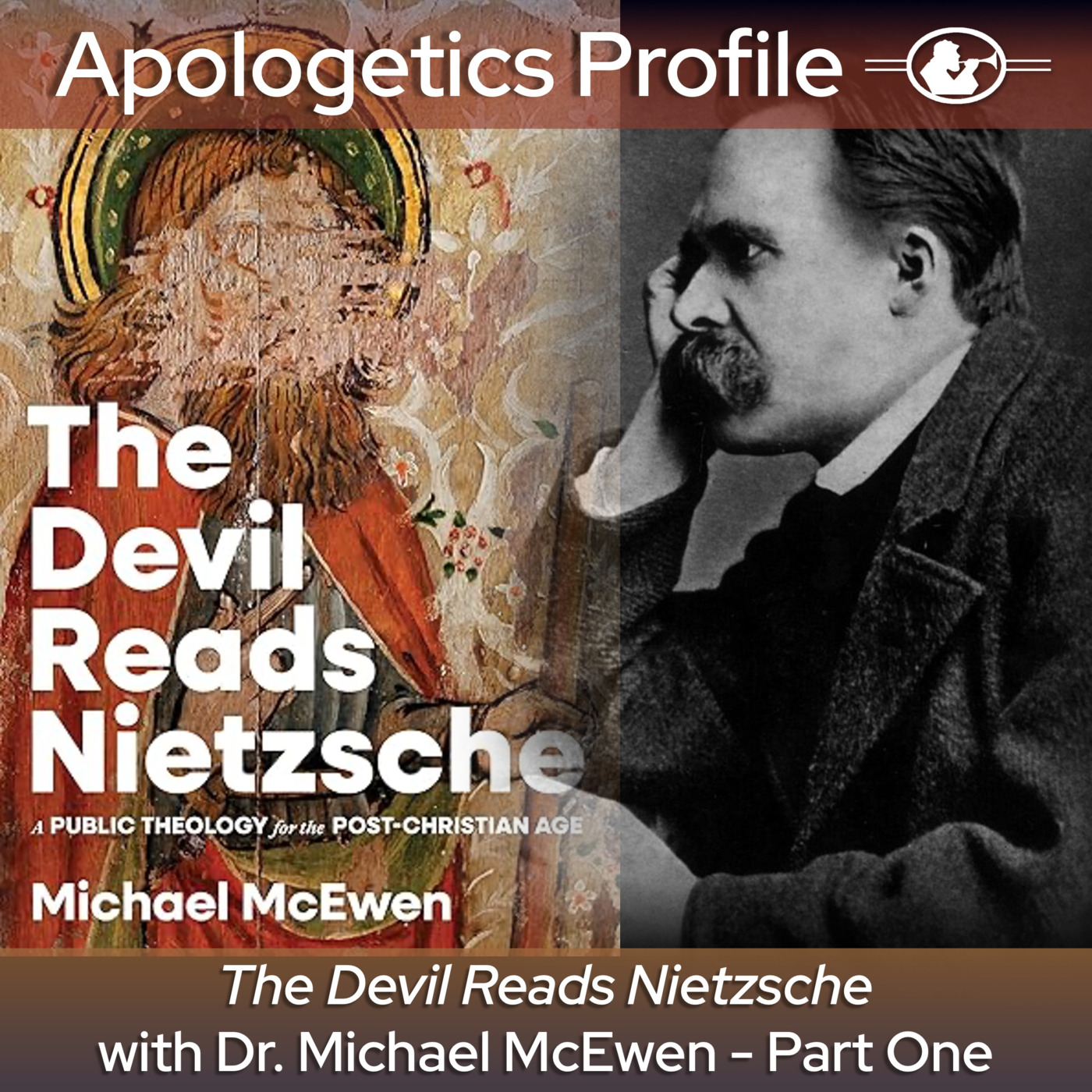
Apologetics Profile
Episode 342: The Devil Reads Nietzsche with Dr. Michael McEwen - Part One
00:44:00
On the last two episodes of the Profile we discussed the influences of 19th-century German philos...
Loading summary
Transcript38 lines
- [00:03]
Podcast Host
You're listening to Apologetics Profile.
- [00:12]
Co-host or Secondary Host
On the last few weeks of the profile, we examined the impact and influence of Karl Marx's ideologies in our colleges and universities. This week and next we'll be taking an in depth look at another influential German philosopher, Friedrich Nietzsche, who and how his ideas still influence us. Nietzsche offered what he called a will to power that he believed could overcome the rampant nihilistic impulse of the modern world following in the wake of what he calls the death of God. Nietzsche was not advocating for a military dictator or for the rule of martial law when he advocated his will to power. Rather, the will to power is a heuristic assertion of the individual self, or over and against God and the physical cosmos as the handiwork of God. Nietzsche saw Christianity as a weakness, a decadence that impeded the free expression of the individual self to create his or her own meaning and identity, which is inherently one of the fundamental facets of postmodern suspicion of metanarratives and of our culture. Yet Nietzsche, along with postmodernists who remain under his influence, failed to see that his suspicion of Christianity was in fact a kind of quasi religious replacement metanarrative, a secular mythos of the individual who is constantly defining and redefining his own reality, eventually becoming something like a religion where the individual becomes themselves a God. As John Milbank notes in his 2006 second edition of Theology and Social Theory, while the Nietzschean tracing of cultural formations to the will to power still results in a suspicion of religion, it also tends to assert the inevitably religious or mythic ritual shape that these formations must take. In other words, Nietzsche's will to power heavily borrows from themes within Christian theology. Instead of being made in the image of God, for example, man remakes himself in his own image. In Nietzsche's Genealogy of Morals and Attack, he argues that external moral values rooted in Christianity are merely illusory. He believed instead that all noble morality grows out of a triumphant affirmation of oneself which acts and grows spontaneously. Nietzsche's system of thought sought to free the individual and society from what he considered to be their enslavement to Christianity and its set of morals and ethics. Jesus is replaced with Nietzsche's concept of the Ubermensch, a superman or superhuman, not a political despot, not a religious guru, but an individual who would deliver society from the shackles of religious paradigms and and inspire a continuous evolutionary and revolutionary remaking and redefining of truth and human flourishing that continues eternally. In Killing God, Nietzsche realized that this was also the death of being itself as well as the death of traditional Judeo Christian metaphysics and philosophy. Rather than engendering a radical nihilism, Nietzsche believed the deaths of traditional ways of thinking in Western society offered an exuberant and exciting realization full of self actualizing possibilities. Freed from religion, man was now endlessly free to redefine himself and the world around him. What Nietzsche called the doctrine of eternal recurrence, the will to power and the doctrine of eternal recurrence are central to Nietzsche's philosophy and arguably continue to exert a widespread influence in culture today. Our guest this week and next on the profile, pastor, author and publisher for B and H academic Dr. Michael McKeown, suggests that Nietzsche's overall push was to institute a new creation story where God is not denied but metamorphized. Supreme power, once located in a transcendent deity, can now be found in humanity through its will and heroism. Additionally, through this spiritual pathway of godlike will and heroics, eternal life is actualized for the self and as a result the self becomes exalted, praised and worshipped. For Nietzsche, human beings become gods and thus even he cannot narrate a genesis for European society without deities and doxologies. That comes from McEwan's new book, the Devil Reads A Public Theology for the Post Christian age, on pages 57 and 58, a book which we will be discussing this week and next with Dr. McEwen. There is a footnote on page 58 that cites quotes Carl Truman from his book Rise and Triumph of the Modern Self, where Truman notes, in Killing God you take on the responsibility, the terrifying responsibility of being a God yourself, of becoming the author of your own knowledge and your own ethics. McEwen's book is short and compact, but nevertheless offers an insightful survey and a charitable reading of Nietzsche's two most impactful ideasthe doctrine of eternal recurrence and the will to power. McEwen analyzes how these ideas still implicitly and explicitly shape our culture today. As McEwen notes, Our cultural imagination is injected with cynicism and skepticism towards sources of authority, whether they be theological, institutional, political or religious. This is our shared reality. Suspicion is the epistemological default setting, the modern cultural imagination, an imagination haunted by disenchantment. And we can see the manifestation of these ideas most clearly in the popular trends of deconstruction, where people are suspicious and skeptical of traditional Christianity, often attempting to re examine and ultimately tear down certain axiomatic Christian doctrines and practices. The suspicion and skepticism toward authority, however, is never completely eviscerated as the individual self experimenting with self creation and self truths becomes the axiomatic seat of all knowledge and authority. Precisely as Nietzsche envisioned, we become gods ourselves and put God on trial, judging him and sentencing him to death.
- [07:39]
Dr. Michael McEwen
SAM.
- [08:11]
Co-host or Secondary Host
Of course, many challenging questions remain for Nietzschean postmodernists resting on the authority of the inner self. If God is but a projection of the individual, why would the self authored belief in God's non existence not also be a mere projection of the inner self attempting to fabricate his own will to power? Also, if truth within Nietzschean thought is nothing more than an inner reality of the self, if truth is not an external reality, if truth does not come to us from the outside, in other words, then on what grounds or by what means can one accept Nietzsche's authority? For if we take it to be true, then it must be conceded that such truth came from outside ourselves, from an external source, namely Nietzsche himself, not from within us. In attempting to kill God, Nietzsche sets himself up as a go. In short, Nietzsche is saying to us, don't listen to God, listen to me. Jesus, however, remains central to human history as our Lord, Savior, judge and King. No human being or man made philosophy or government has yet to replace him. Those who do make such an attempt to kill or replace God, however, set themselves up to be like God nonetheless. That is the first ancient temptation that led to humanity's fall. Jesus, however, steadfastly remains the way, the truth and the life. As John Milbanke notes, at the first order level of narrative and practice, Christians regard Christ as their judge. They try to gauge every aspect of their lives by a standard embodied in the stories about his life. Furthermore, they consider these stories to be a kind of climax situated paradoxically in the middle of history for all other stories, so that all history before Christ can be narrated as anticipating his story and all history since as situated within it, such that everything which subsequently happens is nothing but the acceptance or the rejection of Christ. This then is to treat Christ as measuring all reality in the same way that God's generated wisdom, His Word is taken to do. As we pick up here in part one, I asked Michael how he became interested in Nietzsche and how the idea for his book began. Here is Michael McEwen it's one of
- [10:52]
Dr. Michael McEwen
those where it has been a labor of love. Sort of what I, how I introduced the book is, you know, 20 years of really ruminating on not just Nietzsche but German philosophy. Was totally unaware of what I was picking up nearly 22 years ago and it ended up becoming sort of this speaking of hiking metaphor, a hiking through the forests of. Of German philosophy that eventually opened up to other forests like French philosophy, because they, they go hand in hand. So. Well, a lot of those guys, Foucault and Derrida, they're. They're reading Nietzsche and others that are close not only in European society to them, but also close in proximity in philosophical ideas and those, man, that's the territory I've been in. And it's one of those where to your question I had to get out of me it just saturating on it and marinating on it so much that it. It just seemed to simmer and I really wanted to get it out. And that was a time where I was in a previous position as more of a content editor with B H and since my. My position has changed to publisher. So that one was already written before I stepped into the publisher position because I could not have done it at that time. But yeah, it was. It was good to get it out. And I've had incredible feedback individuals like yourself who have read it and hiked through it. And it's sad when you finish a book and you feel like, all right, it's done. Then you hear feedback. You're like, man, I wish I could go back and revise this part. So there's. There's areas where I should have done a little bit more work for the reader.
- [12:50]
Guest or Interviewer
One thing to your credit about that though, I think some. I just edited a book for our ministry friend, friend of mine, Rob Bowman, who has written extensively on Jehovah's Witness, and he had his second edition of a book on Jehovah's Witnesses and the Holy Spirit or the Trinity coming out. So I went through that with him. And it's a second edition. The temptation is always to expand, but when you do, Charles Taylor sized books by sheer size, you're eliminating half the audience you want to reach. They will pick up a book like this. So I think, even though it's a small book, I think you've conveyed the ideas enough to get people interested in it. And like yourself, when I write the whole idea of award limit, it's like, are you kidding me? I only have 3,000 words for this chapter. You know, but I think you've really condensed the thought into an accessible, interesting and intriguing way. It's like you want to you. The book draws you down this path through the forest of like, oh, this is interesting. I'd never thought about this before. I know that Nietzsche exists in the minds of popular culture today. If you'd mention, I know the films are a little dated now, but the God is dead series, where obviously they're, they're riffing on Nietzsche. But I think it's a, it's, it's a, it's a mischaracterization of Nietzsche's, of what Nietzsche is really doing. Why don't you. We'd start with contrasting this popular idea of the whole God is dead genre. You know, I don't want to be super critical of it. I know people really have enjoyed that film, but it's not trying to deal with Nietzsche in the detail that you are. But it does borrow from the God is dead. If anybody knows anything about Nietzsche, it's like, well, God is dead, right? This is what we know of him. But why don't we unpack what God is dead, what he was trying to do with that phrase, what is going on behind that?
- [14:58]
Dr. Michael McEwen
Yeah, you're right. Popularized films or even books that maybe we've read in recent past where it, it goes straight for the jugular of, of Nietzsche. Without it, it's so easy for us to go for that phrase, God is dead, and pull it out of its context, pull it out of Nietzsche's corpus, the larger writings that he has, and only focus on that. And it comes from this book that he had written, the Gay Science. And what he's trying to able. What he's trying to convey is that there's this madman who's running through the streets and it's. It's the middle of the day and he's got this lantern, right? And he's able to scream, God is dead. God is dead. And we. It is we. And the emphasis that Nietzsche has is we have killed him. And everybody around him laughs. And you almost have this disparaging a madman who then leaves the streets because he realizes as he's internalizing this. I've come too early. I've come too early. And it's really not about what. You've got two interpretations on this. Some would say that Nietzsche is exclaiming, God is dead. God is dead. And that is the emphasis that we ought to live in a society where God is dead. Then you have another area of, of interpretation which says that it seems that Nietzsche is not excited about this, that European society has made this direction, this move, but they don't know. And that's sort of why there's the laughter. And, you know, the, they're. They're pushing back against Nietzsche is that he's come too early. They're laughing at him. And there's this great applause about. They don't understand why they're upset, they don't understand why they're laughing. And Nietzsche wants them to understand that there is an emphasis in their life that what you have proclaimed is true. If God is dead, then you're living in his shadow still to this day. And you almost have that repetition in that scene that, yes, you say this, but you're still living with a Christian morality, a Christian metaphysics, that God seems to be real, but you don't live in light of that. And so, again, it's really hard to decipher, at least within that story, if. If Nietzsche really wanted to, quote, kill God and to throw European society into chaos. But I think what Nietzsche is so excellent at, the man could write, he was a brilliant writer. He mainly wrote in aphorisms, just short snippets of sayings, or in fictional detail, like you find with the gay science in that scene. And he's really trying to diagnose the social or cultural condition of where Europe is, not just Germany, but Europe, Europe as a whole. And he's essentially saying, you all haven't felt the full weight of what's going on. The news hasn't arrived yet. I've come too early.
- [18:42]
Guest or Interviewer
It's like. Like a dormant virus. Yeah, People are carrying. They don't have symptoms, but everybody's carrying the disease. And do you think, Michael, that the gay science chapter and the madman is detecting sort of the cultural leftover? I mean, as you say, he's obviously addressing a cultural Christianity that has been eviscerated of its substance. And I think you would see this later in the writing of in the Americas and J. Gressam Machen in Christianity and Liberalism, where his argument is similar, that Christianity, that liberalism in Machen's definition, is an evisceration of Christianity retaining the language but not. But not having the substance that gives that language meaning and purpose. And so is how much of Nietzsche in that passage, and in general, is dealing with the. I certainly think it's an accurate diagnosis, however you want to look at it, whether he was trying to kill God or he was recognizing culturally that God was really dying or had died. This is a leftover remnant of Enlightenment philosophy. How familiar was he with the Enlightenment program? It seems in one direction he's parallel to it, but yet in another direction, with the will to power, he wants to kill every metaphysical concept that has given the west its cultural identity and intellectual traditions. How much is he dealing with Enlightenment philosophy or the leftover remnants of or Connotations of, of, of the cultural Enlightenment.
- [20:38]
Dr. Michael McEwen
Yeah. The way I phrase it in the book is that he's, he's certainly a child of, and a poster child of modern modernism, modernity, Enlightenment philosophy. I know we could probably be pinpointed on that, trying to get us to dovetail what that means, but it's certainly the case is that he's, he's a poster child of, of enlightenment. What you find in the writings of, of Kant and even closer companions, at least German companions of him. Julius Felhausen, who is a biblical scholar in his day. Ferbach would have been a close reading companion. He loved to read Feuerbach and Schopenhauer would have been a very close reading companion for him. So these individuals are certainly looking back to the past, but they're also trying to read their present. And I think what I think we don't credit Nietzsche well on is that he was a brilliant and prodigy in a lot of ways. In his late teens, early 20s, he was brilliant at reading the past and also trying to decipher the present. But I would, I would even go further and say that he seemed to know what was on the horizon culturally and politically and philosophically. And what you do find, if I can sort of zone in, in his historical context, look at the German Academy and German culture, you know, we were talking about Zeitgeist earlier, is that there seems to be three defining features that are happening within Germany that at least related to religion in the Bible. That the Bible seems to be a historical construction. And so from there you have certain methodologies that arise from that assumption. Historical grammatical, redaction theory, source theory, grow from this assumption that the Bible is a historical construct or a human construction. And then from that you also have the Bible is. If it's a, if it's a human construction, it should be deconstructed and mastered. This is what you find in Julius Felhausen's work. Source theory, documentary hypothesis, where if it's just this human construction, and if you look at the Torah, the first five books of Scripture, for example, there seem to be four ish sources that are giving the, the full scope of what the Torah is and making it and redacting it into what it is. And so you have these German scholars like Valhausen who are trying to find those sources because the Bible is a human construction. And that I think the third area that you find within German academia, pulling from Enlightenment philosophies and theologies, is the diet the Bibles to be demythologized that there's nothing sacred or transcendental to it. I think you find this in Kant. I don't think he meant to do this, that there's this transcendence way up there and there's this imminence down here, and we can't really know the gap between that. Our, our minds are unable to know what is transcendent. So we have to have faith beyond what we can know. But the mind is only focused on what's imminent. And you have nature really just imbibing so much of what has happened before him. And he's reading other German scholars, David Strauss, who, Who believe strongly that those three assumptions were true. The Bible is a human construction. It can be deconstructed and it should be demythologized. And when you get into the works of Nietzsche in the 1880s, you can see all three of those assumptions at play. And he's trying to figure out if these things are true. What is our. What is the. What are the horizons for not only Germany, but European society as a whole? How do we get there beyond what we. We've been taught by histories past.
- [25:05]
Guest or Interviewer
So it seems he's. And I would say, having read Nietzsche myself, that you're right. There's a prophetic voice in there that we often, too often ignore because of our simplistic polemics against him. We just kind of look at him as a hardcore atheist and we just kind of dismiss the husk and the colonel and not recognize that there are certain redeemable truths in him. He was pretty accurate about what was coming. If you look at the whole movement of that era of demythologizing, there's an overarching. And I know you point this out in your book, that though Nietzsche is after, in the late 19th century, he is finally his thought is matured into the idea that he definitely wants Christianity to die. The idea of it being elevating the weak is Nietzsche's decadence. That weakness is problematic and we shouldn't elevate it like Christianity does. It's not good to be weak. But in that polemic against Christianity, though, his voice takes on. And you talk about this in the book a meta, the concept of meta. In other words, he's exploring the root. What we might even say is something like a transcendence. You take on a transcendence to analyze history and God and philosophy and the cosmos, and the philosophy is almost omniscient in a sense that you've done away with God. Okay, so right there you're like, okay, I'm Transcending the transcendence. I'm going one step beyond Kant and I'm going to say not only can you know it, but you can know it that it's flowing false. And so he makes that move. But I think that's an interesting perspective on him reading between the lines about how he takes on. If you're going to do away with God, you basically have to speak with the voice of a God like Herod or Joseph Smith or somebody like that in making these pronouncements that are just so broad sweeping. But it also comes down to that individual self and the will to power.
- [27:30]
Co-host or Secondary Host
Right.
- [27:31]
Guest or Interviewer
It's the individual that has to demythologize and look at history and rewrite history and recreate meaning. And what you've just said, Michael, is so very common today in the blogosphere and the interwebs and the Internet social media of this idea that the manifest destiny of deconstruction, taking the philosophies of the late 19th century and using it to demythologize and deconstruct and walk away from having an intellectual reason for walking away from Christianity. So in that sense, I think you're right that Nietzsche was prophetic, that this is what we're doing today. Even if people aren't crediting Nietzsche with that, this is what you see a lot of in popular culture today.
- [28:15]
Dr. Michael McEwen
Yeah, and I try to be careful in the book, to your point. I try to be careful because it's easy for us to say, oh, Nietzsche came about as a historical figure, therefore this is where we landed. 125 years after him, he dies in 1900. But there seems to be, and that's why I use the language in the book, a Nietzsche inspired kind of philosophy that ends up settling into culture eventually, 125ish years later. And that's, that cannot be overlooked, that there seems to be enough influences that are retained within our culture. Now, could we have gotten to, you know, some of the examples that you brought up just a moment ago? Could we have gotten to where we're at without nature? Maybe so, but it seems to be he's propelling it forward as well. And to, if we could name some examples that you, you certainly see within culture, the, as you mentioned, the rise of the self, the therapeutic self, a self help culture that you often see that's sort of secularized Nietzschean kind of pieties that we are able to, to transcend what we thought we were and to become a greater self and that just has so much godlike language. As you brought up attached to it. Another area that I try to point out in the book is that Nietzsche talks a lot about pathos and being able to shape the emotions of a culture. Not just their thoughts, but the emotions of culture and do it in such a way where it causes an unrest amongst people so that they rise up to power. And he's, he, he sees the double edge of this, that this can be a pro, but this can also be a con. And he brings up plenty of examples in his writings in the 1880s where he. It seems that the Jewish people and the Christians eventually this judo Judeo Christian perspective and Judeo Christian values did this. That they were once weak but then they saw themselves as the victim of, made themselves more powerful in order to shame the strong. And so yeah, there's that double edged sword of what he calls resentment, resentment. And he does see a lot of the. Of power in his language is a force to be reckoned with. The self as powerful, the will as powerful and man. That just rings so true in our culture, right? The self that rises up in order to discover itself, to rise the power. What I say about myself seems to dominate what others might say about me or any other authorities or sources that I've been taught to listen to. So yeah, man, it's just, it's disseminated for sure.
- [31:38]
Guest or Interviewer
I don't know. I'm sure you're familiar with Chuck Swindoll. Yeah, he's. I think he's, he's in his 90s, but I don't think he's preaching anymore.
- [31:47]
Co-host or Secondary Host
But he has a son.
- [31:48]
Guest or Interviewer
I know it's a long, difficult struggle. He's not been very public about it, but his son, Chuck Swindoll Jr. Is an atheist and he's written a book on this very thing.
- [32:00]
Co-host or Secondary Host
The idea of seeing yourself as sinful
- [32:03]
Guest or Interviewer
is abhorrent and harmful. And we have to break away from that and discover what we can. The potentiality to become, which is very, very prevalent in Nietzschean thinking. As you point out in the book that Nietzsche is trying to do away with the self as perceived as being created in the image of God. Okay, but if you do away with that, as you point out, you do away with ontology, you do away with being, capital B. You're still retaining some kind of ontology, but for Nietzsche it's this continual recycling of being and becoming with the end. The end seems to be Michael, just the establishment and the authority and the triumph of the self. Philip Reif with the triumph of the therapeutic. Charles Taylor's this Is his thesis in a secular age. It is anathema to the biblical definition of denying yourself because of the dangers of what happens in a self centered culture. The Book of Judges Everybody does what is right in their own eyes. So Nietzsche's Zeitgeist is very ancient, if you will. The idea that the individual can determine for his or herself what God is like or in the sense. I saw a lot of parallels with, with Mormonism in the sense that Mormons view themselves as when they say children of God, they like, literally like we are little deities who are progressing and forming toward deification. Not in the sense of enjoying fellowship with God forever as one of God's children created in his image. No, Mormons believe in a deification process that begins in the here and now. And so it's a constant work toward. Even though a Latter Day Saint would tell you that he's not self focused, Latter Day Saint theology derivatively is laser focused on the self and all the duties that you have to do in order to attain celestial exaltation. So you're right in the sense of this culture of self is. Would we have gotten there without Nietzsche, you know, the Enlightenment philosophy, who knows? But when you start to look at the granular details of Enlightenment philosophy and then later the whole I can't pronounce the word, I always say it. Religion School of German Philosophy and Theology why do you think, Michael, that. I don't mean to pick on the Germans, but as I was reading this morning, a couple of passages in your book about Nietzsche identifying the root of morals with the Jews and the whole idea of struggle. It seems to be, you can see the seeds of the Third Reich in Nietzsche's thinking. Is that too much of a polemic to say that there's a thread from Nietzsche to Hitler?
- [35:10]
Dr. Michael McEwen
Yeah, I have. This is one of the historical areas that I've really struggled with because I've read historians that can certainly they seem to suppose that Hitler had read Nietzsche and was infatuated with his works. But what we can definitively say, or at least from the works that I've, I've read, is that Hitler didn't have any books of Nietzsche on his bookshelves and it doesn't seem that he had read anything by Nietzsche. Regardless, whatever angle we take, I don't think it's too hard for us to suppose that he was somehow familiar with Nietzsche's ideas, whether he had heard somebody lecture on them or he had somebody teach him about Nietzsche's works. But I'm not a historian within early 20th century German military history. I'm, I'm not there. But what I find in what we discover about Hitler is that man, there's just so many conceptual connections to what Nietzsche was saying. Now, let me caveat it and, and say this is that I think Nietzsche would have been appalled with what Hitler did. He, he, he didn't see if, if we can use one of the terms that Nietzsche has, the, the uber Meech, this overman, the superman, that this one person should be able to rise up to power and establish his set of morality and philosophies over the world in order to crush the world. I think Nietzsche would have had issues with that because how you understand what Nietzsche understood as will to power, he didn't mean it in a military sense, he didn't mean it in a, in a political sense, but rather in a philosophical sense.
- [37:36]
Guest or Interviewer
It's the self. It's not an army, it's not a dictator.
- [37:40]
Dr. Michael McEwen
There you go, though.
- [37:41]
Guest or Interviewer
You can see the self as very dictatorial from a biblical perspective. Serving the self is, is a, is misery, it's tyranny, because you never know what the next thing would be. But. So that's a good distinction. I'm glad you made that. The will to power in Nietzsche is not to be misread as militaris power, a crushing force. But I think in what you've just said, it crystallized in my mind that if you take Karl Marx and I know that Nietzsche and Marx weren't.
- [38:07]
Co-host or Secondary Host
I don't think that they knew each other.
- [38:09]
Guest or Interviewer
Their lives overlapped. I don't know.
- [38:11]
Co-host or Secondary Host
It doesn't seem like Nietzsche read Marx,
- [38:13]
Guest or Interviewer
but there is that overhaul of the connection of the class struggle.
- [38:19]
Co-host or Secondary Host
So I'm wondering in a general sense over. We look at German culture of this
- [38:24]
Guest or Interviewer
time from the mid to late 19th century into the early 20th century, there does seem to be. Even though maybe these individuals, Marx and Nietzsche and Hitler maybe weren't intercommunicating per se by reading each other's works. The spirit over Germany, the cultural spirit, the intellectual spirit, the zeitgeist was the ruling.
- [38:48]
Co-host or Secondary Host
It just reminds me of the biblical
- [38:50]
Guest or Interviewer
principle of principalities and powers in heavenly places, that the overall zeitgeist here is not so much philosophers reading philosophers or historians or whatever, but the interconnectedness of the wickedness, the spiritual wickedness that pervades our society.
- [39:05]
Dr. Michael McEwen
Yeah. And I'm not sure if they were interlocutors with one another, that they were, you know, pen pals. I don't think we had that. But.
- [39:17]
Guest or Interviewer
Right.
- [39:18]
Dr. Michael McEwen
If I remember in my reading of, of Nietzsche's works and those who wrote about Nietzsche, I remember at some point them saying that in, in sort of the sidebars of some of the notes that Marx had been writing that he, he does quote Nietzsche at some point almost verbatim. And so that goes to show that Marx might have known about Nietzsche's works that. But maybe not the opposite.
- [39:49]
Guest or Interviewer
Okay.
- [39:50]
Dr. Michael McEwen
Because again from my, my readings and research that Nietzsche doesn't seem to quote Marks. No, but there seems to be again that zeitgeist. There's, there's a cultural spirit that is at play.
- [40:06]
Guest or Interviewer
Yes.
- [40:07]
Dr. Michael McEwen
And classes, how social culture rises, how there's this play of embattle of individuals, but also classes as a whole. I mean Nietzsche talks abundantly especially in, in his notes on Will to Power. That was not something that was never published during his time. It was compiled later by his sister. And the Will to Power is again his sisters works that she had thrown together based off of notes and other writings that he had had stored off to the side. But he, he certainly talks plenty about the way in which every human being is its own little individual in Adam. And they're all colliding with one another. And his hope was one of them would rise up in order to display a new horizon, a new culture, a new anthropology, a new set of deities. And so again, the zeitgeist, the, the cultural persuasion here is very much within the waves of enlightenment. They were all about progress. Where are we headed? And this would make sense, you know, the 1500s, 1600s, 1700s, there's an explosion of ideas about our cosmology. The sciences are exploding left and right, from biology to physics, you name it. And so they really thought that they were on this penultimate kind of movement towards history that we're about to explode into something brand new. Because we have never seen anything like this in history since. And to their credit, whether we're talking about Kant or Copernicus or or Nietzsche, they understood that there were a lot of revolutions, scientific philosophical revolutions in their midst. So we, we can't look past the progress component of, of the Enlightenment that informs Marks as well as nature.
- [42:47]
Podcast Host
Apologetics Profile is a weekly podcast discussing world religions, apologetics, atheism, cults, the occult, alternative religions, controversial doctrines and spiritual practices. Apologetics Profile is a production of Watchman Fellowship, a non profit Christian apologetics ministry focused on interfaith evangelism and discernment. For more information visit our website@watchman.org that's watchmen.org.