← Apologetics Profile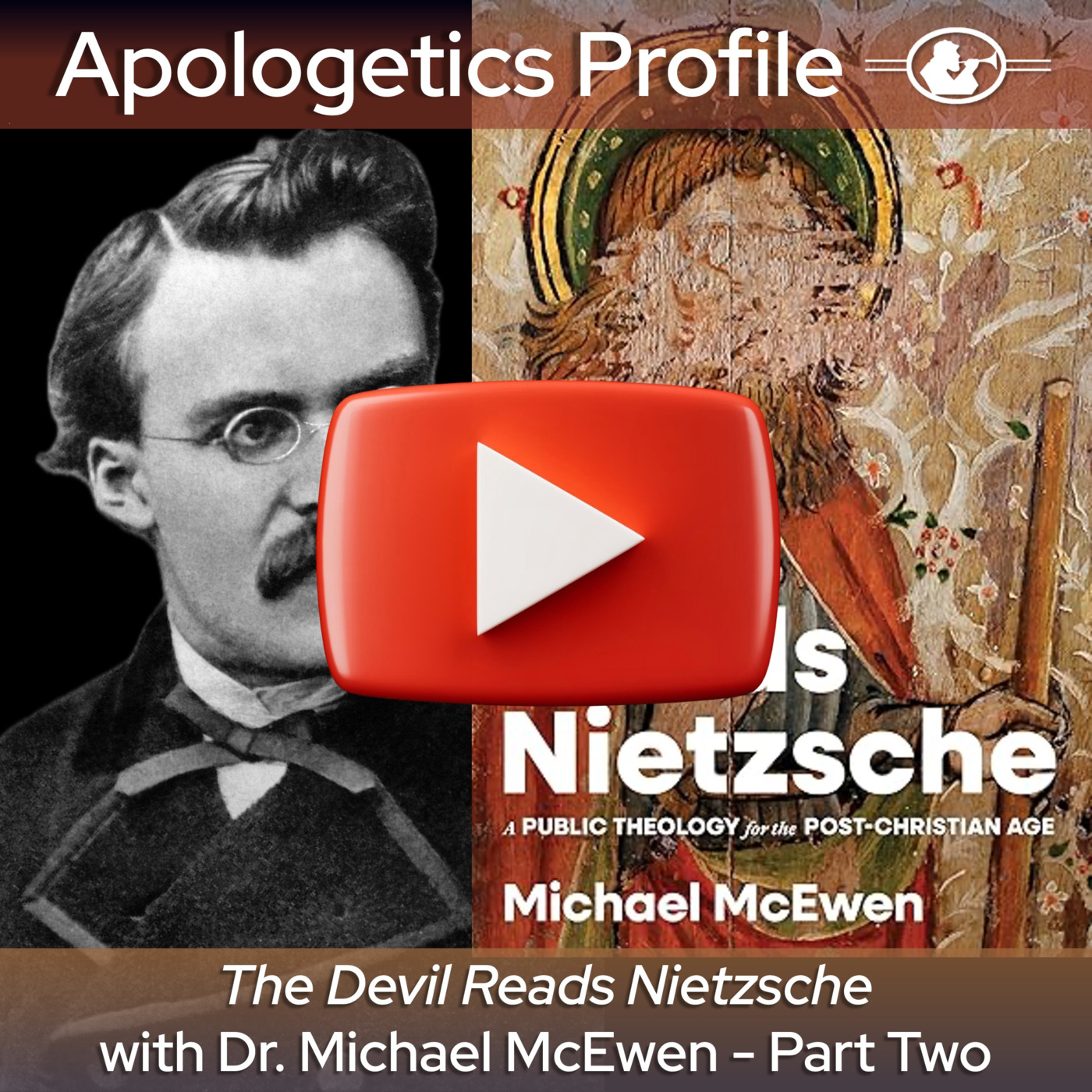
Apologetics Profile
Episode 343: The Devil Reads Nietzsche with Dr. Michael McEwen - Part Two
00:46:42
This week we continue our conversation with pastor, author, and publisher at B&H Academic, Dr...
Loading summary
Transcript52 lines
- [00:10]
Podcast Host
Helping the body of Christ proclaim the truth of Christ in a post Christian world. This is Apologetics profile.
- [00:25]
Narrator/Philosophy Expert
It remains something of a mystery as to why Friedrich Nietzsche turned so militantly against Christianity as an adult. It was almost certainly not related to his upbringing or his warm, loving relationship with his Lutheran pastor, Father Ludwig. As a child, Nietzsche grew up around what Julian Young describes as authentic Christian lives with the unforced manifestation of Christian virtue. Young, in his comprehensive 2010 book Friedrich A Philosophical Biography, notes that Nietzsche's childhood upbringing quote is what makes the ferocity of mature Nietzsche's attack on Christianity a biographical puzzle. Christianity was the material and emotional foundation of an extended family that filled his childhood with love and security, a warmth he never ceased to value. To his father in particular, he was intensely attached.
- [01:22]
Interviewer/Co-host
End qu?
- [01:44]
Narrator/Philosophy Expert
Yet as Nietzsche's philosophy reached its maturity in the late 1800s, Nietzsche proclaimed that God was dead and society had killed him. In 1887, he wrote the greatest recent event, that God is dead, that the belief in the Christian God has ceased to be believable, is even now beginning to cast its first shadows over Europe. In aphorism number 125, from the gay science comes one of Nietzsche's most famous passages. It is that of the madman in the marketplace, proclaiming to the blissfully unaware market goers that God is dead. Whither is God? He cried. I shall tell you. We have killed him. You and I. All of us are his murderers. But how have we done this? How were we able to drink up the sea? Who gave us the sponge to wipe away the entire horizon? What did we do when we unchained this earth from its sun? Whither is it moving now? Whither are we moving now? Away from all suns. Are we not plunging continually backward, sideward, forward in all directions? Is there any up or down left? Are we not straying as through an infinite nothing? Do we not feel the breath of empty space? Has it not become colder? Is not night and more night coming on all the while? Must not lanterns be lit in the morning? Do we not hear anything yet of the noise of the gravediggers who are burying God? Do we not smell anything yet of God's decomposition? Gods too, decompose. God is dead. God remains dead. And we have killed him. How shall we, the murderers of all murderers, comfort ourselves? What was holiest and most powerful of all that the world has yet owned has bled to death under our knives. Who will wipe this blood off us? What water is there for. For us to clean ourselves? The madman realizes, though he had come to the marketplace too early. He proclaims that such an event has not yet reached the ears of man. He concludes, what are these churches now if they are not the tombs and sepulchres of God? The madman is Nietzsche's literary mouthpiece, not only for declaring the death of God, but but for introducing his radical new philosophies of the will to power and the eternal recurrence. What the world needs is an Ubermensch, a superman of sorts to replace God. The Ubermensch isn't a political or military potentate, but one who rightly understands the past, present and future, one who discerns the underlying truths about God and society and man within it. This superman, or overman, is a kind of secular deity, a cyclical Dionysian revolutionary, eternally dying and resurrecting, perpetually recreating, retransforming and redefining his own being. Nietzsche believed that the only way to remove the divine bloodstains on our collective conscience is to remake, refashion and redefine ourselves, to free ourselves from the slavery to Christianity's God, morality and ethics. But some 250 years before the madman made his appearance in the marketplace, Shakespeare's Lady Macbeth wrestled with virtually the same question posed by the madman. If there is no God, how do we rid ourselves of guilt? Aroused from her sleep and consumed by her own guilt related to her role in the death of the virtuous King Duncan, Lady Macbeth is found sleepwalking, trying to cleanse her conscience from Duncan's blood. Out, damned spot. Out, I say. One, two. Why then. Tis time to do it. Hell is murky. Fee, my lord. Fee, a soldier and afeard. What need we fear who knows it when none can call our power to account? Yet who would have thought the old man to have had so much blood in him? Lady Macbeth chides her husband, Macbeth, for being a soldier and yet being afraid to murder King Duncan. She also tries to comfort herself that no one knows about the murders she and her husband have been a part of. Yet, ironically, she remains tormented by the permanence of her own guilt. Lady Macbeth eventually descends into madness. Nietzsche likewise became mentally ill. Much has been discussed as to the causes of his decline in the last 11 years of his life. But whatever the causes may have been, Nietzsche increasingly believed himself to be a messiah with godlike powers. As his biographer Julian Young notes, after having become God, he believed himself to possess telekinetic powers, capable, for example, of deposing crowned heads of Europe. Shakespeare was onto something, Though never saying so in his writings. Specifically, Nietzsche in his later years had seemingly come to embody the Ubermensch of his own darkened theological and philosophical imagination. Historically, Nietzsche's Ubermensch also shared parallels with Social Darwinism of the late 19th century. Darwin published the Descent of Man in February of 1871, which cataloged Darwin's beliefs that man was nothing more than a descendant of the lower animals, an idea that had devastating social consequences. While Nietzsche did not argue for the maltreatment of the less fortunate as many Social Darwinists did at the time, the evolutionary developmental idea of man evolving towards moral, physical and intellectual perfection, rooting out human weakness along the way, served as grist for Nietzsche's belief in the evolution of the Ubermensch. As our guest again this week, Dr. Michael McKeown notes in his new book, the Devil Reads A Public Theology for the Post Christian Age, Nietzsche took full advantage of the philosophical foundations of Social Darwinism. Social Darwinism was an in vogue theory in the late 19th and early 20th centuries and Nietzsche co opted this theory in order to leverage a new age of humanity, values and truth. Using Zarathustra as his European prophet, Nietzsche anticipated the social conditions were becoming more fertile for a future world flourishing with new truths. There also seem to be striking parallels within Mormon theology in Nietzsche's thought. Though Mormonism precedes the height of Nietzsche's philosophy by several decades, there is no evidence that Nietzsche knew anything about Joseph Smith or Mormonism. Nevertheless, Mormonism's founding prophet, Joseph Smith, believed and taught that God was once a man and that we too are progressing towards a future divinity ourselves. In Joseph Smith's General Conference King Follet Discourse, given just months before his death in 1844, Smith, like Nietzsche's Ubermensch, attempts to go back to the beginning before the world was to show what kind of a being God is and quote There is an excited and animated cadence in Smith's General Conference discourse that mirrors that of Nietzsche's madman in the marketplace, especially when Smith declares, God himself was once as we are now, and is an exalted man and sits enthroned in yonder heavens. That is the great secret. If the veil were rent today and the great God who holds this world in its orbit, and who upholds all worlds and all things by his power, was to make himself visible. I say if you were to see him today, you would see him like a man, in form, like yourselves, in all the person, image and very form as a man.
- [10:55]
Interviewer/Co-host
End quote.
- [11:16]
Narrator/Philosophy Expert
While Nietzsche tried to kill God entirely, he nevertheless advocated that man should in fact strive to become a God. In the famous Madman passage, Nietzsche continues, what festivals of atonement, what sacred games shall we have to invent? Is not the greatness of this deed too great for us? Must not we ourselves become gods simply to seem worthy of it? There has never been a greater deed. And whoever will be born after us for the sake of this deed, he will be part of a higher history than all history hitherto. Like Smith before him, Nietzsche also spoke of returning to the beginning and revealing the true nature of the God and man. In his 1886 work Beyond Good and Evil, Nietzsche declared that the ideal of the most world approving, exuberant and vivacious man, who has not only learnt to compromise and arrange with that which was and is, but wishes to have it again as it was and is for all eternity, insatiably calling out Da Capo not only to himself, but to the whole piece and play, and not only the play, but actually to him who requires the play and himself anew and makes himself necessary. What and this world would not be Circulus vitiosus Deus. That last phrase, circulus vitiosus Deus, means God in a vicious circle. Da Capos simply means once more. This is the heart of Nietzsche's eternal request currents where the individual freed from any external divine creator, becomes their own creator eternally, going back to the beginning, infinitely without end. That is the great secret shared by both Smith and Nietzsche. In LDS theology, for example, there exists an endless cycle of man becoming gods, what is known as an infinite regress. If God today was once a man, then he must have worshipped a God before him who was also once a man, and so on without end, man becoming gods ad infinitum. Latter Day Saints will often also affirm the truth of Mormon doctrine by means of a singular heuristic experience often called the Burning in the Bosom, where after praying about whether or not the Book of Mormon is true, a devout saint will often have a singularly subjective individual experience within themselves that allegedly is said to confirm the truth of their scriptures. While again, this idea predates Nietzsche by decades, there is nonetheless a kind of will to power of the individual at work in the Latter Day Saint, expressly affirming by means of a personal subjective conviction or feeling that the Book of Mormon and Mormon doctrine in general, including eventually becoming a God, are all true. We'll be talking more about the Burning in the Bosom experience on the profile next week with author and theologian Robert M. Bowman. The foundationally similar Zeitgeist or spirit. Between LDS doctrines and Nietzsche's will to power and eternal recurrence is the diabolical Edenic temptations to first disregard what God has revealed to us through his Word, through creation and through Christ Jesus, and to become a God ourselves. History, however, has repeatedly shown that anytime a man disregards God's words and thinks that he is himself a God, or at least could become a God, has never really bode well for himself or society. As we begin here. In part two of our conversation with Michael McKeown, I asked him to discuss briefly what Nietzsche knew of Charles Darwin's ideas and how he might have incorporated them into his own philosophy.
- [15:23]
Interviewer/Co-host
How conversant was Nietzsche with Charles Darwin or Darwin's philosophy? Because you have Darwin writing, I think his more devastating work was the Descent of Man, of course, which really paints man in a bad light. And whether Darwin intended it or not, Social Darwinism really took off in the late 19th, early 20th century. The implications of Darwinian, the philosophical implications of Darwinian evolution had a profoundly negative impact on the way we view people. And I see a parallel in Social Darwinism and in what Nietzsche thought of invalids and the weak. Now, he didn't espouse for their eradication. He just said it's disgusting that we elevate this to some sort of place of goodness. This is the Christian Manifesto here, that God chooses the weak things of the world and that human weakness is decadence. But I see a parallel between the philosophical implications of Darwinian biology in Social Darwinism and what Nietzsche advocated in terms of the elevation of the weak. That that's. We shouldn't do that they should be suppressed and we should elevate what is for Nietzsche. Again, getting back to this, I think he would, I think he probably would not have agreed with what actually played out in Social Darwinism. He was just looking. The will to power was supposed to yield some kind of manifest goodness. As I understand him, charitably that he wasn't advocating that we kill off the weak, but that we should do something to fix our minds about weakness and humanity. The will to power is a strong self and it doesn't emphasize that. What do you think about the connections between Social Darwinism, Darwin and Nietzsche? How interconnected are they?
- [17:32]
Dr. Michael McKeown
Yeah, that last part that you just mentioned is spot on. He was all about the, the growth and development of, of the mind. And this in, in many of his writings. It almost seems like a spiritual act for, for Nietzsche is to be able to grow in such a way that you reach a Higher condition, a higher set of, or level of, of humanity. And so I mean we, we see Charles Darwin, you know, 150 years down the line, right? But even in Darwin's day his publications were flying off the shelves again. Scientific, you know, scientific revolution in his day. And so Nietzsche does. We, we do see the parts where Nietzsche is interacting within his notes with, with Darwin. And even though he borrows the language of Darwin, he certainly diverges as well. And I heavily lean on a historian throughout the book, Julian Young, who this, this book by the way, is fantastic, I think nearly 700 pages and it's a philosophical history. So he does not only the wonderful extrapolating of the history of Nietzsche, but he also is versed in philosophical language and so he's able to converse in both fields. And Julian Young talks about, when we look at Nietzsche's language, about the Ubermensch, the, the superman, the great individual that rises up that certainly has like survival of the fittest kind of language attached to it. And we have to understand, at least from Nietzsche's perspective, that this means that this evolution not only of human beings but society is meant to reach that higher condition. And so it's not just biological. Where Darwin is mainly talking about the biology of species, Nietzsche seems to see that this is a spiritual act, a psychological act. And so yet he co ops evolutionary language that he would have read evolutionary theories, but I think we have to be careful that it's not straightforward or explicitly Darwinian. He meant something closer to a developmental theory of the will to power. And this has to take place, this, this has to take place in order for human beings to reach that next level of humanity because he really believed that we were on again, the precipice of a new human.
- [20:49]
Interviewer/Co-host
I wanted to read something I read in Charles Taylor that is specifically connected to your thesis in your book. As Nietzsche is trying to, at the pinnacle of his thinking, trying to kill God and replace, replace a Christian worldview in a sense. Again, he's not looking at it as a violent, revolutionary, evolutionary sort of military sort of thing, as he's often misconstrued. He's looking at it as a way to perfect the self and the becoming you're constantly cycling through. And hopefully those cycles lead to a higher consciousness, a better human. And Taylor's thoughts here are exactly what you're getting at. That for Nietzsche, staring into the void, doing away with God, emptying the universe of God for a lot of people, is a terrifying, horrible. What are we going to do now? But Taylor says this in Nietzsche's portrayal, it's virtually a hymn of praise. We sense another reaction, exhilaration. It is partly the very spectacle of immensity and power, but there is also almost a giddy sense that in this massive turbulence, all meaning is up to us. This can appear as the ultimate emancipation, freeing us from all exogenous significance, in other words. So for Nietzsche, doing away with Christianity and leaving this massive cosmic void of meaning and being is an exhilarating, exciting kind of thing. And now you can start to redefine from the ground up, you can make yourself, you can start the definitions, being freed from all ecclesiastical ideologies and worldviews that elevate human weakness and talk about sin. Tearing down the Christian faith, for Nietzsche, is an exhilarating proposition.
- [22:56]
Narrator/Philosophy Expert
This is. Isn't this exciting?
- [22:57]
Interviewer/Co-host
You know, there's God's dead, but now we can do stuff.
- [23:00]
Dr. Michael McKeown
This is the way I wanted to frame the book, the way I did is that if you have the death of God, then you have the death of metaphysics, which means you have the death of. Of morality, and you also have the death of meaning, as it's. As it's been based culturally, socially, for centuries before Nietzsche, those who have been highly influenced by Christendom or the Christian faith into Europe and even into America, across the globe, that it is exhilarating. And Nietzsche is very logical. I think this is one of the areas where we can, you know, say you're on to something. You're at least logical that if you kill off God, then you have to kill off the metaphysics that have been surrounded, this triune God according to Christian faith. Then you can kill off the morality that has been tethered to that Christian metaphysics and Christian God, and then also attached to that, the Christian meaning, you know, meaning and purpose that has all been interconnected in this web of the Christian faith. And for him, that was logical and linear and it certainly propelled them into, if we can use the phrase, like a tabula rasa, a blank slate of society. And it was exhilarating. Now we get to start over.
- [24:38]
Interviewer/Co-host
Mm.
- [24:39]
Dr. Michael McKeown
Where do we go? And you and I know that's not exhilarating, that's. That's actually very terrifying.
- [24:50]
Interviewer/Co-host
Yeah.
- [24:50]
Dr. Michael McKeown
And so this is. This is why one of the reasons I wrote the book is that I would never suggest to, you know, a layperson who has this close affinity to philosophy to pick up Nietzsche and just to begin reading, because there's some terrifying features to what he's saying, especially as his philosophy becomes really well formed in the 1880s. That's when he started to put all the pieces together. And this book is meant to introduce slowly, but also give a Christian lens to why this conversation matters. Mm.
- [25:34]
Interviewer/Co-host
We had talked at the beginning about the overlap of the French and German schools of thought, and you quoted Augustine in your book. I wanted to just briefly mention this how Augustine. It's on page 78. Augustine is lamenting late have I loved you, O beauty, ever ancient. So beauty, for Augustine is God himself. Right. And I was thinking of the. I'm familiar with the French poet Baudelaire. I think you mentioned him in the book a little bit. There was a footnote in your book. I think it was your book. Baudelaire was an atheist and he wrote a poem, a short prose poem called the Artists Confession, or the Artist Artist's Confettior. And he's at the end of it. He concludes this. He says, and now the profound depth of the sky dismays me. Its purity irritates me. The insensibility of the sea, the immutability of the whole spectacle revolt me. Ah, must one eternally suffer, or else eternally flee Beauty, Nature, pitiless, sorceress, ever victorious rival, do let me be. Stop tempting my desires in my pride. The study of beauty is a duel in which the artist shrieks with terror before being overcome. And to some extent, I think Baudelaire is in some sense reflecting the repulsion that Nietzsche had toward the Christian worldview that Nietzsche is fleeing this as well. I'm just going to. Baudelaire is struggling with Nature is beautiful, but I hate that. And Nietzsche says, well, I got one better. I'll just do away with it. But not entirely, because Nietzsche. It's a beautiful thing for Nietzsche to destroy Christianity and start with the tabula rasa. But in order to do that, Michael, as you've pointed out, Charles Taylor points out, in order to establish this tabula rasa, we can start defining the cosmos and ourselves however we want to. We got to rewrite history to make it look like this is a good thing. Because if you really look at history, the idea of a man who thinks he's God, or the idea of a self centered. When you center a universe on a human being other than Jesus, it never bodes well for mankind. But that contrast between Augustine calling God beautiful and, you know, this French poet who is fleeing beauty, and then Nietzsche who just wants to crush the Christian concept of beauty and. Or God completely, none of them are actually. I think they all kind of speak the same thing, that there is A objectively something beautiful about the universe and that God is the source. And Nietzsche goes one further and understands that beauty must come from God. Creation is a beautiful thing, but he's got to destroy that and redefine it. But he's still bar. And this is what I liked about your book. Nietzsche needs Christian language in order to accomplish his mission, which is really ironic.
- [28:56]
Dr. Michael McKeown
It is. It's a fascinating discussion to be able to watch from Augustine in the way in which Augustine. And we could say further into that, to Aquinas, the way in which those two individuals. And there's of course, plenty in between there and beyond the way in which their thoughts had greatly shaped European culture, African culture, with, you know, Augustine being in hippo and then moving outward and then towards to the Americas. As we get into, you know, the 16th, 17th centuries, there is a shift in. In Enlightenment thought. And of course, it's easy for us to say enlightenment and not pinpoint specific individuals, but there is an Enlightenment spirit that's certainly diagnosable and then it's true. And you know, you pointed out to, to Charles Taylor, who's done this magnificently, but there, there is this promotion of the self, there is the promotion of progress, there's the promotion of the liberties, religious liberties, scientific reasonings and so. And another number of other concepts, but those are there and they're informing whether we're talking about French or German thinkers in such a way that they still had to borrow from Augustine and Aquinas, they still had to borrow from the Scriptures, they still had to borrow from what they knew. And even if they're trying to transcend it, they still can't get away from it. And that's why I use the. The metaphor of parody throughout the book, that Nietzsche wants to move away from Christianity, he wants to critique it, but he can't. He just borrows. He parodies the. The narrative structure. That's which is why I structure the book the way that I do from pretty much from Genesis to Revelation. And he still has to borrow and parody the vocabulary not only of the Christian scriptures, but of the Christian story and Christian theology. And what he ends up giving the rest of history, where we are today is not anything novel that he still ends up with gods, even though trying to get rid of God, he incorporates new gods. And Dionysus is one that I bring up. He doesn't get away with anthropology. He's. He still talks about human becoming. He doesn't get away from metaphysics. He talks about this spiritualized imminence that everything around us seems to be teeming with something divine almost. He doesn't get away from the fall. He speaks deeply about decadence, of the ways in which culture is deathly and we've got to move beyond it. He doesn't get away from the prophets of the Old Testament, he just has new prophets like Zarathustra. And he doesn't get away from any messiah or savior. He, he has the uber minch that rises up. So it's, it's, that's when I, that hit me 10 years after reading Nietzsche. It's like he hasn't gotten away, he's just parroting so that he can build this new program, so to speak, for the future of Europe.
- [32:47]
Interviewer/Co-host
His metaphysics still has to have a ground. His ontology still has to have a capital B, being.
- [32:57]
Narrator/Philosophy Expert
And any.
- [32:58]
Interviewer/Co-host
I think this to your point, and it's not just applicable in Nietzschean thinking, but even in something like cosmology, where the secular cosmologist and doing his best to be charitable and trying to understand the universe still needs a minimum borrowing from theological language. Because the concept of eternity is not a physical concept. But in order to have the universe the way it is, some kind of eternality, like a static universe, an eternal universe, or an infinite regress of causalities that procured our universe, you're still dealing with a metaphysical concept. The universe requires eternality. But the physicist radically transforms that concept. Just like Nietzsche radically redefines theological terms, just like Mormonism takes Christian vocabulary and radically redefines it to the deification of the self. I mean, what. I don't think there's any physicist out there who views themselves as God, but their thoughts about, you know, what happened 13.8 billion years ago and how it all happened and where it all came from, that it was all reduced to this singularity, whatever that might be. There's still this idea of an overarching sense of omnipotence in these non Christian narratives about reality, that the human being, the self, is positing itself. Like Kant, you gotta know something about the ineffable and the eternal to be able to say you can't know anything about it. The idea that God doesn't exist requires you to define what you mean by God. So there's this overarching sense, and this is what I think your book is really helpful for, in recognizing that when
- [34:58]
Narrator/Philosophy Expert
a man tries to do away with
- [34:59]
Interviewer/Co-host
God and reconstruct the world in his own eyes, that he has taken on, whether intentionally, unintentionally, the language, the knowledge, the characteristics of a divine being. And this goes all the way back to Genesis. You will be like God knowing good and evil. And of course, one of Nietzsche's most famous works is Beyond Good and Evil. Like I can tell you more about good and evil than anybody has heretofore, but it just seems characteristic, Michael, of any non Christian philosophy, the progenitor of which always has to assume, intentionally or otherwise, the mind of a God.
- [35:42]
Dr. Michael McKeown
Yeah, And I love the way in which you phrased all that because there's, and I borrow from John Milbank here, theology and social theory, wonderful work in the way in which Milbank is doing that as it relates to the social sciences. And he's trying to demonstrate throughout that work is that any modern social science, or even modern philosophy is its own mythos. It's still telling a story of origins. It's still telling a story of how things came about. It's still telling a story of decadence in the fall. It's still telling story about where we're going to be in the future and what it means to be human now. And, and those aren't going away. And that's, that's what we have to wrestle with. And I think being able to understand that any Western philosophy, or even Eastern philosophy, if I can make a strong statement, are distortions or imperities of, of the Christian faith.
- [36:53]
Interviewer/Co-host
Yes.
- [36:55]
Dr. Michael McKeown
And I think this is what Augustine was doing in the City of God. He's hearing these pushbacks against so many Romans and philosophers in his day and saying, well, it's because we have accepted this Christian God. It's because this Christian God has made its way into our culture that we now have the fall of Rome. And then here's Augustine saying, actually, let me tell you another story.
- [37:22]
Interviewer/Co-host
Yeah.
- [37:22]
Dr. Michael McKeown
It was actually your gods that led to our fall.
- [37:26]
Interviewer/Co-host
Right.
- [37:26]
Dr. Michael McKeown
And here's how this Christian God actually meets us in our midst. And I'm not comparing myself to Augustine, I'm greatly indebted to Augustine. But that's where I try to pull from Augustine to be able to show that that type of story, what we have been told, is in fact not true. And these cultural philosophies that we imbibe and we, how we see the world, they're nothing more than distortions and parodies or the orthodox Christian faith.
- [38:01]
Interviewer/Co-host
Yeah, yeah. I think that's what Paul said or saw in Acts 17 on Mars Hill. And I think it's no small irony that the leftover remnants of the Greco Roman culture of Paul's day, as we see it, are the armless and headless statues and the destroyed temples, the idols in the marketplace are primarily responsible for the fact that nobody is attending Athena's worship services anymore. Those temples have been gutted because their idols were unable to sustain that culture. To Augustine, to summarize Augustine in a nutshell, the evisceration of the superficial. Whether it's a, a cultural Christianity that has the language of Christianity without the substance, which is what the 20th century Machen was talking about, or whether it's just pure idolatry, those are unable to sustain a culture or a people or an individual. I mean, the tragic reality of our time, Michael, is According to the CDC, I think it's some 40,000 or more people, which is a capacity crowd at a major league baseball stadium, take their lives every year. You know what, what is driving that? And I think it's the, the emptiness and the fatigue and the despair of trying to define meaning and purpose in everything from the origin of the cosmos to my existence here on planet Earth. How can I possibly be in any kind of position to properly define and understand the universe as big as it is, or my place within it apart from my being created here for multiple reasons? It's a theology, and I will call it a theology of despair to try to recreate your own meaning and purpose. So as we're wrapping up here, Michael, what are some intelligent ways in which we as Christians can engage this, this voice of our age and the people who are succumbing to it? What we don't want to just be knee jerk, throw a Bible verse at it. But, but what can, what are some things that we can do to, to thoughtfully engage this zeitgeist that we are grappling with.
- [40:27]
Dr. Michael McKeown
Yeah, and I like the way you've turned this conversation because this isn't us just talking about some German philosopher who died 126 years ago. That this has greatly impacted and influenced the way in which we see the world. And that's, that's one of the goals of the book, is to be able to show that we all wear Nietzschean lenses in some capacity. And Alistair McIntyre, 20th century, early 21st century philosopher, he, he even said that Nietzsche was the moral philosopher of our day. And as Incredibly intelligent as McIntyre was, he passed away a few years ago. I think he's right. Is that what we find in a culture of, of outrage, of therapeutic self helps? You certainly have the politics of, of the body and sexuality and identity and these all carry Nietzschean freight with them outside the church and inside the church. And I'M trying to raise an awareness of the ways in which we've imbibed Nietzschean influence thinking and I want us to be able to return back to the scriptures.
- [41:57]
Narrator/Philosophy Expert
So you're the madman.
- [41:58]
Interviewer/Co-host
You're the madman, Michael.
- [42:00]
Dr. Michael McKeown
No, I'm not. I'm pointing people to the resurrected king.
- [42:04]
Narrator/Philosophy Expert
You're taking Nietzsche and becoming a good madman.
- [42:08]
Interviewer/Co-host
You're pointing people in a direction that God is alive.
- [42:12]
Narrator/Philosophy Expert
But in a sense your mission is the same.
- [42:14]
Interviewer/Co-host
You're now parroting Nietzsche by taking on this.
- [42:18]
Dr. Michael McKeown
If I did that, I totally didn't mean to do that.
- [42:22]
Narrator/Philosophy Expert
No, I mean in the sense that you're.
- [42:23]
Interviewer/Co-host
You are. Well, Nietzsche's borrowing from Christianity and you're just taking it back from him and you're. Yeah, that's, that's what I meant.
- [42:32]
Narrator/Philosophy Expert
Yeah.
- [42:32]
Dr. Michael McKeown
Yeah. And it's, it's certainly the case that we see around us a culture that is filled with. I want to self discover myself. I want to find a new identity. And this is why I lean on the work of enter root in these performances that we find there's. I've got to perform in order to become who I want to be.
- [42:57]
Interviewer/Co-host
Yes.
- [42:58]
Dr. Michael McKeown
Expressive identities. If I can use some of Charles Taylor's language.
- [43:03]
Interviewer/Co-host
Yes.
- [43:04]
Dr. Michael McKeown
And that's why I end the book the way that I do is that, look, church, we already have the scriptures that provide us a God who is already with us. A metaphysics that's true and real and good. A morality that tells us how we're called to be shaped by the Spirit and by Christ, by the Father to live out this good news message before others. That the, the longing for self discovery and performance and expressive identities will not lead to anything of abundance and, and life giving. That we can truly find rest in the Christ who has already done everything that we need and have and we can find our true identity in him. And you do not have to perform for him. He who works through us and then we live that out. And this is the play on the. The subtitle, A Public theology. An embodiment of what this Christian faith is and that ultimately. And this is where I land the book is that Christ is risen and Nietzsche is not. We have to take a path of a risen king and not a dead philosopher.
- [44:23]
Interviewer/Co-host
That's a good point. I lost my dad to suicide when I was in high school and I almost succumbed to it about 20 years ago myself. And I just, I see God's redemptive mercy and, and when I came out of my black pit, God said okay, you know, I was a Christian at the time I was an adult convert and I just failed. It's like well kind of the gentleness of God said, well now you failed so just watch what I'm going to do. So basically just taking the performance. My first five years of Christianity were performance oriented. I was performing for God. That's what I thought Christianity was. Put on the church mask and do everything you possibly can to make yourself look like you're a believer. And it, it exhausted me because I was never, I was defining, I was, I was self defining God and it was miserable. And so the, the latter half of my Christian life has been God doing things through me and for me, for his glory. And I'm just kind of like literally sitting back and letting him. Not that he needs my perpetrators mission, but that he's doing things through me that I never thought I could ever do myself.
- [45:29]
Dr. Michael McKeown
That's a beautiful testimony. I'm glad to hear that.
- [45:38]
Podcast Host
Apologetics Profile is a weekly podcast discussing world religions, apologetics, atheism, cults, the occult, alternative religions, controversial doctrines and spiritual practices. Apologetics Profile is a production of Watchman Fellowship, a non profit Christian apologetics ministry focused on interfaith evangelism and discernment. For more information visit our website@watchman.org that's watchmen.org.
- [46:16]
Interviewer/Co-host
Sa.