← Apologia Radio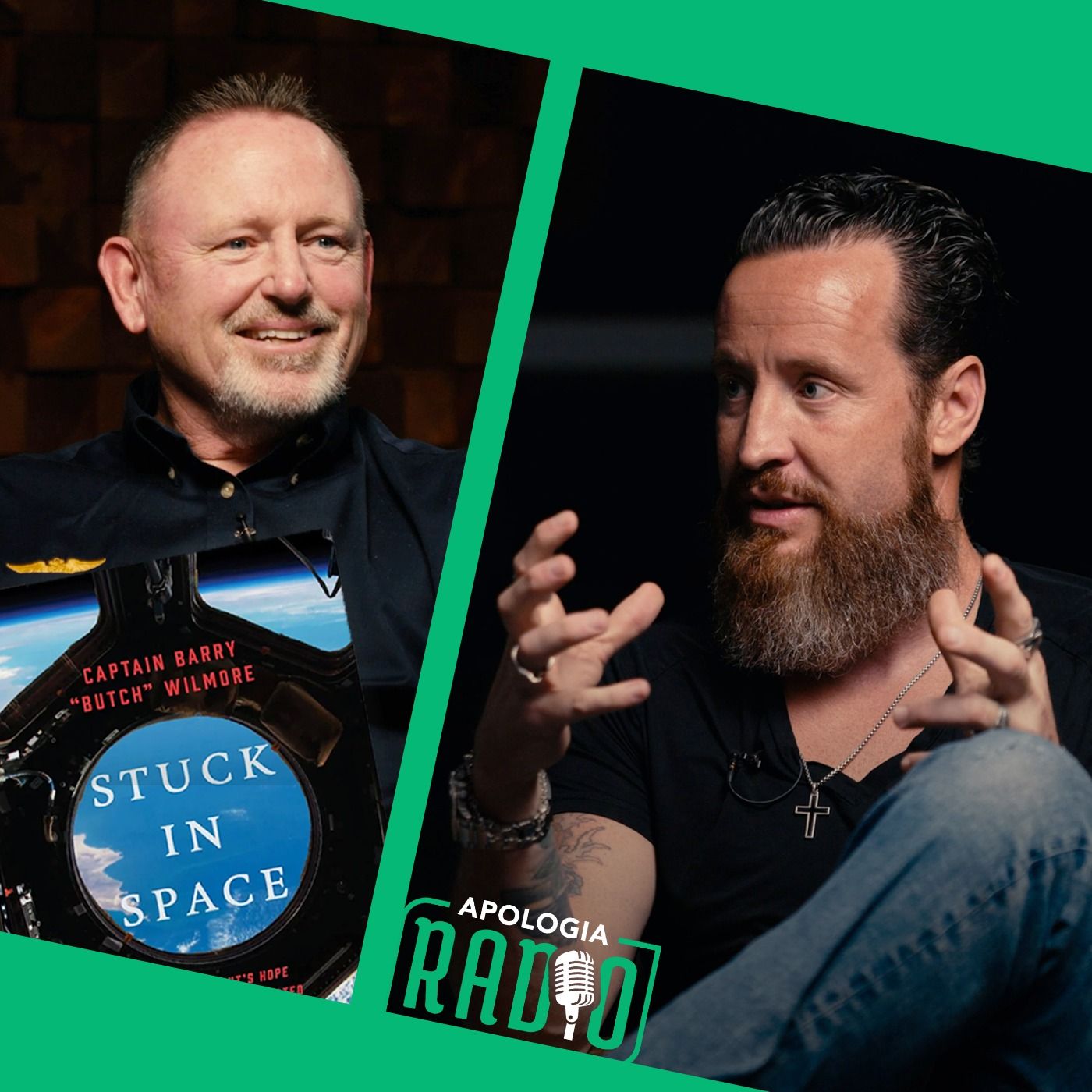
Apologia Radio
569. Flat Earth, Aliens, & Stuck in Space w/Astronaut Butch Wilmore
01:27:12
Do not miss the new and special episode of Apologia Radio in which we are joined by the Astronaut who was stuck in space for 286 days! Barry "Butch" Wilmore comes into the Studio to tell his story about God's faithfulness in his life and how he endured so much time being stuck in space. You'll also hear the incredible story about how he got home. Don't miss this powerful episode and be sure to tell someone about it!
Loading summary
Transcript289 lines
- [00:00]
Dominion Wealth Representative
For most people, their finances aren't one big problem. It's a hundred small ones. A retirement account from a job five years ago. A budget that lives in your head but never on paper. Life insurance that you meant to look into. A will half finished or not even started. And the longer you leave those loose ends untied, the harder it becomes to move forward with peace of mind. At Dominion wealth, we walk with you step by step to help you tie it all together. We meet you where you are. We listen. We get your financial picture out of your head and into practice. Then we build a strategy to meet your needs. Now, prepare for your future and bless the next generation. We don't pressure you. We give biblical, honest guidance. Let the strategy follow your values and help find the right solutions. If your financial path feels uncertain, let's get together one on one and get you on the right track. Book a free consultation today. We are here to help you get your finances in order so you can feel confident about the future. From baptism to burial, Dominion's got you covered. You can find us at Reform Money.
- [01:15]
Captain Barry Wilmore
Non Rockabotus Must stop. I don't want to rock the boat. I want to sink it. Are you gonna bark all day, little doggy? Or are you gonna bite?
- [01:29]
Jeff (Host of Apologia Radio)
Delusional. Yeah, delusional is okay in your worldview, I'm an animal.
- [01:32]
Ion Layer Sponsor Representative
You don't chastise chickens for being delusional.
- [01:34]
Jeff (Host of Apologia Radio)
You don't chastise pigs for being so. You calling me delusional Using your worldview is perfectly okay. It doesn't really hurt. She hung up on me.
- [01:47]
Captain Barry Wilmore
Desperate times call for faithful men and not for careful men. The careful men come later and write the biographies of the faithful men, lauding
- [01:57]
Jeff (Host of Apologia Radio)
them for their courage.
- [02:00]
Luke (Co-host or Guest on Apologia Radio)
Go into all the world and make disciples. Not go into the world to make buddies, not to make corrosives.
- [02:05]
Dominion Wealth Representative
Right.
- [02:05]
Luke (Co-host or Guest on Apologia Radio)
Don't go in the world, make homies.
- [02:07]
Jeff (Host of Apologia Radio)
Right.
- [02:08]
Luke (Co-host or Guest on Apologia Radio)
Disciples.
- [02:09]
Jeff (Host of Apologia Radio)
I got a bit of a jiggle neck. That's a joke, Pastor.
- [02:15]
Captain Barry Wilmore
When we have the real message of truth, we cannot let somebody say they're speaking truth when they're not. Take an amazing journey to a place that will blow your mind and move your mind so you will never be the same again.
- [02:37]
Jeff (Host of Apologia Radio)
What's up, everybody? Welcome to a very special episode of Apologia Radio. You can get more at apologiastudios.com a P O L O G I a apologiastudios.com this is the gospel heard around the world. That's Luke the bear.
- [02:49]
Luke (Co-host or Guest on Apologia Radio)
What up?
- [02:50]
Jeff (Host of Apologia Radio)
I'm Jeff, the Callman of Ninja. And we have a special, special program. As you can see, everything looks different. And it's because we are talking about a very important and special book, Stuck in Space with Captain Barry Wilmore. Captain Barry, thank you for joining us.
- [03:04]
Captain Barry Wilmore
Wonderful to be with you.
- [03:06]
Jeff (Host of Apologia Radio)
We've been so excited for this. You're the first actual astronaut I've spoken to in person and, and so we're going to have just, I think, great conversation today. I'm so excited to get to know you and hear about your story and what God has done in your life to bring you to this point. So you were stuck in space for how long?
- [03:23]
Captain Barry Wilmore
Well, that's most recent. It was 286 days. 286 planned for about two weeks, but 286 is what it wound up being.
- [03:30]
Jeff (Host of Apologia Radio)
Yeah, man.
- [03:31]
Captain Barry Wilmore
Such is the way it goes.
- [03:32]
Jeff (Host of Apologia Radio)
Yes, I guess so. That's awesome. All right, so we, we want to talk about your history and what God. How, how God sort of built you up to get to this place of being an astronaut, being in space. I think that the burning question though, to start with, on everybody's mind is, is the Earth flat?
- [03:50]
Captain Barry Wilmore
The Earth is not flat. The Earth is round. So I've spend a total of 464 days in space and you're orbiting the planet at 17,500 miles an hour. That's, that's every 90 minutes you're going around the planet. If you do the math, that's 16 sunrises, sunsets a day, 16 orbits around the planet every 24 hours. So you do that math, 464 times 16. That's 7,424 orbits of the planet. And every single time I went around it, it was round.
- [04:19]
Jeff (Host of Apologia Radio)
It was round every single time. So, you know, God says to, you know, base all things on the testimony of, you know, two to three eyewitnesses. And there's been enough Christian eyewitnesses. People who love Jesus are sold out for the truth, that know God's commands not to lie. And you're saying, as someone who loves Jesus knows God's law, that it is most definitely round.
- [04:39]
Captain Barry Wilmore
It is round. And I tell you, Jeff, just to be honest, that those that people that are believers, that profess to be believers in Christ and they say they're using the scriptures and to say that the Earth is flat, and they say that they're obviously they're not discerning the scripture correctly.
- [04:55]
Jeff (Host of Apologia Radio)
Right.
- [04:56]
Captain Barry Wilmore
And that's why it is a concern because if you're not discerning Those scriptures correctly, because the Earth is not flat, it is round. You're likely not discerning scriptures in other places correctly, too. Yeah, and that's why it's a concern. So my heart goes out to those individuals that think the Earth is round and they're really basing it on the scripture. That can be dangerous, not understanding the
- [05:18]
Jeff (Host of Apologia Radio)
language of the scripture and those sorts of things.
- [05:21]
Captain Barry Wilmore
Exactly.
- [05:21]
Jeff (Host of Apologia Radio)
But you got literally a bird's eye view indeed of the Earth, the world that God made. We're going to get into all kinds of discussion that lead up to what got you stuck in space and your book, which is so very special. But I just would love. As people are just getting into this episode and just starting this conversation, give everyone a sense of what you felt, what that was like. When you are above the Earth and you're in space, what are the sort of feelings that you have? What did that invoke within you to get to see that? Was it terrifying?
- [05:58]
Captain Barry Wilmore
Maybe if I gave you the. Just kind of a view of visual view as best I can with words when I first got to space in my first mission. Okay, so it's a space shuttle. We launch, and there's all kinds of, you know, it's solid rocket boosters are separating. If you're familiar with how the space shuttle is, you finally get to space. The external tank separates, and it's a bunch of jarring. And you can hear the pyros firing. And when that happens, there's condensation on the external side part of the external tank. That condensation comes off and it flakes off. And then it kind of crystallizes into ice. And so after this, a couple of minutes, I look out the front window because I'm the pilot. I'm still strapped in. I'm weightless, strapped down, but still my arms want to float up. And I can feel weightlessness for the first time. And I look out the forward windscreen, best seat in the house, by the way. And I see what looks like diamonds, thousands of them, outside the window. The sun's behind us, so it's all illuminated. Sparkling, sparkling, sparkling. And we have reaction control system thrusters that fire to keep your attitude, maintain your attitude. And initially, when you first get to space, they fire. They're 870 pounds of thrust. When they fire, really large explosions right at my feet. Eventually, about two hours later, we transition to Verniers where they're 24. You don't even. You don't even feel or hear them fire. But initially, those reaction control system jets are firing. There's orange blasts right outside the window. These explosions taking place right at my feet. So explosions, orange blasts, diamonds, wow. Wrap your mind around that. And then weightless. And honestly my thought was, lord, why me? Because I'm experiencing all of this for the first time. I never really been told that. Nobody ever told me about diamonds outside the window and about explosions at your feet and orange blasts and the weightless feeling and seeing my crewmates levitate up from the mid deck. There's a ladder there, but they don't need it anymore. They just levitate up, you know, see that with your own eyes for the first time. And I'm like, lord, why me? There's millions of people that would love to be sitting in that seat. But the Lord allowed me to have a desire of my heart and there I was. And that's very humbling. Yeah.
- [08:08]
Jeff (Host of Apologia Radio)
Was it terrifying?
- [08:10]
Captain Barry Wilmore
I wouldn't say terrifying. It's something you've dreamed of since you were a kid, not plotting a path to get there. But the Lord allowed it to happen. And it's responsibility. And you know that responsibility you have. And so it's not fear. It's not that. Because honestly, fear, you know, fear not God's word tells us, those of us that know him as Lord and Savior, one day he will take me. If he takes me on the space shuttle launch, glory be to him. And so from that aspect, no fear, fear of. I guess the fear that we do have is the fear that I will mess something up and do something wrong because there's something in the right seat of the shuttle. I was a plt. I was a pilot. There's some things that I could do. I could do some things wrong and it would be the end of the day for everybody. And so there's that responsibility. So you don't want to mess that up, any of those things up in that respect. There's fear about that, but fear, no. It's a glorious ride and just praise to the Lord for it all the way.
- [09:02]
Jeff (Host of Apologia Radio)
I'd love for people to get a sense of this. So Scripture says that the heavens declare the glory of God, right? And scripture clearly teaches that God is speaking through his creation. And that message is always getting through to every image bearer of God. Indeed, it's not a lack of evidence or light from God or that God's voice isn't getting through in his creation. It's that because we're separated from God in our sin, we suppress God's voice. We don't want God in our thinking. And so we switch God for something else. But it's clear that Scripture teaches that what can be known about God is evident and clear through what has been made. And we, I think every day, all of us get a great sense of that when we look into a baby's eyes, our baby's eyes. Look at their little fingertips, the perfect little bodies, you know, I mean, Arizona is the greatest. I've been all around the world. I mean, I've been all over the world. And I will say that I truly am convinced that Arizona has the best sunsets of anywhere on planet Earth. It is just unrivaled, what we have here.
- [10:02]
Captain Barry Wilmore
You said the key on planet Earth, sunsets in space. Pretty spectacular.
- [10:05]
Ion Layer Sponsor Representative
I. Wow.
- [10:06]
Captain Barry Wilmore
Bet.
- [10:06]
Jeff (Host of Apologia Radio)
I want to hear about that. He's like, not Arizona. Try getting up there. Try getting up there. But so I. I was talking to my. My son Augustine, and every time we see these, I pointed out to him, but I was talking to him, I was like, look, God does this every day. He does this every day here. He just splashes up this amazing painting. It's nothing to God. It's just there every night. And it's just glorious and beautiful. And no human artist, as much as they will try to copy this, can duplicate the glory of this right here. And everything about Earth is just shouting to us about God. But you got a sense that is so unique in human history. Barely any humans have. Have touched what you have. In terms of what do you. What I guess I'm trying to just get what do you. What's different in terms of being above the Earth. And now you're in space. And in terms of what God is saying about shouting to us about his. Him as Creator, his glory, his creativity, what did you sense when you're above it all and you're. You got space behind you and the Earth below you, what kind of feelings do you have just as a human being?
- [11:19]
Captain Barry Wilmore
That's a wonderful question. And I've got to start back with knowing the Scripture. If I did not know the Scripture, it's general revelation, like you said. But my perspective in that is far different now than I know that it would be. Did I not know my Lord as Savior had he not transformed me? Did I not know the Scriptures and that he is creator in all of these things and that he is glorified in it all? So I know my perspective from that standpoint is different than it would be if I had not had that. I could still see the beauty. I could still appreciate the beauty. But to be able to see the Beauty, appreciate the beauty and know from whom it is created. Created with a plan and a purpose. Isaiah 45:18 created this planet to be inhabited. And knowing all of that gives an appreciation that is honestly, it's beyond words to describe. And knowing that, as you said, one of the few in history, human history of billions and billions and billions of. There's less than 600 and I'm one of them that has had the opportunity to view this planet from that vantage point and see the brilliance and the colors and the sunrises and sunsets. You're mentioning high noctilucent clouds in the high atmosphere in the northern hemisphere and things that no one's ever seen before. Space flight. Wow. My Lord is mighty. He is amazing. I didn't need to go to space to learn anything about my Lord. His Word is sufficient, totally sufficient. But an appreciation for his creative power, his magnitude, his majesty. I so appreciate that I had that before I went because now I see it and he is magnified even all the more.
- [12:53]
Jeff (Host of Apologia Radio)
So you love Jesus?
- [12:55]
Captain Barry Wilmore
I do.
- [12:55]
Jeff (Host of Apologia Radio)
You trust in Jesus. He's your Savior.
- [12:57]
Captain Barry Wilmore
I loved him because he first loved me.
- [12:58]
Jeff (Host of Apologia Radio)
That's right. And so you had a. You loved Jesus before you went to space. But I've always wondered this. Life can feel like it's so full of trials that are hard to overcome, things that just feel like they're impossible to get over, or there's just tragedies, there's difficulties, there's death, there's disease. Every day feels like there's obstacles that just seem like mountains. Right. I can't get over this mountain. People will get a sense of that in this life. But I've always felt like if you could stand above the earth and in space, do you get a sense that all these problems are really not as big as they seem as they seem that they are? Because it seems like you would just get a sense of your smallness as a creature once you get to that vantage point. Did you feel some.
- [13:46]
Captain Barry Wilmore
Well, that last part, the smallness. So I've heard atheists, evolutionists comment that we are the earth is a speck in the magnitude of the universe and, and then the people on that speck are even smaller specs in significance of the magnitude of the universe. But when I read scripture, you know, if I were to give a summary of scripture, like a one sentence summary of the Bible, it would be before the foundation of the world, God the Father determined to present God the Son with a redeemed humanity that would honor, worship and glorify Him. Glorify him for all eternity. And then I go to Genesis, chapter one, verse one, and it says, in the beginning, God created the heavens and the earth and knowing the all of Scripture, the summary of what scripture is, this planet was created for a purpose. It is not. Yes, it's a speck in the magnitude of the universe, but it is the speck and me, an individual that God loved and sent His Son to die on the cross and incur his wrath for my sin that I deserve because he lived the life that I couldn't and sinless. That makes my little speck on this little speck. It magnifies it. Because the Lord knows me and he knew me again, reading all of scripture and knowing this, he knew me before he created any of it and called me out to be one of those that would be redeemed, that would honor and glorify His Son. I'm part of a love gift from the Father to the Son. And that is humbling. And that makes me see that this isn't a speck, it is the speck. And we are not specks on a speck. We are glorified. Glorified, will be glorified one day in his image. And we were created with a purpose, as you mentioned, in the image of Almighty God for His glory forever. And that. That's again, I go back to viewing the planet. Knowing all of that ahead of time makes it that much more special and that much more glorifying to Him. I hope I'm being able to put that in the word.
- [15:53]
Jeff (Host of Apologia Radio)
Very special answer. It's very different than I thought you would answer. And it's better than I thought you would answer. That is powerful and the purpose.
- [16:00]
Captain Barry Wilmore
But in that. I'm sorry, I didn't answer the last
- [16:02]
Jeff (Host of Apologia Radio)
part of your question.
- [16:03]
Captain Barry Wilmore
Sorry to interrupt, but you know, in that when we have trials and difficulties. You mentioned the book, the premise. There's a couple of premises throughout the book and there's a reason for the book. Well, a couple of the premises are. One of them is life is tough in all aspects because of what that three letter word sin S I N brought all this on. And that's why life is tough. But you realize in it all, if you know Scripture, our Lord is working out his plan and his purpose, purpose is for his glory and our ultimate good if we will believe. And. And that is the mainstay of all events in life. Horrible events. My mother was taken. The Lord took my mother with brain cancer. And it was difficult, but she was amazing content throughout it all. Glorifying my Lord throughout it all. And eventually it took her life as part of his plan and his purposes. That eventually providentially strengthens me, which my daughter saw it and we talk about it. Which providentially strengthens them. And seeing God's glory in all events, even death. And how someone can handle death and be content in death. And the reason my mother was content is the same reason I was content in space when things didn't go right. Is because she understands that our Lord is at work. And that makes all the difference in all aspects of life.
- [17:33]
Jeff (Host of Apologia Radio)
Yeah. You want to ask a question?
- [17:35]
Luke (Co-host or Guest on Apologia Radio)
Yeah, I was just curious, talking about sunset stuff.
- [17:39]
Captain Barry Wilmore
Is there.
- [17:39]
Luke (Co-host or Guest on Apologia Radio)
When you're in space, is there ever a point where you don't see the sun?
- [17:42]
Captain Barry Wilmore
There is. Oh, yes. Yeah. Quite a while. Depends on where you are. You got to realize this, and I'll try to make this. The space station is orbiting the Earth, right? And that orbit is pointing at a star way, way, way out there. So regardless of where the Earth is. And its orbit around the sun as it orbits. We're always pointing at that star way out there. So because of that, let's say you're the sun and I'm orbiting. I get the dark side of the planet. And then I get the light side of the planet. But when I'm 90 degrees over there, let's put me over there, which will be here. I'm still orbiting this way. Now, the sun never sets. You see that? So it depends on where you are in that orbit. Because of how this orbit around the planet is pointing at that star. You'll get to a point where you get high beta, high angle off. Where the sun never sets. So but when it does set, when it's on the. At that exact point where you've got about 45 minutes a day, about 45 minutes a night. Because you're orbiting every 90 minutes goes completely black. And it's amazing because then you can see the auroras. And the auroras are a visible representation. Of the Lord's protection of our planet. You know, real quick for Aurora. The sun's putting out nasty radiation throughout the heavens. But the Lord designed our planet magnetized. And there was a Geiger counter on Explorer 1. The very first satellite we launched. And a guy named James Van Allen was one of the primary investigators for this little experiment. And discovered this magnification of the Earth. It's called the Van Allen Belts. Now. So all that nasty radiation goes around our planet. And we're protected except for some high energy electrons that enter at the poles. So those high energy electrons interact with widely spaced oxygen molecules and it gives off a green, a red glow in the electromagnetic spectrum. And you get down closer to the Earth as the Earth, the atmosphere gets more dense, the oxygen molecules get closer together. That same interaction gives off a green glow. And that's why you see the northern and the southern aurora at the poles is that high energy electrons at. It's a visible representation of the Lord's protection of our planet. Every single time I see that, and I'll give you a picture, maybe you can show it every time I see that, that's what I see. And I would not even know that had I not known the Lord like I know him, that this is nothing more than a visible representation of his protection. So northern lights, you go see the northern lights. Have you ever seen them? Protection of our planet as that nasty radiation is going around us.
- [20:08]
Jeff (Host of Apologia Radio)
That's incredible.
- [20:08]
Captain Barry Wilmore
Glorifies him.
- [20:09]
Luke (Co-host or Guest on Apologia Radio)
So what does the sun look like from space?
- [20:11]
Captain Barry Wilmore
Is it just brilliantly bright? I mean it's bright from Earth, but even its brightness is reduced a little bit by our atmosphere. But then hugely bright and something interesting. Nobody would know this unless you've been to space. But as the sun rises or sets, the atmosphere acts like a prism. So it breaks down the white light into its various colors. And so you can see the prism in the, in the horizon. We call it the terminator. And as it comes through that, the most prevalent light that comes through as it's setting or rising is orange. So there's about a period, depending on how big this beta I mentioned earlier, about how much the angle off is at how long that takes for anywhere between 2 and about 8 to 10 seconds. The whole space station goes orange. Amazing. I mean, just brilliantly believe you're looking out the window. It's silver, silver, silver. The sun rises or the sun sets, it goes through that eight seconds of just everything turns orange. It's amazing. That's wild. Yeah, that is so wild.
- [21:12]
Luke (Co-host or Guest on Apologia Radio)
How close have you come to the moon?
- [21:15]
Captain Barry Wilmore
Well, not much closer than the Earth. Artemis of course, went around the moon. Yeah, but the Moon is still at a distance. We're just orbiting low Earth orbit around the planet. So, you know, my chance to go to the moon was not, is not going to happen because I've left NASA now. But those that will go. It's, it's an amazing thing just to think about this every night of your life. You look out and you see the moon and now all of a sudden you're in a capsule and it's starting to fill the windscreen. And it gets bigger and bigger and bigger in your window. And then big enough to where now you can see the detail of the craters, and you can see things that you never even dreamed about seeing. And then you go to the backside of the moon, which we've never seen with our naked eye because the Moon, the moon doesn't orbit. It's stable in that. And the gravitational pull keeps one side at us the whole time, so it orbits like this. So the backside of the moon we never see from Earth. And then you see the backside of the moon, which you've never seen. That's got to evoke emotions that you just never, never expected when you think
- [22:15]
Jeff (Host of Apologia Radio)
about people to see it. Yeah.
- [22:17]
Captain Barry Wilmore
Yeah. Amazing. Yeah.
- [22:19]
Luke (Co-host or Guest on Apologia Radio)
Well, before we go too, too much further, I, you know, we watched the Sean Ryan episode, and I know he gave you a cool gift. I have a gift for you that's not quite as cool, but I think you'll actually, if you were to go back to space, you could actually use this.
- [22:33]
Captain Barry Wilmore
Okay, great.
- [22:33]
Luke (Co-host or Guest on Apologia Radio)
So this is from one of our sponsors, a fellow Navy guy, Amac Blades. And he, Bill Rapier, is a legendary Navy seal. He's one of our good friends and sponsors. He made this custom.
- [22:46]
Captain Barry Wilmore
Oh, wow.
- [22:47]
Jeff (Host of Apologia Radio)
For you.
- [22:47]
Luke (Co-host or Guest on Apologia Radio)
Careful. It's very sharp.
- [22:49]
Captain Barry Wilmore
Fantastic.
- [22:50]
Luke (Co-host or Guest on Apologia Radio)
Pull it out and look at the spine. There's a special little on the top. There's a little something here familiar to you.
- [22:57]
Captain Barry Wilmore
If I could see it, this light. I can't hardly. I can't read it.
- [23:01]
Luke (Co-host or Guest on Apologia Radio)
It's your mission. It's your mission number. Is that right from Starliner? Yeah.
- [23:05]
Captain Barry Wilmore
So fantastic.
- [23:07]
Jeff (Host of Apologia Radio)
Yeah.
- [23:07]
Captain Barry Wilmore
So that is wonderful. Thank you.
- [23:09]
Luke (Co-host or Guest on Apologia Radio)
M. Tech Blades. He's great. It's very, very sharp.
- [23:12]
Jeff (Host of Apologia Radio)
So, yeah, keep that still. Rapier.
- [23:15]
Captain Barry Wilmore
Thank you.
- [23:15]
Jeff (Host of Apologia Radio)
Deb Groove. Navy SEAL SEAL Team six.
- [23:18]
Captain Barry Wilmore
Fabulous. Now I gotta check my bag. Going home. Yeah.
- [23:21]
Luke (Co-host or Guest on Apologia Radio)
Now you. Yeah, you better. Yeah, those. You don't want that getting snatched up.
- [23:24]
Captain Barry Wilmore
So there we go.
- [23:26]
Luke (Co-host or Guest on Apologia Radio)
Yeah, you can go to.
- [23:27]
Captain Barry Wilmore
Fantastic. Thank you. Thank you, gentlemen. Thank you.
- [23:29]
Luke (Co-host or Guest on Apologia Radio)
Go to amtacblaze.com and put apology in the coupon code.
- [23:32]
Jeff (Host of Apologia Radio)
Yep.
- [23:32]
Luke (Co-host or Guest on Apologia Radio)
Whichever camera I'm supposed to look at.
- [23:33]
Jeff (Host of Apologia Radio)
And speaking of that, we're gonna do a quick commercial break. Come back, more with Captain Barry. I have so many questions. Maybe we'll even talk about aliens too, after some of this story.
- [23:42]
Luke (Co-host or Guest on Apologia Radio)
Oh, yeah.
- [23:43]
Jeff (Host of Apologia Radio)
So stay. Stay tuned, everybody. So quick break. We'll be right back.
- [23:47]
Luke (Co-host or Guest on Apologia Radio)
This video is brought to you by Amtec Blades. We are very excited to be partnering with Amtech. Bill Rapier. Long time. Navy Seal DevGur operator. Amazing brother and friend. Looking for a battle axe to carry on your person to chop some wood. They've got you covered. Looking for a blade to carry on you every day. Also got you covered. Look at this. I gotta check my meal. What do we got going on here? Oh, look how sharp that is. What is this? Oh, 5% off. You can go to amtech blades.com, put apology in the coupon code, get 5% off your order and he will match that and give 5% to End Abortion Now. Again, amtec blades.com. we're grateful for them. Check them out.
- [24:30]
Jeff (Host of Apologia Radio)
Welcome back, everybody. Thank you for joining us here with Captain Barry. His book Stuck in Space is something that you should get. It'll bless you. It tells a story of how he got stuck in space, but I think more importantly is how he weaves the story together and his testimony about being a believer and what God's word says and God's providence. And so stuck in space. Got to get a copy. We have the privilege of having him right here in the studio with us. And so we have lots of questions. So before we get to some of the, I think more interesting ones, peculiar ones, I'd love to hear. How did this happen? You were a Navy. I'm actually Navy aviator is a better way to say it.
- [25:07]
Captain Barry Wilmore
Right.
- [25:07]
Jeff (Host of Apologia Radio)
Or Navy pilot.
- [25:08]
Captain Barry Wilmore
Naval aviator. Naval aviator, of which there are pilots and non pilots.
- [25:12]
Jeff (Host of Apologia Radio)
There you go. Okay, so Naval aviator. And that was the course that God brought you through to get you to the point eventually where you're working for NASA and you're an astronaut and you're in space. But I loved to hear some of those stories, though, about being a naval aviator. You were in some tough missions and some difficult.
- [25:28]
Captain Barry Wilmore
Yes. You know, the Lord again, providentially at work and something that had a desire, tug of my heart, a desire to do my part for my country, to serve my country. As I was finishing college and in my mind's eye, there was a jet airplane I thought maybe I could go and use. I had a law school engineering degree. Use that degree in some fashion. And so I went to the Air Force recruiter, and the Air Force recruiter says, we only take the best and the brightest in the Air Force. And I'm like, that's probably not me. But the Navy recruiter is like, yeah, come on, you're great. Come on. Yeah, yeah, yeah. We want you. The Navy love you. So I went Navy. And also the challenge of landing a jet on an aircraft carrier, on a boat, that was something that Was intriguing at that point. I'd never flown. I had never flown. Never flown, Never flown. No. I had none. None whatsoever. But I just felt that that's the way the Lord would have me go. And I'm praying all the time. And it was not easy. I mean, it was hard to get in the Navy. I had reconstructive knee surgery from a football injury in college and other issues in the Navy. Eventually said no, but I just felt like this is what the Lord is calling me to and it's perseverance. And kept pressing. And eventually, long story, it's in the book. The Navy took me and went in, was able. Fortunate enough to select jets. It wasn't guaranteed. Got jets, went through flight school. Eventually I'm on aircraft carrier on deployment and came back from that deployment. And Saddam Hussein invaded Kuwait. And I got pulled out of my squadron and sent to another. And that was leaving no notice on a different aircraft carrier. So I spent basically two years at sea and there was combat involved in that. Again, a couple of the stories are in the book. I think, you know, this book is not just a little bit about the book. It's not a book that just talks about God's sovereignty from Scripture and God's providential direction of lives from Scripture. It does that, but it shows the evidence. And what I'm trying to show people is that the Lord is at work providentially. Let me show you some events in this life and how this event built on that event which built on the next event which culminates in this starliner, which is where this story ends. My life continues, the providence continues, but that's where that story ends. But I'm not unique. He's at work in everyone's life. He's working providentially if you believe. He's working providentially for his glory and your good, if you believe in everybody's life. And I think all too often we don't recognize that. We don't see it. We don't see him at work in the trials, which are difficult. It's part of life. It's part of the. The sin nature that we have the result of that. And we don't see him at work in the good. We don't see him at work in behind the scenes, but he's constantly at work. And that's what I'm trying to show in the book, that he is glorified, even in all aspects of it. Even those times that are trying. Maybe more so in those times that are trying. Because that's when he's really molding us. I mean, that knife, I guarantee you that knife, sharp as it is, it's been heated and cooled and heated and cooled and heated and cooled to get it to that rigidity. And that's what he's doing with us. He's working on us to get us to that point where we're, you know, solid. You know, I see society and boy, I'm going off on a tangent here.
- [28:29]
Dominion Wealth Representative
Oh, go for it.
- [28:30]
Jeff (Host of Apologia Radio)
Yeah.
- [28:30]
Captain Barry Wilmore
But I see in society, I see some failures in men, multiple failures in men. I'm going to give you a statistic. Probe Ministries did a survey. It's five years old, but in that survey, it said individuals professing Christians age 18 to 39. So right in the middle window of, you know, professionals 18 to 39, 60% would say there are multiple ways to forgiveness, multiple ways to heaven. Jesus, Buddha, Muhammad, pick one. That those other avenues are valid ways to heaven. That's what this survey shows. And what that tells me is our churches are not teaching the gospel. They're not teaching the details of the gospel, that Jesus. It's not being restricted, that Jesus is the only way. But that's our only hope because of what sin nature and how forgiveness only can be forgiven from a perfect, holy and righteous just. God has to punish a perfect, holy and righteous just sacrifice as a propitiation, as a substitute. That's the only option for forgiveness of sin or you'll be punished forever. And we're not teaching that clearly. Fathers are not teaching that clearly in their homes. If 60%, and that's not. That's one survey. Other surveys would say 40 to 70% believe there's multiple professing Christians believe there's multiple ways to heaven. That is sad. That hurts my heart. And it says. It says that our churches are failing to teach the gospel. It says the fathers who have the responsibility, what is the father's responsibility? Protect, provide, and pastor their families. The fathers are failing in their responsibilities to teach the basic gospel. If that larger percentage doesn't understand what the gospel is, they obviously don't truly understand it all. If they're saying, hey, if you believe in Muhammad or whatever and you live that according to what you believe and you do a good job with it, that'll be good enough. That's heresy. That's heresy. And that's a passion. That's part of what this book shows, that Jesus Christ is the answer. He is the only answer. It starts with Christ, it goes with Christ, and it'll go for all eternity. With Christ. And there's hope in the now and there's hope for all eternity in Jesus Christ alone. And that's really. I didn't publish a book to tell a story. I published this book because it points you back to scripture that shows the truth. Because honestly, doesn't matter what you believe is true. Doesn't matter what I believe is true. When what matters is what's true. Right. And our journey is to keep aligning ourselves up with truth. And the only place absolute truth that you can find it is in God's holy word. That is it. There's nowhere else. And not to say there's not truth elsewhere there is, but absolute truth where you can believe everything rightly discerned. It's in God's word alone.
- [31:15]
Jeff (Host of Apologia Radio)
The thing that you measure all truth against.
- [31:17]
Captain Barry Wilmore
Indeed, scripture. Exactly. Right.
- [31:20]
Jeff (Host of Apologia Radio)
So you were a believer when you were. When you were a naval aviator.
- [31:25]
Captain Barry Wilmore
Yes.
- [31:26]
Jeff (Host of Apologia Radio)
And you were deployed. You've even in combat situations.
- [31:30]
Captain Barry Wilmore
Right.
- [31:31]
Jeff (Host of Apologia Radio)
In that jet and even had some close calls.
- [31:36]
Captain Barry Wilmore
I've been shot at. Dodged some missiles, dodged some AAA as best you can because it's coming fast.
- [31:42]
Jeff (Host of Apologia Radio)
Yeah, yeah.
- [31:43]
Captain Barry Wilmore
Been chased down by migs successfully. Not I didn't shoot them down, but other. We got other aircraft called in to defeat them. Yeah. So all the gamut, I've been through
- [31:52]
Jeff (Host of Apologia Radio)
it all and all that as a
- [31:53]
Captain Barry Wilmore
believer and as a believer. But the Lord's using all that again, you know, be able to dispel this, dispel the fear and press forward with the responsibilities and focus in on what your responsibilities are in the moment to survive. And also you're looking out for your wingman and wingmen if there's multiple in those situations as well. So a lot of responsibility.
- [32:15]
Jeff (Host of Apologia Radio)
Okay. So you have a fascinating life as a believer, walking with God in this incredible profession that most guys just dream about doing the kinds of things that you did. And then you stopped doing that. How did you get to. Okay, now I'm going to be an astronaut.
- [32:32]
Captain Barry Wilmore
How do you go? That's something I just decided.
- [32:34]
Jeff (Host of Apologia Radio)
Right.
- [32:34]
Captain Barry Wilmore
How did that happen?
- [32:35]
Jeff (Host of Apologia Radio)
How do you go from one to another?
- [32:36]
Captain Barry Wilmore
So I did that two years basically at sea and had a unique resume at that point, even by Navy standards, that I had two deployments in two years, which is not common and with combat experience. And so I again thinking how I could best use my degree and honor God and all of that honor, my Lord. I think I'll apply to the Test Pilot program. And because I had a unique resume, they selected me on that first request. So I went to the test pilot program, did flight test, was an instructor at Navy Test Pilot School for a period of time, went back to sea duty for five years, went to shore duty. My shore duty was an instructor on exchange with the Air Force at Edwards Air Force Base as a. As an instructor at Air Force Test Pilot School. So again, that's kind of a unique resume. And the Lord providentially all of that to where, by that point, make an application to NASA. A unique, you know, your resume, when you put application in for NASA, it has to stand out somehow. You know, when I applied, there was 9,000 people that applied. And, you know, how does your resume stand out? And again, I didn't do things to make my resume stand out. But when you have combat and you have instructor at Air Force and Navy Test Pilot School, something I couldn't have orchestrated myself, the Lord hands in all of this providentially, then that looks good. It pulls you out to where you actually get an interview. And now you go to the interview and you stand. You're sitting in a room with a bunch of astronauts, a bunch of managers in NASA. And the one that ran the board when I was selected was John Young. And John Young is one of 12 men that have stepped foot on the surface of the moon. And he's the one that's in charge of the board. And that's fairly intimidating. But I'd been in many intimidating situations in the years prior. And so they're looking for a couple of things. Can you articulate a story? They just want to your life. Can you appear to be someone that can handle stress? Because if you're in an astronaut interview and you realize there's so few opportunities people have to be selected to this unique program. And you're sitting with one of the guys at one of 12 men that walked on the moon, I mean, that's kind of a. That can be a stressful situation. How do you handle that? So they're looking at all aspects of those type of things during that interview. And by God's grace, I actually interviewed twice. The first time I did not get selected. And then this next time I thought, I'll put one more application in perseverance. And it got selected, obviously, that time. So that's how that process. It's not that they say, hey, we want you. Come be an astronaut. It's that you make an application, you go through the process, and honestly, ultimately, it's the Lord giving you the desire of your heart, but he's preparing all, like I say, providentially, you see it in the book. You see it in our lives. Preparing all the way to be able to sit in that. On that table or sit in the. In on that chair at that table with all these individuals.
- [35:24]
Jeff (Host of Apologia Radio)
Yeah. Gotta have the life experience.
- [35:26]
Captain Barry Wilmore
Indeed.
- [35:26]
Jeff (Host of Apologia Radio)
And you gotta have the resume that stands out and leaps out at him with, like, a good headline proved. Air Force recruiter. Wrong. Take that, Air Force. Right.
- [35:36]
Captain Barry Wilmore
There you go.
- [35:37]
Jeff (Host of Apologia Radio)
You're lost as usual. Air Force.
- [35:42]
Captain Barry Wilmore
I love it. Thank you. Just kidding.
- [35:44]
Jeff (Host of Apologia Radio)
My son's Air Force, so I have to throw that out. So. All right. So you passed this very rigorous and difficult process to get accepted for this. What does it look like to transfer from being a naval aviator to now you're doing stuff about space. I don't like. It seems like it's like you'd have to train a lifetime, it seems like, to even start engaging that understanding. It. It just seems like is it at two different worlds? I mean, there's so much more you have. Seems like you have to learn. It's not like it's the same physics. It's something entirely different.
- [36:17]
Captain Barry Wilmore
I'll give you an example of what. One of the first briefs we had while there, the briefer stands up and he said, okay, here's what your expectation is. Here's what we expect of you. Know everything and perform it well. And I'm thinking, wow, I may not be here long. I may not be here long. Yeah, Know everything and perform it well. That's what your expectation is. But then thinking about it, that's what God calls us to be. Ye, therefore, perfect. Even as your father in heaven is perfect, we can't be perfect. We can only be perfect in the eyes of God because of Christ and the price that he paid because he's perfect. He's perfect and paid the price for our sin. So I can't do that. But you don't set lower goals than that. You don't say, know most things and perform them. Okay. You don't set those type of goals. Know everything and perform it well. For this position, because there's such great responsibility, you have to know everything and perform it well. And the only way you can know everything and perform it well is be totally committed. Biblical principle, all in. Commit your way unto the Lord. Right? Trust in him. That commitment breeds preparation. Biblical principle. Always preparation. Always preparing. I mean, the Lord was preparing Joseph, and Joseph was sold into slavery, Potiphar's wife into prison. You know, rising up, preparing all the way. Rising up to be number two with Pharaoh to preserve the lifeline of The Savior of, of the Messiah through the famine. So and Moses, 40 years in the desert preparing, you know, Paul after that, Damascus road, three years in Arabia preparing. So that's another biblical principle, preparing, preparation. Because the responsibility is great and the responsibility is great. If I'm going to stand up and say, I am a child of the almighty God, Jesus Christ, my Lord, and I don't say God, only a lot of people say God, believe in God. I don't use God because people will use, they will put their own wrap around what that God means. But it's hard to do that when you say Jesus Christ because it is defined. So I always say Jesus Christ and I always say my Lord to be what he would have us be is that be therefore perfect in your Father in heaven is perfect. Know everything and perform it well. So that is the goal as an astronaut, because of the great responsibility that you know, the third, the third key in that three legged chair, great responsibility requires you to know everything and perform it well. And where you can't, but where you can't, you go as broad as you can, as deep as you can in every areas. The team comes together then. And that's the same thing with the church, the local church. I can't be perfection, but I can be in a local church where Jeff sees something in me that needs to be challenged. And he comes to me lovingly and says, brother, you need to think about this in that type of situation. And that's what we do, right? Coming together, those 1511 anothers in the new Testament and the local church. So we see this in society, playing out in society, how the Lord orchestrates these things and directs us. But we see it exactly in the local church as well. Because what's the most important thing? That I be a good astronaut or that I be a good believer and I walk worthy. What's more important? It's more important that I walk worthy, right? So we see that in the church, like I said, we see it in our work and we should see that in our lives.
- [39:26]
Jeff (Host of Apologia Radio)
What I appreciate so much, Butch, about your story and how you articulate it and explain is something that I've always tried my best to try to express to young men especially, and to women, of course, but especially to young men. They'll be in love with Jesus. They love God's word and they feel like that a life of true spiritual service to God, a true worship, a life of worship to God is, I guess it's that role behind the pulpit, that pastor role, like that's where my life will be spiritually significant. The pinnacle of spiritual significance is if you're the preacher, the teacher, the pastor, it's that guy behind the pulpit. And I've tried my very best to try to crush that idea that all of life is worship and every vocation that God gives to us, whether it's an astronaut, a police officer, a basketball player, whatever the case may be, you are bringing glory to God and every aspect of that can be worshiped. So I, I love how you take your story and you're explaining that everything that God called me to do in this experience, transitioning from naval aviator to astronaut, you're explaining that I think the most important elements that, that when I'm being told to do this or I'm working to do this, I'm in planning stages. It's all to the glory of God. It's with biblical wisdom and principle, hard work, laboring for profit, planning for the future. I'm using these clear God ordained disciplines and spiritual wisdom to engage in this area of life to the glory of God. So I am worshiping God as I'm preparing to be an astronaut. And being an astronaut, I love that because I really want men to stop seeing. Again, I say men, it's women too, but especially men, to stop seeing the pastorate as the ultimate spiritual form of worship. But it's what you're doing, it's your job, it's your calling, your vocation. You can worship God well in that and apply all that God says in his Word to your everyday life, to have victories there and bring glory to God there. So I just love how you explain it that way.
- [41:36]
Captain Barry Wilmore
Praise the Lord.
- [41:37]
Jeff (Host of Apologia Radio)
I think it's important.
- [41:38]
Captain Barry Wilmore
Can I add one thing too?
- [41:39]
Jeff (Host of Apologia Radio)
Sure.
- [41:40]
Captain Barry Wilmore
There are pastors that are shepherding local bodies of believers. And I know there's probably in many my own prideful heart. How broad can I make my ministry? How broad will the Lord allow this to go? And that's a thought. Right now I have a fairly broad reach with opportunities. Sitting here on your show is something that I didn't plan for, I didn't orchestrate. You've got a broad reach with this whole organization, apologetic and all the things that you do. It's a broad reach, but to encourage the local pastors, there's nothing more important, nothing more important than shepherding the local flock. It is Christ's church that he says he will bless, the only entity he says he will bless. And that's where the rubber meets the road, shepherding that local body. Now we have a broad reach and be able to proclaim Christ and do these things. That's important. It's very important that we do that, take advantage of those opportunities the Lord gives us. But the local pastor and the local church, praise the Lord for you. And I say it. Praise the Lord for the local pastors and the ministry and the shepherding that you do. Because that's hard, that is difficult, because we're a bunch of sinners saved by grace, trying to live worthy, and sometimes we have to make tough decisions. So I praise the Lord for the local pastors, and I hope in their own mindsets they see the importance of the ministry in their flock. Yeah. And focus on that. Yeah.
- [43:08]
Jeff (Host of Apologia Radio)
So I want to get to how you end up getting stuck in space. Such a fascinating story. But I mean, just knowing Jesus and experiencing these just amazing things of life, getting to now pass this, this process that so many, so many men, women want to be a part of, they just don't get that opportunity. And by God's grace and his providence, God pulls you there.
- [43:31]
Captain Barry Wilmore
Right.
- [43:31]
Jeff (Host of Apologia Radio)
And so now you go through all this training, you got all this preparation, you're learning all these things and learning to do everything well, everything well, which just seems so intimidating to me. Just, it's. It's literally a different world out there, you know, and you have to learn all of that. Okay, so now you go to space. What's that look like?
- [43:49]
Captain Barry Wilmore
Well, let's, let's talk about the Starliner as an example. So when I flew the space shuttle first, we'll say space shuttle. It's a mature program. There's a training cycle where you're going in and there's a template and they're checking off boxes. You do this, you do this, you do this, you do that in preparation for spaceflight. And then you get mission specific. What are you doing on your mission? And you go through that, and it's a template. You go through that. Starliner is none of that. Starliner is brand new. It's the first flight of the spacecraft. Never been flown with humans on board before. So that's only the sixth first flight of a spacecraft. You know, there was Mercury, Gemini, Apollo, space shuttle, then you had the SpaceX Dragon had flown, and now us. This is the first. It's a test flight. So there is no training template. It doesn't exist. That's why commitment, preparation, responsibility comes into play because we're setting the tone for what we do. And I can tell you, because it's a first flight and because I know the responsibility, I know the business, my preparation had to be over the top. Yeah, the rendezvous officer, Ray Bigginess is his name. He, he's a volunteer fireman. He'd be coming off of shift. He's at, you know, he said, butch, I'm coming off shift at 5:30 Saturday morning. Let's meet at the sim. So we go in and meet at the simulator at 6am on a Saturday. There's nobody on site but us. We got the key. We go in and we are doing stuff, preparing for this mission because that's what it takes. It takes that level of commitment, that level of preparation to go above and beyond because you don't know what's going to happen. And I can tell you that instilled in me from the time I was a kid and my parents took me to church and all the way through. Providentially is again, this is the whole theme, Providentially showing me that if I hadn't had that preparation and that focus, I think the outcome would have been very different. Because when we got to the point where we're losing our thrusters, it was challenging to maintain control. And I know it was falling back on all of that preparation, even though we didn't come up with that scenario, we never dreamed about losing the ability to fully control the spacecraft in space, which had never happened. Real quick on the details. You got, you got pitch, roll and yaw. That's attitude of a spacecraft in space. But you can also translate forward and aft, up and down and left and right, right. Three degrees of attitude, three degrees of translation. That's six degrees of freedom. We've never lost the ability to control a spacecraft in space in six degrees of freedom. It's never happened until us when we lost the thrusters that we lost. So I'm on the controls manually controlling the spacecraft and it's not fully controllable. And I wouldn't have been able to do it if the preparation hadn't been there. If I hadn't lived in the simulator, be able to visualize orbital mechanics and just kind of a short definition of oral mechanics. How do two spacecraft in close proximity fly to each other? The space station, passive, not doing anything, just orbiting the planet. The starliner, active. We're the one that's coming in to rendezvous. And eventually, Doc, it would have been, I don't think it would have. The outcome would have been very different had I not had all this building approach. The preparation required doing it on our own. Me and Ray going to the sim on a Saturday morning and doing those type of Things the outcome would have, I'm sure, would have been different. But it was there. It was there because of these biblical principles that the Lord had instilled in me since I was a kid, kid preparing all the way up to that point. So that's what happened. We lost four aft firing thrusters. We actually lost a fifth one. Fortunately, that fifth one and for everyone, explain.
- [47:15]
Jeff (Host of Apologia Radio)
You lost it when we lost it.
- [47:16]
Captain Barry Wilmore
Yeah. So good, good question. Good point. So we're in the final phases of rendezvousing and docking to the space station.
- [47:23]
Jeff (Host of Apologia Radio)
To the space station.
- [47:23]
Captain Barry Wilmore
So we're out in front of the space station. We lost a thruster, then we lost the second one. Then we lost the third one. I'm already manual control at this point. Then we lost a fourth one. That's when we lost the ability to fully control the spacecraft. But I have to maintain control. If I don't maintain control, we don't dock. And we have to dock because docking to space station is safe. It's safety. That's our, that's our safe haven. Once we get there, we can relax and we can try to figure out what happened and why we got time. If we don't dock to space station, which there was question whether or not we'd be able to because we've lost the ability to fully control the spacecraft. I'm not sure what our options are. Real time in the moment. I don't know if we can make it back to Earth. We have an emergency mode called backup where you bypass the computers and you go straight to the thrusters. And maybe a thruster that has failed, maybe it will fire, maybe it won't, I don't know. But all this is running through my mind. We have to dock. If we don't dock, I'm not sure we're going to make it back to Earth. I don't think we can like this. And I don't know what the future holds thinking about, can we get thrusters back, all of that. I don't know what that holds, but in the moment. But I was again, people say, were you scared? No, I wasn't. I was full up, focused. I've learned through this life about the responsibility is great. And fear in those type of situations are detrimental. And I've experienced it. I've made significant mistakes because of fear. Fear in the past. And I've learned over the course of all these things providentially, again the Lord, that can't happen. So the focus is full up. You know, we call it aviate, navigate and communicate. That's Common in flight, whether it's military or civilian. You aviate first and foremost. If you can aviate and navigate, then you incorporate navigation in. And if you can aviate and navigate and communicate, then you talk. I couldn't do anything but aviate. That's all. My full focus was maintaining control and Sunny with me. She's the one doing the navigating and the communicating. Because I couldn't. I didn't have the capacity. And that's what it took. But thankfully, the Lord had stopped when we launched. This has nothing to do with me. This is all the Lord. When we launched on the 5th of June, 2024, there was one person in the astronaut corps that had manually controlled a spacecraft in space, and that was me. I had manually controlled the space shuttle. Nobody was left that had done that. I was the only one left. When we launched on that day. There was one individual that had lived this. Orbital mechanics. I mentioned rendezvous and docking. I'd lived it for decades, going back to the shuttle era. There was only one astronaut left that had that experience, and that was me. And the Lord providentially put me in that seat. Through this process, I had more experience than anyone. If I were to rack and stack it 100%. If I'm 100% experienced, number two is maybe 30, 30% in comparison. Because I had lived it. Just how the different jobs that the astronaut office where I had been put. I understand propulsion, I understood I didn't have to think about my control inputs. How's that going to affect oral mechanics? It was intuitive. I know that if I do this, this is going to pitch down, pitch right, because I don't have. My aft firing thrusters are unbalanced. And I need to counter that. It's just intuitive at that point. I'm trying to explain in such a way. And it's not. I'm not praising myself, it's not me. I should have been able to do this because the Lord had put me in those positions all those years. I mean repeatedly, repeatedly, repeatedly. To be able to handle that situation.
- [51:02]
Jeff (Host of Apologia Radio)
Well, there's a biblical principle that we've been through the Proverbs for years now. In apologia, you see a man skilled in his labor, he will stand before kings, not before.
- [51:10]
Captain Barry Wilmore
Amen.
- [51:10]
Jeff (Host of Apologia Radio)
And so God does call us to that. To be skillful in our labor. It shouldn't be the abnormal, it should be the normative experience that we work to be because of wisdom, because of what God has done with us. Be skillful in our labor. We shouldn't be Bad at what we do.
- [51:27]
Captain Barry Wilmore
You know that mantra. I know you've heard it, Let go and let God, which I understand it in a certain respect, we let go of our sin and God takes our sin in that respect. But I think it's gone to not a positive kind of mindset that the Lord's going to take care of it.
- [51:42]
Jeff (Host of Apologia Radio)
Right.
- [51:43]
Captain Barry Wilmore
And that's. We don't see that in scripture. I don't see that in scripture.
- [51:46]
Jeff (Host of Apologia Radio)
No, you see hard work, developing skills.
- [51:47]
Captain Barry Wilmore
Exactly. Responsibility, putting forth the effort, all of
- [51:50]
Jeff (Host of Apologia Radio)
that, that puritan mindset. Puritan work ethic.
- [51:53]
Captain Barry Wilmore
Yes.
- [51:54]
Jeff (Host of Apologia Radio)
Yes. Very good. So, okay, this is fascinating. So we're going to take a quick break. I want to come back and I want to hear about how you got linked up.
- [52:03]
Captain Barry Wilmore
Right.
- [52:03]
Jeff (Host of Apologia Radio)
Like how that happened. And then of course after that. And just a quick question for everyone. As, as, as we're going to this break. Is it. How do we. You spent so much time in space, stuck in space. So do you guys have the reward or the award for most time in space or is there somebody that's been like, like an. That's been there longer?
- [52:23]
Captain Barry Wilmore
Yeah, I'll tell you when we get back.
- [52:25]
Jeff (Host of Apologia Radio)
Okay.
- [52:25]
Captain Barry Wilmore
Right on.
- [52:26]
Jeff (Host of Apologia Radio)
Okay.
- [52:27]
Ion Layer Sponsor Representative
This episode's brought to you by ion layer@ionlayer.com Go and check out the health benefits, the wellness benefits and longevity benefits of NAD treatments. NAD is nicknamed the fountain of youth for a reason. You have an abundance of this in your system when you're young. As you get older, it drops off. And now we found a way to get NAD into our systems. They do it through IV treatments, but they're very expensive and it's also extremely painful and difficult. However, Ion Layer are found a way to get a high dose of NAD into your system through a medical patch you wear on your arm. You wear it for about 14 hours. You get a high dose of NAD treatment into your system and no pain at all. And it is a fraction of the cost of what you would pay through for an IV treatment. In the coupon code, type in Apologia in all caps. They're going to hook you up with a great discount for an already amazingly cost effective product. And, and they bless Apologia studios and help us to stay on the air and do all these programs with you. Don't forget. Also Ion Layer has added a glutathione patch as well. Glutathione, the master antioxidant. Go check out the health benefits of glutathione. I'm doing this stuff anyways. It's blessed my life in tremendous ways. And so if you want to focus on your health, wellness and longevity, nothing better in my mind than ionlayer.com for your NAD and Glutathione treatments. Ionlayer.com don't forget to put apologia in all caps in the coupon code.
- [53:58]
Jeff (Host of Apologia Radio)
Welcome back everybody here talking to Butch Captain Barry. The book is Stuck in Space. It's an amazing story. And so I ended before the break asking the question of who has the most time in space. And so what's that look like?
- [54:12]
Captain Barry Wilmore
Well, right now, as far as US astronauts, I think I'm number eight or something on the all time list. Sundi Williams, that was her who was with me. That was her third long duration. I've only done two long durations. So she's got 600 and some days.
- [54:25]
Luke (Co-host or Guest on Apologia Radio)
Wow.
- [54:25]
Captain Barry Wilmore
So I'm like 486, is that what I said? Yeah, 486. 464. Excuse me, but the longest ever was a Russian during. There was a time years ago, back in the 80s that they, the Russians didn't have enough money, I think to bring him back. He was left up there for like 434 days straight or something like that. Just a long time. So he actually has come back swinging it everywhere.
- [54:47]
Jeff (Host of Apologia Radio)
What's wrong with you?
- [54:49]
Captain Barry Wilmore
Anyway? Yeah, he's got the record.
- [54:51]
Jeff (Host of Apologia Radio)
Okay, so you lose control, but you find a way to work this thing back into control to dock with a space station.
- [55:00]
Captain Barry Wilmore
Yeah.
- [55:00]
Jeff (Host of Apologia Radio)
How'd that happen?
- [55:01]
Captain Barry Wilmore
So the spacecraft has sensors on board cameras, infrared sensors, lidar that sees the space station and it builds a digital, it builds a digital picture, continually updating a digital picture from the time we're below the space station until we finally come up in front. We dock from the front. So it's been building this picture the whole time. So I have to maintain my attitude. If I drift off and drop that, even if just a couple of seconds, it drops that digital picture and it can't get it back to do an automated type of rendezvous. So I have to keep the attitude there. I need to keep my distance. I'm using this orbal mechanics like I mentioned. And then the ground says, okay, the plan is we're going to send test signals to these failed thrusters to see if we can get them back, see if they'll fire. And if they fire, we'll put them back in and then we'll not and we'll, we'll disable the automatic detection software that will take them out so we won't be able. They Won't, the software won't take them out. The computer won't, won't take them out for sure if we can get them back. So to do that you have to go hands off. So hard to difficult to maintain attitude and, and distance. And then I kept, got to touch nothing. So that's not easy to do. So just get in a spot where it's little drift, almost no drift, hands off. I'd say Sonny would call down hands off. And they'd send the signal to the thrusters. And during that course of sending those signals, of the four we lost initially we got two of them back and then we disabled the software that would take them out again so they couldn't be deselected again. Now moving closer, they said they, they needed to do it again. So again it's the same thing now. I've at least got a little bit of control. And then we lost the fifth thruster. So now we're back to. Now we're three thrusters down instead of. It's not as bad as four, but still it's challenging. So it's still the same thing. Maintain your attitude, maintain your distance, don't touch anything. Send the test signals. And so through that process we got enough thrusters where we were able to eventually dock. Okay, so that's how we got docked. Is we just, like I said, real time working through the process. The ground team's amazing, working together. This had never happened before. This isn't something we'd simulated before. This isn't something they had experience with before. But working a real time team or plan to come up and get us docked. Because like I said earlier, not docking really wasn't an option because I don't think we could have done a deal with Burn to get back. I couldn't have got us to a point where we could do a deal with Burn.
- [57:32]
Luke (Co-host or Guest on Apologia Radio)
What was that timeframe between losing the first thrust?
- [57:35]
Captain Barry Wilmore
It was about an hour and a half through all then until I gave it back until I was on manual control. About an hour and a half throughout the whole process.
- [57:43]
Jeff (Host of Apologia Radio)
So when you got into the space station, did you take a deep.
- [57:47]
Captain Barry Wilmore
No, because not fully. Certainly when we got docked it was like, thank you Lord. But when we got inside, there's always a chance something could happen to the space station to cause you to leave in an emergency. We trained for that. You could take a projectile, you know, something that could go through and cause a hole that you can't find. So you're losing pressure. You could have a fire where you need to leave, you could have an ammonia issue. We do cooling. There's water loops inside the space station, taking all the heat out of the avionics, and it's transferring it via a heat exchanger to ammonia loops outside the station to the radiators to dispel it into the vacuum of space. So that's how we remove heat. But that ammonia can get inside the space station. So we had an ammonia event. You have to leave. So my first thing, as soon as we did all our cugs and in front of the camera and smiles and all that, I, I made a call down to mission control, to the flight director, Vincent lacourt, and I said, vincent, what's our plan? We have a sick spacecraft. If we have to leave an emergency, what do we do? I mean, at the point. At that point, I don't want to crawl back inside space. I don't. We don't know what, why we lost these thrusters. We have no idea. I don't want to crawl back in. If we have to leave in an emergency. He said, well, it's never happened in the history of space station program, which I knew. But if you do, if we do get in that scenario where you have to leave, that's your only option. Okay. So for two months, we didn't have our emergency return. Spacecraft was Starliner. We eventually built seats in the dragon, SpaceX. In the bottom, we built seats out of foam and other things. We built ourselves some seats to where that became our emergency return. If we had to come back with the four of their crew and the two of us, there would have been six inside of it. And that was our option. But that was two months down the road before we got those seats and all built.
- [59:39]
Luke (Co-host or Guest on Apologia Radio)
So there was four people there already
- [59:42]
Captain Barry Wilmore
from Dragon, from the Dragon. That was the crew that was there. We were just gonna overlap for a week or so, a week and a half, two weeks, and then we were gonna leave. Right. But that's. Obviously that didn't happen. So we were together with them for four and a half months.
- [59:55]
Luke (Co-host or Guest on Apologia Radio)
Wow.
- [59:56]
Captain Barry Wilmore
Until the next SpaceX came up, and that's how we got back. The next SpaceX comes up, they took two people off for that one. So only it came up with two extra seats. And when they came up and docked, the other crew went away. And then that was why we were just a normal increment timeframe, roughly six months before we would come back with them. So that's why we were almost 10 months. That's why it was extended that way. Wow.
- [60:18]
Jeff (Host of Apologia Radio)
Saved by Elon Musk?
- [60:19]
Captain Barry Wilmore
Well, in a sense, yeah. The company. His company. Yeah. Yeah, we had the other provider. And that's a great thing about two providers. You have a problem with one spacecraft, you got another to cover it. Yeah.
- [60:29]
Luke (Co-host or Guest on Apologia Radio)
How many ships can dock on it at one time?
- [60:34]
Captain Barry Wilmore
We have two docking adapters that can take the starliner or Dragon, only two. So that's one of the reasons why the most likely scenario has us coming back in June, because you got cargo spacecraft coming up. So we wouldn't have gotten back until June of last year, which would have been a full year. But Trump administration got involved, and they did some processing on the ground with a couple of spacecraft that had some issues, and they swapped them one that was able to get. Get to us sooner. So that's why we got back in March, because they. They got that next mission, that next crew up there a little bit quicker than what would have happened.
- [61:10]
Jeff (Host of Apologia Radio)
So what was the experience like? Being stuck.
- [61:14]
Captain Barry Wilmore
Being stuck. So if you got to be stuck somewhere, space is not a bad place to be. The timing for us personally, our family was not great. My junior. My. My youngest daughter was a senior in college. That was her senior year. I missed all of that. Missed all the, you know, her last year of volleyball, all that standard stuff. But there's. There's individuals that make sacrifices for our nation. They go through a lot worse than that. So from that standpoint, plus we've trained our daughters that kind of resilient mindset. Trust in the Lord. He's working out his plan, his purpose, and this, all the stuff that we've been talking about. And there'll be times in your life when you'll have to. You'll have to. It'll. It'll play out, and you'll have to go through times that you would rather not go through. And that's exactly what happened with our family. But that's been a part of the process. We've been teaching them since they were little girls. And those responsibilities that we have as believers and those responsibilities we have as citizens of the United States, sometimes we have to suck it up for our nation. And this is one of those situations. And so ultimately, the Lord is gracious. He's good in all of it. Our church family came together, helping out in many ways, which, of course, another one of the reasons we have the local church is not just the fellowship, but helping one another out. And so they came together and did that, and it's certainly a blessing in that respect. So a lot of good came out of it. Trying at times I'm not saying there weren't some tears when I finally told them. So. The third thing I thought just to go back before we docked. We have to dock. If we don't dock, I'm not sure what our options are. The third thing I thought was, if we dock, I don't think we're coming back on this spacecraft even before we docked, because people will say, well, how'd you feel when you found out you weren't coming back on Starline? It was going to be extended before we docked. Evernote. Yeah, Because I've been, I mean, at the time, 24 years with NASA. I know how difficult it is to understand why something like this would happen, and then to find out what caused it to happen would be even harder. You can't go outside the spacewalk or on a spacewalk and inspect the thrusters. They're not designed for that. You can't look at the hardware and determine what happened. We wouldn't be able to do that. I knew that. So the. The fact that we would get extended was the most likely scenario. I knew it from the beginning, and it was three months later until that final decision was made. But about a month into that process is when I told my family the most likely scenario. I won't be back until at least 2025, sometime. Sometime in 2025, which at that point, that was July of 2024, was over six months away.
- [63:36]
Jeff (Host of Apologia Radio)
Do you get to talk to them while you're on the station?
- [63:39]
Captain Barry Wilmore
Yeah, they video stuff or come a long way. I can make a video call, let them know I'm going to make a call, and they say, yep, I'm ready, and I can make a video call if the satellite connections are right. And this is new. This is brand new. Just within the last couple of years, we've had that capability from phenomenal. Yes, it's great. Yeah, it's fantastic.
- [63:55]
Jeff (Host of Apologia Radio)
They could be at home and just talk to you.
- [63:56]
Captain Barry Wilmore
Exactly. On their phone or other iPad. Yeah, it is. It's amazing. It wasn't like that the last time I was there, but it's that way now.
- [64:04]
Luke (Co-host or Guest on Apologia Radio)
Was there, like a weird delay at
- [64:05]
Captain Barry Wilmore
all or very short? It's almost imperceptible. It used to be like a second or so or more and you could tell it, you know, always talking over each other. But now it's. It's even quicker. I'm not sure what they've done, but technology, it's amazing.
- [64:17]
Jeff (Host of Apologia Radio)
Wild.
- [64:18]
Captain Barry Wilmore
Yeah.
- [64:18]
Jeff (Host of Apologia Radio)
That's fantastic to have that access to your family and encouragement.
- [64:21]
Captain Barry Wilmore
What a blessing.
- [64:22]
Jeff (Host of Apologia Radio)
Talk to them.
- [64:22]
Captain Barry Wilmore
Yeah.
- [64:23]
Jeff (Host of Apologia Radio)
So, all right. You realize now you're going to be here for the long haul. What kind of effect does it have on your mind, your body, physically? I mean, do you have to put a lot of work in to keep yourself strong and mentally still there?
- [64:37]
Captain Barry Wilmore
You know, mentally? Again, I can't help. I go back to scripture. I am content. Paul said it. I mean, he got all these things in his life. Beaten, you know, whipped five times, 40 lashes minus one, beaten with a rod three times, three times shipwrecked, night and a day in the sea, stoned and left for dead. He tells us, what's that? Second Corinthians, chapter 11. He gets Philippians and he says. What does he say? Says through it all, I am content. Why is he content? He's not content because he's getting beaten. He's content in knowing that he's in the middle, right? Exactly where the Lord would have him be. And that brings contentment. And that brings. Not just contentment, but it brings joy even in some things that take place. Not that you love it, but there's always joy in the Lord regardless. I mean, I'm not always happy, but I only lose my joy when I sin, when I fall short of what the Lord had me do. Because joy comes from the Lord. And even in these tough situations, they can still be there. And it was so. I wasn't perfect in it all, but overall, yeah, I was content. I was content just going with the flow, understanding this is the way it is. I'd been extended on deployment before. Again, preparation, the Lord preparing me providentially. It wasn't the first time. It was the first time for my daughters. But, you know, it's a good experience for them. And I can tell you this, I'm proud of them, proud of how they handled it. They handled it exactly as I would have prayed that they would. Sadness, yes. But handling it going forward, praising the
- [66:05]
Jeff (Host of Apologia Radio)
Lord all the way, trusting God through it all.
- [66:07]
Captain Barry Wilmore
Amen.
- [66:07]
Jeff (Host of Apologia Radio)
And that's where your peace came from. And comfort.
- [66:09]
Captain Barry Wilmore
Because they have. Ultimately, I tell them, when the Lord saved them, the first thing I tried to instill in them, just think, you now have eternal hope. Doesn't matter what happens in your life. Anything can happen. Horrible things can happen. No one, no entity, no thing can ever take away your eternal hope because you are forgiven. Your Lord loved you enough to come and incur the wrath of God the Father for your sin. Now. Eternal hope. What a blessing. What a blessing.
- [66:37]
Jeff (Host of Apologia Radio)
That is so encouraging to hear. Just something I've always Wondered. So I have heard some testimonies of astronauts and people who are in space and have experienced this new reality of physics. Right. Floating and everything else. One guy was saying that there's no perception of up or down.
- [66:55]
Captain Barry Wilmore
True.
- [66:56]
Jeff (Host of Apologia Radio)
You know, and so how do you sleep like that? I mean, you. I mean, you're just. You're just floating, but you don't know what's up and down. It seems like that would get. You'd get, like, vertigo or you would get sort of confused physically or, you know, get nauseous or something if you don't know where up and down is. And.
- [67:11]
Captain Barry Wilmore
Yeah. So you get in the front of the space station and you look down the tube and it looks like kind of like a tube, a tunnel. I could go to the side. There's a module on the side. And I could lay on my back, close my eyes, and it's the same tube, but I close my eyes. Laying on my back, you know, not laying, but just holding myself to the bulkhead on the side. And I'd look. And I'd look down the same tunnel. But because I'm laying on my back now, it looks like it's going up, right? Because mentally my mind says, you're laying on your back, it's going up. It's the same tube. It's the same one that's this way. Or I could get on the other bulkhead and lay on my back. And it would look like it was going down. I go over, across the corner, look down, look like a hole going down. Because my mind. That's what my mind is accustomed to.
- [67:51]
Jeff (Host of Apologia Radio)
That's what I mean.
- [67:52]
Captain Barry Wilmore
I can make it flip around in my mind. It's fun, actually. It's amazingly fun. Because the same scene looks different to you because of how your mind processes.
- [68:03]
Jeff (Host of Apologia Radio)
Yeah, mind's processing. I think your mind would probably just be going back and forth.
- [68:06]
Captain Barry Wilmore
So you go to sleep. It's just comfort. It's no pressure, no nothing. You're just floating. All your ligaments and your bones. I'm sorry, your ligaments and your muscles go to a neutral. So your arms will go like this. I did find myself when I was trying to go to sleep because I'm orienting my body. We still label the overhead and the floor and the important starboard bulkhead. So I'd orient my sleeping bag towards the ceiling, though it's no up or down, but towards the ceiling. So I'd find myself, pull my head down because the floor was down there. And I realized that I was making myself pull my Head down. I was using the muscles in my neck because that's mentally how my head would go if gravity was pulling my head, pulling me down. And then I said, stop doing that. And then my. Just relax and my head would come back up.
- [68:50]
Jeff (Host of Apologia Radio)
Is it some of the best sleep you ever had?
- [68:51]
Captain Barry Wilmore
It's fantastic.
- [68:52]
Jeff (Host of Apologia Radio)
Is it really? There's no pressure. Nothing's hurting your back. It's just.
- [68:55]
Captain Barry Wilmore
No, matter of fact, I have. It's hard for me to turn my head to the right because pulling G's for 30 plus years in Jet aircraft. So my neck is a little bit of a mess. I had no neck pain at all in space. None. All that goes away because there's no pressure on your body. So I had the joint pain. Everything gone. So we land. When we finally come down, we touch down, we splash down. We're bobbing around in the ocean and we haven't even gotten picked up yet and put on the ship. 10 minutes in, my neck starts hurting again.
- [69:26]
Jeff (Host of Apologia Radio)
Just 10 minutes, you're like, send me back.
- [69:28]
Captain Barry Wilmore
Send me back to space. Oh, man.
- [69:31]
Jeff (Host of Apologia Radio)
What was that? Okay, just quickly, what was the transition like when you do come home, you splash down and now you're feeling the effects of gravity again. How hard, how much time or how hard and difficult was it to. To sort of get used to all this? Did you get sick? Did you get nauseous like now?
- [69:48]
Captain Barry Wilmore
Yeah. So let me back up. This is probably a week, three weeks before we came back, we had a press conference. Sonny and then Nick Hague and myself, the three of us. And in this press conference, I don't remember how or why, but they spun me. They put. I went into a ball and they just spun me like really fast for like 30 seconds. Just around, around, around, around, around, around, around. Well, I stopped when they stopped me. Your neuro vestibular, your semicircular canals, you know, little hairs in there is what give you your balance. You would think that it would be kind of jarred. Nothing. I mean, it was this. They hadn't spun me at all because my semicircular canals had gone completely dormant over the previous 10 months or nine months. At the time, completely dormant. It didn't affect me as if. It was as if they hadn't spun me. Wow. But the moment you hit gravity, those semicircular canals, those hairs in those canals, they start sensing gravity even though it has been so long and it starts messing with you. Gravity is not your friend when you first get back from space and plus then you. When it's time to Stand up. Your body is not accustomed to holding up your structure. And I worked out two and a half hours a day, every day, every day, because you're combating the muscle atrophy and the decalcification of your bones because you're not stressed. There's no gravity, so you're not stressed. So we're always working out long periods of time during the day, every day. So coming back, when you come back, there's some smaller muscles in your back that you can't work out. It's just, you can't do it. They get worked out just by sitting and standing in gravity. But you come back now they got to perform, and, oh, my, those little muscles get tense and your back is a mess for a while. And I still have something in my side. I don't know what it is. I got it from the not, not this mission, but the one before 10 years ago. When I got back, it never went away. It's something coming out of the side, middle side of my back. It's always pain, different levels of pain, but it's always there. And it's still there. It wasn't there in space the 286 days we were there. But when I got back, it was back with a vengeance. So it's just one of the gifts of space flight that you continue to go forward with the thorn in my side. So. But anyway, it comes back in stages. Another thing, just the last point, your blood is floating in your blood vessels, and your body goes, hey, you've got too much blood. It's the sense it's normal processes, so it purges out all your red blood cells. It purges out a bunch of them because it doesn't think you need them. But you come back, and now you come back to Earth and you're anemic because you don't have the red blood cells that transport the oxygen throughout your body. So your stamina is dramatically affected. Like, if you could go out and work 10 hours a day in the yard, now you're only good for about three until your body builds back up those red blood cells and you get back to. You know, eventually you get back to normal. It takes time. It takes time for those red blood cells to get.
- [72:38]
Jeff (Host of Apologia Radio)
How long did it take until you felt normal again?
- [72:41]
Captain Barry Wilmore
Probably this time was a little bit longer because where my spine connects into my pelvis in the back, that point was, something was going on, I don't know what. And it was just painful and just bending over and picking up something off the floor. And I Was dropping stuff all the time, just pain. Probably at least five months before I felt fully normal. Wow. Yeah. And even running, you know, go for a run and just trudging along and eventually one day, about three months in, there's a little pep in my step. It's finally back. Same thing the last time I came back. There it is there. It's finally back. Otherwise it's just boom, boom, boom. You just feel like you're.
- [73:16]
Jeff (Host of Apologia Radio)
And you have to get to work right away. Right?
- [73:17]
Captain Barry Wilmore
You have to. That's one of the things that we do, why we work out so hard. Because if we do go to other far distant destinations, you gotta be able to function when you get there. You can't take a month to, you know, to transition back to gravity. You gotta be able to perform. So that's part of what we're doing as far as those stepping stone events to go.
- [73:35]
Jeff (Host of Apologia Radio)
Maybe get to Mars or something.
- [73:37]
Captain Barry Wilmore
Potentially. I think Mars is hard. Mars is really hard. It's gonna be. For many reasons, it's hard. I don't, you know, I can't predict the future. But to go to the surface of Mars. I'm not sure anybody alive today is gonna go to the surface of Martin to Mars. It's that hard. It's really, really difficult. Now go to the surface one way and stay there. That might happen. But I don't know why we would do that. We're relational beings, like we said earlier,
- [73:59]
Jeff (Host of Apologia Radio)
and just go to die.
- [74:00]
Captain Barry Wilmore
Just go, yeah. What's your success criteria? We made it. Now we got a month. How much longer? Got.
- [74:04]
Jeff (Host of Apologia Radio)
Yeah, exactly.
- [74:05]
Captain Barry Wilmore
I don't think we're going to do that.
- [74:07]
Jeff (Host of Apologia Radio)
Right, right.
- [74:07]
Captain Barry Wilmore
But getting there and getting back, really, really tough.
- [74:09]
Jeff (Host of Apologia Radio)
It's a long way, I imagine.
- [74:11]
Luke (Co-host or Guest on Apologia Radio)
Yeah.
- [74:11]
Jeff (Host of Apologia Radio)
Well, all right, so. Interesting question. So I have to ask it. I think people are going to want to know. There's been so much discussion, particularly over the last two years or so, especially before Congress. Naval aviators with footage, strange things, can't explain physics or, you know, defying our laws of physics, those sorts of things. Our government just bought the domain alienandaliens.gov there's supposed to be some disclosure of some interesting things that, you know, people are having a difficult time explaining. Much of the footage is from naval aviators and what they've seen and their stories and testimonies before Congress of chasing things that just disappear. So I have to ask the question, you were in space for that long, did you ever see anything that was unusual or things, you know, coming in and out of the Atmosphere, things that just sort of defy explanation.
- [75:08]
Captain Barry Wilmore
Yes and no.
- [75:09]
Jeff (Host of Apologia Radio)
Okay.
- [75:09]
Captain Barry Wilmore
Not explainable. No. This time, other than last time. The Starlink cluster, there are, I think it's over 11,000 Starlink satellites up there now. Wow, 11,000. Now, they're at a higher altitude than us, but just like any other satellite, if it's near dawn or near dusk, when you're in the darkness, like still on the dark side of the planet, but they are illuminated by the sun, because if the sun is rising or setting, you can see them. And there are everywhere, I mean, thousands of them, glistening, moving. So that is explainable. Far different. Just between us and all of your listeners. It's all explainable. Yeah. You can explain it all.
- [75:57]
Jeff (Host of Apologia Radio)
Yeah.
- [75:57]
Captain Barry Wilmore
A naval aviator flying his F18 may not be able to explain it, but those that are in the know, they're all explaining.
- [76:04]
Jeff (Host of Apologia Radio)
Yeah.
- [76:04]
Captain Barry Wilmore
And you're going to get a aliens.gov or whatever. That's. That's fine. You. You know, if I'm the. I'm the leader of a country, I want people not to explain some things because I can do some things that I might want to do and that unexplainable type stuff. So.
- [76:17]
Jeff (Host of Apologia Radio)
Yeah, good answer. Yeah, good answer.
- [76:19]
Captain Barry Wilmore
Yeah.
- [76:19]
Jeff (Host of Apologia Radio)
So I know there's supposed to be some disclosure from Trump, and there's been some congressmen, you know, really talking about this conversation and releasing the new footage from aviators and from radar and things like that. And so I know that people want to know, and I. Talking to an astronaut.
- [76:33]
Captain Barry Wilmore
Yeah. I think that what. What I would want to see is the evidence. Right. Footage like that is not evidence. Show me the evidence that there's something.
- [76:40]
Jeff (Host of Apologia Radio)
Yeah.
- [76:41]
Captain Barry Wilmore
Then it might be more plausible. But until that happens, and I don't think it will. Yeah. It's just, it's. It. You got to consider it's probably explainable somebody. And maybe they're not explaining to me right now. And that's okay. Yeah. Yeah.
- [76:53]
Jeff (Host of Apologia Radio)
Well, good. So, Luke, more questions.
- [76:55]
Luke (Co-host or Guest on Apologia Radio)
Good answer. Yeah. So I like to eat food.
- [77:00]
Captain Barry Wilmore
Amen.
- [77:01]
Luke (Co-host or Guest on Apologia Radio)
And so I'm sure you get asked this a lot about, like, what are you eating? And I know, I heard you say, like, you basically ate the leftovers for
- [77:08]
Captain Barry Wilmore
four and a half months. You gotta tell the whole story.
- [77:10]
Luke (Co-host or Guest on Apologia Radio)
But I'll let you tell it. But, like, that's what I heard when I. When you talk to us like, he ate the leftovers.
- [77:15]
Captain Barry Wilmore
That's true.
- [77:16]
Luke (Co-host or Guest on Apologia Radio)
What. What do you eat in space?
- [77:19]
Captain Barry Wilmore
They have, of course, you launch things as light as you possibly can. So where you can dehydrate stuff, take the water out of it. It's going to be lighter, so you can launch a lot more. So we have a lot of dehydratables where we just add water to it and it rehydrates and we eat it. Strawberries as an example, Brussels sprouts, different types of meat. A beef patty, you know, a hamburger patty. You can rehydrate it. And it's not that bad. Put a little condiments on, a little Tabasco sauce, you're good to go. But other things, like Meals ready to eat, MREs that the military have, we have that too. Pouches of soup and other things that have. And the flavors are. The flavors are really good. They do a great job. Our NASA nutrition ladies and men do a great job. But it is different in that it is processed in such a way that it will not have bacteria grow in it over long periods of time. I call it radiated somehow. They radiate it. I don't know what they do. That's a term I would use. So it gives it a little bit different flavor. But we've got plenty of condiments that they send up. Tabasco sauce on little anything makes it better. So, yeah, good stuff. And I enjoy the food. So the story about eating trash food, leftover food, you know, in the Lord's providence again, the couple of years before I went up, I'll just call them maybe skinny astronauts, I don't know. But you get these packages of food, like vegetables, meats, desserts, snacks, and every package, you can open that up and you've got seven days, six days, ten days before you can open the next. So if you're eating a pack of vegetables, as an example, and you got seven days, you pull out of that pack and there's things that you don't like, you put them away and you get the next packet. Seven days. So that's the food that is set aside. And I put them in these big blue bags, trash that would eventually be trashed. On these cargo spacecraft that come up, you fill a full of trash, and they burn up in the atmosphere when they. When they return. So there were four and a half bags of trashed food. Trash is a misnomer. It's still good. It's just in the trash category, but it's there. And so I just went and one day and I just parsed it all back out into its categories, put it in bags. And that's basically what I ate for the first four months, was the trash food.
- [79:25]
Jeff (Host of Apologia Radio)
That's awesome.
- [79:26]
Captain Barry Wilmore
But the Lord providentially had it there, right? Yeah, there it was. So, yeah, it was good. It's fine. It's good food. But it was available. So there we go.
- [79:35]
Luke (Co-host or Guest on Apologia Radio)
So what do you do about water? Because obviously that's a heavy thing.
- [79:39]
Captain Barry Wilmore
Yeah, it's good question.
- [79:40]
Luke (Co-host or Guest on Apologia Radio)
You can go fill up.
- [79:41]
Captain Barry Wilmore
Do you like coffee?
- [79:42]
Luke (Co-host or Guest on Apologia Radio)
I do.
- [79:43]
Captain Barry Wilmore
I'm not a coffee drinker, but for you, let's say you're in space. Think about this. Today's coffee is tomorrow's coffee.
- [79:52]
Jeff (Host of Apologia Radio)
I thought that was urine.
- [79:54]
Captain Barry Wilmore
There you go. You drink your coffee, you process it, you expel it. We expel it into a system, a vacuum system that sucks it in. And in that system it takes the urine and separates it the good part of the urine from the bad part of the urine. The bad part of the urine we put in these big metal containers and store it until these cargo spacecraft come up and we fill them full of trash. That's part of the trash. So. And they burn up in the atmosphere. So rain is not always what you think it is
- [80:23]
Jeff (Host of Apologia Radio)
anyway.
- [80:23]
Captain Barry Wilmore
Chemtrails. The good part of the urine is gone in process. And also we sweat in the atmosphere. We pull out, pull the sweat and all the condensation out of the atmosphere and we process that. And the good part of the urine goes through a process of zapping it with high energy filters and who knows what all. And we drink it. The next day comes back around the process.
- [80:41]
Jeff (Host of Apologia Radio)
That is.
- [80:42]
Luke (Co-host or Guest on Apologia Radio)
I did not see.
- [80:43]
Captain Barry Wilmore
So you are drinking your yesterday's coffee.
- [80:46]
Jeff (Host of Apologia Radio)
Oh, that is. That is amazing.
- [80:48]
Captain Barry Wilmore
So it's great. It tastes great though. It's the best tasting water I've ever had. Honestly. It's great tasting.
- [80:52]
Luke (Co-host or Guest on Apologia Radio)
So you don't.
- [80:53]
Captain Barry Wilmore
I'm glad I wasn't part of the process. As they were developing.
- [80:57]
Jeff (Host of Apologia Radio)
Sample this. How'd we do? Not good.
- [81:00]
Captain Barry Wilmore
That guy. But now it's really. It's really good.
- [81:04]
Luke (Co-host or Guest on Apologia Radio)
So you don't bring any water with you.
- [81:06]
Jeff (Host of Apologia Radio)
They.
- [81:06]
Captain Barry Wilmore
They upload some water on the progress, brings up some water because eventually you deplete it some. But we're recycling everything, our air, everything gets recycled. Everything, including water. So that's one of the processes that's beneficial to me here on Earth. Some of the water reclamation things that are taking place throughout, you know, some of the remote areas of our world is a benefit from our. From our human spaceflight program. Those lessons learned, that's phenomenal.
- [81:30]
Luke (Co-host or Guest on Apologia Radio)
Is it easy like to get dehydrated up there or is that something you
- [81:34]
Captain Barry Wilmore
have to worry about? You can. Yes. And you do have to worry about it, you have to make sure you maintain your hydro. As a matter of fact, when you go to space, you have a fluid shift. You know, the gravity is pulling the fluid to your lower extremities right now. That shifts all over your body. So your body goes, whoa, we got too much fluid. It purges. So you actually get dehydrated even in space. So when you come back from space, you're already in this less liquid in your body mode. So we do what we call fluid loading. So you drink a massive amount of liquid, usually with a salt tablet. Hopefully it sticks to you. And so when you come back to gravity now, you don't come back terribly dehydrated. When I was on the Russian Soyuz, my body's different than most. My body takes in liquids, uses what it wants, and purges immediately. That's when my body is. And I know that. So I had some extra bags of water in the Soyuz descent module. And the commander of the Soyuz says, butch, I sorry, we can't do that. And he took my bags of water and removed them from the descent module. Well, I know how I am. I knew I was going to be back dehydrated because I'd done the fluid loading protocol, but my body had already purged all that. That's the way my body is. And I needed it right then, just before we hit gravity. And I know that I got back, I was terribly dehydrated. I couldn't. My body would not take liquid. Matter of fact, you know, when they take, they, they, they take all your urine. So they, we land eventually, 24 hours later, they fly me, but fly us back all the way to the United States and they take all your urine. And I filled up every single bottle they had because they're pumping fluids into me constantly and my body's not taking, it's just passing right through me. And terribly dehydrated because my body's different than others. So those type of things can't happen. And unfortunately. But you, you know, you power through it. Eventually your body starts to take it. You're always fine. But the first, for 24 hours, it was, it was a rough road.
- [83:31]
Jeff (Host of Apologia Radio)
Oh, man. So I'd love to just finish this, this up here with just a word from you about the book and what the main thing you want to communicate to people is through this experience, through what you're trying to explore and tell about in the book. What's the, what's the main thing you want everyone to know? So it sounds to me just real fast, it Sounds to me like that this book could be purchased and given away even to unbelieving friends and family. Because it's almost like a gospel tract contained within a story.
- [84:00]
Captain Barry Wilmore
Yeah. So it's a couple of themes. Life is tough. It is biblical principle. You gotta want it. That incorporates commitment, preparation, responsibility. You got to want it. And that started my junior high football coach, Coach Sims, and went through. And I've. It was mentioned many times. So a couple of those themes. The reason I wrote it was for my daughters. I started writing stories before all this happened. Then while I was in space, approached by publishers and I'm like, well, maybe, maybe publish a book might be beneficial. And so I continued to write. The reason I published it was for the message of hope. If I could put it in one word, it's hope. It's hope for the now in Jesus Christ our Lord, and it's hope for all eternity. It shows that he is at work sovereignly. He is sovereignly in control of things. And he's working providentially in our lives. Not just mine, but yours, yours, yours and everyone's, if you will just see it and understand. The gospel is the key. And the gospel is, in a nutshell, is this God's character? You got to understand God's character to understand the gospel. Because God is perfectly holy, righteous and just and other attributes. But we'll mention those three for the sake of time and because of his holiness, righteousness, his justness. He must punish sin. If he doesn't punish sin, then he's not the God of the Bible as outlined in Scripture. He must punish sin. So we will be punished for our sin. And our sin is not minimal, it's not little. Our sin is infinite against an infinite God. That's how we need to look at our sin. And that's why we will be punished for it everlasting. Because we can never pay the price for it. The only way to appease the wrath of a perfect, holy, righteous and just God is with a perfect, holy, righteous and just sacrifice. And that is only Jesus. There is no other option. It is only Him. We said this earlier. I want to say it again. It's only him. Again. To appease the wrath of God takes a perfect, holy and righteous just sacrifice. And that's Christ. He lived the life that we can't fully fulfilled the law and took the punishment, the wrath of God that we deserve. And that is our only hope, if we will believe. And believe is commit, totally commit and totally surrender. And that's what the book shows the story Also, the book tells. It uses the Scriptures. The Bible is the key. It draws in that hope in the now, in Jesus Christ our Lord, in whatever situation you're in, eternal hope comes only through him. And that's honestly, that's why I publish.
- [86:27]
Jeff (Host of Apologia Radio)
I'm thankful for you, man. Thankful for your testimony, thankful for all you've done, thankful for this time with you and the book. And I'm just grateful. I hope that it. Hope everyone gets it and benefits from it themselves, but also gives it away to somebody because I think it's an awesome opportunity to introduce people to Christ.
- [86:44]
Captain Barry Wilmore
Amen.
- [86:45]
Jeff (Host of Apologia Radio)
In a unique way.
- [86:46]
Captain Barry Wilmore
It is very. And it tells it in the stories of life, like we said, flying off aircraft carriers, combat and all those things. It's all in there as it tells this story of God's providence and his providence direction for his glory and our ultimate good if we believe. Amen. Amen.
- [87:00]
Jeff (Host of Apologia Radio)
Amen. Well, thanks for being with us today. I know it took a lot to get you here and grateful to have you in the studio and look forward to talking to you again and getting to know you more and hopefully having you again in the future.
- [87:09]
Captain Barry Wilmore
That'd be great. Thank you as well, Luke. Thank you.
- [87:11]
Jeff (Host of Apologia Radio)
Thank you, brother. Okay.