Loading summary
Transcript39 lines
- [00:05]
Gideon Resnick
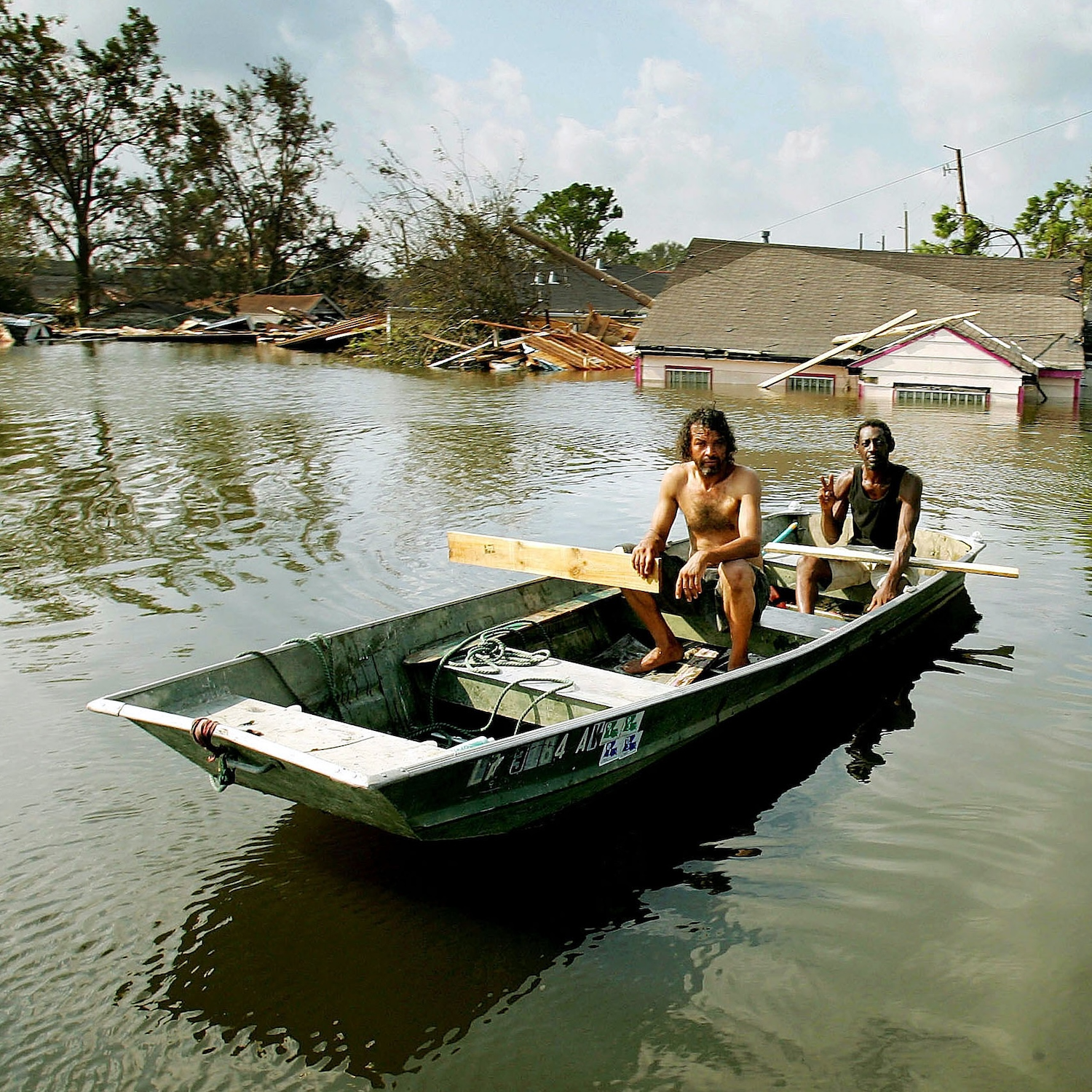
Good morning. It's Friday, August 29th. I'm Gideon Resnick in for Shamita Basu. This is Apple News today. On today's show, the continued fallout from firings at the cdc, how the president is flexing his view of executive power, and why the yellow brick road leads to Las Vegas. But first, today marks 20 years since Hurricane Katrina made landfall in Louisiana, one of the most powerful and deadly storms to ever hit the U.S. nearly 1,400 people died, thousands of homes flooded, entire neighborhoods were swept away, and over 1 million people were displaced. A quick warning to our listeners. In this segment, you'll hear some accounts from survivors. No one could control Katrina's intensity, but in the years since, it's become clear that man made failures made it even more disastrous. New Orleans authorities failed to quickly evacuate residents as Katrina was getting stronger, and many people stayed. The U.S. army Corps of Engineers, which built the levees to barricade the city from flooding, failed. They made serious engineering mistakes during construction. Fema, which is supposed to quickly address disasters of this scale, responded slowly, taking days to get aid to New Orleans and leaving survivors stranded on rooftops with no food or water, waiting to be rescued. Many were separated from their families in the storm surge.
- [01:37]
Susan Glasser
Who was at your house with you?
- [01:38]
Hurricane Katrina Survivor
My wife.
- [01:39]
Susan Glasser
Where is she now?
- [01:41]
Hurricane Katrina Survivor
Can't find her body. She gone. You can't find your wife? She told neighbor. She told me, I tried. I hold her hand tight as I could and she told me, you can't hold me. She said, take care of the kids and the grandkids.
- [01:57]
Gideon Resnick
Some managed to swim to safety, like this survivor who spoke with khou, the CBS affiliate in Houston. The worst of it was getting out here, swimming the two and a half.
- [02:08]
Hurricane Katrina Survivor
Miles through 30 foot of water to get down here to meet my family.
- [02:11]
Gideon Resnick
And state and federal authorities failed to find space for those who were displaced. Reports of horrifying humanitarian conditions emerged from the Superdome football stadium, where as many as 30,000 people took shelter. Drinking water was limited, and much of the stadium lost power. Here's how one survivor described the conditions to NBC.
- [02:31]
Susan Glasser
It was horrible.
- [02:33]
Gideon Resnick
We couldn't sleep at night.
- [02:34]
Susan Glasser
Sanitary was nasty.
- [02:36]
Hurricane Katrina Survivor
The food was horrible.
- [02:38]
Susan Glasser
You understand what I'm saying?
- [02:40]
Hurricane Katrina Survivor
My children is a nightmare.
- [02:42]
Gideon Resnick
Subsequent studies and reports found that most of the destruction and death could have been prevented. President George W. Bush later apologized.
- [02:50]
Hurricane Katrina Survivor
Americans have every right to expect a more effective response in a time of emergency when the federal government fails to meet such an obligation. I, as president, am responsible for the problem and for the solution. So I've ordered every cabinet secretary to participate in a comprehensive review of the government response to the hurricane.
- [03:13]
Gideon Resnick
After Katrina, the government invested more into figuring out how to forecast hurricanes, bringing together top scientists from federal agencies, universities and national labs to develop better systems. And NPR climate reporter Alejandra Barunda told us that work has paid off.
- [03:29]
Alejandra Barunda
We have come a really long way since Katrina in the last 20 years in terms of hurricane forecasting. Our track forecasts are way better, and our understanding and forecasting of the intensity increases are also much, much, much better.
- [03:43]
Gideon Resnick
That has helped save lives and billions of dollars in potential damage. A study from the National Bureau of Economic research released in 2024 found that these forecast improvements save the country $2 billion per hurricane because people can better prepare for them. Despite the lessons learned from Katrina and evidence that climate change is producing more intense hurricanes, the future of hurricane forecasting is less clear. The Trump administration has slashed funding for many of the organizations that play a key role in hurricane science, and Barunda says that more cuts could be on the way.
- [04:16]
Alejandra Barunda
There's really big concern that a lot of the progress that has been made could stall out and maybe even be.
- [04:25]
Gideon Resnick
Reversed, one hurricane scientist whose job was eliminated by the administration told her. We're setting ourselves back years. Let's turn now to Washington and a busy week that showcase President Trump's expansive view of executive power. A court fight is brewing over the attempt to fire Lisa Cook, a governor on the Federal Reserve Board. Trump said that he has the authority to fire her for cause and has accused Cook of listing two different homes as her primary residence on mortgage applications. She is now suing, saying that that allegation is unsubstantiated, that it violates her due process rights and thus the firing violates the federal law that governs the Fed. Trump has been pressuring the independent institution for months to lower interest rates, and he's spoken about wanting to install political loyalists on the board. The president also signed a series of new executive orders, putting the total number from his term close to 200. Already, he signed fewer than 60 in the first year of his first term, as did Biden and Obama. One of the orders that Trump signed this week seeks to outlaw flag burning, which the Supreme Court has ruled is a legally protected First Amendment right. Another directs the Defense Department to take a larger role in domestic law enforcement, as Trump has floated expanding deployments of the National Guard to cities governed by Democrats. And he told reporters this week that he believes the office of the presidency gives him unchecked power if he declares.
- [05:58]
Hurricane Katrina Survivor
An emergency not that I don't have the right to do anything I want to do. I'm the president of the United States. If I think our country is in danger, and it is in danger in these cities, I can do it.
- [06:09]
Gideon Resnick
Susan Glasser is a staff writer at the New Yorker who chronicled Trump's first term in her book the Divider. She says this perception of executive power is something that Trump has talked about often throughout his political career, but he's acting on it in new ways during this presidency.
- [06:24]
Susan Glasser
It's an aggressiveness in acting on that and essentially daring anyone to stop him. This is something without much precedent anywhere in American history, even in Trump's own first term.
- [06:34]
Gideon Resnick
One way that Trump has tried to centralize power is through federal spending by canceling or withholding billions of dollars of funding that Congress had already approved, which is known as impoundment.
- [06:45]
Susan Glasser
The idea that a president can simply disregard those laws that Congress passes that he doesn't like seems antithetical to what the United States is all about. And by the way, annual appropriations bills are laws. So when the president says, oh, I'm not gonna spend this money that Congress told me to spend in this way, that's a law that's being disregarded.
- [07:04]
Gideon Resnick
Glasser says broadly speaking, Republican lawmakers have not demonstrated much interest in checking the president's efforts to consolidate his power.
- [07:12]
Susan Glasser
Congress, at least for now, has chosen partisan identity over institutional identity. They've chosen to act as fellow Republicans and to go along with the leader of their party rather than to speak up for themselves as an institution. And that is something that the founders really didn't anticipate. And I think that's the biggest way in which you can say we're looking at a constitutional malfunction here.
- [07:36]
Gideon Resnick
Glasser added that the conservative majority on the Supreme Court, which was in large part built by Trump in his first term in office, played a large role in emboldening these actions.
- [07:45]
Susan Glasser
I think that when the history of this period is written, you're going to have to go back to the Supreme Court's immunity ruling in the summer of 2024. So even before Donald Trump was reelected to office, which appeared to offer the presidency something of a blank check, and we haven't seen the Supreme Court go back to that ruling yet to us a little bit more about what it viewed as the contours of it. But for now, I think it's fair to say Donald Trump says, not only do I have the power to do anything I want, but I feel validated by this Supreme Court in doing it.
- [08:31]
Gideon Resnick
Last week, a federal judge in Florida ruled that the controversial immigration detention facility in the Everglades, known to some as Alligator Alcatraz, was would have to wind down operations, with the last detainee needing to leave within 60 days. The facility had been hastily built two months ago with the goal of holding as many as 3,000 people. There were numerous allegations of inhumane conditions in the facility, but the litigation that led to this judge's ruling zeroed in on a different aspect.
- [09:00]
Amy Green
The lawsuit argued that the detention site had been rushed to completion without any public comment or environmental review.
- [09:09]
Gideon Resnick
That's Amy Green, a Florida correspondent with Inside Climate News. Those reviews are necessary to comply with federal laws like the Endangered Species act and the National Environmental Policy Act. Environmental groups that sued were joined by the Micazukie tribe of Indians of Florida who live in a number of villages nearby the detention site, including one just 1,000ft away. Every day, a bus stops at each village and picks up children to take them to school on the main reservation 10 miles away. Federal and state officials have characterized the area as just a swamp filled with alligators and snakes.
- [09:44]
Amy Green
The Miccosukee tribe, for many generations, has regarded the Everglades as sacred. During the first and Second Seminole wars in the 19th century, the tribespeople were pushed deep within the marsh and found sanctuary on the tree islands there. And for them, the Everglades are sacred because they saved their people from annihilation during the removal era.
- [10:07]
Gideon Resnick
Greene said that when she visited the area earlier this month, leaders in the Micazuki community said that they had not been consulted before plans for the facility became public, that they learned about it on the news when everyone else did. In the past, the tribe has similarly advocated for environmental causes in the state.
- [10:25]
Amy Green
Back in the 1980s, the federal government sued the state of Florida over water pollution in the Everglades, and the tribe got involved in that issue as defenders of their sacred river of Grass. And that litigation led to a monumental state cleanup effort that continues today. More recently, the tribe has pursued a deal to phase out oil drilling within the Big Cypress National Preserve, which is in the Everglades.
- [10:51]
Gideon Resnick
The judge overseeing the case reaffirmed on Wednesday that the facility needs to close, and DHS is reportedly already moving detainees out. And the AP reports that Florida taxpayers could be on the hook for millions of dollars that the state spent to build the fac. Before we let you go, a few other stories we're following. The chaos continues at the CDC after firing the director, Dr. Susan Menares, one month into the job. Several members of the leadership team walked out in protest, criticizing HHS Secretary Kennedy for weaponizing public health. Now, influential Republicans have also raised concerns, including Senator Bill Cassidy, who called on the HHS to postpone an upcoming meeting of the Advisory Committee on Vaccines. Cassidy was a key vote in Kennedy's confirmation. Sen. Susan Collins also expressed concern after speaking with Manares and agreed that congressional oversight would be warranted. Meanwhile, a temporary replacement for Manaras has already been selected. Multiple reports suggest that Jim o', Neill, the deputy HHS secretary, will fill the role in the interim this weekend, College football is back, and with it the much anticipated debut of former New England Patriots head coach Bill Belichick. He's now coaching for the University of North Carolina. Belichick spent close to 50 years in the NFL, winning six Super Bowls, but as he prepared for his first college year, it turns out that he had some learning to do. The Wall Street Journal reports that Belichick spent a season peeking in on the University of Washington football program. Now, it makes some sense that he would need to learn a little bit more about how a college team ran, but learning from a program that had six wins last year was a little bit surprising, even if his own son was part of the coaching staff. Belichick said that the school's head coach, who had roots in the NFL, was building a kind of template for him to build off of, so much so that he even poached a few players and assistant coaches. UNC will face off against TCU on Monday and finally, last night, the yellow brick road led all the way to Las Vegas. The 1939 classic the wizard of Oz premiered at the Sphere in Sin City, which, as it sounds, is a gigantic circular structure that has played host to concerts, shows and a whole lot of ads on its 580,000 square foot led exterior. So you can imagine when it was announced that the classic film would play there, some went so far as to say it marked the death of cinema. That's because in order to adjust the aspect ratio of the wizard of Oz to accommodate what is touted as the highest resolution LED screen on earth, some liberties had to be taken. Using VFX and AI tools, the team behind the screening of the film has adjusted it to show things that were previously off screen treetops swaying when you look up Dorothy's uncle leaning against the wall. In this presentation, the movie is also 30 minutes shorter. If you don't have the opportunity or the desire to see it in this format, the Washington Post got a preview of the experience, including the Big Twister scene. You can find all these stories and more in the Apple News app. And if you want to follow those games we mentioned, you can get live scores super fast on the lock screen of your iPhone by downloading the Apple Sports app. If you're already listening to this show in the news app right now, stick around for an episode of Apple News in Conversation this week. We're digging into our ARC archives. The episode was hosted by Sam Sanders, who is filling in for Shamita. He talks to New Yorker staff writer Emily Nussbaum about how much reality is actually behind reality tv.
- [14:27]
Susan Glasser
Nobody who works in reality television is shocked by producers lying to or manipulating or causing cast members to cry, because that's literally what your job is.
- [14:36]
Gideon Resnick
If you're listening in the podcast app, follow Apple News in Conversation to find that episode and a quick programming notebook before we let you go. There will be no episode of Apple News today. On Monday we're going to be off for Labor Day, so enjoy the holiday weekend and we'll be back with the news on Tuesday.