Loading summary
Transcript35 lines
- [00:05]
A
Good morning. A woman is shot dead by ICE agents in Minneapolis as an immigration crackdown intensifies. We speak to the Minnesota Star Tribune reporter who went to the scene.
- [00:15]
B
I saw about 30 ICE agents that I was able to count, and there were definitely over 100 people who were yelling back at ICE agents saying, Shame on you. You killed one of our neighbors.
- [00:27]
A
Bloomberg tells us why President Trump's ambitions to seize Venezuelan oil product run into trouble. And what's in the new flipped food pyramid.
- [00:36]
C
These new guidelines will revolutionize our nation's food culture and make America healthy again.
- [00:43]
A
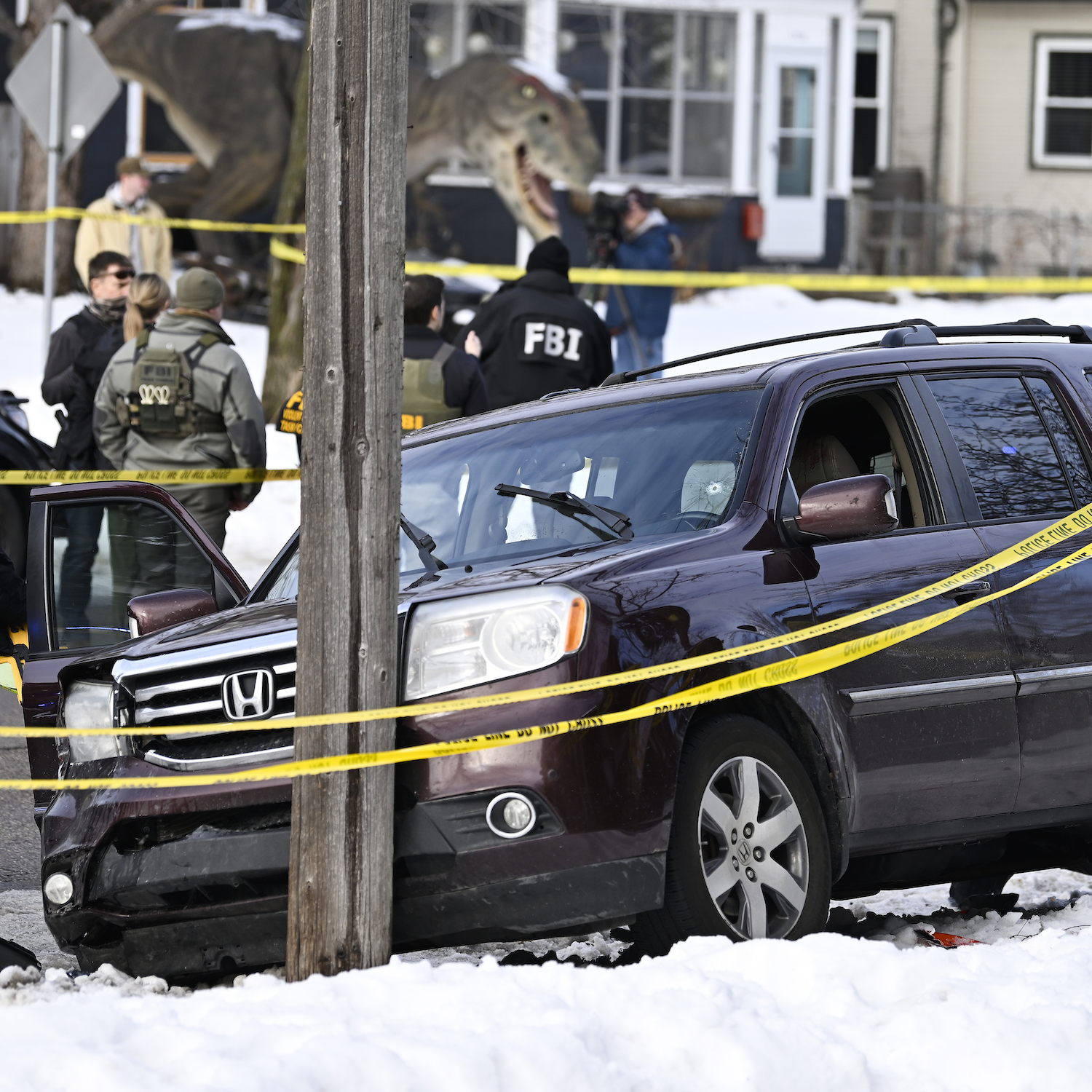
It's Thursday, January 8th. I'm Shemitah Basu. This is Apple News Today. Let's start in Minneapolis. Yesterday, Renee Nicole Good was shot in her car by ICE agents. She was 37 years old, a U.S. citizen. Her killing drew hundreds of people to protest in the streets. They were met with armed federal agents who deployed chemical irritants. It comes amid a widespread immigration crackdown in the city, long opposed by Minnesota's state government. President Trump and Homeland Security Secretary Kristi Noem described the shooting as seeming to be in self defense, a characterization rejected by Governor Tim Walls, the local mayor, and some witnesses at the scene. By now, you might have seen the video of the fatal encounter verified by multiple news organizations. From the video, Good's car is seen blocking a lane on a snowy residential street. A truck approaches and she appears to wave for them to go past. The agents instead emerge from the truck and order her out of the vehicle. One agent tries to open the door and Good first reverses away from the agents and then drives forward. In Reuter's analysis of the video, the driver turns the wheels right in what appears to be an attempt to drive up the street away from the officers. The agent in front of the car pulls out his weapon and fires three times. In Reuter's conclusion, at least one of those shots fired after the car's front bumper had passed him. Secretary Noem described the incident as domestic terrorism. At a press conference, they were attempting to push out their vehicle and a woman attacked them and those surrounding them and attempted to run them over and ram them with her vehicle. An officer of ours acted quickly and defensively, shot to protect himself and the people around him. When Minneapolis Mayor Jacob Frey spoke to reporters, he angrily disputed the DHS version of events.
- [02:56]
C
They are already trying to spin this as an action of self defense. Having seen the video of myself, I want to tell everybody directly that is bull. This was an agent recklessly using power that resulted in somebody dying, getting killed.
- [03:19]
A
It comes a day after DHS announced an expansion in their month long enforcement efforts there, calling it their largest operation ever. Sophia Barnett, a reporter with the Minnesota Star Tribune's immigration team, told us about it.
- [03:33]
B
A lot of ICE agents have been focused on the Somali community. So we see a lot of people outside of this place called Carmel Mall, which is really sort of like a hub of Somali life and also an area, Lake street, that's got a lot of Latino immigrants. We're seeing a lot of ICE presence there as well.
- [03:48]
A
The administration has been increasingly targeting people of Somali descent, particularly after Minnesota's major welfare fraud scandals which involved a number of Somali immigrants. This latest push comes only days after Walls announced his decision not to seek re election as governor, citing the scrutiny over the schemes. Speaking yesterday, Wall said he had issued an order to prepare the state's National Guard and he urged his constituents to remain peaceful.
- [04:16]
C
To Minnesotans, I say this, I feel your anger. I'm angry. They want to show we can't give it to them. We cannot. If you protest and express your First Amendment rights, please do so peacefully as you always do. We can't give them what they want.
- [04:33]
A
Barnett told us the city's reaction to increased ICE presence in recent weeks had been overwhelmingly negative.
- [04:40]
B
There are a lot of community members who are organizing to rapidly respond to these ICE incidents when they happen. So there are a lot of organizers and community members in group chats who are just constantly dropping locations. They're patrolling, they're monitoring, they're tracking ICE license plat, organizing to sort of monitor these things in their own because they feel as though this is their obligation as community members in Minneapolis. So that is something that we've been seeing a lot of and people will directly respond to the scene when there are ICE agents.
- [05:12]
A
Last night, more than a thousand people gathered at the site of the shooting for a vigil. The Minnesota Star Tribune spoke to Good's mother who described her as kind and compassionate. She leaves behind a six year old son. The White House continues to assert its control over Venezuela's oil reserves across multiple fronts. Yesterday, US troops forcibly boarded one tanker that was being escorted by the Russian Navy. US forces were supported by the British who described the ship as being part of a Russian Iranian axis of sanctions evasion. The Russians meanwhile, demanded humane treatment of its citizens aboard the vessel. US Troops also seized a second tanker carrying Venezuelan oil near the Caribbean Sea. This comes on the heels of a major announcement from President Trump that Venezuela would soon hand over millions of barrels of oil. Yesterday, Energy Secretary Chris Wright went even further, saying that the United States would oversee the sale of the country's production indefinitely.
- [06:19]
C
We're going to let the oil flow, sell that market to United States refineries and to around the world to bring better oil supplies, but have those sales done by the US Government and deposited into accounts controlled by the US Government. And then from there, those funds can flow back into Venezuela to benefit the Venezuelan people.
- [06:42]
A
And tomorrow, President Trump is expected to meet with executives from major American oil companies to discuss the future of production in Venezuela. But one major obstacle to doing all of this may in fact be Venezuela's oil industry itself.
- [06:57]
D
Producing oil in Venezuela is incredibly difficult.
- [07:00]
A
Kevin Crowley is a senior oil reporter with Bloomberg.
- [07:04]
D
There was a report out this week saying that $53 billion of investment would be needed over the next 15 years just to keep Venezuelan production flat at around 1.1 million barrels per day. That's a huge sum of money, especially when you consider the political risk that these companies would be taking.
- [07:23]
A
He said that these oil executives could ask for a number of promises in exchange for making the kind of investments the White House is seeking.
- [07:31]
D
They need some kind of assurance that if they make these investments, those investments will be protected long after the Trump administration leaves office. I mean, if a company commits a billion dollars today, that could take a decade or more to pay out, and they absolutely do not want to be nationalized again.
- [07:49]
A
American and European oil companies at one point had significant operations in Venezuela. Now, many of these companies say that Venezuela owes them tens of billions of dollars for driving them out under Hugo Chavez's leadership decades ago. Chevron is the only American oil company that stayed in Venezuela. Crowley explained, though, that while there are short term hurdles, the prospect of being able to access Venezuela's oil in the long term could prove to be an attractive offer.
- [08:19]
D
Bottom line is these are some of the world's largest oil reserves. And if you look at other countries around the world with large reserves, Saudi Arabia, Russia, Iran, they're all run by national oil companies. They're effectively off limits to the Western oil majors. Venezuela used to be part of this group, but that all changed on Saturday morning. So if you're an oil CEO and you're looking at production going out to the2030s, the2040s, Venezuela is now one of the countries that you're certainly going to be looking at.
- [09:01]
A
Health Secretary Robert F. Kennedy, Jr. Has unveiled his much anticipated overhaul to the federal food guidelines.
- [09:09]
C
Today, our government declares war on added sugar. Highly processed foods loaded with additives, added sugar and excess salt damage Health and should be avoided. As Secretary of Health and Human Services, my message is clear. Eat real food.
- [09:26]
A
Since the 1940s, food guidelines have been presented variously as plates, wheels and pyramids. This time it's been turned on its head, literally as an inverted pyramid with meat, cheese, and vegetables at the top. Sarah Todd is a reporter for the health publication Stat News. She told us what's new in this announcement.
- [09:46]
E
For the first time, they take a position on ultra processed foods, recommending that Americans avoid them as much as possible. That's foods like chips and packaged cookies, those kinds of things, refined carbohydrates. So that's a big deal and a big departure from previous guidelines.
- [10:03]
A
And protein, long championed by Kennedy, also gets two enthusiastic thumbs up.
- [10:08]
E
They, for the first time recommend that Americans have protein at every meal, and they increase their level of protein that they're saying that Americans should consume. They don't differentiate between different types of proteins so much, so they recommend protein both from animals, and that includes everything from red meat to poultry and seafood. And then they recommend plant based sources of protein as well.
- [10:32]
A
The guidelines contradict previous advice in suggesting beef tallow or butter for cooking. And there's a change for alcohol, too. Gone is the recommendation that men have no more than two drinks per day and women no more than one, replaced instead by a vaguer suggestion of less consumption. HHS official Mehmet Oz said he wasn't persuaded by the data behind the old recommendation.
- [10:56]
C
Alcohol is a social lubricant that brings people together. In the best case scenario. I don't think you should drink alcohol, but it does allow people an excuse to bond and socialize. And there's probably nothing healthier than having a good time with friends in a safe way. So there is alcohol on these dietary guidelines, but the implication is don't have it for breakfast.
- [11:16]
A
Todd told us reactions from the experts she'd spoken to so far have been mixed.
- [11:21]
E
They're happy to see how much whole grains are emphasized and how much fruits and vegetables are emphasized. They're concerned that when it comes to the protein and the fat part of things, you know, the images have everything from butter and steak to salmon and nuts. So there are foods that everyone agree are healthy. There are foods that people would say you should really be limiting your consumption of them. And they're all kind of thrown together without differentiation.
- [11:46]
A
Most people probably don't decide their dinner routine, or for that matter, their breakfast drinking habits based on government guidelines. But Todd told us they do have real world impact.
- [11:57]
E
They certainly have a cultural influence on people. I don't think that we have great research showing like exactly how much most Americans don't follow the guidelines to the letter. That's certainly true. There are all sorts of trickle down effects. For example, the guidelines do inform directly what schools serve to kids through the school lunch program. That's a big deal. USDA will have to translate this guidance. So it's not like schools will be implementing changes right away. But that is one way that it'll directly impact Americans health.
- [12:33]
A
And finally, a few other stories we're following. Residents in Juneau, Alaska are in a race against time to dig out of a record snowfall. The Weather channel reports nearly 40 inches of snow from back to back. Storms buried Alaska's capital, but as workers haul out truckloads of powder, they're running out of places to put it before a rainstorm hits and risks causing flooding. All of this is happening after nearly an entire year's worth of snow dumped on Juneau over Christmas and New year's when almost 7ft hit the area at Juno's airport. 50 inches was recorded on New Year's Eve, an all time depth record. President Trump says he is withdrawing the US From a climate change treaty that has for decades committed much of the world to the goal of reducing emissions. The UN Framework Convention on Climate Change is the basis for efforts for 198 countries to slow pollution. In 1992, the US was the first industrialized nation to join the treaty under President George H.W. bush. In a White House memo, Trump said the treaty no longer serves American interests and also withdrew the US from dozens of other international organizations. A former administrator for the EPA under President Obama told Politico the move was, quote, short sighted and foolish. And finally say it ain't so. But it seems some Americans are falling out of love with pizza. The Wall Street Journal reports what was once the most common type of restaurant pizza joints are now outnumbered by coffee shops and Mexican restaurants. Pizza has lagged behind the broader fast food market for years and sales and growth data say the future doesn't look great either. The Journal notes pizza places engaged in a price war, pitting them against cheaper fast food options that have families rethinking a $20 pie now despite the declining market share, Americans still do eat a lot of pizza. Around 1 in 10 consume a slice on any given day. You can find all these stories and more in the Apple news app. And if you're already listening in the news app right now, we've got a narrated article coming up next. The New Yorker explores the congressional career of Marjorie Taylor Greene and how the once close ally of Trump went from MAGA superstar to being called a traitor by the president himself. If you're listening in the podcast app, follow Apple News plus Narrated to find that story. And I'll be back with the news tomorrow.