Loading summary
Transcript21 lines
- [00:05]
Shemitah Basu
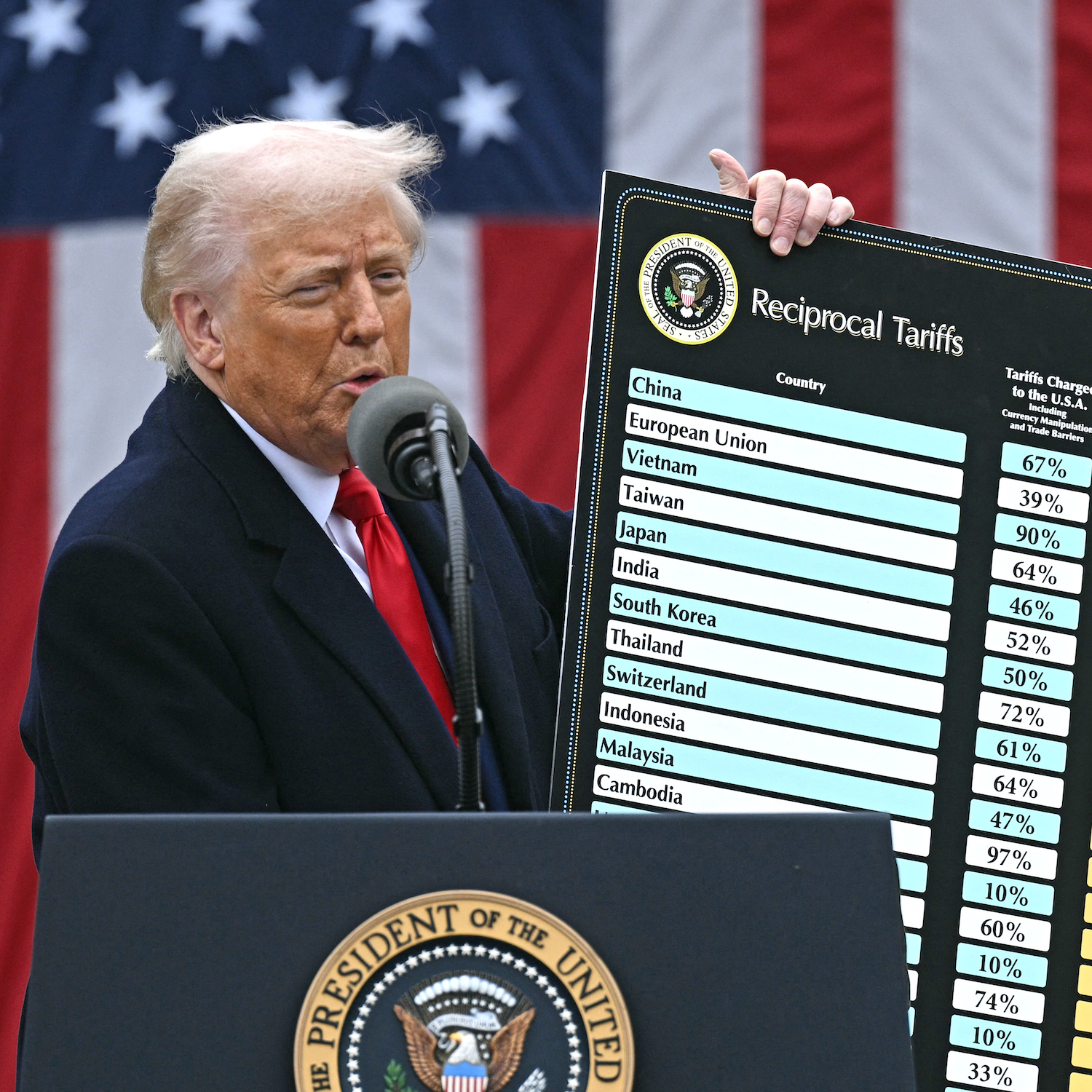
Good morning. It's Monday, April 7th. I'm Shemitah Basu. This is Apple News Today. On today's show, why hundreds of thousands of Venezuelans living in the United States legally might be sent back. The UN Learns more about what happened to rescue workers killed by Israeli troops. And UConn wins its record 12th women's basketball national championship. But first, businesses, economists, and governments across the world are still digesting and reacting to sweeping tariffs enacted by the Trump administration. The announcement last week sent markets careening, with the S&P 500 hitting the lowest level in almost a year. Last week was the worst for American stocks since the beginning of the pandemic five years ago. Over the weekend, thousands of protesters gathered in Washington, D.C. and in cities across all 50 states to demonstrate against President Trump and Elon Musk in what organizers dubbed hands off protests. Demonstrators told reporters they were motivated by a diverse list of issues, from Musk's overhaul of government agencies to cuts to medical research to tariffs. And yet on Sunday, administration officials remained defiant and waved away forecasting that has shown the tariffs could tilt the US Economy into a recession. Treasury Secretary Scott Besant made the case on Meet the Press that there are long term gains to be made here for the US Economy.
- [01:35]
Scott Besant
There doesn't have to be a recession. Who knows how the market is going to react in a day, in a week. What we are looking at is building the long term economic fundamentals for prosperity that I think the previous administration had put us on a course toward financial calamity.
- [01:52]
Shemitah Basu
Besant also claimed that over 50 countries have been in contact with the United States since the announcement in order to begin trade negotiations. President Trump on social media said Americans need to, quote, hang tough and wait for the end result. He also recently said that it could take two years for American manufacturing to grow as a result of this policy. Sean Donnan, a senior writer for economics at Bloomberg News, told us that in the short term, a recession could cause companies to rethink their investment strategies.
- [02:24]
Sean Donnan
If you have a recession in the United States, that by definition means Americans are buying less stuff that the the market in the United States is less attractive than it was otherwise. And so you may have companies also saying, well, hang on a second, maybe now's not the time to invest. If I'm going to be spending billions of dollars to build a factory in the United States, I kind of want some certainty about where we're going, what it is that I'm investing in.
- [02:49]
Shemitah Basu
As the White House tries to kind of shock the economy into submission and reshape a global trade order, Donen said it's going to be key to watch how other countries respond. China has already said that it will impose reciprocal tariffs of 34 on all imports from the US beginning this week. The European Union is reportedly preparing a response as well. As Donen points out in his reporting, when the US imposed new tariffs in the 1930s, it sparked a broader trade war. That is a historical reason for the concern here.
- [03:21]
Sean Donnan
What happened in 1930 after the Smoot Hawley tariffs went into place is that we saw countries all over the world retaliate, and that just brought global trade down to a halt and led to the deepening and the lengthening of the Great Depression.
- [03:35]
Shemitah Basu
There are some industries, like steel and aluminum, that have welcomed tariffs. They've watched their cheaper foreign competitors win business in their markets, and they're eager for change. Some Republican leaders are already expressing worries about future retaliatory tariffs the US could face. And some parts of the organized labor sector that have voiced support are doing so with some caveats.
- [03:58]
Sean Donnan
The labor unions have traditionally been pretty supportive of tariff policy, but one of the things we're seeing this time around is even some protectionist parts of the conversation. Those communities we're seeing, people say, well, hang on a second, this may be just going a little bit too far too quickly.
- [04:27]
Shemitah Basu
Let's turn now to immigration, where the future is uncertain. Uncertain for hundreds of thousands of Venezuelans living in the United States legally under tps, short for Temporary Protected Status. TPS is a government designated protection for people who have fled countries that US Officials determined are not safe to return to, like Venezuela. And it allows them to work legally in the US without the risk of deportation. The Department of Homeland Security initially planned to end TPS for around 350,000 Venezuelans today, but a federal judge last week paused that plan, saying deporting them would cause irreparable harm to families and cost billions in economic activity. One industry that could be seriously disrupted by more deportations is caregiving. Foreign born workers make up a significant portion of caregivers in the United states, more than 40% of home health aides, close to 30% of personal care workers, and just over 20% of nursing assistants. That's according to data from 2022 from the Bureau of Labor Statistics. And because these jobs are so demanding and relatively low paying, NBC and KFF health News report, they often struggle to attract enough American born workers to fill roles. So KFF health news reporter Vanessa Sanchez told us, increasingly, immigrants are taking them.
- [05:49]
Vanessa Sanchez
The share of foreign born workers who are in these settings has increased by 3% in the past decade and it is expected to increase even more. They represent a very important share of the caregiving workforce. And there is this sense of fear that even if they have legal status, they could be detained and they could be deported.
- [06:10]
Shemitah Basu
Sanchez told us about one woman living through this uncertainty. Alanis Ortiz is a Venezuelan immigrant and caregiver in New Jersey with TPS.
- [06:19]
Vanessa Sanchez
She's been taking care of Josephine Sanek. She's a 16 year old who has severe autism and other disabilities. She needs a routine and any disruption in her routine can cause more distress.
- [06:32]
Shemitah Basu
Josephine's family told Sanchez Ortiz plays a critical role in her well being and they've been trying to win a reprieve for Ortiz. They've called congressional representatives. One family member wrote a letter to President Trump asking him to reconsider revoking tps. And Josephine's mom, Krista, told Sanchez, if anything happens to Ortiz, their family and especially Josephine would be, quote, gutted beyond.
- [06:57]
Krista
Belief to rip somebody out of her life that has been her best friend for almost three years. You have no way to explain to her, oh, Alanis is being kicked out of the country and she can't come back.
- [07:09]
Shemitah Basu
As for Ortiz, the possibility of losing her job and being deported has brought a lot of anxiety.
- [07:15]
Vanessa Sanchez
She is scared and she doesn't feel that going back to Venezuela is safe. And she doesn't know if she's gonna return to Venezuela if she is either detained or is forced to leave, that she will end up in detention center for a very long period of time. So there is a lot of uncertainty right now.
- [07:35]
Shemitah Basu
The judge who paused the Department of Homeland Security's plan to revoke TPS gave the government until today to file notice of an appeal. On March 23, a few days after Israel ended the ceasefire with Hamas and fighting resumed, a group of aid workers in ambulances approached an area in the town of Rafah, which borders Gaza, to assist people wounded by an Israeli airstrike. That's when Israeli soldiers opened fire. The Wall Street Journal reports. After several hours, more vehicles, including a fire truck, more ambulances and a UN vehicle showed up to look for their missing colleagues and they too were fired upon. Now, so far, these facts of what happened that day Israeli and Palestinian officials agree on Israel's military says the event is under examination. But in the meantime, it wasn't clear what had happened to the bodies of these rescue workers. After days of searching by the UN, a phone call came in from an Israeli military official who directed them to a mass grave. Buried under sand were 15 bodies and their crushed vehicles. Eight were paramedics with the Palestine Red Crescent Society and six were from the Palestinian civil defense, which included firefighters and emergency responders, and one was a UN employee. Here's Jonathan Whittle, the head of the UN's humanitarian office in Gaza and the west bank, who took that phone call, speaking at the gravesite.
- [09:12]
Scott Besant
They were here to save lives. Instead they ended up in a mass grave.
- [09:15]
Shemitah Basu
The audio quality isn't so great, but what he said was they were here to save lives. Instead they ended up in a mass grave. Video of the incident contradicts the IDF's initial account of what happened. Here's Sky News Middle east correspondent Alastair Bunkel speaking on the network about what the video shows.
- [09:34]
Alastair Bunkel
The IDF also, and this is the crucial bit in relation to this video, said that those ambulances were traveling without their lights on and without any sign of them being emergency vehicles, and so therefore they were suspicious. But the video obtained by the New York Times very clearly shows that those ambulances had their emergency lights flashing.
- [10:00]
Shemitah Basu
The Israeli military has since said their first account of what happened was a mistake. It claims nine Hamas militants were killed in the incident, including one who took part in the October 7 attacks in 2023. Reuters reports the Israeli government gave no evidence of how it made those identifications. Israel is expected to share more conclusions from its report sometime this week. Meanwhile, Israeli Prime Minister Benjamin Netanyahu is set to meet with President Trump today to discuss the war as well as other topics like Iran and tariffs. Before we let you go, a few other stories were following. A second child has died of measles in West Texas. The Houston chronicle reports an 8 year old girl died of measles pulmonary failure in Lubbock last Thursday, and Axios reports the death prompted a last minute trip to Texas from Health and Human Services Secretary Robert F. Kennedy Jr. He says the most effective way to prevent measles is the MMR vaccine. The health publication Stat notes Kennedy stopped short of recommending the vaccine, which in the past he has falsely characterized as dangerous. 500 cases of the measles have been reported across Texas, New Mexico and Oklahoma. The majority are in the South Plains and Panhandle region of Texas, where 481 confirmed cases have been reported since late January. A federal judge says the Trump administration must take steps to return a Maryland man who was erroneously deported to El Salvador. The administration last week said the judge had no power to order the return of Kilmar Abrego Garcia and that the judge was intruding on the president's power to direct foreign policy. The judge rejected that notion in an overnight opinion Sunday, saying Abrego Garcia was seized without lawful authority and that the US Government has the power to facilitate his return. Meanwhile, Politico reports that in addition to backlash from congressional Democrats and the courts, this case has also caused turmoil within the Justice Department. The career DOJ attorney who argued the case for the government was put on administrative leave after expressing exasperation about the department's unwillingness to provide more information to the court or take steps to bring Abrego Garcia back to the U. S. Attorney General Pam Bondi confirmed the attorney was put on leave, saying, quote, he shouldn't have taken the case. The administration filed an appeal on Sunday asking for an emergency stay of the judge's order. And finally, UConn is the 2025 NCAA Women's Basketball National Championship. The two seed Huskies dominated South Carolina on Sunday. This is a record 12th national championship for the UConn women, who were led by senior guard Az Fudd and freshman Sarah Strong, who combined for 48 of the team's total points. Senior guard Paige Beckers, who's likely to be the first pick in the WNBA draft, scored 17. The men's championship game is tonight. Houston, who pulled off a big upset of Duke Saturday night, takes on Florida. You can find all these stories and more in the Apple News app. And if you're already listening in the News app right now, we've got a narrated article coming up next. It's been three months since devastating wildfires erupted across Los Angeles, and there's still a long road ahead to recovery. But California's insurance market isn't making things any easier. The San Francisco Chronicle examines how faulty algorithms and a broken process have left scores of homeowners underinsured and unprotected. If you're listening in the podcast app, follow Apple News Narrated to find that story and I'll be back with the news tomorrow.