Loading summary
Transcript32 lines
- [00:05]
A
Good morning. Another Republican targeted by Trump loses a primary election. Bloomberg explains why Louisiana Senator Bill Cassidy became a Trump target. Federal judges have ruled against the administration in more than 10,000 immigration cases. Politico breaks down the staggering number of losses.
- [00:24]
B
The Trump administration dramatically changed the landscape for how ICE detains people, leading to this sort of explosion in court cases and people seeking freedom from detention and
- [00:35]
A
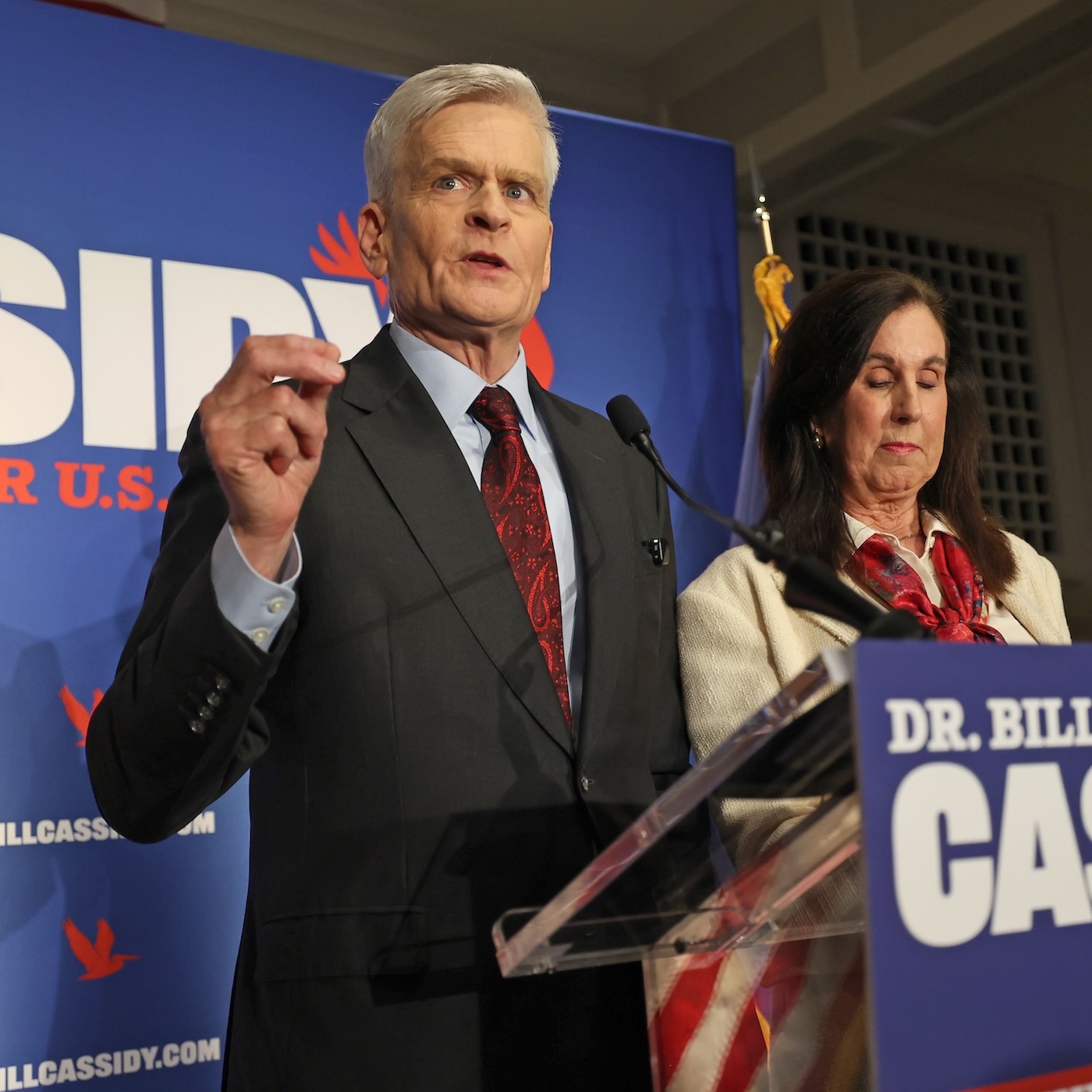
how Iranian society is buckling under the regime's Internet Blackout. It's Monday, May 18th. I'm Yasmeen Khan, and this is Apple News. Today, President Trump's winning streak against Republicans who have crossed him politically continues over the weekend. Louisiana incumbent Senator Bill Cassidy lost his primary to Trump backed Representative Trump, Julia Letlow. But no candidate in the race broke the 50% threshold for an outright win on Saturday. Letlo and State Treasurer John Fleming now advanced to a runoff on June 27. Whoever wins the runoff is heavily favored to win in November in deep red. Louisiana Bill Cassidy not only lost his bid to keep his seat, but came in third out of three Republican candidates in the race. He's the first sitting U.S. senator to lose a primary race since 2012. Cassidy, during his concession speech Saturday, alluded to the president's harsh criticism of him and Trump's efforts to oust him from office.
- [01:42]
C
Our country is not about one individual. It is about the welfare of all Americans, and it is about our Constitution. And it is the welfare of my people and my state and my country and our Constitution to which I am loyal. And if someone doesn't understand that and attempts to control others through using the levers of power, they're about serving themselves.
- [02:19]
A
Cassidy and a super PAC called Louisiana Freedom Fund spent more than $22 million on ads in the race. That was more than Letlow and Fleming combined. The race echoed what happened in an Indiana state Senate primary earlier this month. But when five of seven Trump endorsed Republicans ousted their fellow party members who voted against the president's efforts on redistricting in the state. That race was dominated by negative ads, which also played a part in the Louisiana race. After advancing to the runoff on Saturday, Letlow credited the president for his support.
- [02:52]
D
People ask me all the time, Julia, why would you put your family through this? Why would you elect to have $26 million spent and negative ads against you? Again, that's another testament to the president's endorsement, how powerful it is in Louisiana that we were still able to garner 45% of the vote.
- [03:13]
A
Despite the negativity, Trump had targeted Senator Cassidy for multiple reasons. First was Cassidy's vote to convict Trump on impeachment charges in 2021. And more recently, Trump blamed Cassidy for sinking the nomination of Casey Means, Trump's pick for surgeon general and a close ally of Health Secretary Robert F. Kenned Jr. Cassidy is a doctor and chairs the Senate Health Committee. Kennedy also played a big role in Cassidy's primary laws. Rachel Khors Zhang is a national healthcare reporter for Bloomberg and told us about Kennedy's efforts.
- [03:48]
E
So Secretary Robert F. Kennedy Jr. Has a political operation left over from his presidential campaign. It's unusual for a sitting Cabinet secretary to have an operation like this, and they kind of mobilized for the first time since he's been in office in this Louisiana Senate primary.
- [04:04]
A
Opposing Senator Bill Cassidy, Cor Zhang notes that without Cassidy, RFK Jr. S own nomination and eventual confirmation may never have happened.
- [04:13]
E
He was very concerned about some of the rhetoric that Secretary Kennedy had displayed before taking office, questioning vaccine safety and advocating for policy changes to what vaccines were recommended by the government. And so it was a difficult choice for Senator Cassidy to support Secretary Kennedy's nomination, but he ended up doing so and being this deciding vote to confirm him.
- [04:36]
A
The relationship between Kennedy and Cassidy devolved shortly after Kennedy's confirmation, and the two have often clashed on the Hill. Still, Corziang notes that Cassidy, perhaps emboldened by losing his primary, could still be a thorn in Trump and Kennedy's sides for the remainder of his term.
- [04:53]
E
He does have quite a bit of leverage now because Secretary Kennedy has three high profile vacancies that have to go through Senator Cassidy's committee. The Surgeon General nominee, the leader of the Centers for Disease Control and Prevention and the Food and Drug Administration. The commissioner just departed last week, so they'll have another nominee coming for that. So I think they obviously want to get these nominees through before the midterm elections when they could lose control of the Senate potentially.
- [05:18]
A
At the same time, Cassidy's departure also leaves a power vacuum in the GOP's Senate health leadership, where Cassidy not only brought medical expertise but a willingness to work across the aisle. Meanwhile, Trump's mission of retribution against Republicans he sees as disloyal continues tomorrow. That's when Kentucky Representative Thomas Massie, who's been a critic of Trump over high profile issues like the Iran War and the Epstein files, also faces a primary. That race has become the most expensive House primary battle in history, with roughly $32 million spent on TV, radio and digital attack ads. Trump has called Massey Quote an even bigger insult to our nation than Cassidy. The immigration enforcement efforts that have swept through major cities during Trump's second term have resulted in a staggering number of losses in court for the administration. An analysis by Politico recently revealed how US Courts have overwhelmingly rebuked Trump's ICE policies. Out of the thousands of cases, even a majority of judges appointed by Trump ruled against the administration. Kyle Cheney is a reporter for Politico and told us a big factor in the losses is the sheer volume of cases flooding the court system. He says the courts have been inundated by individual cases of detainees requesting bond hearings or their release. In more than 10,000 instances, federal judges across the country found that the detention of individuals without a chance to plead their case was illegal.
- [06:56]
B
What's happened then is that the courts and the judges who are interpreting this policy for the first time saying, this is ridiculous. I mean, this is unbelievable and not legal and an overwhelming basis have rejected it. By our count, it's more than 430 federal judges have said this is not the proper interpretation of mandatory detention law that's been on the books for 30 years.
- [07:16]
A
Under federal law, people seeking admission into the US have traditionally been required to be detained. In the past, all previous administrations interpreted this rule narrowly and applied it to individuals who were apprehended at the border. Last July, however, the Trump administration issued a memo reinterpreting that designation. The policy shift has resulted in millions of people being denied bond hearings from the start of the process.
- [07:41]
B
What ICE did under the second Trump administration was say, if we find you, no matter where you are in the country, no matter how long you've been here, we will still treat you as seeking admission to the country as though we've apprehended you at the border. And therefore you are also required to be put in detention.
- [07:55]
A
Among those detained was a nursing mother with active refugee status, parents of US Military service members, trafficking victims or witnesses, and a five year old boy.
- [08:05]
B
What judges are doing is ordering either a bond hearing for these people who are being detained, giving them a chance to plead that case, or ordering their outright release, saying the entire basis for their detention was flawed.
- [08:17]
A
Cheney reports that ICE has defied or tried to circumvent those rulings. In some cases, ICE officials move a detainee to a new state where they'd have to bring a new case with a new lawyer. Administration officials say that the change in policy is their answer to the flawed border policies of the Biden administration. And Cheney says they've shrugged off the court losses attributing them. To quote judicial activists. ICE officials say the number of voluntary departures and decline in border crossings signals success.
- [08:47]
B
I think ultimately the Supreme Court are going to have to resolve this issue to clarify this flood of cases and maybe give some guidance once and for all about how they should be handled.
- [09:03]
A
In Iran, people are suffering through the longest recorded national Internet shutdown in a connected society. That's according to the Internet monitoring group Netblocks. The Iranian regime's Internet blackout has now reached nearly 80 days as it attempts to block citizens from a vital connection to the rest of the world. Bloomberg reports the country's economy is starting to buckle under the strain.
- [09:28]
F
From the very beginning, it's been quite clear that businesses, particularly in the private sector, have been suffering a lot as a consequence of being completely offline.
- [09:37]
A
That's Bloomberg's Golnar Motavalli. She's reported on Iran for over a decade and was previously based in Tehran. She says that like the rest of the world, the private sector depends on the Internet to function, whether that's through sales or marketing or logistics. Businesses there have told her that the blackout had an even greater impact than the bombs dropped on the country over the past few months.
- [10:01]
F
We've also had industry officials, particularly people who are quite active and senior within the Iranian Chamber of Commerce, saying that there has already been a massive wave of unemployment as a direct result of the Internet shutdown.
- [10:18]
A
Iran's leading financial newspaper described the economic impacts as a silent earthquake, while one analyst put the cost of the blackout so far at more than $2.6 billion. Iran's leaders say they need to impose the ban for security reasons during a time of war. But the blackout came after widespread demonstrations when the regime killed thousands of its own people.
- [10:42]
F
A large part of it is in the beginning, at least during the protests, is to prevent any images or information, possibly about what the security forces were doing or attacks on the civilian population from being disseminated across the world and to external media.
- [11:01]
A
Online restrictions within the country aren't new. Iranians have lived with bans on popular platforms like Facebook and YouTube for roughly two decades, but the current shutdown is far broader. Most people only have access to a number of state websites and essential services on what's known as the National Information Network. Motavalli told us the government has recognized they need to loosen things at least a little. Last month, a government spokesperson said Iran's Supreme National Security Council approved so called Internet Pro, a state managed program that gives some approved companies limited access. Though critics said the program is inadequate and didn't help enough people.
- [11:40]
F
It's not a comprehensive response yet by any means. But I think the government knows that at some point they have to do something.
- [11:50]
A
Another way to get online during the war has been through Elon Musk's Starlink. One estimate suggests there's at least 50,000 devices in the country now, with groups smuggling them in to bypass a ban. But Iran's population is over 90 million, so ultimately those serve a very small number of people, motavalli says. Other methods, like VPNs are patchy, so more companies are turning to state managed platforms.
- [12:17]
F
It's kind of left many people with the sense that they have no other choice but to download some alternative apps, native apps that are ostensibly created and produced by state institutions, but then kind of left feeling that if they can actually communicate with each other easily, then it's better than nothing.
- [12:41]
A
Meanwhile, President Trump over the weekend issued a warning saying the clock is ticking for the regime to offer what he called a better deal to end the war. Axios reports that Trump is expected to meet with his national security team tomorrow to discuss military options. And finally, a few other stories were following over the weekend. The World Health Organization declared a public health emergency in the Democratic Republic of Congo and Uganda as a deadly outbreak of Ebola hit the two countries. So far, hundreds of suspected cases have been identified and at least 88 people have died. The WHO says the outbreak does not meet the criteria of a pandemic and has not advised borders to be closed as a result. The center of the outbreak is in a northeastern province of Congo, but at least one case has been traced back to the country's capital of Kinshasa. Ebola, while rare, is highly contagious and spreads via contact with bodily fluids. It's often fatal, with a mortality rate of between 25 and 40% for the current strain that's circulating, the AP notes the WHO's declaration of emergency is meant to spur other countries and donor agencies into action, as the outbreak is considered serious and there's a risk of international spread. A team of experts, along with 7 tons of medical supplies, arrived near the outbreak's epicenter on Sunday. The BBC reports that outbreaks of Ebola tend to be small, but they say specialists in the disease are haunted by a West African outbreak that happened between 2014 and 2016, when nearly 29,000 people died. The current variant, known as bundibugiovirus, has no approved treatment or vaccine here in the US The Senate's parliamentarian says money meant for security of Trump's proposed White House ballroom cannot be included in a current Republican spending bill. Republicans have been working on a proposed bill to fund ice, Border Patrol and other immigration and law enforcement efforts through a time consuming and technical process called Reconciliation. That process allows Republicans to circumvent the 60 vote filibuster rule. The $1 billion carve out for Ballroom related spending, according to the Senate parliamentarian, is subject to that 60 vote threshold. That's because the Ballroom project requires coordination from multiple agencies and committees. Senate Republican leadership vowed to tweak the bill. As a result, Democrats cheered the decision, accusing the administration of attempting to use taxpayer money on a project that Trump claims will be paid for by private dollars. And finally, the climbing season on Mount Everest is in full swing. And for one Nepali guide, this season is a record breaking one, Reuters reports. Kami Rita Sherpa, a 56 year old guide, summited the world's highest peak for the 32nd time on Sunday, surpassing his own record set last year. Kami Rita, notably is from the same village as Tenzing Norgay, who along with Sir Edmund Hillary was the first to ever reach the summit of Mount Everest in 1953. Kami Rita has climbed Everest every year since 1994, except for years when the mountain was closed for various reasons. The Nepalese Department of Tourism issued a congratulations to Kami Rita for achieving the historic milestone and for his contributions to mountain tourism. You can find all these stories and more in the Apple News app. And if you're already listening in the News app right now, we've got a narrated article coming up next. Wired reports on a medical school student who unraveled the mystery of how an AI screening tool may have been responsible for his lack of residency interviews. If you're listening in the podcasts app, follow Apple News Narrated to find that story and we'll be back with the news tomorrow.
- [16:47]
G
Sam.