Loading summary
Transcript29 lines
- [00:05]
Shemitah Basu
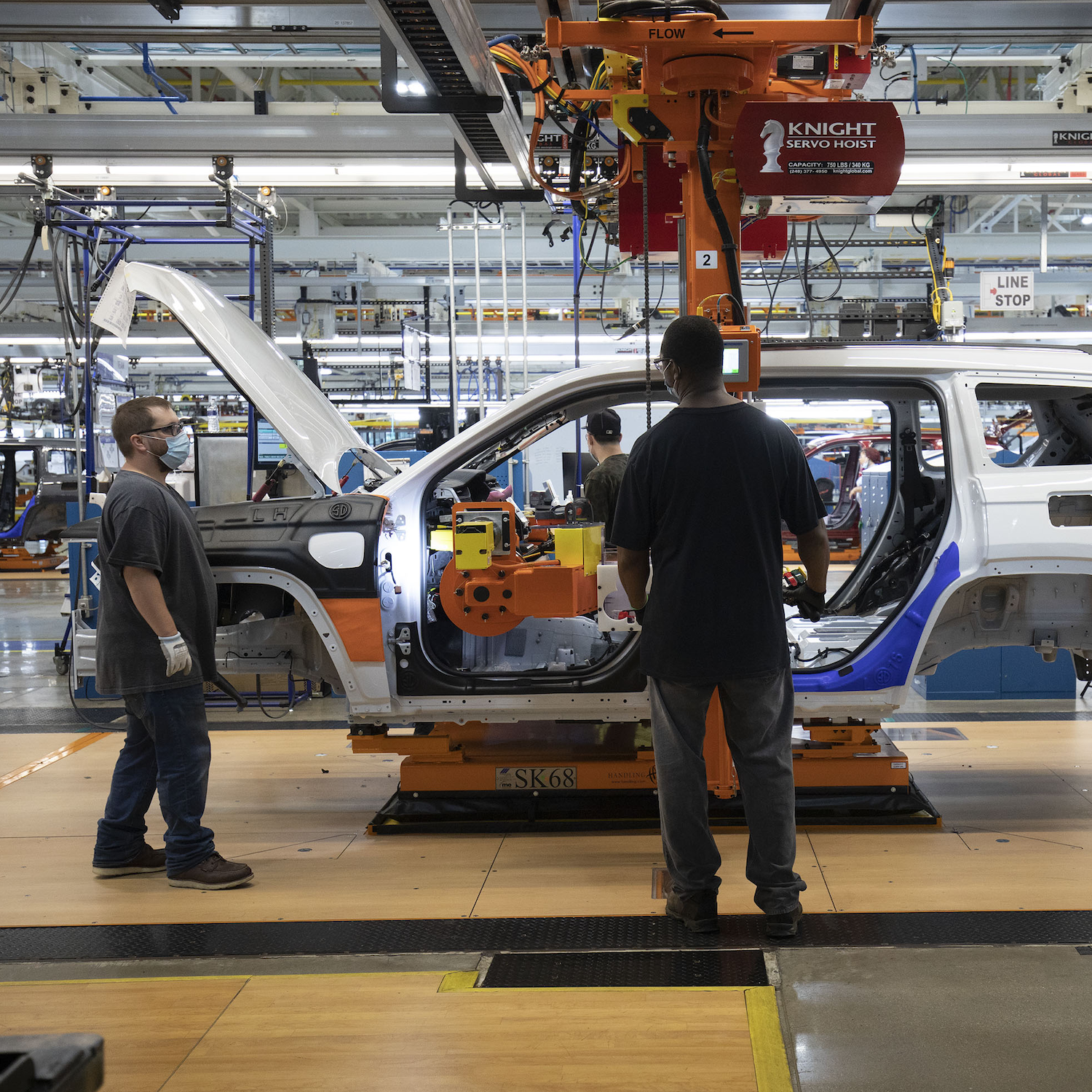
Good morning. It's Tuesday, April 8th. I'm Shemitah Basu. This is Apple News Today. On today's show, the flight attendants working ICE's deportation flights, the dark secrets of Johnson and Johnson, and a New York community rallies to bring a mother and her three children home from immigration detention. But first, it was another wild day for stocks as the markets continued to react to President Trump's tariff policy. The Dow Jones fell more than 300 points, marking a third straight day of losses and its biggest one day swing in points ever. The S&P 500 dipped about a quarter of a percent and briefly entered bear market territory. The Nasdaq, meanwhile, rose 0.1%. Also exacerbating the volatile trading session today, President Trump continued his back and forth with China threatening to enact additional tariffs of 50% if Beijing doesn't remove its 34% tariff on US goods. As we continue to examine the fallout of the Trump administration's tariff policy, let's take a closer look at Michigan. Nearly 20% of the state economy is tied to the auto industry, which is now facing 25% tariffs on imported vehicles. And starting next month, Trump has promised 25% tariffs on imported parts as well.
- [01:32]
Gene Whalen
I think what they're trying to figure out right now, one, is which auto parts are going to be included on the list of things that get tariffed.
- [01:40]
Shemitah Basu
Gene Whalen is an economics reporter at the Wall Street Journal who recently spent time in Detroit.
- [01:45]
Gene Whalen
So I think there's a lot of lobbying happening between the companies and the government about what will be on that list.
- [01:52]
Shemitah Basu
One reason tariffs represent such a threat to Michigan is because many auto manufacturers, through free trade deals like nafta, moved production to other countries or states over the last few decades where they could produce at lower costs. That means Michigan's auto industry today increasingly depends on places like Canada, Mexico and China. Auto parts typically cross the border multiple times as a car is assembled, Whelan told us. It's a little too early to say how these tariffs could change Michigan's auto industry at large, but there are some clear impact so far.
- [02:26]
Gene Whalen
One of the big employers in the Detroit region, Stellantis, which makes Jeeps and Chryslers, shut down two factories in Mexico and Canada temporarily as it tries to figure out how these tariffs are going to affect its business. And that caused the company to then also temporarily lay off 900 people in Michigan and Indiana who supply parts to those factories.
- [02:53]
Shemitah Basu
Other local auto suppliers in the Detroit area are talking about possibly raising prices for customers. A major economic group that consults for the auto industry said tariffs could add anywhere from 2,500 to $12,000 to the overall price of many new cars. And Whelan spoke to one economist at the University of Michigan about the potential impact of the recent steel and aluminum tariffs. He told her he thinks they'll cost around 600 jobs in Michigan's auto industry by the end of 2026, and and the effects of that will ripple out, affecting other kinds of businesses, too.
- [03:28]
Gene Whalen
He's estimating that those tariffs alone will cost an additional 1700 jobs at things like restaurants and dry cleaners and hotels and all of the industries that support the auto industry.
- [03:44]
Shemitah Basu
At the automakers, workers have had mixed reactions to the tariffs. Some told Whelan they're cautiously optimistic. And Sean Fain, the leader of the United Auto Workers Union, which represents hundreds of thousands of workers in the industry, told NPR he believes the tariffs will help rebuild domestic manufacturing.
- [04:02]
Mackenzie Funk
You know, we've sat here for the last 30 plus years with the inception of NAFTA back in 1993, 94, and watched our manufacturing base in this country disappear.
- [04:12]
Shemitah Basu
But despite those misgivings about globalized free trade and a desire to return more manufacturing to the United States, some auto workers Whelen spoke with are feeling less confident.
- [04:24]
Gene Whalen
They were nervous because, you know, there have been all of these prognoses that these tariffs will add so much cost for the automakers that the automakers are going to jack up their prices even more on new cars. And if that happens, more people will stop buying new cars, and that means the automakers will cut production and there could be layoffs.
- [04:45]
Shemitah Basu
And for a lot of people in Michigan, the risk of a recession fueled by tariffs causes extra angst. Detroit and the entire US auto industry almost didn't survive the Great Recession of 2008. Rebuilding took a long time, and no one wants to move backwards now to recent reporting from ProPublica that offers a rare window into the conditions experienced by people on deportation flights. From the perspective of the cabin crew, their stories paint a very different picture than the one offered by the Trump administration, which has characterized the deportations as an efficient military operation. In reality, the vast majority of these flights have used chartered planes. There are some ICE officers and hired security on board, but these planes are crewed by civilian flight attendants, most of whom didn't knowingly sign up for this work. ProPublica recently spoke to seven flight attendants with Global Crossing Airlines, known as Global X. It's a startup that promised employees the chance to fly with celebrities and star athletes. But today it operates Most of the federal government's deportation flights, including the transport of hundreds of Venezuelan migrants who were sent to a notoriously harsh prison in El Salvador last month, despite a federal court order blocking the flights and despite questionable evidence to support most of those deportations. ICE Global X and the FAA did not respond to ProPublica's request for comment in the story, but the flight attendants who spoke to reporter Mackenzie Funk told him feel like they can treat passengers humanely or keep them safe.
- [06:26]
Mackenzie Funk
There was a range of emotion about what they had to do on these flights, or rather, what they didn't have to do.
- [06:32]
Shemitah Basu
The flight attendants told him they had strict rules to follow. No eye contact with migrants, no talking to them, no walking down the aisle without a guard to escort you. And only guards were allowed to take migrants to the bathroom or give them food and water. The thing that disturbed and worried many of the attendants was the fact that most passengers were in shackles.
- [06:53]
Mackenzie Funk
And where they were unified was this fear that in the event of an emergency, they couldn't imagine how they would get everybody off.
- [07:01]
Shemitah Basu
All crew members were trained on FAA safety protocol, which says a plane should be evacuated in 90 seconds in an emergency. But the flight attendants told Funk they hadn't been trained on how to evacuate passengers in chains. And some of the attendants said they were horrified by the little bit of guidance that they did get.
- [07:19]
Mackenzie Funk
Three of them said pilots, told us, if there's an emergency, just get yourself off the plane. That's it. Open the door and get yourself off the plane. And don't check on the migrants. That's not really your responsibility.
- [07:33]
Shemitah Basu
In some cases, they chose to break protocol in little ways, like returning a hello to a passenger who greeted them. And in big ways, too. On one flight, a little girl with a fever who was struggling to breathe collapsed. Her oxygen levels were dangerously low, so one of the flight attendants raced to help her. The plane made an emergency landing in Arizona, where paramedics took the child and her mother to the hospital. But the girl's father had to stay on the plane.
- [08:00]
Mackenzie Funk
And the flight attendant who told me this couldn't believe it. She didn't know if the girl was going to live or die. It looked like the mother was about to have her own crisis, and yet they wouldn't allow the family to stay together. It was her understanding that the father was still going to be deported and that only one parent could go. And she yelled at the ICE officer in board and said, this. This is not okay, and was told, well, only one can go. I'm sorry. That's the rule.
- [08:26]
Shemitah Basu
This flight attendant said after that incident, she decided to leave the job. She bought her own ticket home. When you think about the opioid crisis in America and the companies responsible, the first name that might come to mind is Purdue Pharma, which makes the highly addictive painkiller OxyContin. But there's another major contributor to this crisis that hasn't gotten as much Johnson and Johnson, which is consistently seen as one of the most admired and socially responsible companies in the country, according to Fortune magazine.
- [09:05]
Gardner Harris
This is a company that played, if not the major role in the opioid crisis, one that was equally bad with Purdue ph.
- [09:16]
Shemitah Basu
That's investigative reporter Gardner Harris, who I spoke to recently on Apple News in conversation.
- [09:22]
Gardner Harris
In fact, during the height of the prescription opioid crisis, about 10 to 20% of the bodies that showed up in morgues had a Purdue Pharma product in their system. Roughly 60% had a Johnson and Johnson product in their system.
- [09:39]
Shemitah Basu
Harris is out with a new book today called no More the Dark Secrets of Johnson Johnson. He spent five years investigating the company and found two main ways it contributed to the opioid crisis. One was by selling the raw materials needed to make OxyContin.
- [09:56]
Gardner Harris
They produced most of the natural opioid ingredients used for all opioids in the United States, including Purdue Pharma's OxyContin. OxyContin could never have become as popular or been as widely used without Purdue's partnership with Johnson and Johnson.
- [10:19]
Shemitah Basu
The other way JJ contributed to the crisis was by selling a fentanyl patch called Duragesic. It was originally designed for patients to use immediately after surgery or for palliative care. But Harris says JJ saw how Purdue was marketing OxyContin to people with modest and moderate pain. So the company pivoted and started to push this product on doctors, describing it as non add.
- [10:43]
Gardner Harris
It's hard to even conceive of this now that anyone could possibly claim that fentanyl is non addictive. But that's what Johnson and Johnson did for years and years and years. So of course, death soared.
- [11:01]
Shemitah Basu
Johnson and Johnson's contribution to the opioid crisis is part of a larger pattern Harris found in his reporting. In total, he writes about nine Johnson and Johnson products, including a cancer drug, baby powder, even Tylenol. And he found they have led to the deaths and injuries of millions of people. The company has denied many of these allegations. You can hear the full episode on Apple News in conversation. If you're listening in the news app, we'll queue it up to play for you after today's show. Before we let you go, a few other stories we're following. President Trump says the US And Iran will hold nuclear talks in a meeting set for Saturday. Trump withdrew from the previous nuclear agreement with Iran in 2018 during his first term in office. He has said that Iran would be in great danger if talks are unsuccessful. The president announced the upcoming meeting with Iran while fielding questions in the Oval Office with Israeli Prime Minister Benjamin Netanyahu at his side. Trump also said the US Is working to negotiate a new ceasefire agreement in Gaza to release the remaining hostage held by Hamas. Now just a brief update on the major storms that slammed parts of the Midwest and South over the last weekend. At least 24 people were killed across at least seven states. And NBC reports that flooding still poses a major threat for areas near rivers in Arkansas, Mississippi, Tennessee and Ohio. An update on two immigration stories that we're following. First, Supreme Court Chief Justice John Roberts temporarily paused a lower court order, instead instructing the Trump administration to return a Maryland man who was mistakenly deported to a Salvadoran prison. Roberts, who handles appeals from Maryland, stayed the order to give the justices more time to consider arguments. Then, in an entirely separate incident in Sacketts Harbor, New York, three children and their mother who were detained by ICE on March 27 and sent to a facility in Texas have been released, according to local officials. This comes after about a thousand members of their community rallied on Saturday at vacation home of Trump's so called border czar Tom Homan in Sackets Harbor. Homan said everything was quote, by the book, the youngest child was in third grade. Efforts to bring the family home were led by the area's superintendent of schools, who called this a traumatic experience for the family as well as all students and staff. And as stocks whipped up and down yesterday, you might have noticed a moment where they started to rise suddenly. That was the result of a post on X that rocked the markets and sent analysts scrambling to figure out if it was real. I think we can go with this. This headline from apparently Hassett's been saying that Trump will consider a 90 day pause in tariffs for all countries. Except for China. Except for China. Oh, that's you only problem was it couldn't be verified. I mean, that changes the game. We're trying. We'll try and source that exactly in terms of where that's coming from. It all turned out to be a rumor spread by a popular financial account on social media. And once that falsehood came to light, markets quickly went sour again. You can find all these stories and more in the Apple News app. And like I mentioned, if you're already listening in the News app right now, stick around for the rest of my conversation with investigative reporter Gardner Harris about Johnson and Johnson. If you're listening in the podcast app, search for Apple News in conversation to find that episode. And I'll be back with the news tomorrow.