Loading summary
Transcript19 lines
- [00:05]
Shemitah Basu
Good morning. It's Monday, March 31st. I'm Shemitah Basu. This is Apple News Today. On today's show, what happens to health research when studies that use the word women are cut. South Korea's dark history of adoptions. And in men's college basketball, it's an all number one seed. Final Four. But first, there are a couple of important special elections this week that we're following. Tomorrow, we'll break down a crucial contest in Wisconsin for a state Supreme Court vacancy that's attracted the attention of Elon Musk. Today we're going to look at two House seats up for grabs in Florida that are making Republicans nervous about their slim majority. One of those races in Florida's 6th congressional district is to replace Mike Waltz, President Trump's national security advisor, who's been in the headlines over the Signal Group chat where he and several other top officials discussed military strike plans in Yemen. Running to replace Waltz is Republican State Senator Randy Fine. Last week, Florida Governor Ron DeSantis was asked about the contest.
- [01:18]
Ron DeSantis
I will tell you this regardless of the outcome in that it's going to be a way underperformance from what I won that district by in 22 and what President wanted by in November. That is not a reflection of President Trump. It's a reflection of the specific candidate running in that race.
- [01:33]
Shemitah Basu
Fine's opponent, Democrat Josh Wheal, has out fundraised fine by 10 to 1. And according to CNN, those figures sent shockwaves from Florida all the way to Washington. CNN also reports senior GOP leadership intervened, calling Fine and saying he needs to step up his efforts in the race. One poll showed Fine's lead within the margin of error. Another pollster also found Fine's lead a lot tighter elected. Meanwhile, in Florida's other congressional race, Democrat Gay Vallomont also outraised Trump's endorsed candidate, Jimmy Petronas about 7 to 1. That race is to replace former Congressman Matt Gaetz. Republicans have a 218 to 213 edge over Democrats in the House. So every seat and every vote matters. NBC national political correspondent Steve Kornacki broke down the race on the network and said it's a big ask for Democrats to flip these seats just how Republican these districts are. But these are the exact types of elections where they have a shot in.
- [02:37]
Steve Kornacki
The last couple of years in special elections for the House and in lower turnout elections like not like presidential elections, where everybody votes, that's where the Democrats have had an advantage. That's where they've overperformed. They've done well. Why? Because it seems that the Democratic base for elections that do not have Donald Trump on the ballot seems more motivated than the Republican base. That was the story going right into the 24 election. Didn't turn out to be a thing in November, but it may still very much be a thing in special elections. That's something we could find out on Tuesday.
- [03:09]
Shemitah Basu
The president has acknowledged the importance of holding on to these and other Republican seats. It's the reason he gave reporters last week for pulling the nomination of loyalist and New York Representative Elise Stefanik for UN Ambassador.
- [03:23]
Donald Trump
And I said, elise, would you do me a favor? We can, we cannot take a chance. We have a slim margin. We don't want to take any chances. We don't want to experiment.
- [03:33]
Shemitah Basu
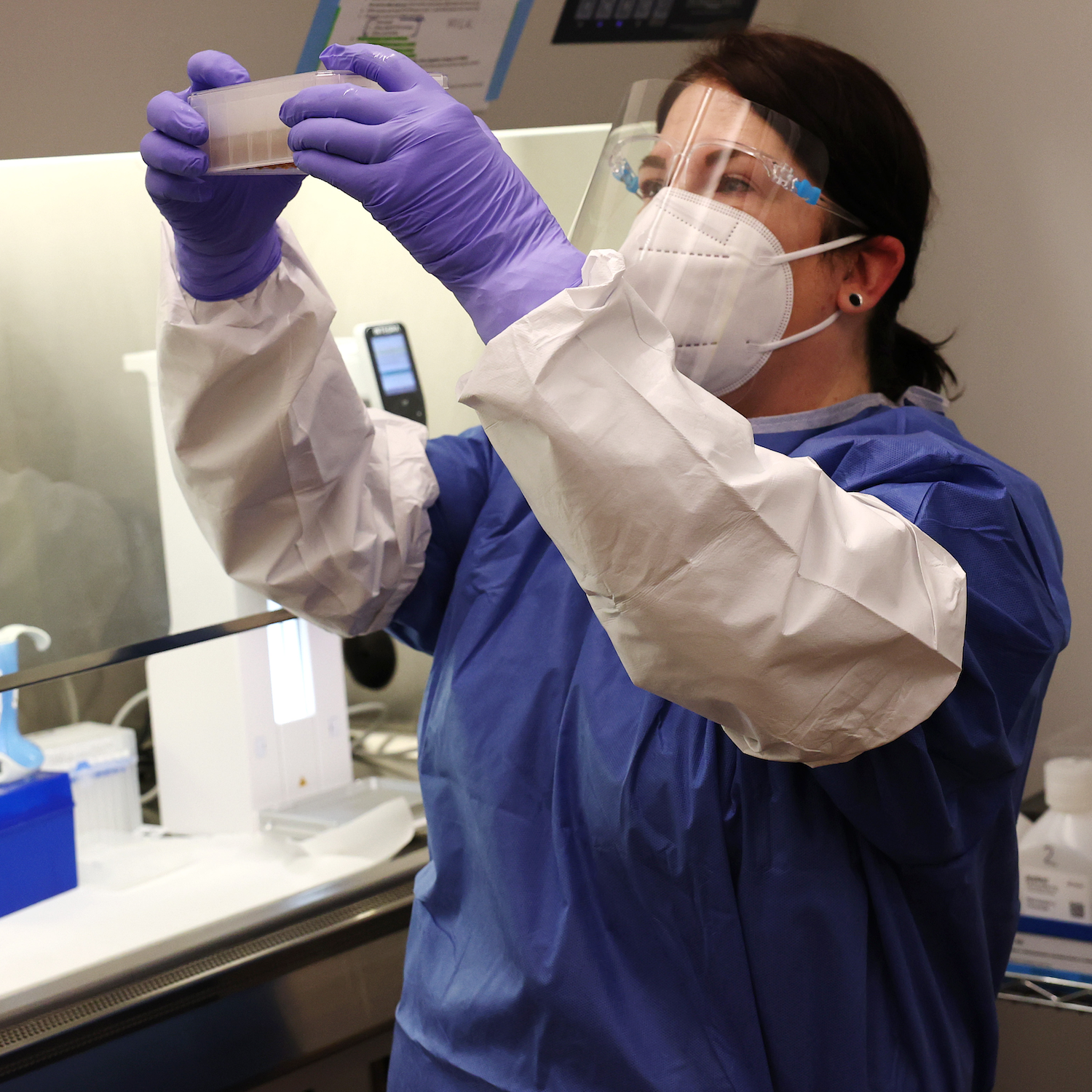
Most observers think these seats will likely remain with the GOP and the campaign arm of House Republicans called Talk about it, quote, noise. Democrats have said if their candidates overperform in these races, which Minority Leader Hakeem Jeffries said shouldn't even be on the radar, it's a sign some attitudes might be shifting. Trump, who won both districts by 30 points, spent part of these final days in teletown halls for both candidates shoring up support report. Let's turn now to recent actions the Trump administration has taken that are impacting science and research. The administration has ordered major cuts to the workforce and funding at the National Institutes of Health and huge reductions of NIH grants to universities. These are institutions that lead research on a huge array of diseases and conditions, everything from pediatric brain cancer to heart disease and asthma. Asthma. And because of Trump's crackdown on dei, NIH employees are being told not to approve grants that include words such as women, trans or diversity. Shefali Luthra is a reproductive health reporter for the 19th who's been talking to researchers about the fallout.
- [04:52]
Shefali Luthra
They had been in the works of running clinical trials or analyzing data and suddenly were told they could no longer do that. And some of them were able to find stopgap funding from other sources. Some of them are figuring out if they will have to shut down their studies entirely. They are seeing if their universities will appeal these cuts and hoping that they will be able to restore some of that funding.
- [05:14]
Shemitah Basu
And Luther says if they can't get that funding back, it'll be a waste of, in some cases, years of research.
- [05:21]
Shefali Luthra
We simply won't get the answers to questions that we had already paid to ask and in turn aren't going to be able to reap the health benefits.
- [05:31]
Shemitah Basu
One of the gaps in healthcare that these kinds of studies seek to address is our understanding of conditions that impact women. Research on women's health already lags far behind men. That's in part because for a long time, the FDA actively discouraged researchers from including women who could become pregnant in clinical trials, which means we have less reliable data when it comes to how a lot of medications might impact women or for women, specific conditions. Luthera told us the story of one researcher at Columbia University.
- [06:04]
Shefali Luthra
She studies uterine fibroids, which are these tissue growths. They are quite common and they cause severe pain. They can cause bleeding, they can cause infertility. They are under researched. They have a heightened impact for black women in particular, and we don't know much about them, let alone how to treat them.
- [06:24]
Shemitah Basu
This researcher says she recently got a call from her advisor that her federal funding had suddenly been cut and she.
- [06:30]
Shefali Luthra
Didn'T know what to do. She didn't know what this would mean for her research in the long term, whether she would be able to do her research, which she views as a piece of the puzzle of trying to understand fibroids and also what it means for our ability as a society to improve this condition and ultimately improve the health of people who have been really neglected by our ecosystem.
- [06:53]
Shemitah Basu
Luthra told us that the opposition to funding research on women is rooted in the culture wars we're seeing play out, but also in a misunderstanding of the research.
- [07:04]
Shefali Luthra
A lot of this sort of comes from this anti trans rhetoric and this idea that, as the President said in his recent joint address, so we're funding research in transgender mice, which was a really inaccurate mischaracterization of how this research was actually being done. It was looking at whether hormones might affect asthma or breast cancer or other conditions that manifest differently based on sex and gender. But what's really important is there's just a real disinterest in thinking about what gender means in our society and what sex means in our society. And that we have seen not only in the NIH cuts, but in how people talk about health funding in a larger sphere, how they talk about international development funding. And it's something that soon will touch many, many aspects of the public infrastructure we've come to take for granted.
- [07:56]
Shemitah Basu
The NIH did not respond to the 19th's request for. In 1975, a mother in South Korea named Choi Young Ja reported her son had gone missing. She told PBS's Frontline her son had been outside playing with neighborhood kids. When he disappeared, she went to the police. She checked orphanages and adoption agencies. Years later, she got A phone call that would change everything she thought she knew about her son's disappearance. She had submitted her son's DNA to an agency that works to reunite adoptees and birth parents. And she says there to Frontline that she got a call from someone saying they found her son. Her son named at birth Sang Yeol, was now named Frank. She was overwhelmed. She hung up and burst into tears. A few weeks later, she video conferenced with her now adult son for the first time. She says there she was shocked the boy she last remembered at the age of four had become an adult with gray hair. Her story is just one of many that's come to light in recent years about fraudulent Korean adoptions, kids and infants who were stolen without the consent of their biological parents for the families who adopted them, they too were lied to, told that the children were abandoned or orphaned and that their identities, information about their birth families was lost or fabricated. Kyowan Lee, a former health ministry official who oversaw adoption policy starting in 2010, told Frontline that she questioned whether so many children were in need of adoption.
- [09:48]
Kyowan Lee
From my understanding, the government did not really care about the details. The top level of policemakers were not really interested about the specific rules and regulations to protect the rights of the child, the safety of the child, the need of the children. What they focused was the welfare need of the national budget.
- [10:13]
Shemitah Basu
For the South Korean government, foreign adoptions had become a way to reduce social welfare spending. Recently, Lee has played a significant role in passing adoption reform in South Korea. As these children have grown up and with the help of DNA websites like 23andMe, some of these adoptees have come to find out their true identities. And they've pushed South Korea to reckon with this dark past. Last week, they got a major victory when South Korea's Truth and Reconciliation Commission released the preliminary results of an ongoing investigation into this matter. For the first time, they acknowledged that human rights abuses took place and that the government failed to protect the rights of adoptees. Before we let you go, a few other stories we're following. President Trump is threatening new sanctions on Russia if it doesn't agree to a deal to end the war in Ukraine. He told NBC News he was, quote, very angry at Russian President Vladimir Putin for his comments calling for an interim governance in Ukraine to push out Ukrainian President Vladimir Zelensky. Putin said Zelensky lacks the authority to sign a peace deal because his term expired last year. Ukraine is under martial law, and according to its constitution, national elections can't be held while it's in effect. Zelensky has vowed to call elections as soon as the war ends. In Myanmar, the death toll continues to rise as the country accounts for the destruction from a 7.7 magnitude earthquake that rocked the nation on Friday. Many people are thought to still be trapped under collapsed buildings. The earthquake struck near Mandalay, which has a population of 1.5 million people. Years of civil war are complicating recovery efforts. A Red Cross regional spokesperson called it not just a disaster, but a complex humanitarian crisis layered over existing vulnerabilities. And finally, the men's NCAA basketball Final Four is set. And perhaps in not so climactic fashion, all four number one seeds are headed to San Antonio to compete for the national championship. It's the first time all four number ones reached the Final Four since 2008. The matchups will be Auburn versus Florida and Duke versus Houston. Those games tip off next Saturday. Meanwhile, the women's Final Four will be set tonight. USC takes on UConn and Texas takes on TCU. UCLA and South Carolina punch their ticket to the Final Four on Sunday. You can find all these stories and more in the Apple News app. And if you're already listening in the News app right now, we've got a narrated article coming up next. Next the Wall Street Journal has the story of Daniel Kahneman, a psychologist that some consider the world's leading thinker on decision making. Last year, at the age of 90, he decided to go to Switzerland and end his own life via assisted suicide. He informed his friends, but many are still struggling with his decision. If you're listening in the podcast app, follow Apple News Narrated to find that story. And I'll be back with the news.