Loading summary
Transcript42 lines
- [00:05]
A
Good morning. Inflation soars to a three year high as the Iran conflict drags on. The Washington Post explains what it means for groceries and the gas pump.
- [00:14]
B
Even if you look past the spike in energy, underlying inflation is still moving in the wrong direction.
- [00:19]
A
Inside the Nebraska quarantine facility that's housing hantavirus patients. And the UK's Prime Minister is fighting for his political life, facing revolts in his own party.
- [00:29]
C
This situation is unsustainable. It is now unstable. And I think, therefore we do need an expedient and orderly Transition.
- [00:36]
A
It's Wednesday, May 13th. I'm Gideon Resnick. This is Apple News. Today. It appears the war with Iran continues to make life more expensive at home. Stark figures released yesterday demonstrated the economic strain for Americans and laid bare another pressure point for the administration's attempts to end the war in Iran. President Trump was asked about how Americans financial situations impact his decision making as he was set to depart for his trip to China yesterday.
- [01:07]
D
The only thing that matters when I'm talking about Iran, they can't have a nuclear weapon. I don't think about American financial situation. I don't think about anybody. I think about one thing. We cannot let Iran have a nuclear weapon. That's all. That's the only thing that motivates.
- [01:24]
A
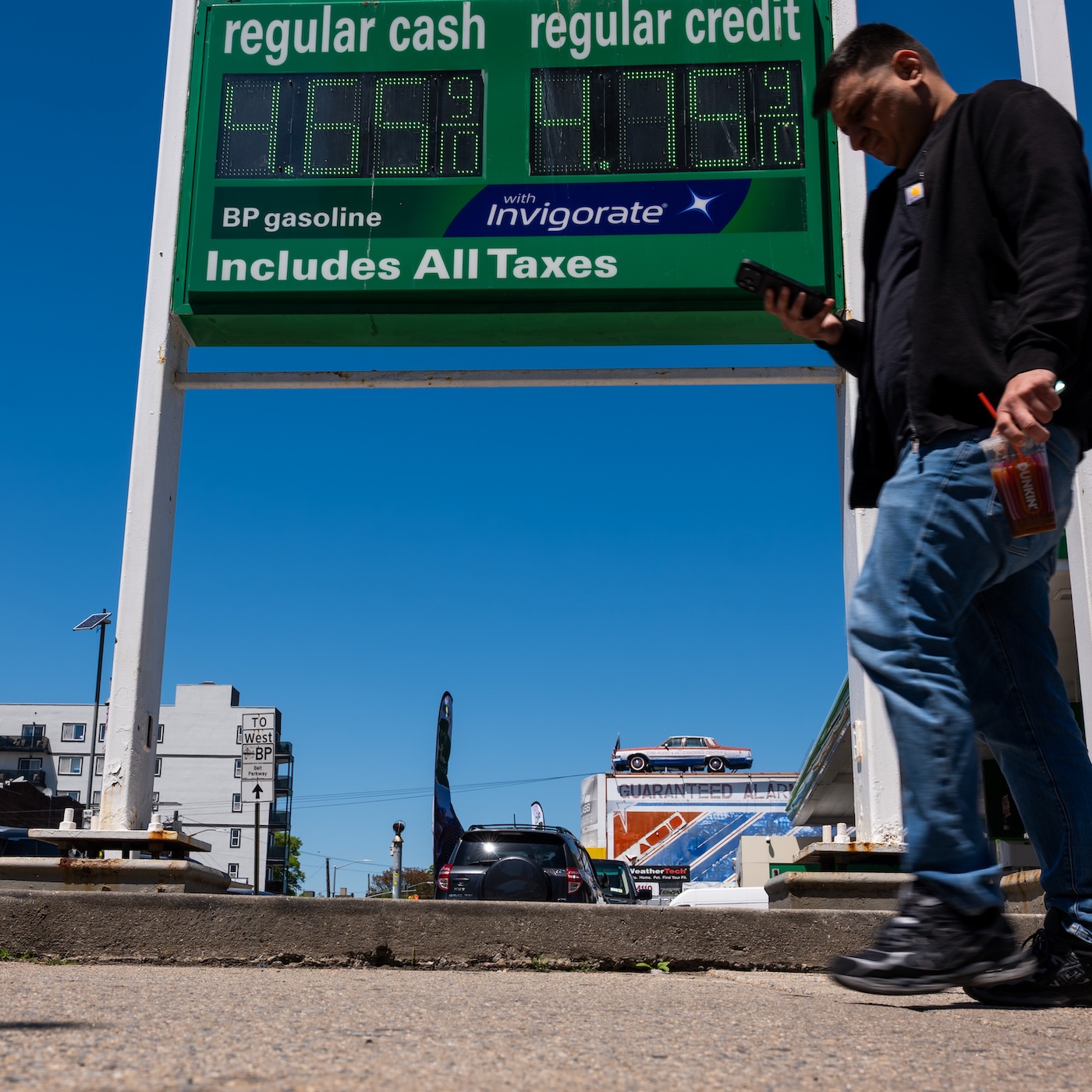
Gas prices shot up by almost 5.4% in April. And energy spikes have rippled into the cost of living across the board. Housing, travel and groceries all ticked up in the Labor Department's analysis. The overall consumer price index, which measures how prices change over time, rose 3.8% from a year earlier. And thanks to a cooling labor market, average hourly earnings have been slower to rise. Andrew Ackerman is a reporter for the Washington Post.
- [01:51]
B
What this means for average everyday Americans is that their wages haven't really kept up with inflation in the last couple months, which is a real problem politically. Politically for the administration. Basically, overall inflation is now outpacing the increase in wages that people get. It's really hurting people's pocketbooks or wallets.
- [02:10]
A
All of this hurts people's purchasing power. And it comes only days after consumer sentiment was revealed to be at a record low. Ackerman says that rising prices could lead households to start pricing inflation into their decision making.
- [02:22]
B
The reason why the spike in gasoline prices is so important and arguably so concerning is that it can fuel changes in expectations. What that means is if I'm an everyday consumer and I see gasoline prices going up 30%, I'm thinking other goods and services could also go up in prices.
- [02:46]
A
Analysts warned Ackerman that could have a self fulfilling effect, prompting businesses to raise prices now and for workers to demand higher wages. The White House has acknowledged what it described as temporary disruptions caused by the Middle east conflict, but said the administration remained laser focused on delivering growth and affordability on the home front. Meanwhile, Kevin Warsh, President Trump's pick to lead the Federal Reserve, is expected to be confirmed as soon as today. These numbers won't make his job any easier. The President is desperate to see rates come down in the hope that cheaper borrowing will boost spending and stimulate the economy in the short term. But in this kind of environment, it could also fuel inflation. When the Biden administration was grappling with a far more severe set of figures, the Fed was forced to step in.
- [03:31]
B
For a period in 2022, inflation was almost at double digits, around 9 or 10%. And then the Fed dramatically raised interest rates to kind of beat back inflation. Inflation was at the highest level in 40 plus years and the higher rates had the effect of lowering inflation. So it went back down to between 2 and a half and 3% over the last couple of years.
- [03:56]
A
Some still argue whether the Fed acted fast enough back then and Warsh could soon face similar tests.
- [04:02]
B
He's known as an inflation hawk, someone who is worried about inflation. But more recently he called for rate cuts and he's inheriting this Fed that has been under kind of a relentless attacks from the President, from the White House.
- [04:14]
A
Warsh has promised to maintain the independence of the Fed, but he will face a tough first meeting in June.
- [04:19]
B
There's no expectation that he can go in there and cut rates. You have a very skeptical board that sets interest rates and they're increasingly fractured. There's a number of people who've been very worried about inflation because inflation hasn't come down to the 2% target. There's a growing number of people who have dissented, which is an important signal that Kevin Warsh is going to have his work cut out for him. He's going to have to try to get to consensus, if he can, on this large group of people who don't want any additional cuts and are very worried about inflation.
- [05:02]
A
Many American passengers evacuated from the cruise ship struck by a deadly hantavirus outbreak have ended up in one somewhat surprising location, Nebraska. That's because the state is home to the nation's only federally funded quarantine center with specially built facilities to contain rare or highly infectious diseases.
- [05:20]
E
The Nebraska National Quarantine Unit is fascinating. It's this place in the Midwest that's set up to really deal with kind of airborne or other contagious diseases like this.
- [05:31]
A
Lauren Weber is a health science and accountability reporter for the Washington Post.
- [05:35]
E
In the past, you may have remembered Americans going there because of COVID or Ebola. And right now they're housing 16Americans who are coming from the hantavirus stricken cruise ship.
- [05:46]
A
Most of the people who were exposed to hantavirus on the MV hondius are in a quarantine unit at the Nebraska facility, which Weber says is sort of like a souped up hotel room. Another person is in biocontainment that's more like an ICU room. Both portions of the facility have specialized air filtration and negative pressure systems designed to keep harmful particles from escaping.
- [06:08]
E
The quarantine unit is for folks who have been potentially exposed but are not currently showing symptoms. The biocontainment unit is for folks where they're a little bit more concerned. They think you could be more likely to test positive and they want to make sure that they have the correct hospital equipment to deal with you quickly because hantavirus is something that can go downhill pretty fast.
- [06:31]
A
The full quarantine period for hantavirus is 42 days, but Weber says it's possible some patients could be released early. They'd be sent home to complete their monitoring period if they continue to show no symptoms. Patients at the facility are given access to wi fi and can video chat with family, but otherwise it's a fairly lonely existence. Jake Rosemary was on board the ship and is now in the quarantine unit. He's given several media interviews and told Good Morning America that he will remain there for the full 42 day period. He seems upbeat overall about his situation and has given tours of his room on social media. Here he is in a post on his Instagram feed, celebrating a little taste of the outside world. I have not had a really, really good iced coffee in so long now and the nurses just delivered me an iced horchata, shaken espresso with oat milk and vanilla cold foam and I'm literally in heaven. Weber told us that the WHO has pointed out the strain that isolation can have on people like Rose Marin. Health officials across the globe continue to monitor the patients who are on board and they've engaged in an intense contact tracing program to determine who may have come into contact with anyone traveling on the ship. But the WHO continues to reiterate this is not the next Covid. Despite the expectation that more cases will pop up in the US the episode comes at a challenging time for the nation's public health system. Weber reports the CDC is in a bit of turmoil with no permanent director in place. And while the agency has earned praise for its communication efforts surrounding hantavirus, some have pointed out that budget cuts have not been helpful.
- [08:08]
E
A lot of public health officials have bemoaned the exodus of talent among folks at the CDC and at other agencies under the larger HHS umbrella. And they say that this is a bit of a stress test for that going forward. And, you know, again, hantavirus has been stressed at every state, national, global press conference is having a pretty low risk to the general public. But that's not to say there isn't something else zoonotic or airborne or something that could be around the corner that could also be a threat. And so many are concerned about that.
- [08:54]
A
The UK appears to be on the brink of losing another one of its leaders, and it arrives at a moment when the special relationship with the United States has been significantly tested. Keir Starmer was fighting for his political life Yesterday after around 90 members of his own party called for him to quit. The center left prime minister's popularity has hit historic lows in recent months, and his Labour Party suffered disastrous results in last week's local elections. He's refusing to stand aside for now, and on Monday he delivered a speech to try and kill off the rebellion and offer a reset.
- [09:26]
F
I know that people are frustrated by the state of Britain, frustrated by politics, and some people frustrated with me. I know I have my doubters and I know I need to prove them wrong, and I will.
- [09:44]
A
But that failed to unite his party. Ministers are continuing to resign, and Starmer faces the prospect of a direct challenge from rivals in the coming days. It's a stunning reversal from a historic win secured less than two years ago,
- [10:00]
E
and as Big Ben strikes 10, the exit poll is predicting a Labour landslide.
- [10:06]
F
Sakiya Starmer will become prime minister with a majority of around 170 seats.
- [10:12]
A
Starmer's victory toppled the conservatives after 14 years in power. He promised change and pragmatic leadership from the center, and he won some praise at home for his role on the international stage, supporting Ukraine and resisting efforts to join the war in Iran. But Starmer suffered a series of setbacks in office. His government raised taxes after promising not to, and his own party forced him to retreat. Unplanned welfare cuts scandals have also impacted people near Starmer, including his former US Ambassador, who resigned over links to Jeffrey Epstein. Party critics have suggested that Starmer hasn't been radical enough and that he lacks the fight to lead the country. One minister told the BBC this morning why he had decided to quit.
- [10:52]
C
In my opinion, the Prime Minister, unfortunately this is not a reflection on his decency or his character, which I know he has in abundance, is that he's irretrievably lost the confidence of the public and of the parliamentary Labour Party.
- [11:02]
A
Historically, the UK is a country accustomed to its leaders sticking around for as long as 10 years. Now resignations are becoming the norm. There have been five Prime Ministers in the past seven years.
- [11:13]
F
I have heard your anger, your disappointment, and I take responsibility for this loss. I have therefore spoken to His Majesty
- [11:21]
E
the King to notify him that I
- [11:23]
F
am resigning as leader of the Conservative Party. And I want you to know how sad I am to be giving up the best job in the world. But them's the brakes.
- [11:34]
A
Some had hoped that the scale of Starmer's win would end the merry go round of leaders that came after the UK's exit from the European Union. Instead, it just sped up, a dramatic political realignment on both the left and the right. During last week's elections, voters rejected the two parties that have governed the UK for the past 100 years. Millions went one of two polar opposite ways to the newly formed Reform Party, led by an ally of President Trump, Nigel Farage.
- [11:59]
F
We're seeing some truly historic shifts in voting patterns in parts of this country, things, frankly, I could never have dreamt that we'd see.
- [12:10]
A
Or to the Greens, which scored their best ever performance under the left wing Zach Polanski. Two party politics is not just dying, it is dead and it is buried. It's very clear that the new politics is the Green Party versus reform. Like much of Europe, the UK is struggling with low growth, high energy costs compounded by the Iran war and an aging population. And like many of its neighbors, the country appears to be undergoing major upheaval as traditional parties struggle to offer solutions to those challenges. Another change in leadership could also impact the country's relationship with the US At a delicate moment today, the King will deliver a speech written by the government that sets out the UK's legislative agenda. But it's far from clear whether Starmer will survive long enough to deliver on those priorities. And finally, here are a few other stories we're following. Dr. Marty Makary resigned as Commissioner of the Food and Drug Administration on Tuesday. The decision came after he authorized flavored Vapes, a product that he was skeptical about following pressure from the White House. Politico described Makary's 13 month tenure at the agency as one marked by mass layoffs, high turnover among senior officials and policy fights. Among his critics were Republicans who wanted the FDA to restrict access to the abortion pill mifepristone. Pharmaceutical companies also complained the FDA was inconsistent in their review of drugs under his leadership. Kyle Diamantis, the FDA commissioner for food, will replace Makary on an acting basis. Jason Collins, the NBA's first openly gay player, died Thursday after a battle with brain cancer. Collins played 13 years in the NBA for multiple teams, including the Memphis Grizzlies, Boston Celtics and Brooklyn Nets. He came out in a 2013 cover story for Sports Illustrated and was then the only out player in any of the US's four major sports leagues. That was seen as a huge moment in pro sports that shattered barriers. Here he is in 2013, speaking with ABC News the day after his announcement. But when you finally get to that
- [14:15]
B
point of acceptance, there's nothing more beautiful than just allowing yourself to, you know, really be happy and be comfortable in your own skin.
- [14:25]
A
Collins was just 47 years old, and it's graduation season, but for those who are about to hit the job market, things might be looking a little bleak. The reason for some of that angst is the AI boom. One commencement speaker at the University of Central Florida this week got a firsthand look at how some recent grads might be feeling about their chance at getting a job.
- [14:46]
E
The rise of artificial intelligence is the next industrial revolution.
- [15:02]
A
That's Gloria Caulfield, a vice president at a real estate development firm, being booed for mentioning AI in her speech. Moments later, students cheered when she spoke about a time just a few years ago when AI was not a factor in anyone's lives. Business Insider notes that since the beginning of 2026, at least 12 major companies have laid off employees and cited AI as the reason 59% of respondents between the ages of 18 and 29 in a poll last year said they believe that AI is a threat to their job prospects. Caulfield's speech was given TO Grads of UCF's College of Arts and Humanities. And while we don't know if these particular students will lose jobs to artificial intelligence, there are at least some AI evangelists like Netflix's Reed Hastings and Anthropics co founder Daniela Amade, who say the boom will only make humanities majors even more valuable. You can find all these stories and more in the Apple News app. And if you're already listening in the news app right now, we've got a narrated article coming up next. The Wall Street Journal explores the end of the Tiger mom era and intense helicopter parenting and how some parents are embracing a new laissez faire Persona known as the beta mom. If you're listening in the podcast app, you can follow Apple News Narrated to find that story. And I'll be back with the news tomorrow.