Loading summary
Transcript46 lines
- [00:05]
Gideon Resnick
Good morning.
- [00:06]
Narrator/Apple News Host
The details of President Trump's secret flight to avoid a possible Iranian threat have been revealed. We'll speak to the Washington Post reporter who broke the story.
- [00:14]
Gideon Resnick
The larger of the two planes was designated as Air Force One, was squawking Air Force One as a call sign, despite the fact that the President was on the smaller plane.
- [00:25]
Narrator/Apple News Host
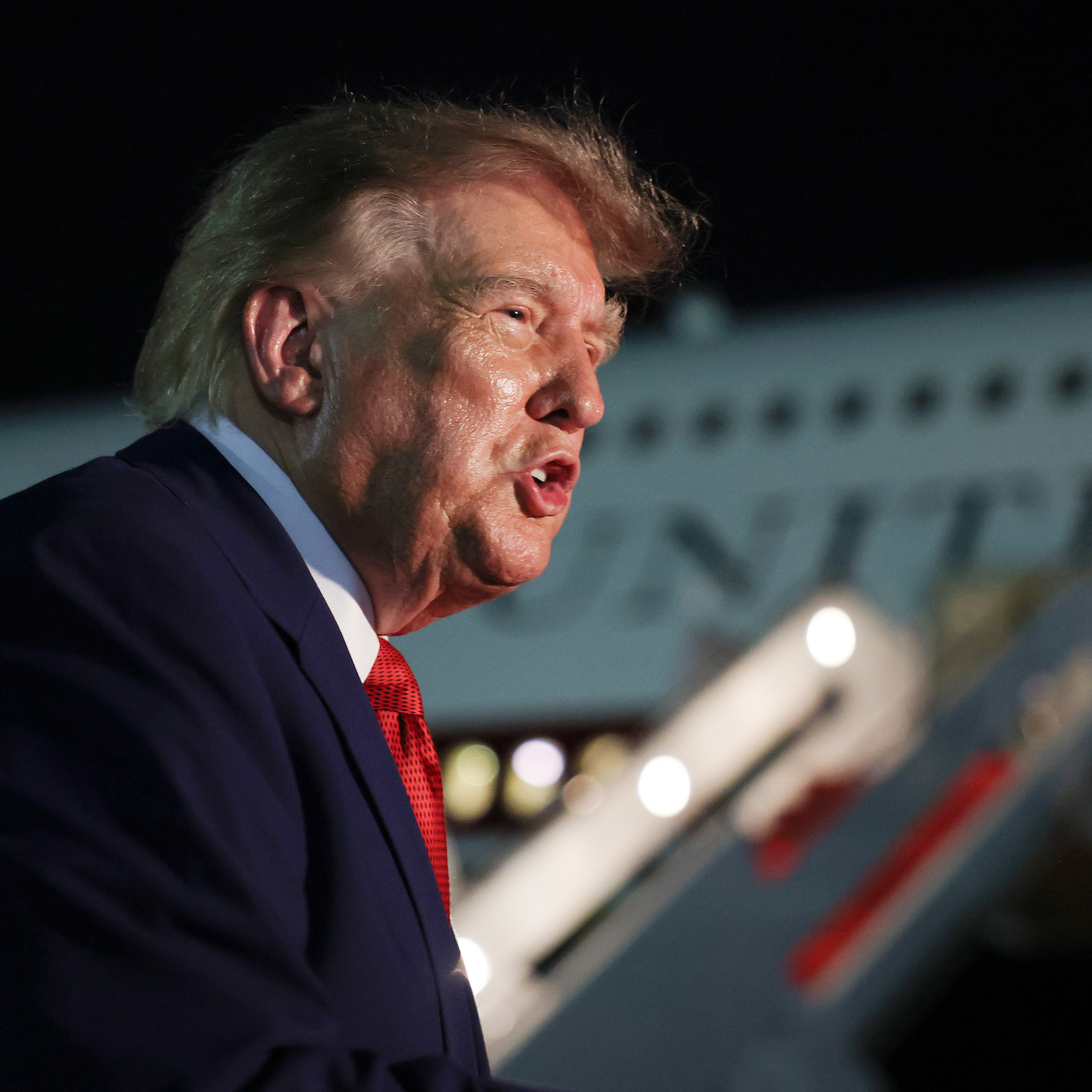
Russia frees an American former Marine from prison, but fears over his health remain and why the country's two largest reservoirs are in serious trouble. It's Wednesday, August 12th. I'm Gideon Resnick in for Shamita Basu. This is Apple News. Today, The Secret Service pulled off an extraordinary feat of subterfuge last month, covertly moving President Trump off of Air Force One and onto another plane before he left a NATO summit in Turkey. Trump was carried between jets after getting on, leaving the plane full of staffers and journalists to take off without him. The move was reportedly prompted by a possible Iranian assassination threat. Fast forward weeks later and everyone, including those in Congress, are only just learning the full extent of what happened. Now from press reports, the secretive nature of the plans long after they were executed makes this a departure from past operations to protect the President, and it's raising questions about how and why it was conducted.
- [01:27]
Gideon Resnick
The President boarded the old Air Force One in view of cameras, waved to the cameras in Turkey, and then secretly, just a couple minutes later, left that Air Force One plane on an airport catering truck.
- [01:41]
Narrator/Apple News Host
Dan Lamoth covers the Pentagon for the Washington Post and broke the story with colleagues.
- [01:46]
Gideon Resnick
The catering truck again goes up. It's there just a couple minutes, seemingly long enough just to drop someone or something off. And then the two planes leave in sequence and. And land nine minutes apart in Britain. On the other end, a few hours
- [02:02]
Narrator/Apple News Host
later, the press corps was none the wiser. But unusually, they were asked to close their window shades after they were on board. Trump confirmed to reporters yesterday there was a threat and that Secret Service wanted him to switch planes.
- [02:16]
Donald Trump
So I go by Secret Service and the military. They wanted me to go on a different flight, a different plane, equal safety, but they wanted me to do it. So I do it. I do what they say.
- [02:29]
Narrator/Apple News Host
The decision to let them fly on it has now drawn criticism from some quarters. CNN's Jake Tapper said that officials he spoke to had never heard of any cases where an Air Force One filled with White House staff and journalists have been used, quote, as a decoy during an imminent threat.
- [02:44]
Gideon Resnick
If there is enough of a threat to move the president, certainly there is probably not a zero danger to that aircraft. I mean, I think that's just a logical conclusion. That said, we've seen some reporting where the Wall Street Journal now says that Secretary of State Marco Rubio stayed on the Air Force One. So it sounds like you had senior officials on both planes.
- [03:06]
Narrator/Apple News Host
When the planes landed in the U.K. trump greeted U.S. service members and joined reporters and staff for the final leg of the journey. Reporters asked him about the window shades and possible threats. Were you aware of any credible threat by Iran against your first?
- [03:20]
Donald Trump
I have a threat all the time. I'm number one on their list before you. But if I go, you go. Right.
- [03:26]
Kieran Ramsey
But was there a specification today?
- [03:28]
Donald Trump
Perhaps someday you want to change professions.
- [03:31]
Narrator/Apple News Host
At the time of the trip, much of the focus was on the new Air Force One that was controversially gifted by Qatar. Trump used that plane to fly to Turkey. But for the route back to the uk, the old legacy Air Force One was swapped in for staff and reporters, with Trump suggesting at the time it was for, quote, old time sake. The back and forth then raised questions about the security capabilities of the Qatari jet.
- [03:55]
Gideon Resnick
Within the space of a day and a half or so, they went from taking that plane very publicly into Turkey to sending it home before anything else they said at the time. They were doing it so US Troops and Britain could see it. That was, even in the moment, kind of seen as unlikely, or at least not the full reason. And then they swapped to these other planes and they never really accounted for why they did so. So I think we're left with question marks about the capabilities of the newest of the jets. And they have since said that they are going to, quote, unquote, max out the security on the newest jet.
- [04:35]
Narrator/Apple News Host
The Wall Street Journal reports that Israel had intelligence that suggested the President could be targeted by a shoulder to air missile. Lamas says that risks like this have only escalated since the start of the war and as Iran's technological capabilities have improved.
- [04:49]
Gideon Resnick
You're not just dealing with shoulder fired missiles and whatever else. You also have to account for drone swarms. You have to account for a variety of other things that at least probably is in the back of somebody's mind, is a legitimate threat.
- [05:02]
Narrator/Apple News Host
For decades, it's been rare for presidents to travel without their press corps, who have also accompanied many to war zones. In 2000, President Clinton made a similar plane switch on a trip to Pakistan. And in 2019, Trump, in his first term made a secret trip to Afghanistan on Thanksgiving. And officials kept a separate press pool and decoy plane at his Mar a Lago estate. In both of those cases, reporters were kept informed. Senate Minority Leader Chuck Schumer has demanded a briefing on this latest operation. Last night, a 32 year old messaged Massachusetts teacher and former Marine landed at an Air Force base near Washington, D.C. after being held in a Russian prison for four years. Robert Gilman was freed after President Trump said that he spoke with Russian President Vladimir Putin about a humanitarian release.
- [05:54]
Steve Holland
What we were told by US Officials is that an appeal was made by US Envoys in recent weeks.
- [06:02]
Narrator/Apple News Host
Steve Holland covers the White House for Reuters.
- [06:06]
Steve Holland
And that they got word over the weekend that President Putin was inclined to sign a decree granting a pardon to Robert Gilman in order to gain his freedom.
- [06:16]
Narrator/Apple News Host
The circumstances leading up to Gilman's arrest are somewhat contested. In 2022, he was arrested for allegedly kicking a Russian police officer on a train while drunk. But his family has pushed back on that account.
- [06:28]
Steve Holland
His father, who immigrated to Massachusetts from Russia, wrote that the charges were false. He said his son had fallen ill when this incident occurred and accidentally kicked the officer. The officer was uninjured, dropped the charges and did not present evidence at the trial. So the father said.
- [06:48]
Narrator/Apple News Host
After his initial incarceration, Gilman was convicted again of assaulting prison guards, extending his sentence. Russian media said that he pleaded guilty and apologized, explaining that he wanted to stay in the prison where he was first housed and didn't want to be moved. The U.S. state Department determined that Gilman had been wrongfully detained, and an advocacy effort led by Massachusetts Sen. Ed Markey and President Trump has been credited with getting him out. Trump said that the release came without concessions or any prisoner exchanges. Haaland told us that Putin's motivation may be tied to global events.
- [07:21]
Steve Holland
We know that the president does try to get favors from President Putin from time to time, and this is one of them. But President Putin is watching all these headlines. The President Trump has been considering granting Ukraine a license to build their own Patriot missiles. Also, the Congress has been debating a package of sanctions that would crack down on Russia. So if you read the tea leaves, it was in Putin's interest to make this gesture.
- [07:49]
Narrator/Apple News Host
A big question now, though, is what exact state of health Gilman is in. He's set to be assessed at a military hospital in Texas and appeared quite gaunt. In an image shared by Secretary of State Marco Rubio, a family representative said that harsh treatment in prison had put him in a, quote, dissociative stupor for 47 days and that at one point he'd been moved to a hospital and was relying on a feeding tube. Earlier this week, PBS spoke with Kieran Ramsey, chief investigative officer of Global Reach and one of Gilman's advocates.
- [08:19]
Kieran Ramsey
He's experienced, if not mistreatment, out and out torture while in a Russian prison for four years. And we've heard reports, continuous reports over the years of not only harsh physical abuse, but mental abuse to include ridiculous disinformation campaigns saying that Russians were en route to Boston to assault his father and that his family and his country had totally forgotten about him.
- [08:44]
Narrator/Apple News Host
Gilman was one of at least 10Americans known to be held in Russia. The nation's largest water reservoir, Lake Mead on the Colorado river, has reached its lowest level on record, threatening water that tens of millions of people across the Southwest and parts of Mexico rely on.
- [09:07]
Trevor Hughes
We use it to generate electricity. We use that water ultimately to drink and to irrigate farm fields.
- [09:12]
Narrator/Apple News Host
USA Today reporter Trevor Hughes lives in Colorado, and he's been reporting on the water crisis there. Years of record low snow and decades of severe drought exacerbated by climate change means there's less and less water flowing down the Colorado river and ending up in reservoirs like Lake Mead and, and the connected Lake Powell. And federal authorities say Powell is on track to hit record lows in a matter of months.
- [09:36]
Trevor Hughes
As the level drops, there's a growing concern that it may drop too far and we'll just run out of water,
- [09:42]
Narrator/Apple News Host
and that could impact electricity for tens of millions of people in the West. Lakes Mead and Powell are designed to power the Hoover and Glen Canyon dams, but their capacity to generate power drops when water levels in the reservoirs drop.
- [09:56]
Trevor Hughes
There are other ways to get electricity across the west, obviously, but Lake Powell and the Glen Canyon Dam are a hugely important provider of that electricity at low cost.
- [10:05]
Narrator/Apple News Host
Seven states plus several tribal nations rely on the river for water. They're the upper basin states like Colorado,
- [10:12]
Trevor Hughes
Utah, New Mexico, Wyoming, and they generate the water, right? The snow falls on the mountains and melts and runs down.
- [10:21]
Narrator/Apple News Host
And the lower basin states, California, Nevada
- [10:23]
Trevor Hughes
and Arizona, those states consume a huge amount of water. And so there's a concern among these upper basin states this tension that lower states need to be using less water.
- [10:35]
Narrator/Apple News Host
Now, these states have been fighting for more than a century over how to manage the river. For a long time, it's run on a first come, first serve type of system. The earlier that a state started to use the river, the higher priority it gets to water when levels are low. California has the most seniority and it gets the most water from the Colorado River. It provides a significant portion of the country's produce. And Arizona uses a lot of water for agriculture as well.
- [11:01]
Trevor Hughes
The upper basin states want to be able to keep that water because once it flows downstream, they can't get it back right. We're not pumping the water uphill, but at the same time, California, Arizona, they need that water to frankly, to feed our country.
- [11:13]
Narrator/Apple News Host
After two years of talks, the states failed to meet a February deadline to agree on a plan to reduce their water use.
- [11:20]
Trevor Hughes
Every state has its own economy, it has its own political demands, it has its own weather, its own climate. That sort of change how it sees and uses water.
- [11:28]
Narrator/Apple News Host
So the Department of Interior could soon step in with their own proposals.
- [11:32]
Trevor Hughes
The federal government ultimately may end up having to step in and tell people what to do, which is not a popular option. But the states have not been able to reach this agreement on their own.
- [11:42]
Narrator/Apple News Host
The plan will drastically cut water use for Arizona, Nevada and California over the next decade, and it will ask for voluntary reductions from Colorado, Wyoming, New Mexico and Utah. Interior Secretary Doug Burgum has acknowledged that some of the states may not be willing to follow the plan, which means that legal challenges could make their way to the Supreme Court. Officials in Arizona, for instance, have already criticized the cuts federal authorities want to see in the lower basin states. Here are a few other stories we're following today. Darlene Graham has advanced to a Senate runoff in South Carolina to fill the seat vacated by her brother Lindsey Graham's sudden death last month. She faced some criticism as a first time candidate, but earned President Trump's support and finished at the top of a crowded field of candidates. Graham will now face Representative Ralph Norman in a runoff. You can find more coverage of that race and other results in the Apple News app. Next year, many freshmen at the University of Michigan will get some relief as they ease into their first college classes. The school announced that it plans to drop grades on formal transcripts for first semester classes, meaning it will now show pass or no credit. The pilot program will apply to about half of the university's 8,000 first year students, and the school said it was designed to help curb a mental health crisis unfolding on college campuses. Grades will not appear on transcripts or count towards grade point averages, but professors will still assign them and use them for things like scholarships and academic awards. The move mirrors other schools like mit, which have instituted similar programs. And finally, if you're worried that AI Slop is taking over your newsfeed, the classrooms and even your bookstores, a new law from Europe might come as good news. It's the EU's so called AI act setting new labeling and transparency standards and to comply with it. Anthropic the makers of the Claude chatbot has brought in a new watermark for text generated on its content to be rolled out worldwide. It'll be invisible to the naked eye, but can be found for those with the tools to detect it. The move was celebrated by some as a way to reduce cheating and highlight when ideas were really produced by AI. But it's generated some debate online. Others felt that using AI was part of their creative process, with some on Reddit angry that Claude might be taking credit for work they felt was still their own. Either way, it might make some students a little more cautious about their next essay. You can find all these stories and more in the Apple News app. And if you're already listening to the News app right now, we've got a narrated article coming up next. Women's health dives deep into the people who are paying tens of thousands of dollars to screen their embryos in hopes of having healthier and smarter babies. If you're listening in the podcast app, you can follow Apple News narrative to find Find that story and I'll be back with the news tomorrow.