Loading summary
Transcript29 lines
- [00:05]
Yasmeen Khan
Good morning. It's Thursday, May 1st. I'm Yasmeen Khan in for Shamita Basu. This is Apple News today. On today's show, Kamala Harris delivered her first big speech since the election. How Donald Trump's spending bill is testing Republican unity. And the Supreme Court seems poised to upend the separation of church and state. But first, U.S. economic growth dropped dramatically for the first time in three years amid President Trump's aggressive global tariff strategy. The GDP declined by 0.3% this past quarter. And if it were to decline again the next quarter, we will officially be in a recession. Consumer confidence has also plummeted to its lowest level since the recession of 1990, and it dropped 32% since January. And hiring in April slowed to its lowest pace in nine months. Despite the bleak numbers, Trump defended his tariff policy at a rally in Michigan on Tuesday, where he marked his first 100 days in office.
- [01:15]
Donald Trump
You're going to be very proud of this country very soon. And with my China tariffs, we're ending the greatest job theft in the history of the world. China's taken more jobs from, from us than any country has ever taken.
- [01:27]
Yasmeen Khan
Trump has repeatedly said that the goal of his tariffs is to move manufacturing back to the United States. But for many American companies, it won't be easy. The Wall Street Journal recently looked at Nike, which for years, even before Trump took office, has tried to move part of its manufacturing out of Asia into North America and automate more of the process. But it's hit some major roadblocks along the way.
- [01:53]
John Eamont
Producing a shoe is actually a lot more difficult than you might imagine.
- [01:58]
Yasmeen Khan
That's Wall Street Journal reporter John Eamont, who's based in Asia.
- [02:02]
John Eamont
So there's a reason why it's always done in a very labor intensive way, and that's because the fabrics that make up a shoe, their dimensions change based on the temperature, based on the humidity. And so if you're, say, the person who's in charge of gluing the sole of the shoe onto the upper part of the shoe, you can easily adjust. If you realize that this sole is a little smaller than the last sole, you'll still know where to put the glue. But a machine is going to really struggle if the dimensions of the shoe are a little different.
- [02:31]
Yasmeen Khan
Imont cites one example in his story where it took robots in a Nike factory in Mexico around eight months to learn how to place the iconic Nike swoosh on a shoe using minimal human labor.
- [02:44]
John Eamont
And then by the time they got it and they were feeling, I think, you know, rather proud of this fact. Nike had already moved on to a new shoe where that method no longer worked.
- [02:51]
Yasmeen Khan
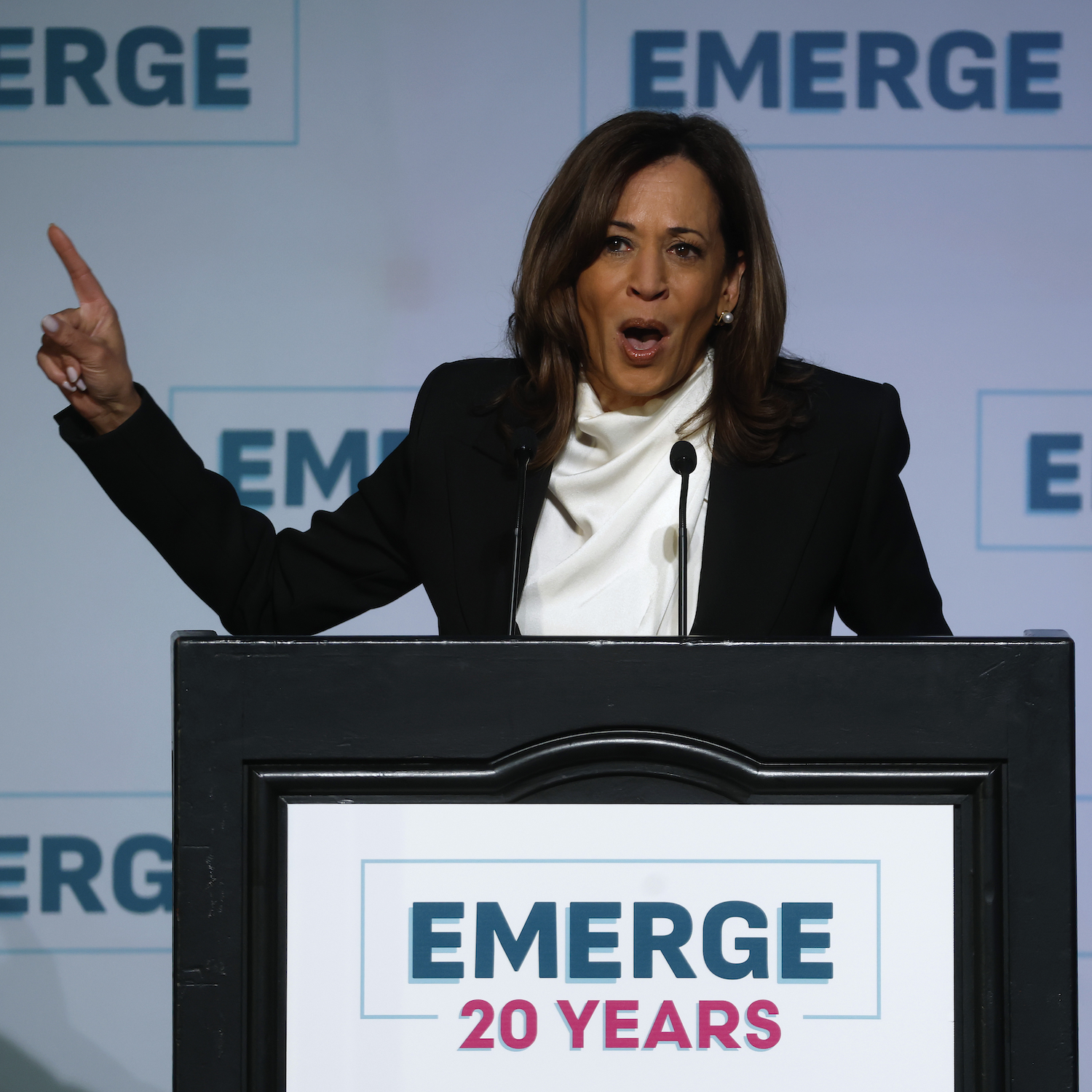
So now, Emont reports, Nike may be facing some tough choices. Make much simpler shoes that are easier to mass produce, or reconsider the efforts to automate manufacturing and move more of its production to the US There are some clear upsides. Producing shoes in the US Would mean products spend less time in transit and get into stores sooner. But a former executive who worked with Nike told in order for Nike to pull it off, the company will need to, quote, have deep pockets and some patience because it's not going to happen fast. Now to California, where last night former Vice President Kamala Harris gave her first major speech since leaving the White House losing the 2024 election. She spoke critically about Trump's first 100 days in office and how he's expanded executive power.
- [03:53]
Kamala Harris
I know tonight's event happens to coincide with the 100 days after the inauguration, and I'll leave it to others to give a full accounting of what has happened so far. But I will say this, instead of an administration working to advance America's highest ideals, we are witnessing the wholesale abandonment of those ideals.
- [04:31]
Yasmeen Khan
Harris also criticized Trump's economic policy.
- [04:34]
Kamala Harris
So look, some people are describing what's been happening in recent months as absolute chaos. And of course I understand why. And it's certainly true of those tariffs, tariffs that, as I predicted, are clearly inviting a recession.
- [04:54]
Yasmeen Khan
Harris spoke at a 20th anniversary event for Emerge, a group that aims to support and train Democratic women who are running for office. As the Washington Post reports, It was Harris's 2002 run for San Francisco district Attorney that helped inspire the formation of the group. And last night she called for more women to enter politics.
- [05:14]
Kamala Harris
Running for office is as important as ever. So please everyone here, please keep doing what you are doing. And to everyone, let's lock it in.
- [05:31]
Yasmeen Khan
Notably, Harris didn't make any major announcements about what will be coming next in her political career. That's despite lots of speculation that she's considering a 2026 for governor of California. Harris has reportedly set a deadline to make that decision by the end of the summer, though she hasn't ruled out another run for president, according to interviews with allies, friends and former aides. If she runs for governor, some political analysts say she would be a front runner in what is already a crowded field. New York Times White House correspondent Tyler Pager recently spoke about this on Face the Nation.
- [06:08]
Tyler Pager
There are people already in the race who have basically said that they would withdraw and clear the way for her she obviously has the stature of a former vice president, but it is not clear that she would automatically run away from the race. There isn't a lot of polling yet to really determine what the race would look like with her in it.
- [06:26]
Yasmeen Khan
If Harris were to enter that governor's race and if she were to win, it would put her in an interesting position in direct conflict with Trump. Once again. California has the world's fourth largest economy and calmatters reports that Trump's tariffs are projected to impact major California industries like farms, wine and shipping ports. Newsom has already filed a lawsuit challenging Trump's authority to unilaterally implement tariffs. And in total, the state has sued Trump 15 times in his first 100 days. Now let's turn to the bill that's top of mind for every lawmaker as they return to Capitol Hill this week. Trump's spending bill. Passing it would put the future of Medicaid in question and it will test the fragile unity of the Republican led Congress. For Republicans lining up behind the president, an ambitious attempt to deliver on Trump's agenda in one sweeping package. They want to extend his 2017 tax cuts that are up for renewal, as well as add new exemptions he campaigned on, like his no tax on tips pledge, all while increasing spending for defense and border control. NBC News national politics reporter Sahil Kapoor has been closely following the negotiations over this bill, and he says its scale is matched only by its cost.
- [07:57]
Sahil Kapoor
It's likely to cost multiple trillions of dollars. Just to give you some context, the extension of the Trump tax cuts of 2017 alone cost four and a half trillion dollars over 10 years. That's a huge amount of money. Now, the caveat to all of this is that conservative hardliners, most notably in the House, are insisting on steep spending cuts as a price of admission for them to be able to vote for this bill.
- [08:20]
Yasmeen Khan
That price of admission was a commitment to find $1.5 trillion in yearly spending cuts. And Republican lawmakers are now deeply divided on how much to cut, how fast and where.
- [08:33]
Sahil Kapoor
Now they say they want to target waste, fraud and abuse. They haven't said what specifically that means because you're not going to cut waste, fraud and abuse and get to the budget targets they're talking about without serious Medicaid cuts.
- [08:48]
Yasmeen Khan
Medicaid covers 83 million low income Americans.
- [08:52]
Sahil Kapoor
In order to get meaningful savings out of Medicaid, you will impact beneficiaries, you will impact hospitals who rely on payments. There's just no way around it.
- [09:01]
Yasmeen Khan
Some of the ideas Republicans are debating involve requiring Medicaid recipients to work at least 80 hours a month to qualify or participate in job training or community service. They're also debating rolling back support for the Medicaid expansion enabled through the Affordable Care act in excluding noncitizens, a population that is largely already excluded from coverage, among other options. To pass the bill, Republicans will need a simple majority in both chambers, which they have. But in the House, the GOP has just a five vote advantage, the smallest margin in modern history. And Kapoor says the Republicans he's talking to are entrenched in their camps.
- [09:43]
Sahil Kapoor
The conflicts between the conservative hardliners and the moderates are very real. Conservative hardliners have said for a long, long time that they want to reduce the debt. And then the beef the hardliners have is that they think the moderates aren't serious about it, that they cave, that they walk away. The moderates believe the hardliner don't understand how difficult it is to get elected in their district when they have Democrats breathing down their necks and accusing them of throwing people off Medicaid. That's all the stuff that Democrats are going to say.
- [10:06]
Yasmeen Khan
So where might this all end up? Kapoor gave us his best guess.
- [10:11]
Sahil Kapoor
My guess is they will be able to pass something that averts default and extends most of the Trump tax cuts. But will they be able to limit the amount that it adds to the debt? I doubt it. Will they be able to meet the targets that conservative hardliners want? I think it's extremely unlikely.
- [10:30]
Yasmeen Khan
During his rally in Michigan this week, Trump issued a warning to any Republicans who might interfere.
- [10:36]
Donald Trump
Every once in a while you have a grandstander Republican. We have some grandstanders, but every once in a while, not many. Not many. But remember who those grandstanders were and vote them the hell out of office. Okay? Will you do that?
- [10:51]
Yasmeen Khan
Speaker Mike Johnson says House Republicans have until Memorial Day to get the bill passed. Before we let you go, a few other stories were following. The Supreme Court appeared open to allowing the creation of the country's first taxpayer funded religious charter school, potentially marking a dramatic shift in one of the U.S. s bedrock principles, the separation of church and state. As Apple News today reported earlier this week, Oklahoma's Republican attorney general sued the state charter school board, saying a contract it awarded to a Catholic school volunteer violated state and federal law. The state's conservative leaning Supreme Court agreed and ordered the contract rescinded. But the U.S. supreme Court's conservative justices were sympathetic to the school. In yesterday's oral arguments, Justice Kavanaugh told the lawyer representing Oklahoma, quote, when you have a program that's open to all comers except religion, that seems like rank discrimination against religion. Justice Amy Coney Barrett recused herself from the case should it result in a 44 tie. The lower court's ruling would stand. An update to a story we brought you yesterday. Mohsen Madawi, a Columbia University student arrested by ICE at what he thought was his final interview before becoming a US Citizen, has been freed. A judge in Vermont ruled the government presented no compelling evidence to keep Madaoui behind bars. Madawi, who was born in a refugee camp in the west bank and is now a lawful permanent resident, was arrested ostensibly for his advocacy on Columbia's campus against Israel's war in Gaza. Madawi will remain free as the government's deportation case against him continues. And finally, have you heard about one of the buzziest movies out right now? It's a vampire film called Sinners, directed by Ryan Coogler and starring Michael B. Jordan, both of Black Panther fame. It's been out for two weeks and is on its way to being one of the highest grossing R rated films. The movie is set in the town of Clarksdale, Mississippi, so naturally residents there are excited to check it out. Except there's no theater in Clarksdale. The last theater there closed in 2003. One community activist drove 80 miles to see the movie and since started a petition to get a public screening in town for locals. So far, more than 1,000 people have signed on. If he gets the screening, he's invited the cast to join. You can find all these stories and more in the Apple News app. And if you're already listening in the news app right now, we've got a narrated article coming up next. The Atlantic spoke to President Trump about his second term in office. Compared to his first term, Trump told the Atlantic he's having more fun and feels like he's running quote the country and the world. If you're listening in the podcasts app, follow Apple News plus narrated to find that story. And we'll be back with the news tomorrow.