Loading summary
Transcript29 lines
- [00:00]
A
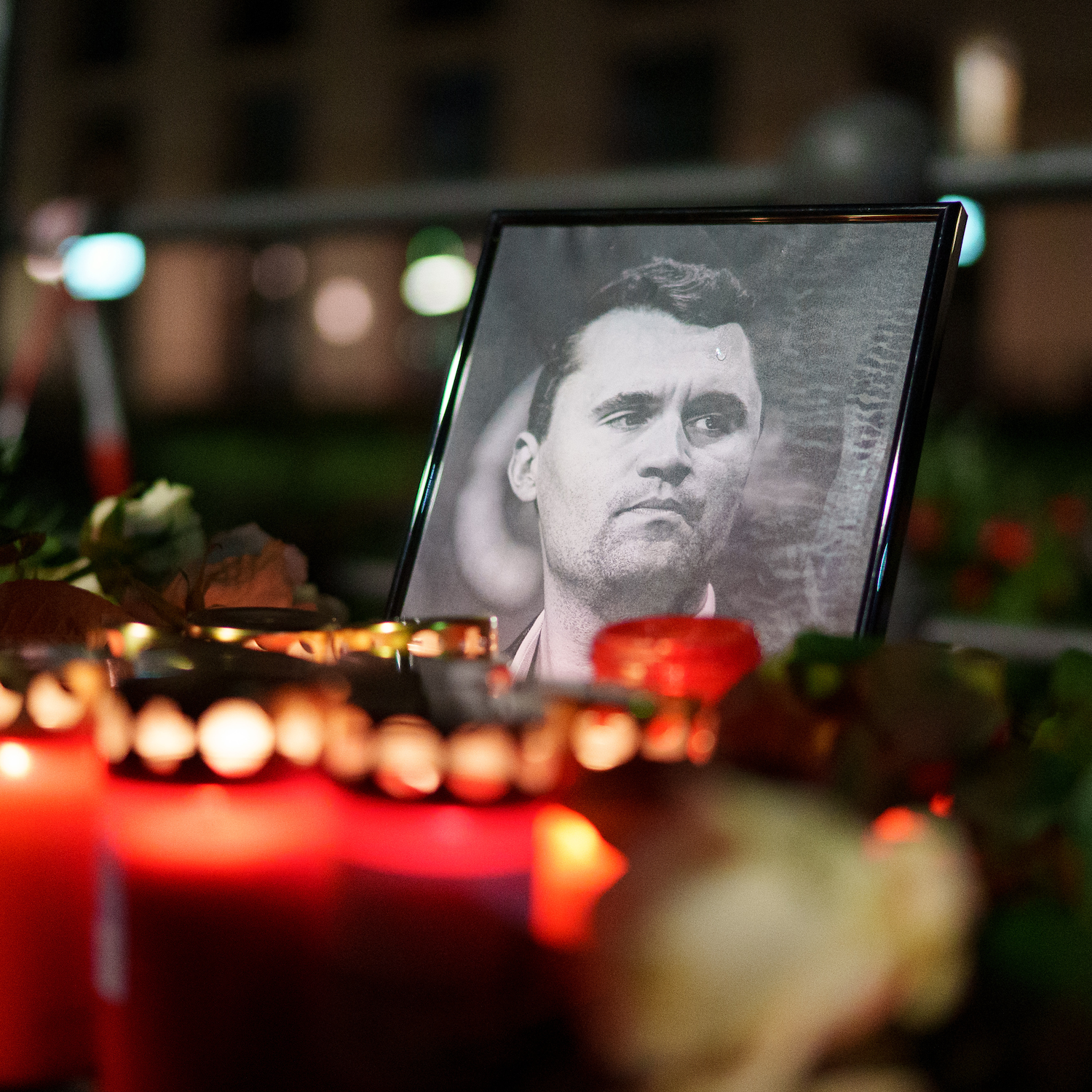
Foreign It's Friday, September 12th. I'm Shemitah Basu. This is Apple News today. On today's show, the health risks from plastics that no one talks about. Bad Bunny's residency concludes as a love letter to Puerto Rico. And what to watch for as the WNBA playoffs get under. But first, to what we now know and still don't know about the killing of conservative activist Charlie Kirk. The search for the shooter is ongoing. Authorities released several photos of their person of interest and a video of him jumping down from the roof of a building nearby. In the images, he appears to be wearing a T shirt with an eagle and American flag. Authorities also recovered a high powered rifle in a nearby wooded area. Speaking at a press conference in Utah last night, Governor Spencer Cox appealed for public support.
- [01:05]
B
We cannot do our job without the public's help right now. The public has answered our call for action. So far, we've received more than 7,000 leads and tips. I would just note that the FBI hasn't received this many digital media tips from the public since the Boston Marathon bombing.
- [01:24]
A
At Utah's state capitol yesterday, there were vigils held to honor Kirk, attended by many college students. Here's Rory Stewart, chair of the Utah College Republicans.
- [01:34]
C
Tonight, as we remember him, let's carry forward his spirit. Let's be people who continue showing up and having tough conversations and defending the freedoms we cherish. That's the legacy Charlie left us, and it's one worth living out every single day.
- [01:52]
A
Authorities say they still don't know why Kirk was targeted. But Kirk was a political individual speaking at a political event. And so, inevitably, his killing has raised questions about political violence and how public figures can keep safe. Here's Senator Mark Kelly, whose wife, former U.S. representative Gabby Giffords, survived a political shooting. Speaking to MSNBC, I didn't agree with.
- [02:17]
D
Much of what Charlie Kirk would say, but I would go to war to defend his right to say it. He had every right to be there. I mean, how does this change things? I think in the, you know, in the near term, people will start wondering if they should participate in public life because they might be concerned for their safety, their family's safety. That's not healthy for our democracy.
- [02:39]
A
School shootings on college campuses are not uncommon in the United States, and rules on campus gun access vary. In Utah, state law changed in May allowing people 18 and older with a concealed weapon permit to openly carry a gun on campus. On msnbc, Kelly also spoke about access to guns as Democrats renewed calls for more gun safety laws.
- [03:03]
D
One thing we do know is We've got very easy access to firearms and we have a lot of people to get shot. I think it's, that's indisputable. And we do also know where there's stronger gun laws, there's less gun violence.
- [03:16]
A
The Washington Post yesterday said the US Was entering a new age of political violence, and it listed a number of recent high profile cases. Minnesota Democrat Melissa Hortman and her husband Mark, shot dead in their home over the summer. An arsonist set fire to the home of Democratic Governor Josh Shapiro while his family slept inside last spring. The firebomb attack on demonstrators for Israeli hostages, a shooting against Israeli embassy staffers, and of course, two apparent assassination attempts on President Trump over the course of his last campaign. For some of these targeted attacks, the motives have become apparent, but for others, like with Trump's attacker in Pennsylvan, it's remained unclear. Professor Robert Pape has been tracking public views of political violence and threats at the University of Chicago. He told Fox 32 that recent polling found an increasing number of people on both sides felt force could sometimes be justified. And he said the country is at a watershed moment.
- [04:17]
E
There is fear, there is angst, there is retribution. We're already in spirals. And the most important thing now over in the coming weeks is concerted serious effort by all political leaders on both sides to do their parts, to take down the temperature among their own constituents and not play the game of your constituents. Worse than my constituent, we turn this into a political football. The spiral will just continue.
- [04:54]
A
Let's turn now to health and the risks posed by a group of common chemicals you've maybe never heard of, but almost definitely encountered in your day to day life, in your kitchen, in your bathroom and beyond.
- [05:06]
C
Phthalates are in our food, they're in our water, and they are in the blood and urine of basically every person in the United States. They are everywhere around us.
- [05:18]
A
That's Washington Post reporter Shannon Osaka, who says phthalates are so pervasive because they're used in all types of plastic medical devices, garden hoses, food packaging, you name it. They're a common ingredient in products like shampoo, perfume and lotion, pretty much anything with a fragrance. And over the past 20 years, scientists have been gathering evidence that shows they are associated with adverse health outcomes. Osaka has reported on how they disrupt the endocrine system and contribute to cancer. They've been linked to adhd, infertility and hundreds of thousands of deaths from heart disease. And in her latest reporting, Osaka examines how phthalates can create problems in pregnancy.
- [06:00]
C
So if a baby is exposed to phthalates while in utero, it is more likely to have infertility problems later in life, more likely to be diagnosed with ADHD later in life, and the woman having that baby is more likely to have premature birth, which can also be linked to a whole array of other health issues down the line.
- [06:21]
A
In fact, data shows that of all people exposed to phthalates, pregnant women and their children face the highest risks. Osaka says that's because these chemicals act like an orchestra conductor, telling the body what tissues to grow and organs to develop, and they can create health issues that follow a baby to adulthood. In boys, for example, phthalates can disrupt the development of testosterone.
- [06:45]
C
And if that testosterone is lowered or if it's blocked in some form, that can have really far reaching effects on sort of genital development, on fertility later in life.
- [06:56]
A
In one analysis, researchers estimated that phthalates contributed to 100,000 additional cases of male infertility over the course of a single year. But despite decades of research about the impact of these chemicals, Osaka says the federal government has introduced few regulations, and it has historically denied petitions from environmental and health groups to reevaluate their safety.
- [07:19]
C
Scientists and many doctors are saying there is clear evidence that there is a harm, while the regulatory agency is saying, we don't think that there's an issue here.
- [07:28]
A
When Osaka reached out to the FDA for comment, a spokesperson told her the agency is working on an updated safety assessment. Reducing your exposure to these chemicals isn't easy. Osaka writes that doctors and researchers are struggling with how to advise pregnant women in particular. But the experts that she spoke to say there are a few steps you can take to lower your risk.
- [07:51]
C
That means not storing food in plastic, not eating out of plastic, and also avoiding highly processed foods that have touched a lot of plastics in the way that they were made. And this is extremely difficult. I mean, we live in a plastic world. We live in a place where so many things that you touch or see or use during the day are made of plastic. So I think we're going to see more of that. It does take a lot of resources. Not everyone can do this, but I think more and more people are opting to move away from plastic for their own health.
- [08:28]
A
This weekend, Puerto Rican superstar Bad Bunny's residency in San Juan comes to an end. When it's all said and done, he'll have played 30 dates at a packed Colosseo de Puerto Rico, performing to an estimated 600,000 people, with about a third of attendees coming from out of town. His shows attracted huge names to the island like LeBron James, John Hamm and Penelope Cruz. The residency is unique in a couple of ways. First, the rapper and singer made the initial slate of shows open to Puerto Rico residents only. And secondly, the concerts generated a huge amount of economic activity on the island.
- [09:06]
B
The estimate we got was close to $200 million.
- [09:10]
A
Elias Light is a music reporter for the Wall Street Journal.
- [09:13]
B
When you factor in accommodations and food and drink and souvenirs and transportation and stuff like that, they suggested that might be a little conservative.
- [09:23]
A
Light notes that it's not uncommon for fans to go all out and dig deep in their wallets to see their favorite artists live in concert, essentially turning the experience into a vacation rather than a one night thing in your hometown. But Bad Bunny chose to leverage his star power to drive economic activity during a typically slow part of the travel season in Puerto Rico. Light told us his most recent album is his most Puerto Rican album ever.
- [09:49]
B
He has a song on there where he it's sort of a love song, but there's a line in there about how tourists basically don't really ever fully engage with the cultures of the countries they visit. So a lot of his fans, they are obviously going to come in as tourists, but they're trying to be very conscious of sort of the impact they have and not just breeze in for the concert, run to the beach and then head back. They're trying to really engage with Puerto Rican culture to the extent they're able to.
- [10:20]
A
Light also says locals felt not only a sense of excitement for the concerts, but of pride in seeing one of their own bringing huge crowds to Puerto Rico.
- [10:30]
B
A lot of times when you talk to fans, of course they're excited to see their favorite artists, but there's like this extra level here where it's like we're not just excited to see him, but he's one of us. He's doing this for us. He's doing this with us.
- [10:42]
A
Once the residency ends this weekend, Bad Bunny will take the show on the road for a global tour. But notably missing from the list of stops is the mainland United States. One reason he's skipping is concerns about immigration enforcement. In a recent interview with I D magazine, Bad Bunny said that even though he's had plenty of successful shows in the States, he was concerned that ICE could be waiting outside one of his shows. An executive promoting the residency told Light that Bad Bunny is likely leaving a lot of money on the table. As he told id, it was important to him to have mainland US Based fans better understand his music and get the whole experience by coming to Puerto Rico. Foreign before we let you go, a few other stories we're following. Former Brazilian President Jair Bolsonaro was sentenced to 27 years in prison after being convicted of plotting a coup to remain in power after losing the 2022 election. The conviction ruling was delivered by Brazil's Supreme Court yesterday. Bolsonaro's plot to reverse the election included plans to assassinate his rival and current Brazilian President Lu Inacio Lula da Silva. Bolsonaro denies plotting to overturn the election and assassinate da Silva and says he was studying ways in the Constitution to remain in office. The New York Times notes that of the 15 coup attempts with military ties in Brazil, Bolsonaro is the first to be convicted of one of those plots. In economic news, the interest rate on 30 year mortgages has fallen to its lowest level in a year. The average rate dropped to 6.3% from 6.5% last week, according to Freddie Mac. The Associated Press notes that rates have been falling steadily since July, as an expected rate cut from the Federal Reserve could come at the central bank's meeting next week. A weaker than expected jobs report fueled speculation that a rate cut is imminent. Meanwhile, inflation rose in August at the fastest pace since January, while weekly jobless claims also rose to the highest level that they've been at in almost four years. That combination has economists worried about the possibility of stagflation, where prices jump and growth slows at the same time. And finally, the WNBA playoffs begin this weekend with a group of eight teams vying for the championship. The number one seed is the Minnesota Lynx, who lost in the final last year to the New York Liberty. The Liberty are back as the number five seed this year, and the Indiana Fever are in as well, though they'll be without star guard Caitlin Clark, who is out for the season with an injury. Another team in the mix is making some history. The Golden State Valkyries are the first WNBA expansion team to make the playoffs in their inaugural season. You can find all these stories and more in the Apple News app. And if you're already listening in the news app right now, we've got a narrated article coming up next. The Times of London examines how Charlie Kirk's visits to college campuses led him to become the preeminent MAGA influencer for the Gen Z era. If you're listening in the podcast app, follow Apple News Narrated to find that story. Enjoy your weekend and I'll be back with the news on Monday.