Loading summary
Transcript25 lines
- [00:05]
Yasmeen Khan
Good morning. The Supreme Court's ruling on Trump's tariffs raises new uncertainties. Axios talks us through what could happen next.
- [00:13]
Courtney Brown
It was really easy for the president to wield tariffs as a threat on almost any issue, and now it's a little bit more complicated.
- [00:22]
Yasmeen Khan
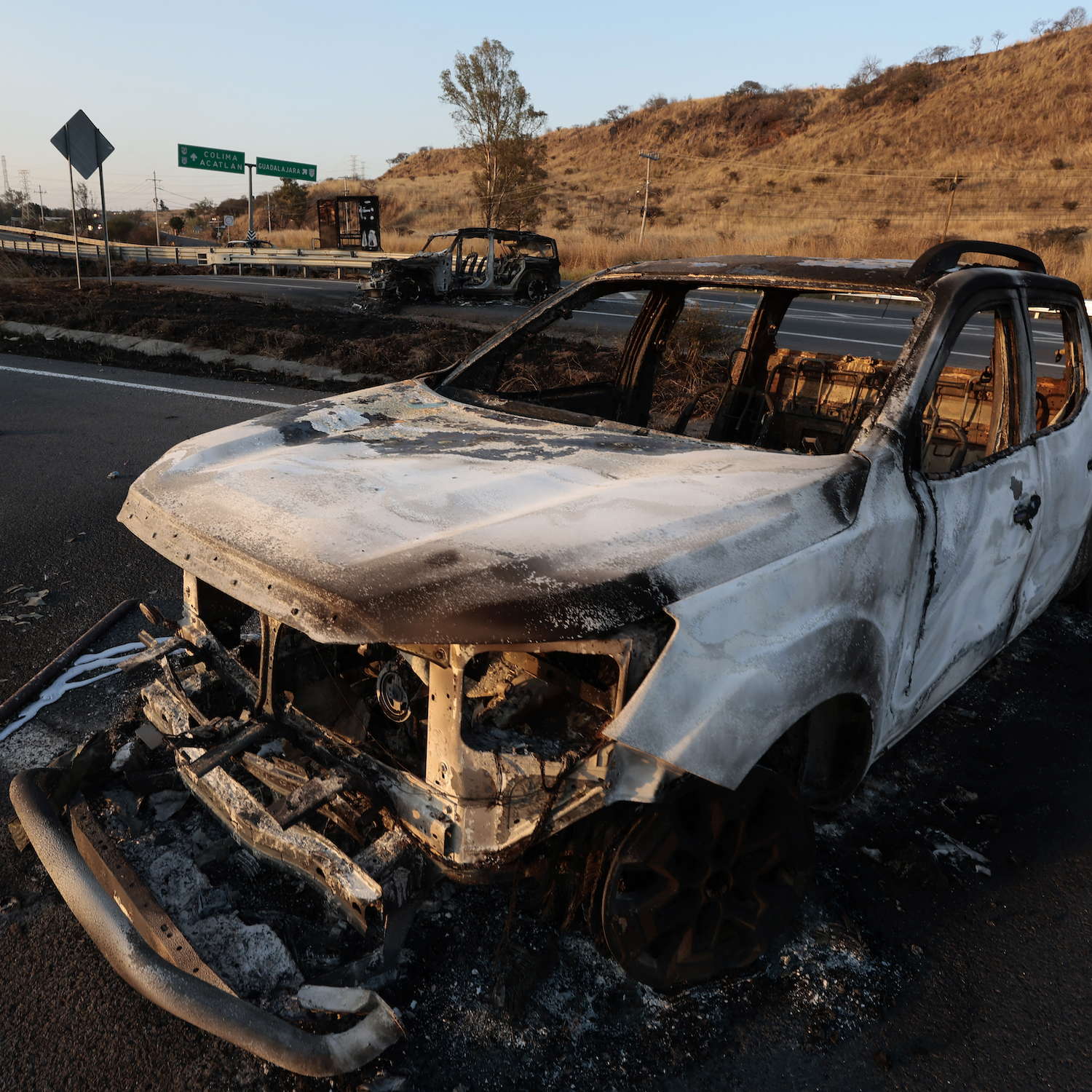
Mexico's most wanted drug lord is killed, setting off a wave of violence inside the country. And the Winter Olympics draws to a close. The athletic looks back at Team USA's Metal Hall. It's Monday, February 23rd. I'm Yasmeen Khan, and this is Apple News. Today, Businesses, diplomats and politicians spent the weekend trying to make sense of the implications of the Supreme Court's decision last Friday to strike down the Trump administration's tariffs and the subsequent angry response from the President. The Supreme Court's ruling on tariffs is deeply disappointing, and I'm ashamed of certain members of the court, absolutely ashamed for not having the courage to do what's right for our country. After lashing out at the justices, Trump announced a 10% global tariff on imports, which later went up to 15%. The court's majority opinion said that the power to tax and impose tariffs belonged to Congress. Chief Justice John Roberts went further, adding that the framers did not give any part of the taxing power to the executive branch. Trump has a Plan B, which relies on a different untested argument based around a part of the 1974 Trade Act. Courtney Brown is a senior economics reporter at Axios and explained it to us.
- [01:49]
Courtney Brown
Section 122, which dates back to the 1970s, says a president can impose tariffs if there is a balance of payments crisis, a big plunge in the dollar, for instance, related to a trade deficit. And there are some lawyers that have been quite vocal over the weekend in my inbox and on Twitter, other social networks, on television, saying that I'm not sure that really fits the condition of the United States right now.
- [02:13]
Yasmeen Khan
That probably means more legal challenges, but it might not matter as these tariffs lapse after 150 days without congressional approval. As businesses try to make sense of how this new tariff affects them, many will be wanting a refund on what they've already paid. Around $140 billion has been generated by the tariffs, according to one estimate, and it'll now be up to lower courts to decide what the administration's obligations are.
- [02:40]
Courtney Brown
Justices said in the oral arguments that that process would be, quote, a mess. And I think that's right. I think it will be a little bit of a mess. The US has done something like this before. The US has sent refunds for tariffs paid, but not to this large a scale. And so there are so many questions about whether small businesses will have to go to court and try to get a refund or whether it will happen automatically. There just no one knows.
- [03:08]
Yasmeen Khan
A forecast from researchers at Yale suggested the tariff rate would only be about 2% lower than what it was before the Supreme Court ruling, thanks to Trump's retaliatory announcement. U.S. trade Representative Jamison Greer told ABC that Trump remained convinced by the value of tariffs, even as polls suggest public disapproval.
- [03:28]
Laura Gottastener
The reality is we want to maintain the policy we have, have as much continuity as possible, make sure that business understands this is the direction we've been going. We're going to continue going this way. And there's been a through line to President Trump, Biden and President Trump again, that we're going to have tariffs, we'll have tariffs on China, we'll protect US Industry. It's actually not as big a change as people might think that it is.
- [03:48]
Yasmeen Khan
Brown from Axios told us that not much is likely to change for businesses working with countries that Trump has signed recent trade deals with, provided both sides honor the agreement, but it could still create uncertainty for those yet to be finalized. Officials for both the European Union and India are considering postponing ratification with the US until the White House offers more clarification on its policy. Some analysts predict that, as before, the cost of these tariffs will be absorbed largely by US Consumers or businesses. But as Brown said, the new tariffs are less flexible and Trump has lost a key lever he's enthusiastically pulled as he sought the upper hand in geopolitical negotiations.
- [04:30]
Courtney Brown
When President Trump entered office for his second term, we had reported that we knew that he was going to do things a little bit differently on the trade front. Tariffs were going to be the absolute centerpiece of his economic agenda, and he was going to move fast and quickly to implement them. So his advisors decided that President Trump should rely on a completely unprecedented, untested type of power.
- [04:56]
Yasmeen Khan
After the Supreme Court's ruling, Trump appears to have lost that power. Mexican authorities killed the country's most notorious drug boss yesterday in an extraordinary military raid. It's a dramatic escalation in the government's crackdown against organized crime, and his death has sparked a wave of retaliatory violence. Nemesio Aceguira, known as El Mencho, was once a police officer but became a drug dealer and rose to become the head of the Jalisco New Generation Cartel, running a vast criminal enterprise. The operation that killed him was led by the Mexican authorities But reportedly used American intelligence. At least nine other cartel members were killed and various weapons, including rocket launchers, were seized. Laura Gottastener is a senior correspondent with Reuters Mexico Bureau and explained Aseguerra's significance.
- [05:54]
Laura Gottastener
He's been one of the top targets both for the United States as well as Mexico for many years now. Unlike some other cartel leaders and sort of narcos that you might see on Netflix, Elementio has really kept a very, very, very low profile.
- [06:06]
Yasmeen Khan
She told us the cartel he ran was one of the most powerful groups in the country with a presence across the Americas.
- [06:13]
Laura Gottastener
It is a poly crime organization, which means it is a criminal organization that does not just traffic drugs, although it does. It engages in human smuggling, human trafficking, forced labor, all sorts of financial schemes, financial frauds. It has a pretty developed timeshare fraud. So it defrauds mostly American retirees out of their savings by selling them timeshares that don't exist. It is really a broad and complex criminal organization.
- [06:39]
Yasmeen Khan
The death of Aseguerra has sparked violent clashes in response. In Jalisco, the western state where the raid was carried out, gangs burned cars and trucks to block roads. And in the tourist hotspot of Puerto Vallarta, several roads were blocked and a video posted by the news site Reforma showed thick smoke rising from vehicles near the beach. The US Embassy has warned Americans in the region to shelter, while multiple airlines have canceled flights to Puerto Vallarta. Mexico's president, Claudia Scheinbaum acknowledged the violence in a social media post, but said, quote, we must stay informed and remain calm. Gotta Steiner told us that Shanebaum has broken with her predecessor by targeting these groups. She's deployed thousands of troops to try and tackle the violence amid intense pressure from the White House to slow the drug trade into the US but as Gaddastino notes, the events of the weekend show that the government has a tricky balancing act as it weighs the potentially violent consequences of its operations.
- [07:38]
Laura Gottastener
The question here in Mexico is whether we're really going to see the country having broader outbreaks of violence in different parts of the country as a result of this crackdown. And that is another political consideration that the government is constantly always measuring how to crack down on crime groups without creating a situation of retaliatory violence.
- [08:05]
Yasmeen Khan
The fire in Milan finally went out last night as the Winter Olympics came to a close. Last to enter the stage is Roberto Bolle, who had previously lit the circle of water and fire. The flames simultaneously extinguished in Milan and Cortina. In total, Team USA is coming home with 12 gold medals, a record for the team. And they finished second in the medal count overall behind Norway. There were some incredibly high highs. Like Alyssa Liu's historic gold medal for women's figure skating, the first medal for the American women since 2006, when Sasha Cohen won her Olympic medal. Incredible. And the men's hockey team's dramatic win over Canada in the gold medal match yesterday. United States with numbers. Waka Claus, it comes. Jack Hughes wins it. The golden goal for the United States. For the first time since the 1980 miracle, the United States takes the gold. That win came just two days after the US Women's hockey team won its gold medal match over Canada, also in overtime. But the overall results at the Games have been a little more mixed, with a number of high profile athletes either succumbing to injuries or underwhelming performances.
- [09:34]
Matt Futterman
So it's been a good games, but it's not been good in the way that they expected it to be good.
- [09:39]
Yasmeen Khan
Matt Futterman is a senior writer at the Athletic who covered the games in Milan. He said the devastating injury suffered by skier Lindsey Vaughn early on left a big impact.
- [09:49]
Matt Futterman
I think a lot of people thought Lindsey Vonn was gonna win. We all know what happened with Lindsey. And that was a real blow. Affected a lot of people personally who weren't don't have anything to do with this team. And it definitely affected people on the team. And I think it affected much of the Olympics too. In that first weekend, a couple of
- [10:09]
Yasmeen Khan
other star athletes were also nursing injuries coming in. Like Chloe Kim, the snowboarder who tore her labrum while training. She ended up falling short of a third straight gold medal. Jesse Diggins, thought of as the world's top cross country skier, crashed and bruised her ribs during her first race and ended up gutting out a bronze medal. And then there was the surprise of 21 year old Ilya Malinin struggling on the ice.
- [10:35]
Matt Futterman
I don't know that anyone will be able to really rationally explain Ilya Malinin, the figure skater, all of a sudden just not being able to land those jumps. I mean, the jumps are incredibly hard. So I'm not judging him in any way, but he's a world champion. He was nailing those jumps and all of a sudden he just succumbed to the pressure.
- [10:55]
Yasmeen Khan
As for the host country, Futterman said it was a year to remember for Italy with 30 medals.
- [11:00]
Matt Futterman
The Italians have worked very hard and spent a tremendous amount of money to not repeat the horror of 20 years ago when they became the rare host country that won fewer medals. When they were hosting the Games than they did in the previous Games, and that's sort of this embarrassment that they've been living with. So they were determined to not repeat that they've been investing a tremendous amount of money in Olympic sport.
- [11:27]
Yasmeen Khan
Overall, the US still outdid itself in the medal count in these Olympics compared to last time in Beijing. But a group with such lofty goals bears lofty expectations. And finally, a few other stories were following Law enforcement officers shot and killed a man at President Trump's Mar? A Lago estate in Florida during the early morning hours on Sunday. The Secret Service said a man in his 20s breached a secure perimeter carrying what appeared to be a shotgun and fuel can. Authorities say he entered the north gate of the property in a vehicle before being confronted by the Secret Service and a Palm beach county sheriff's deputy. Trump and first Lady Melania Trump were in Washington when the incident took place. New York faces a second major snowstorm of the year today, causing widespread disruption. Thousands of flights have already been canceled, the city's public school students have been given a snow day, and New Jersey Transit has suspended its service entirely. Mayor Zoran Mamdani declared all roads closed to traffic until noon today except for essential and emergency trips. Over 35 million people in total are under a blizzard warning, and more than a foot of snow is expected along large parts of the Eastern seaboard. And finally, if you were scrolling the Internet this weekend, you may have come across the story of Punch, a seven month old Japanese macaque monkey at a zoo just outside Tokyo. Punch went viral after his mother rejected him and the young primate took comfort in a stuffed orangutan from Ikea, which has since sold out in stores. Videos showing Punch looking lonely, being shoved and scolded by fellow monkeys, then rushing back to his plushie for comfort, have captured people's hearts. Zoo officials say the sudden fame led to a doubling of visitors last weekend compared to the previous year, with even higher numbers expected in the coming days. Things may be looking better, though. Punch has been observed being groomed, getting hugs and sitting with adult monkeys, all signs he's finally acclimating. Zookeepers say this is all normal and they're encouraging people not to feel sorry for Punch, but to support his efforts at integrating. You can find all these stories and more in the Apple news app. And if you're already listening in the news app right now, we've got a narrated article coming up next. Bloomberg Businessweek reports on how cryptocurrencies became the preferred method for drug cartels to launder money and why law enforcement agencies are struggling to catch up. If you're listening in the Podcasts app, follow Apple News plus Narrated to find that story and I'll be back with the news tomorrow.