Loading summary
Transcript30 lines
- [00:05]
Shemitah Basu
Good morning. It's Wednesday, March 26th. I'm Shemitah Basu. This is Apple News today. On today's show, the fight over non citizens right to free speech. What one photojournalist saw when deported Venezuelans landed in El Salvador. And President Trump signs an executive order to overhaul voting foreign. But first, National Security Advisor Mike Waltz says he takes full responsibility for a group chat on the messaging service Signal that included several cabinet members, the vice president and a journalist, Jeffrey Goldberg, editor in chief of the Atlantic. The text thread included details about upcoming US Military strikes in Yemen. In an appearance on Fox, Walt said he built the group, called it embarrassing, and pledged to get to the bottom of it. Officials who were on that chat deny any classified information was exchanged. Goldberg, in his initial report and again on Tuesday, said the chat did include classified material. On Monday, when Defense Secretary Pete Hegseth was asked by reporters on the tarmac about whether he shared, quote, war plans in that chat, he instead attacked Goldberg.
- [01:23]
Jeffrey Goldberg
You're talking about a deceitful and highly discredited so called journalist who's made a profession of peddling hoaxes time and time again.
- [01:32]
Shemitah Basu
Meanwhile, on Capitol Hill, two other people in the chat, Tulsi Gabbard, the director of National Intelligence, and John Ratcliffe, the CIA director, were questioned about the incident by Democratic lawmakers in a previously scheduled Senate Intelligence Committee hearing yesterday. Both Gabbard and Ratcliffe mostly deflected questions about the group chat during that hearing. When Ratcliffe was asked if he agreed the incident was a big mistake, he responded no. In one exchange, Independent Senator Angus King from Maine asked Gabbard about the specifics of the operation and why they weren't classified.
- [02:08]
Tulsi Gabbard
You've testified that nothing in that chain was classified.
- [02:12]
Shemitah Basu
Wouldn't that be classified? What if that had been made public that morning before the attack took place?
- [02:18]
Tulsi Gabbard
Senator, I can attest to the fact that there were no classified or intelligence equities that were included in that chat group at any time. And I just so the attack sequencing and timing and weapons and targets you.
- [02:31]
Shemitah Basu
Don'T consider to should have been classified.
- [02:33]
Tulsi Gabbard
I defer to the Secretary of Defense and the National Security Council on that question.
- [02:37]
Shemitah Basu
Ratcliffe said during the hearing. It's Hegseth's responsibility as the authority on materials classification to determine what was appropriate to share. Republicans on the committee mostly didn't ask about the episode during the hearing, but two said that they would do so in a classified setting. Later. One Republican representative, Don Bacon from Nebraska, told CNN that he was very concerned about what he had read this is.
- [03:02]
Tulsi Gabbard
A gross error and it's intentional. They intentionally put highly classified information on a classified device. I would have lost my security clearance in the Air Force for this.
- [03:12]
Shemitah Basu
Trump on Tuesday downplayed the incident and expressed confidence in his national security team, calling it a minor glitch. Meanwhile, Goldberg hasn't ruled out sharing more information from the signal chat, although speaking to the Bulwark podcast, he said, just because they're irresponsible with the material doesn't mean that I'm going to be irresponsible with this material. Now let's continue. Following efforts by the Trump administration to deport students who have participated in pro Palestinian demonstrations on college campuses, at least three foreign born students living in the US Legally have already been arrested. And Politico reports that at least two more students, both legal residents, are on the run from immigration officials as they pursue legal action to prevent their deportations. Yun SEO Chang has a green card and Mamadou Tal is in the US On a student visa. The Justice Department says the State Department canceled Tal's visa for his involvement in pro Palestinian demonstrations six months ago, which they say created a, quote, hostile environment for Jewish students. And the Trump administration argues Chung, who was arrested in connection with a protest at Barnard College, is a threat to the administration's foreign policy agenda. Both Chung and Tal say their First Amendment free speech rights are being violated. A judge Tuesday evening ruled Chung can't be detained as she fights her deportation. Tal spoke to the Intercept on Sunday, saying that just a few days before federal agents showed up looking for him, he, he and two US Citizens filed a lawsuit against the Trump administration challenging the executive orders to combat antisemitism on college campuses and expel foreign nationals who the administration says pose security threats.
- [05:09]
Jeffrey Goldberg
It's very interesting to me that on a random Friday for an event that took place six months ago, all the federal agencies were planning to come after me. And now that I've filed, my visa has been revoked. So for me it clearly looks like retaliating and retribution for filing.
- [05:22]
Shemitah Basu
The administration's efforts to revoke students legal status has sparked fundamental questions more broadly about the right to free speech and whether it's reserved for citizens only. Recently, NPR's Michelle Martin spoke to Troy Edgar, the deputy secretary of the Department of Homeland Security, about the arrest of Columbia University graduate Mahmoud Halil, a legal permanent resident of the US who was detained earlier this month for his role coordinating anti war protests. Martin asked what exactly Khalil did that warranted his arrest and qualified as terrorist activity. Edgar, as you'll hear struggled to answer her questions clearly.
- [06:01]
Michelle Martin
And what did he engage in that constitutes terrorist activity?
- [06:05]
Jeffrey Goldberg
I mean, Michelle, having watched it on.
- [06:07]
Shemitah Basu
Tv, it's pretty clear.
- [06:08]
Michelle Martin
No, it isn't. Well, explain it to those of us who have not, or perhaps others have not. What exactly did he do?
- [06:13]
Jeffrey Goldberg
Well, I think it's clear or we shouldn't be talking about it. I mean, the reality is that if you watch and see what he's done on the university.
- [06:20]
Michelle Martin
Do you not know? Are you telling us that you're not not aware, you don't know what he did that you know, I find it.
- [06:26]
Jeffrey Goldberg
Interesting that you're not aware?
- [06:28]
Michelle Martin
I think you could explain it to us. I think others would like to know exactly what the offenses are.
- [06:33]
Shemitah Basu
Martin ended the interview there. Meanwhile, universities and colleges are being pressured by the Trump administration to crack down on student protesters. At Columbia University, where the Trump administration recently canceled $400 million in federal funding for failing to protect Jewish students from harassment, the interim president recently agreed to hire an internal security force that will be empowered to make arrests, and she placed the Middle Eastern, South Asian and African Studies department under additional oversight. It's being seen as an effort to get that funding restored. In recent days, faculty members have condemned university leadership's decisions in closed door meetings and publicly protested them. Catherine Franke is a former law professor at the school who, who says she was pushed to resign in January over her support of the pro Palestinian movement on campus. She spoke with Democracy Now.
- [07:28]
Tulsi Gabbard
We need to buckle our seatbelts. Things are about to get a lot worse in April and in May because this administration knows that it can get away with an awful lot of conduct and chilling speech and authoritarian governance with very little resistance from institutional actors like universities as powerful, we thought, as Columbia. So these, these actions are designed to kind of test the water. How far can we go? And they now know they can go all the way.
- [07:58]
Shemitah Basu
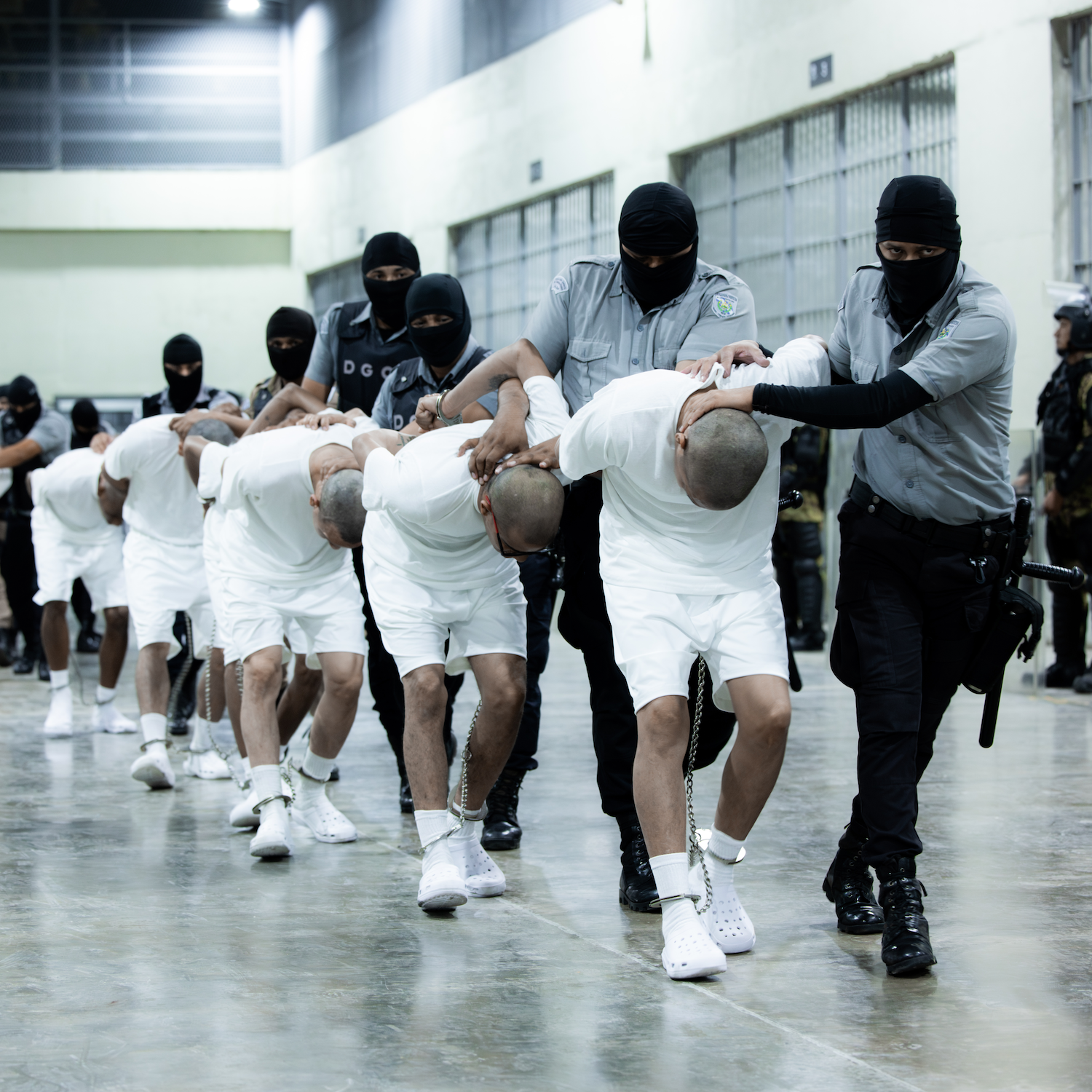
Federal civil rights lawyers launched investigations into more than 50 schools last month in response to Trump's orders. Several attorneys with the Office for Civil Rights told the Washington Post the administration instructed lawyers to collect the names and nationalities of students who, who may have harassed Jewish students or faculty. And these attorneys say they're concerned these lists could be used to target or deport more students from foreign countries who participated in protests. A representative with the Education Department told the Post they want the information to assess how universities handled cases related to antisemitism. They did not directly respond to questions about whether these lists would be used for deportations. When the Trump administration deported more than 200 Venezuelan men from the US to El Salvador earlier this month with zero due process. Photojournalist Philip Holsinger was on the tarmac in El Salvador when they arrived, and he documented what they experienced from the time they landed to the time they were thrown into El Salvador's most notorious maximum security prison, known for its harsh conditions. Please be warned. This story involves descriptions of violence. In a photo essay for Time magazine, Hulsinger wrote that what he witnessed was a, quote, theater of fear. Holzinger describes the men being chained at their ankles and wrists. Many stumbled or fell to the ground as they tried to walk. And as they were falling, they were kicked, slapped, or shoved by the guards. They had their heads shaved. One of the migrants sobbed, telling the guards, quote, I'm not a gang member. I'm gay. I'm a barber. A guard slapped him. He cried out for his mother, and he was slapped again. We caught up with Hulsinger to ask about what he saw.
- [09:51]
Jeffrey Goldberg
As soon as I saw the faces of the Venezuelans, there was something different. The main difference is that I was used to seeing the murderers coming off the planes. I was used to seeing the Ms. Thirteen guys, and they don't cry. They're hardened. I was used to that. So these Venezuelan guys, even in defiance, you could see some fear. You know, when somebody's angry, but they're thinking, maybe I'm about to get eaten alive. The way they were crying struck me because it was unlike anything else I had seen. With gang members in detention, they were.
- [10:27]
Shemitah Basu
Transported by bus to sicat, short for the center for Terrorist Confinement. It's a remote facility at the foot of a volcano. El Salvador's President, Nayib Bukele has praised its harsh conditions, and Trump has promised to pay Bukele $6 million to these men there for one year. People detained at SICAR cannot make phone calls, have visitors participate in recreational activities, or receive education. And they're never allowed to go outside.
- [10:56]
Jeffrey Goldberg
It's almost like a spaceship. It's just concrete and steel, totally new. You have no freedoms. You can't even speak. A prisoner is not even allowed to address a guard. You have to have some very specific request. It's. I've never been in a prison like it.
- [11:14]
Shemitah Basu
Hulsinger told us. At some point, it struck him, many of these people don't even know where they've landed.
- [11:19]
Jeffrey Goldberg
And maybe some of these guys realize, maybe whispering, maybe they know they're in Salvador, but they're in a foreign country. And even if they don't know it, they can't call anybody and nobody's going to come and ask about them.
- [11:35]
Shemitah Basu
As I mentioned earlier in the week, 238 men in total were sent to El Salvador by President Trump and his administration. They have accused more than half of being part of the Trende Aragua Gang, a group that Trump has called a foreign terrorist group and wartime enemy. The administration has provided little evidence to support those claims. Before we let you go, a few other stories we're following. President Trump Tuesday signed an executive order that could have a big impact on elections. The order, which will likely be challenged in court, would require proof of citizenship to register to vote on federal forms. Most people register to vote through their state. It would also bar absentee and mail in ballots from being counted if they're received after Election Day. The order claims the US has failed to enforce basic elections protections, but the Wall Street Journal reports states regularly audit rolls to weed out ineligible voters. The order also threatens to pull funding from states that don't comply. Palestinian filmmaker Hamdan Bilal, who co directed the Oscar winning documentary no Other Land, was released from Israeli custody yesterday after being attacked by Israeli settlers in the west bank on Monday. Bilal was reportedly beaten up by masked settlers before being pulled out of an ambulance and taken into custody by Israeli military and police forces. Bilal told the Associated Press he was blindfolded and forced to sleep under an air conditioner while he listened to Israeli soldiers laugh about him. Israeli military officials said that they responded to disperse a confrontation but denied pulling anyone from an ambulance. They did say Bilal was detained for allegedly throwing rocks at IDF police, which Bilal denies doing. And finally, today is the one year anniversary of the collapse of the Francis Scott Key Bridge in Baltimore after a container ship crashed into it, killing killing six people. A blistering NTSB report last week said Maryland leadership could have done more to prevent the collision and that the bridge was vulnerable. Governor West Moore pinned the blame entirely on the ship's operator, telling Fox News they were reckless. Despite all of the finger pointing, commuters are the ones still feeling the impact. A survey released this week said 60% of people who live within three miles of the bridge say that their lives are still being disrupted a year later. You can find all these stories and more in the Apple News app. And if you're already listening in the news app right now, we've got a narrated article coming up next. New York magazine examines how workplaces in New York City have largely mandated that workers return to offices in a shift from the early days of the pandemic. Except now many are struggling to find adequate space for all their employees. If you're listening in the podcast app, follow Apple News plus Narrated to find that story. And I'll be back at the News tomorrow.