Loading summary
Transcript32 lines
- [00:05]
Shemitah Basu
Good morning. It's Tuesday, February 25th. I'm Shemitah Basu. This is Apple News today. On today's show, Republican lawmakers are feeling the heat from their constituents at town halls. A look at how abortion bans affect sepsis rates. And a controversial pick could win the Oscar for best actress. But first, to the ongoing fallout from federal job firings. Yesterday, the Office of Personnel Management, which is effectively the government's HR department, told federal agencies that they can ignore Elon Musk's email demanding they outline what they accomplished last week or risk losing their jobs. President Trump commented, too, saying some employees work with sensitive information and should be exempt from the email request. But but he also suggested employees could still be fired or, quote, semi fired for non compliance. One DOJ employee described the past few days to Politico as massive whiplash all the time. The next large scale cuts are coming for the Pentagon. On Friday, the Defense Department announced plans to cut 5,400 probationary workers starting this week, which would reduce its workforce by up to 8%. The Pentagon also said it plans to put a hiring freeze in place and it's proposed cutting 8% of its budget per year over the next five years. That's roughly $50 billion a year. However, the Pentagon says a number of defense priorities will be exempt from cuts like money that goes toward border security and countering China in the Pacific. The Washington Post examined one agency within the Defense Department where there's a lot of fear about the impact of cuts to staffing and budget.
- [01:53]
Alex Horton
The small office that handles the recovery of missing in action personnel, otherwise known as the Defense Department pow, mia, accounting agenc.
- [02:03]
Shemitah Basu
Alex Horton is a national security reporter for the Post.
- [02:07]
Alex Horton
It's not really clear to us whether this is a sacred cow that they're willing to lose or if it's going to be overlooked when it comes to sparing some of the federal employees.
- [02:17]
Shemitah Basu
The agency has around 700 people on staff and their backgrounds are quite unique. There's forensic anthropologists, historians, even underwater archaeologists. That's because this agency does the difficult and painstaking work of finding, identifying and repatriating the remains of Americans who died in wars overseas.
- [02:39]
Alex Horton
This takes a lot of work, a lot of science. You know, there are historians trying to figure out where people are in the field. Archaeologists have to go to like a lot of times these very austere, you know, dangerous environments and there's unexploded ordinance and stuff. So these things take a long time to unfold.
- [02:56]
Shemitah Basu
Horton told us about one veteran recovered by the agency during Trump's first term, when the US Struck a deal with North Korea to repatriate the remains of Americans who died during the Korean War. Master Sergeant Charles McDaniel was last seen in 1950 tending to wounded soldiers in battle. His remains were identified by the agency in 2018, 68 years later, and parts of his skull, clavicle and dog tag were returned to his sons. They spoke to the agency that year about what it meant to finally be able to lay their father to rest.
- [03:31]
Rich McCormick
Well, it doesn't answer all the questions, you know, about his actual dying, but it certainly lets us have some certitude about that and some gratitude that there is some answer to that now. But it's still amazing to look at that. And I was actually felt like, you know, it's a. It's a gift from, from God to us.
- [03:51]
Shemitah Basu
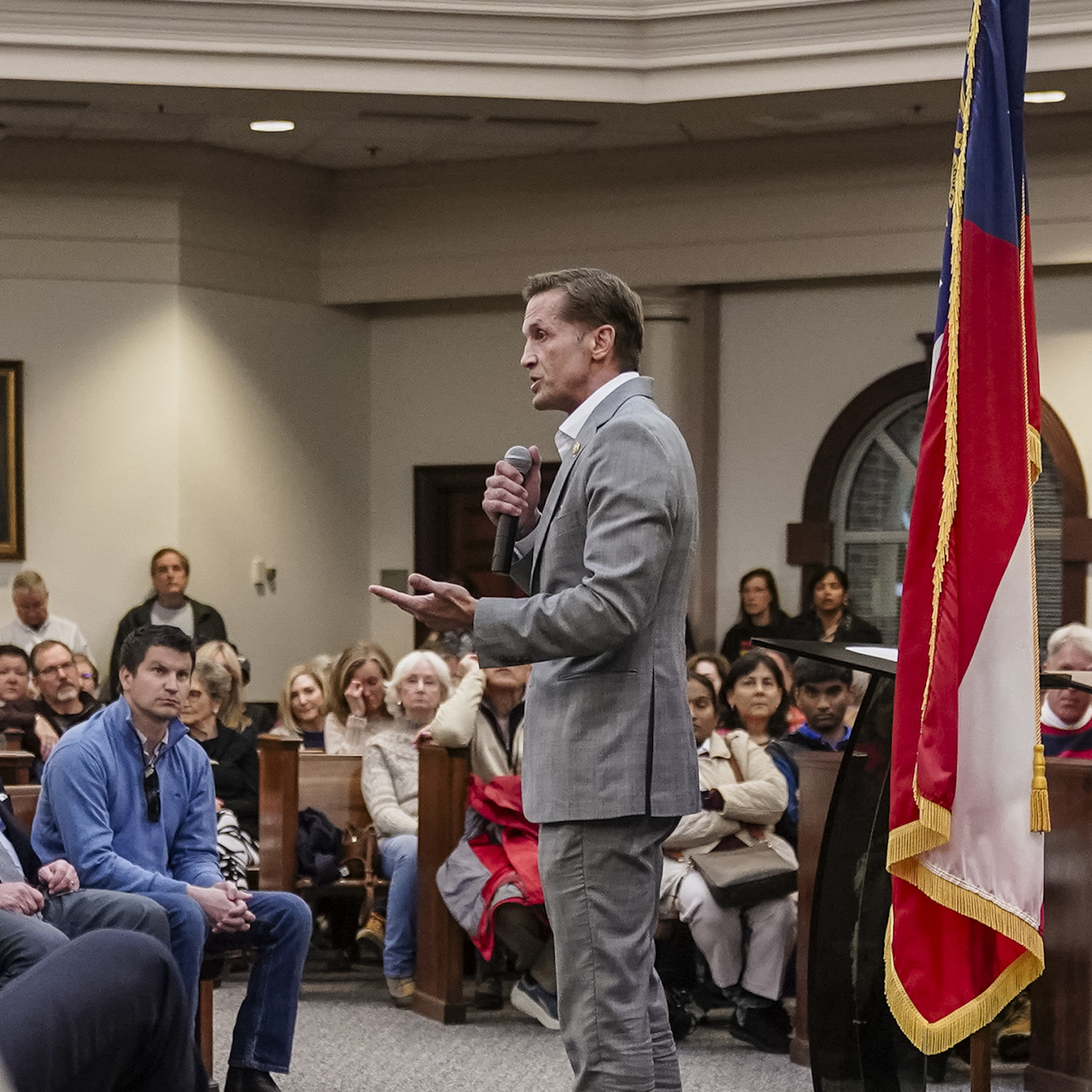
It's unclear how exactly this agency might be affected by upcoming cuts, but staff are bracing for them to be widespread and indiscriminate. One employee of the agency told Horton, out of every DOD agency there is, we're the only one above reproach. From a moral standpoint, it's not about making weapons. It's about returning loved ones to their families. While Congress was in recess last week, many Republican lawmakers returned to their districts and held some of their first town halls with constituents since Trump took office, and a lot of them received an earful. People demanded answers about how sweeping budget cuts might impact them locally, about the mass firings of federal workers, and about the authority President Trump has given Elon Musk. Here's how one town hall sounded in Georgia.
- [04:51]
Virginia Host
Elon was going to be the main topic tonight, and he's going to continue to be the main topic tonight because we are all freaking pissed off about this. You're going to hear it and feel it.
- [05:01]
Shemitah Basu
President Trump's efforts to expand executive powers came up, too.
- [05:06]
Sue Oliver
You can imagine my shock and pure horror when I woke up to find that our president had given himself unprecedented executive powers and then within a few days named himself king to his followers.
- [05:22]
Shemitah Basu
Republican Representative Rich McCormick was hosting this particular town hall, and that woman you just heard who introduced herself as Virginia host, told McCormick she is a descendant of founding father Patrick Henry, and she.
- [05:35]
Sue Oliver
Quoted Henry a king is a tyrant. If a wrong step is made now, the republic will be lost forever and tyranny will rise. It's clear from all the writings of our founding fathers that our great republic was never meant to be ruled by a dictator nor a king.
- [05:56]
Shemitah Basu
McCormick responded.
- [05:58]
Rich McCormick
When you talk about tyranny.
- [06:00]
Alex Horton
When you talk about presidential power, I.
- [06:02]
Rich McCormick
Remember having the same discussion with Republicans.
- [06:04]
Alex Horton
When Biden was elected.
- [06:09]
Shemitah Basu
He went on to say that he believes executive power should be restricted because it feels out of balance right now with other branches. And he later told the Atlanta Journal Constitution that he believes the pace of federal employee firings has been too fast. In Wisconsin, constituents at one town hall were angry that their Republican representatives weren't pushing back on Trump and keeping executive power in check.
- [06:33]
Rich McCormick
Do your job. Do your job. Do your job. Do your job.
- [06:40]
Shemitah Basu
On the west coast in Oregon, a woman named Sue Oliver expressed similar concerns, speaking directly to her representative. Republican Cliff, you are an attorney, you.
- [06:51]
Virginia Host
Are an officer of the court, in addition to swearing an oath to our Constitution, and yet you and so many of your colleagues are just sitting around watching. Well, I don't know. We'll see what happens next month. There won't be a country left to run, sir, if you guys just sit back and are afraid of a primary, because I hear President Musk has threatened a primary. Any Republican who doesn't get on board.
- [07:19]
Shemitah Basu
The White House said these town hall incidents include just a handful of critics. NBC reports that these contentious town halls could be an early sign that the honeymoon period for the Trump administration is coming to an end. And the New York Times notes that with a slim majority in the House, Republicans are in a precarious position, especially for members in vulnerable districts. But the fact that this pushback is also happening in deeply red areas could be a sign of a larger problem for the party down the road. Let's turn now to a recent investigation from ProPublica that found pregnancy in Texas has become much more dangerous in recent years. The state implemented a six week abortion ban in 2021, which became a total abortion ban in 2022, soon after the Supreme Court overturned Roe v. Wade. But since then, no one at the state or federal level had studied the impacts of the policy on patients. So ProPublica did their own analysis using hospital data from 2017 through 2023. Reporter Lizzie Presser told us what they learned.
- [08:34]
Lizzie Presser
The rate of sepsis for women who are losing their pregnancies in the hospital in the second trimester spiked more than 50% after the first abortion ban was passed in Texas in 2021.
- [08:47]
Shemitah Basu
Developing sepsis is one way the body's immune system responds to infection, and it can be incredibly dangerous.
- [08:54]
Lizzie Presser
One of the things that's so scary about sepsis is that once it sets in, it's extremely difficult to get ahead of. Sepsis can lead to a life threatening drop in blood pressure. It can cause permanent kidney damage, permanent brain damage, very dangerous bleeding, and it can also cause death really rapidly.
- [09:17]
Shemitah Basu
Before Roe v. Wade was overturned, the recommended standard of care for patients with pregnancy complications or miscarriages, before fetal viability was to offer to terminate the pregnancy because of how dangerous infections can be. But today, under Texas law, a physician cannot terminate a pregnancy unless they can document the patient's life is at risk. And doctors face up to 99 years in prison for violating that law.
- [09:43]
Lizzie Presser
Some doctors said, okay, that's very clear in the law. But when you're in the practice of medicine, it's extraordinarily gray what constitutes a life threatening risk?
- [09:52]
Shemitah Basu
According to ProPublica's analysis, that uncertainty physicians are facing could explain why Texas hospitals are seeing rising sepsis rates for pregnant patients.
- [10:02]
Lizzie Presser
They are waiting for women who are experiencing pregnancy complications to get really sick before they intervene. But then you may not be able to intervene anymore because that risk can escalate so fast.
- [10:15]
Shemitah Basu
Between 2019 and 2023, the maternal mortality rate rose in Texas by 33%. Meanwhile, nationwide, it dropped by 7.5%. And Presser says this trend with sepsis is not limited to Texas. Other states that have similar laws banning abortion are seeing sepsis rates climb, too, for patients experiencing complications before their pregnancies are viable. Texas abortion law is under review this legislative session as a result of ProPublica's reporting. Presser says Republican lawmakers in Texas, including several of the authors of abortion policy in the state, have expressed a willingness to amend the law to better protect the lives of patients. But it's unclear if proposed amendments will receive a public hearing this session. Before we let you go, a few other stories we're watching. The United States on Monday joined Russia to vote against a UN Resolution condemning Russia's war against Ukraine. CNN reports The UN Measure, which was backed by longtime European allies, called for immediate withdrawal of Russian forces from Ukraine and a peaceful resolution to the war now marking its third year. The AP called it a sign of a shift in transatlantic relations, with the United States continuing to signal a willingness to split from Europe and refuse to blame Russia for its invasion of Ukraine. Now to an update on the closely watched mass rape trial in France, where 51 men were convicted two months ago of raping Gisele Pellico. Six of the 50 men are already out of jail and living relatively normal lives. The Sunday Times reports the men who have been released were let go because of their poor health or because they'd served their time in pre trial detention. Now many are back in villages in France. Some have returned to their families, to their job. Gisele Pellico's lawyer says she is trying to return to normal life, too. And the Oscars are this weekend and after skipping several awards season ceremonies, Carla Sofia Gascon, who is nominated for best Actress for her role in the film Amelia Perez, says she still attend the Oscar ceremony. Gascon was largely left out of Oscar campaigning and has kept a low profile after years old. Offensive tweets resurfaced where she made charged statements about black people, Islam and immigrants. Gascoigne is the first openly trans woman to be nominated for best actress and said, quote, I'm grateful to be back. Emilia Perez led all Oscar films with 13 nominations. You can find all these stories and more in the Apple News app. And if you're already listening in the news app right now, we've got a narrated article coming up next. Popular Mechanics has the story of a puzzling archaeological object that spent 2,000 years at the bottom of the Aegean Sea before some of it got hauled up. It might have been the world's first computer. If you're listening in the podcast app, follow Apple News Narrated to find that story. And I'll be back with the news tomorrow.