Loading summary
Transcript23 lines
- [00:05]
Yasmeen Khan
Good morning. It's Tuesday, June 10th. I'm Yasmeen Khan in for Shimita Basu. This is Apple News today. On today's show, Robert F. Kennedy Jr. Removes an entire panel of vaccine advisors, the scramble to undo the Doge firing spree, and the country that just banned dog walking in the city. But first to Los Angeles, where unrest and largely peaceful demonstrations against federal immigration raids have been met by escalating action from the federal government. Yesterday, Defense Secretary Pete Hegseth deployed hundreds of Marines to the area, citing a need to protect federal property and personnel. Protesters continued to gather in downtown la, but the city's police chief nonetheless warned that the arrival of federal forces presented, quote, a significant logistical and operational challenge. This came just one day after thousands of California's National Guard troops arrived on President Trump's orders and against the wishes of state leaders. Governor Gavin Newsom, a Democrat, has now sued the administration over the Guard's deployment. And. And while announcing the lawsuit, State Attorney General Rob Bonta said the National Guard's presence only inflamed tensions that had started to cool down.
- [01:32]
Robert F. Kennedy Jr.
This was not inevitable. We'll never know what might have been had the president left our state and local authorities to continue the important work they were already doing and were more than capable of doing. What we do know is that what we saw yesterday happened after the the president's unnecessary, counterproductive, and most importantly, unlawful order.
- [01:59]
Yasmeen Khan
Los Angeles Police Chief Jim McDonnell told reporters Sunday night that the federal government acted too quickly by deploying the National Guard.
- [02:08]
Robert F. Kennedy Jr.
We could handle this. I believe that we would have gone through a number of steps before we'd have deployed the National Guard or requested deployment on the National Guard. Looking at it tonight, this thing has gotten out of control.
- [02:19]
Yasmeen Khan
Newsom argues that Trump violated the 10th Amendment, which protects states rights. Nigel Duara is a Justice reporter with Calmatters.
- [02:29]
Robert F. Kennedy Jr.
So what Newsom is saying is that the president essentially doesn't have the right.
- [02:32]
Yasmeen Khan
To do this, that this is unconstitutional, and that in this specific case, it is unnecessary and a direct provocation. Trump, meanwhile, is arguing that federal intervention was necessary because he says California's Democratic leaders hadn't done enough to respond to the protests. And in his order to deploy the National Guard, Trump invoked a federal statute that allows the president to bypass a governor's authority in situations like a foreign invasion or a rebellion against the federal government. Trump has described the protesters as insurrectionists. He has not, however, invoked the Insurrection Act. That's a much discussed 1807 law that gives the president the right to send troops into cities to police the streets armed with much broader powers than they have now. The California attorney general said on Monday that he thought the courts would side with his state in this dispute, but he conceded the issue had not been fully litigated before. And a number of scholars have raised questions about Trump's approach. Steve Vladek, a professor of law at Georgetown University, described it as unnecessary, and Hina Shemse with the American Civil Liberties Union told NPR she thinks the order.
- [03:46]
Robert F. Kennedy Jr.
Is an overreach because the Constitution preserves to the state, the states, the ability to address unrest through the exercise of their police powers, and it generally prohibits the federal government from unilaterally deploying military personnel where no federal interest is genuinely threatened.
- [04:08]
Yasmeen Khan
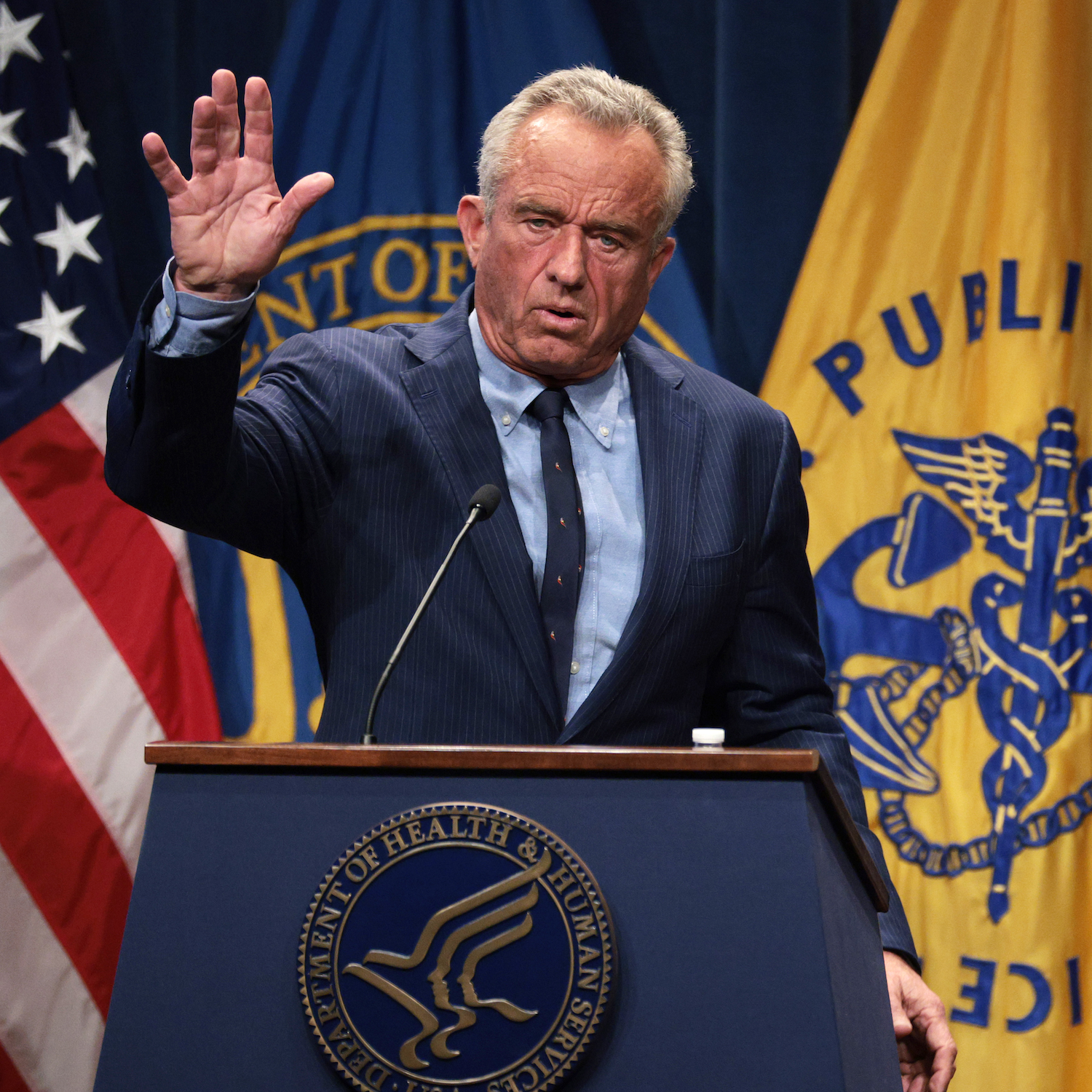
Other experts have warned that the presence of troops around protesters can lead to potentially tragic outcomes, and Trump's order notably did not lay out any guidelines around when troops would be able to use force, lethal or otherwise, if his administration determines a protest threatens federal personnel or property. The Health and Human Services Secretary, Robert F. Kennedy Jr. Took the unprecedented step yesterday of removing an entire panel of vaccine advisors. All 17 members of the panel, which provide guidance to the Centers for Disease Control and Prevention, were retired early. In an announcement made by Kennedy and a Wall Street Journal op ed, one committee member told Politico they had received no official communication from the department. Kennedy does have authority to remove the panel, but its members are not considered political appointees and they go through a vetting process before recommendations are made to the secretary. Kennedy said, quote, a clean sweep was needed to re establish public confidence in vaccine science. He said the decision would empower the Trump administration to appoint its own members long before the panel was due to be renewed in 2028. The panel is made up of scientific experts who come up with recommendations on vaccine policy. Insurance companies must cover vaccines recommended by the group. Kennedy's decision to gut the membership has put a spotlight on his confirmation process. Before his confirmation hearing, the Republican senator Bill Cassidy had expressed doubts about Kennedy's anti vax statements. But in explaining his justification for voting Kennedy through Cassidy said this it confirmed.
- [06:02]
Robert F. Kennedy Jr.
He will maintain the Centers for Disease Control and Prevention's Advisory Committee on Immunization Practices and Recommendations without changes.
- [06:11]
Yasmeen Khan
Today, it appears Kennedy has abandoned that pledge. The question of the vaccine panel's future wasn't raised in the hearing itself, though he did pledge to back the CDC's work.
- [06:22]
Robert F. Kennedy Jr.
I support the CDC. My job is not to dismantle or harm the CDC. My job is to empower the scientists. If I'm privileged to be confirmed but.
- [06:32]
Yasmeen Khan
In recent months, the CDC's distance from Kennedy's decision making process has become more apparent. For example, he announced that the CDC would be removing its advice for healthy children and pregnant people to get the COVID vaccine. That announcement came before the advisory panel could vote on it this month. The decision itself was not entirely out of step with some other countries, but it broke the conventional norm by acting before the CDC panel could weigh in. According to STAT News, the CDC learned about that announcement on social media, and last week a pediatric infectious disease expert resigned from a CDC vaccine working group, declaring she could no longer help the most vulnerable. Kennedy said the panel was plagued with conflicts of interest, a claim he has made before citing an old report. An analysis of that report by NPR did not show significant or widespread conflicts, though it did show paperwork errors, and panel members do publish any potential conflicts online, which are publicly disclosed. Kennedy has always denied the label of anti vax, but he has made demonstrably false statements relating to vaccines and autism and has questioned the efficacy of the measles vaccine. The advisory panel was due to meet on June 25, Bloomberg Health reporter Madison Mueller noted, it's not clear who will fill that void.
- [08:01]
Robert F. Kennedy Jr.
It's important, I think, that they act quickly in order to ensure that they are able to roll out these important recommendations and to keep things mo so how does this change the status quo? And are we going to see other outside agencies try to make their own recommendations, like we don't really know what's going to happen?
- [08:22]
Yasmeen Khan
This all comes not long after Kennedy announced plans for a major restructuring of the Department of Health and Human Services. He said staffing levels would drop from 82,000 to 62,000 and that parts of the CDC and the Food and Drug Administration would be centralized.
- [08:41]
Robert F. Kennedy Jr.
Foreign.
- [08:46]
Yasmeen Khan
Let'S turn now to the continued fallout from Doge and Elon Musk's efforts to downsize the federal government. Since Musk's departure, the future of Doge is slightly murky. Some close to Musk followed him out the door, but others, like Airbnb co founder Joe Ghebia, are reportedly staying put. And Russell T. Vote, director of the Office of Management and Budget and co author of the Project 2025 paper, insisted to lawmakers that Doge staffers were now far more institutionalized within the workforce. So far, tens of thousands of federal workers have either been fired, forced out, plan to resign, or are caught up in lawsuits that are putting their jobs in limbo. According to a Number of estimates DOJ over 200,000 people lost their jobs in all Doge's efforts were predicated on making the government more efficient, something that many federal workers themselves has said is an admirable goal. But Washington Post reporter Hannah Natenson told us, in many cases, those efforts backfired.
- [09:55]
Robert F. Kennedy Jr.
You just have at every level of the government, these different new layers that DOGE have imposed that federal workers say not only in many cases duplicate existing checks on spending, which were actually already quite strong, but are making things much worse.
- [10:11]
Yasmeen Khan
There's another problem, she says. The administration has now realized it went too far with staff reductions across several federal agencies, cutting the workforce without necessarily cutting the work, to the point where it's now trying to rehire some of the very same workers Doge pushed out. And in some cases, it's posting very similar job descriptions to the ones that DOGE eliminated.
- [10:36]
Robert F. Kennedy Jr.
Agencies that are particularly scrambling include the Food and Drug Administration, the Internal Revenue Service, the Department of Housing and Urban Development, the National Weather Service, and even.
- [10:48]
Yasmeen Khan
Some staffers at USAID are seeing signs of reversal. The agency was fully gutted by doge, which is being challenged in the courts. But some workers got emails asking if they would be interested in joining the State Department, which has taken on the responsibility of distributing foreign aid, one of USAID's core functions. Natenson says many feel like the administration has undermined the stability of federal work, which is one of the job's more attractive qualities.
- [11:18]
Robert F. Kennedy Jr.
They're tired of waking up and having to think about their job like this. It can't be every day I wake up, do I have a job? What's different about my job? Am I going to be asked to do something that I think goes against the oath I took to uphold the Constitution? I'm out.
- [11:32]
Yasmeen Khan
Or, as one FDA worker who was fired and rehired put it to the post, the Doge cuts, in hindsight, feel like it was all just a game to them, with no thought about what parts might be worth keeping. In fact, one former Doge staffer who recently spoke with NPR said he was surprised to learn during his time with the Department of Veterans affairs just how efficient the federal government was. Later this week, the House is expected to take up legislation that would codify over $9 billion in doge cuts. But the bill's future is uncertain. Before we let you go, a few other stories we're following. The largest prisoner swap to date between Ukraine and Russia got underway on Monday. Soldiers who have spent nearly the entire duration of the war in captivity were among those returning home, as well as young Ukrainian troops who defended the city of Mariupol the site of a brutal Russian assault in the war's early stages. The exchange was agreed to last week, and it also includes the return of deceased soldiers, according to the local media outlet Kyiv Independent. For many of the young Ukrainians returning home, most of whom are between the ages of 18 and 24, their first calls were to their moms to let them know they were finally back now to Hollywood, where a Judge dismissed a $400 million lawsuit filed by actor Justin Baldoni against actor Blake Lively and her husband, Ryan Reynolds. Lively and Baldoni co starred in a film last summer where the drama off screen quickly overpowered the drama on screen. Lively filed a lawsuit late last year accusing Baldoni of sexual harassment, creating a hostile work environment and strategizing to destroy her reputation through what she says was a highly orchestrated digital and press campaign. She also sued the production company, which he owns, and others involved in the film. Baldoni sued back, accusing Lively and Reynolds of defamation and trying to take control of the film. His suit also accused the New York Times of libel for its reporting on the PR team working for Baldoni. A federal judge yesterday dismissed all of Baldoni's complaints, saying he failed to prove actual malice was involved in Lively's accusation, and the judge said the Times's reporting appeared to be based on the available evidence. A trial examining Lively's accusations remains scheduled for March of next year. And finally, Iran has issued a new crackdown on dog owners, extending a ban on dog walking to at least 18 cities. Transporting dogs in vehicles is also banned. Iranian authorities aren't a fan of man's best friend because they consider dog ownership to be a legacy of Western cultural influence. The ayatollah has previously described owning a dog as reprehensible, but there is no outright ban, and anecdotal evidence suggests dog ownership is actually on the rise in Iran. According to the BBC, younger people in cities especially have come to view it as a form of rebellion. You can find all these stories and more in the Apple News app. And if you're already listening in the news app right now, stick around for a narrated article. New York Magazine writes about the studios churning out content for an app backed by China that specializes in soap operas and what keeps fans tuning in for more. If you're listening in the Podcasts app, follow Apple News plus Narrated to find that story and I'll be back with the news tomorrow.