Loading summary
Transcript39 lines
- [00:05]
Cecilia Lay
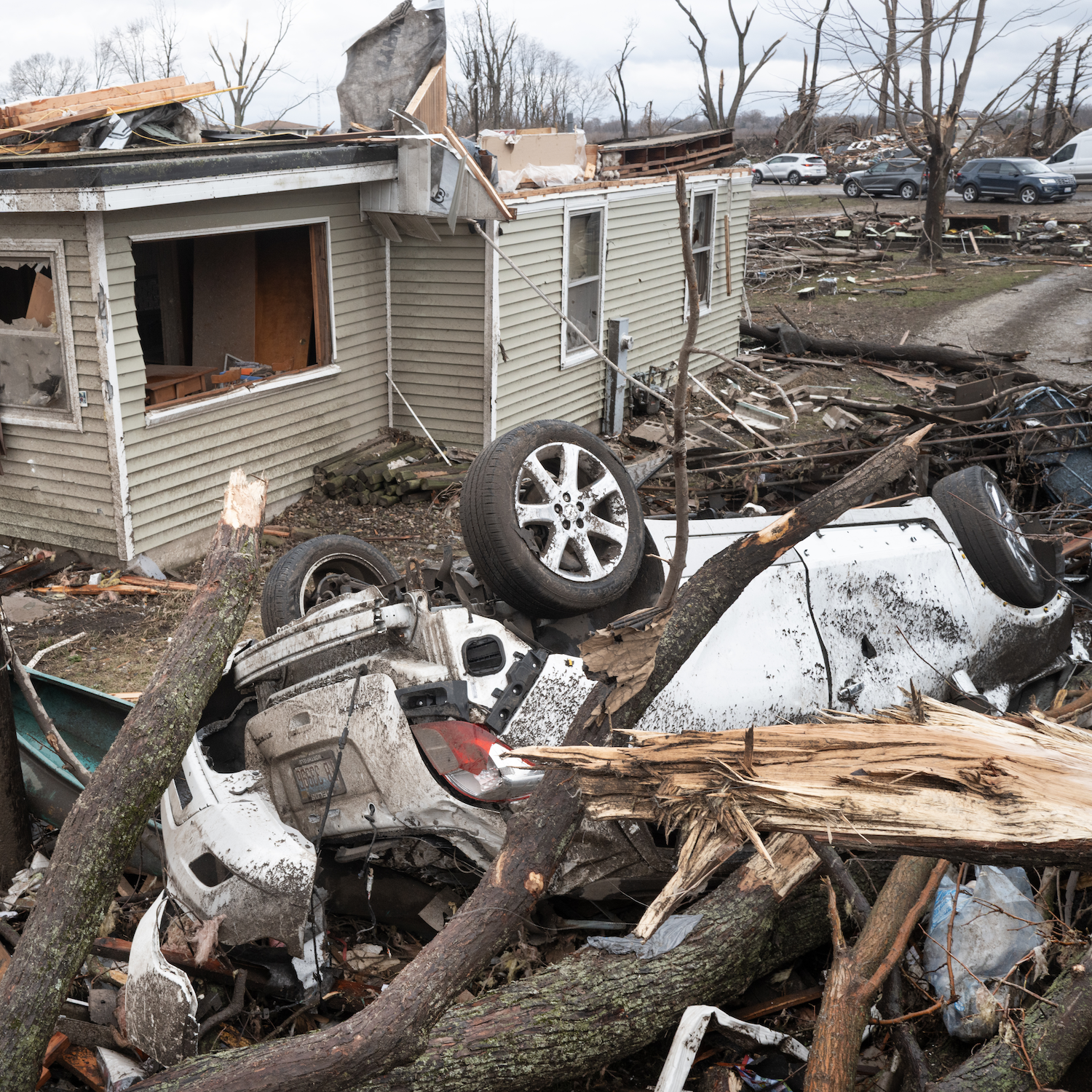
Good morning. We're heading into a week of weather extremes that could cause major upheaval. AP's science reporter maps out what to expect.
- [00:14]
Seth Borenstein
98 million people are going to be under threat for severe storms like tornadoes or just strong thunderstorms.
- [00:23]
Cecilia Lay
Trump turns to other countries for help in avoiding a spiraling energy crisis and how one battle after another won big. At last night's OSC news, it's Monday, March 16th. I'm Cecilia Lay and this is Apple News. Today. It's set to be yet another unpredictable high stakes week in the Middle East. Over the weekend, the US And Iran gave competing signals on when the war might come to an end. On ABC, U.S. energy Secretary Chris Wright tried to reassure Americans that there would soon be relief at the gas pump, but he offered no guarantees.
- [01:06]
Chris Wright
I think that this conflict will certainly come to the end in the next few weeks. Could be sooner than that and we'll see a rebound in supplies and a pushing down of prices after that. But yes, we were very aware, very aware that we would have short term disruption. We would cause a little bit of increased prices on Americans.
- [01:25]
Cecilia Lay
Meanwhile, Trump spoke to NBC on Saturday where he insisted Iran wanted a deal, but that the terms weren't, quote, good enough. But a day later on Sunday, Iran's Foreign Minister, Abbas Arachi told CBS there was no pressure from their side for a quick resolution.
- [01:41]
Abbas Arachi
It's not a war of survival. We are stable and strong enough. We are only defending our people and we don't see any reason why we should talk with Americans because we were talking with them when they decided to attack us. And that was for the second time. There is no good experience talking with Americans.
- [02:02]
Cecilia Lay
In the days ahead, all eyes will be on a narrow channel of water where the fate of the global economy currently lies. Iran has kept the Strait of Hormuz, the world's most important shipping route, effectively closed. And no obvious alternatives exist to replace the lost supplies. Diplomacy also doesn't seem to be working. So now eyes are on Trump to see if he'll turn to military force to open the strait. Trump has suggested the US Navy could escort tankers on their routes. But on CNBC last week, Energy Secretary Chris Wright was hopeful of anything imminent.
- [02:35]
Chris Wright
It'll happen relatively soon, but it can't happen now. We're simply not ready. All of our military assets right now are focused on destroying Iran's offensive capabilities.
- [02:46]
Cecilia Lay
The Pentagon has reportedly begun moving around 2,500 U.S. navy reinforcements into the Middle east to support efforts near the strait. Trump also urged other nations to join him in sending warships there to help secure the route. In the meantime, he said, the US Would continue bombing the shoreline and attacking Iranian boats. But even if other countries joined, there's no guarantee that the strait would reopen because of the risks facing traders. Industry insiders have told Reuters that only Iran could offer enough reassurance to resume shipping. Over the weekend, oil prices rose as the US Targeted another site northwest of the strait, Hag Island, a strip of land in the Persian Gulf. It's a key processing hub for Iran's oil exports that's essential to its economy. US Struck the island, but they stopped short of hitting oil facilities. Aaron McLean, senior fellow at the Hudson Institute and a former marine, explained the significance on cbs.
- [03:45]
Aaron McLean
Carg Island's this really small piece of terrain on which there are really only three things oil, infrastructure, gazelles, and the military means to protect them. And now there's just oil infrastructure and gazelles. The military stuff reportedly is all gone, but obviously he now feels like he needs leverage because Iran has closed the Strait of Hormuz. The president has linked the vulnerability now of Kharg island to Iran's continued closure of the Strait of Hormuz.
- [04:08]
Cecilia Lay
On Saturday, Iran accused the US of using bases in the United Arab Emirates to strike Kharg island and threatened to attack infrastructure in response. In other updates over the weekend, the Pentagon identified the six U.S. military members who died last week when a refueling aircraft crashed in Iraq under circumstances that are still being investigated. Their deaths bring the total number of American service members killed to at least 13. According to Iran's UN representative, at least 1,348 civilians in the country have been killed since the war began. This Friday marks the start of spring, but it's not going to feel like that for millions of people across the country because of extreme weather.
- [04:57]
Abbas Arachi
This storm system alone bringing a whole host of issues, starting with blizzard conditions in parts of the upper Midwest into the Great Lakes.
- [05:04]
Chris Wright
There's also the risk for even a few tornadoes. You can see the zone here from eastern portions of Arkansas into western Tennessee, parts of the lower Ohio Valley here.
- [05:12]
Abbas Arachi
Really, this is just the beginning of a prolonged period of high heat, including 100 degrees plus not just for one
- [05:20]
Chris Wright
day, but for several days in a row.
- [05:23]
Cecilia Lay
To make sense of what's going on, we caught up with Seth Borenstein, a science reporter with the Associated Press. He says Southwest cities like Phoenix are experiencing oppressively warm weather because of what's known as a heat dome.
- [05:37]
Seth Borenstein
Like you're trapped under a glass and the sun is bearing down on you. That's one way to think about it. And so the US Record for the hottest March day in the United States is 108. And that was in a place called Thermal California, which is a wonderful name for a hot record. And we are going to be threatening that, flirting with it, and maybe even breaking that somewhere this week.
- [06:03]
Cecilia Lay
Meanwhile, temperatures plummeted in the northern part of the country, in some cases into the single digits. And lower blizzard conditions hit parts of Minnesota and Wisconsin over the weekend.
- [06:14]
Seth Borenstein
There's all this arctic air that is in Canada right now. It's the polar vortex we've learned to know, and many of us not like. And we've had that happen a few times this winter. Winter, pretty cold air. So given that it's March, this is not going to be as cold as some of the polar outbreaks we've had. But it's March, so it will feel cold because it's so unusual. Anomalous is the word meteorologists love. But it's so off normal, we're looking in places in the Southeast that might get into the 20s.
- [06:51]
Cecilia Lay
And the final threat, storms will hit a large swath of the east coast today, affecting nearly 100 million people.
- [06:58]
Seth Borenstein
So it's basically in an area from the Florida Panhandle up to New York, this giant area where a lot of people live. The strongest risk, the highest risk, is from South Carolina up through to Baltimore, a little north of Baltimore area, even
- [07:17]
Cecilia Lay
Hawaii is experiencing extremes, breaking daily rainfall records and facing flash flood warnings. Borenstein says underlying much of this whiplash weather is a jet stream, a river of air that normally looks like a small roller coaster with mild dips, but now those dips are steep. One meteorologist told Borenstein that when they look more and more like vertical drops, the result is extreme conditions happening next to each other like blizzards, tornadoes and heat waves. Bornstein reminded us of this old weather proverb that says, March comes in like a lion and goes out like a lamb. Not this year, it seems. And we may be seeing more marches like this in the years to come.
- [07:57]
Seth Borenstein
I often ask scientists, is this our new normal? And their phrase usually is no. Because as the world warms, weather gets more extreme. So we may be looking back at this as the good old times.
- [08:17]
Cecilia Lay
Last week, the Senate passed a massively successful piece of legislation. It was the biggest federal move on housing in decades, and it was bipartisan.
- [08:27]
Sahil Kapoor
This bill passed with 89 votes in the Senate, which is just extraordinary. You don't see that very often, even on small things, let alone a major piece of legislation like this, which is about housing affordability. So there's a lot in here that both parties found agreement on.
- [08:43]
Cecilia Lay
Sahil Kapoor is a senior national politics reporter for NBC News. He told us about the Senate's bill called the 21st Century Road to Housing act, which was led by Republican Senator Tim Scott and Democratic Senator Elizabeth Warren.
- [08:57]
Sahil Kapoor
It includes a series of grants and pilot programs for housing construction. So it's all about increasing the supply of housing, which is a major concern because housing prices have gone up for renters and for home buyers. And this is a way to try to combat that. And the other thing it does is that it prevents Wall street, so investors private equity from buying up lots of single family homes and increasing the price.
- [09:21]
Cecilia Lay
The bill also seeks to speed up home building by relaxing regulatory barriers. Scott, the Republican champion of the legislation, spoke with CNBC last week about the rare consensus that he and his colleagues
- [09:34]
Tim Scott
had reached when President Trump and Elizabeth Warren and the Senate majority Republicans can all come to the same place on a housing bill. What it says is you put partisan politics aside and you ask yourself what is one of the most profound issues impacting the American people? My mother became a first time homeowner at 38. Today it's 40, 40 years old. We all see the pain and the misery the average person is going through in this country. And I gotta tell you, solving that problem requires us to have a bipartisan coalition.
- [10:05]
Cecilia Lay
And yet, as the House returns this week, the bill faces an uncertain future as both Democrats and Republicans want to make changes to it and as Trump has signaled other priorities.
- [10:16]
Sahil Kapoor
This thing has a long way to go before it gets to the president's desk. But suffice it to say, it comes down to Trump in terms of what he wants and how badly he wants this version or that version or whatever. In terms of pressuring House Republicans.
- [10:31]
Cecilia Lay
As we talked about last week, the President has been far more focused on the Save America Act, a sweeping voter ID bill that would require proof of US Citizenship. He's been so fixated that he allegedly pushed for it in stern terms to House Speaker Mike Johnson.
- [10:47]
Sahil Kapoor
What we are told by one lawmaker with knowledge of this is that Speaker Johnson told Republican leaders at their annual retreat that Trump wants to Save America act as his top priority and that Johnson told members, Trump privately emphasized to Johnson that the Save America act is so important. And he said, the president said, quote, no one gives a bleep about housing, end quote. That is Trump talking to Johnson, according to a lawmaker who was there. Now, we reached out to the White House who denied that the president is unfocused on housing affordability and that he does want action on this issue.
- [11:20]
Cecilia Lay
As Republicans juggle a host of priorities this year, Kapoor said that the housing legislation could be more appealing to a particular set of voters.
- [11:28]
Sahil Kapoor
If you talk to independents and swing voters and some of the voters who flipped from Democrat to Republican in 2024 because they were worried about the economy and costs, housing affordability is a much bigger issue to them than election laws. That would be a rare achievement that Republicans could take back to their constituents and say we did something on housing affordability and something on lowering costs in general, which they have really, really struggled with.
- [11:54]
Cecilia Lay
The House and Senate will need to negotiate the final terms of the package before it reaches Trump's desk. He might decide to block it, but NPR notes that he could also simply take no action, allowing it to become law without his sign. And finally, a few other stories we're following. The long lines and delays continue at airports and over the weekend, TSA airport workers missed their first full paycheck thanks to the partial government Shutdown. Now the CEOs of the major airlines are urging lawmakers to put an end to it as the spring season kicks in. The CEOs of Alaska, united, Southwest and Delta, among others, urged lawmakers to not only fund the Department of Homeland Security, but pass three previously introduced pieces of legislation that would guarantee pay for security workers, air traffic controllers and customs agents during shutdowns. DHS has been shut down for a month now. It's been more than two weeks since the White House's latest proposals, and there are no signs of any breakthrough. Over the weekend, President Trump urged unpaid employees to continue going to work, posting on social media that he would, quote, never forget them. In sports, March Madness kicks off this week as the 2026 NCAA Men's and women's basketball tournaments get underway. Yesterday was Selection Sunday, and in the men's draw, Duke is the overall number one seed in the East Region. Arizona, Michigan and Florida are the other 31 seeds. The first four men's playing games begin Tuesday. Meanwhile, on the women's side, the undefeated Yukon Huskies are the number one overall seed out of the Fort Worth region, and they are joined by the seeds UCLA, Texas and South Carolina. The men's final four and championship games are April 4th and 6th in Indianapolis. The women play their final four in title games in Phoenix on April 3rd and 5th and at the Oscars last night, it was a succession of wins for one battle after another. The action thriller with a warning about authoritarianism it took home six awards, including best picture Director. Paul Thomas Anderson finally won best director after 14 past nominees, placing him firmly among the industry's greats. He struck a political tone in his acceptance speech for best adapted screenplay.
- [14:23]
Chris Wright
I wrote this movie for my kids to say sorry for the housekeeping mess that we left in this world we're handing off to them, but also with the encouragement that they will be the generation that hopefully brings us some common sense and decency. My Pearl, Lucy, Jack and Ida. I love you. Thank you very much.
- [14:45]
Seth Borenstein
Thank you very much.
- [14:46]
Cecilia Lay
It beat out nine other films, including Sinners, which had a record breaking 16 nominations, but in the end took home four Oscars. Among those was a best actor win for Michael B. Jordan, delivering something of an upset against Timothee Chalamet. Jess Buckley, meanwhile, won best actress for her performance in the historical drama Hamnet and Sinner's Autumn. Derald Arkhipa made history as the first woman to win best cinematography for her work in Sinners. The night was hosted by Conan o' Brien for the second time, and there were moving tributes for the late Rob Reiner and a surprise performance from Barbra Streisand during a tribute to the late Robert Redford. There was also a rare tie for the Live Action Short category, but apparently Time Press producers weren't in the mood to offer more time to both speeches. It led to an awkward moment for the audience as the lights were turned off and the microphone began retracting from the stage as the winner spoke. Adrien Brody, take note. You can find all these stories and more in the Apple News app. And if you're already listening in the News app right now, we've got a narrated article coming up next. The New Yorker has a story about Alexander Friedman, one of the most respected prison reform activists in the country, and why he repeatedly broke into a Nashville prison for months. If you're listening in the podcast app, follow Apple News Narrated to find that story and I'll be back with the news tomorrow.