Loading summary
Transcript21 lines
- [00:01]
Shemitah Basu
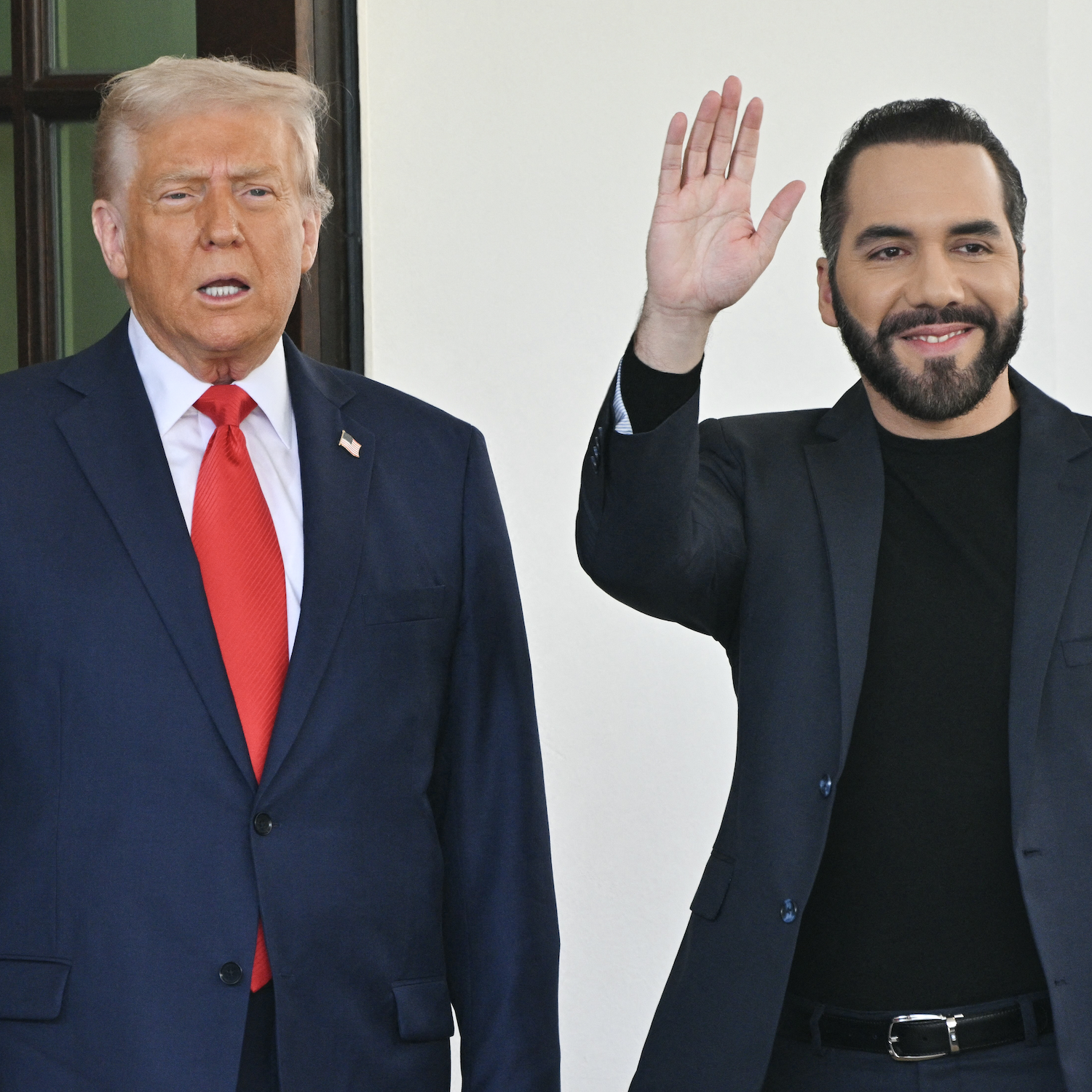
Hey there, it's shemitha. I've got a quick request for you. If Apple News Today is an essential part of your morning routine, follow the show in Apple Podcasts. And if you have another 30 seconds, leave us a rating and a review, too. It helps other people find our show and it helps us know what you like about it. Thanks. Good morning. It's Friday, April 18th. I'm Shemitah Basu. This is Apple News Today. On today's show, how the Salvadoran president found an ally in President Trump, a federal indictment in the United Healthcare CEO killing, and why some people are painting potatoes for Easter. Let's start with the big story all this week, which has been Trump's defiance of a Supreme Court order to bring back Kilmar Abrego Garcia, a father of three kids living in Maryland with no criminal record who was wrongly deported by the Trump administration to El Salvador's harshest prison. Yesterday, Maryland Senator Chris Van Hollen, a Democrat, visited Abrego Garcia, who is his constituent. He initially tried to visit him at the prison, but says he was denied entry. Hours later, Van Hollen was able to meet him at a nearby hotel and said he just wanted to confirm Abrego Garcia is doing okay and underscore that he deserves due process. The man behind Abrego Garcia's detention, as well as the detention of hundreds of other migrants deported by the Trump administration, is El Salvador's president, Nayib Bukele, who's become a key ally of Trump's and has said that he'll take no action to release Abrego Garcia. How can I return him to the United States? Like I smuggle him into the United.
- [01:50]
Vera Bergengrun
States or what do I do?
- [01:51]
Shemitah Basu
Of course I'm not going to do it. It's like the question is preposterous. For more about the rise of Bukele and how he became one of Trump's most crucial and supportive foreign allies, I called up Vera Bergengrun, a national security reporter at the Wall Street Journal who profiled Bukele for Time last year. I started by asking her to give me some background on Bukele and how his relationship with Trump initially started.
- [02:17]
Vera Bergengrun
The most important thing to know, I think, about him, is that he has an advertising background. He comes from a wealthy family in El Salvador, and his image has been all about rebranding. He wants to rebrand himself. He wants to rebrand his country. And when he was elected, he went about that by trying to change people's perception of El Salvador. He wanted to move away from this Dangerous country that was being completely overrun by gangs. Now when you walk into the airport, it says, you know, the land of surf, volcanoes and coffee. And for him, one of the best ways to do that was building up this image that is very appealing to right wing Americans, to MAGA Americans, this tough on crime guy who was brave enough to take on the courts, take on his own country, take on corruption to great effect. I mean, it is very safe now and it's been very effective at earning him a lot of allies in Trump's inner circle.
- [03:10]
Shemitah Basu
Yeah, I'll just say this stat from your piece, Farah, is it was kind of mind boggling. You write that Bukele has incarcerated one out of every 57 people in his country.
- [03:20]
Vera Bergengrun
Correct. It's the highest incarceration rate in the world. And yet again, it is something where he's able to say, you know, I mean, he said this at the Oval Office this week. He said we imprisoned this many people, but we liberated millions. That's of his message. I think we underestimate how appealing all of that is to a lot of Americans, to a lot of right wing Americans or Republicans. We see them echoing a lot of this. And I've said this before, but it really struck me in years of reporting on this, on how much of what Bukele is doing is kind of a MAGA fever dream. You know, he gets rid of judges, he swaps out lawmakers he doesn't like. He's basically running a one party state because the other party exists, is just completely weakened because there isn't really a real opposition and because there so much popularity for his measures.
- [04:06]
Shemitah Basu
Well, what I thought was interesting also in your piece, you mentioned how some of his harshest critics, even some people within the Biden administration at the time were, were kind of courting Bukele's favor. Help me understand why.
- [04:20]
Vera Bergengrun
You know, there's two things. Number one, he helped the US Solve its own problem. Because by making El Salvador safer, by allowing people to go back, you know, there was less of a migration pressure. You know, Salvadorians weren't fleeing the gangs and, you know, the US Saw something that was benefiting as they were dealing with a crisis at the border. And for them in many ways a stable El Salvador, even if it was something that they would consider approximating a police state, was just not worth fighting in that particular way. And the other thing is just that he does have a real 90 plus percent approval rating. And this isn't a Vladimir Putin sham approval rating kind of thing. It's real. I'VE spoken to so many people who have family members in jail who still prefer to live this way because they can live. They can. They don't have to be worried for their lives. I think it's hard to overestimate just how horrific life under the gangs was.
- [05:15]
Shemitah Basu
Very complicated.
- [05:17]
Vera Bergengrun
Yeah.
- [05:17]
Shemitah Basu
So what do you make of the way that Bukele has been handling this storyline now of Venezuelans being deported to El Salvador by the US Agreeing to incarcerate them in El Salvador? I mean, what is in it for Bukele? Why strike this deal with Trump?
- [05:37]
Vera Bergengrun
I think, again, if we put ourselves in his shoes, the leader of a country of 6 million people, a poor country, a country that has given it more visibility than it has ever had, except for wars, basically, you know, the fact that people consider this a success story and someone who had so many human rights groups and the US Itself, European countries going after him from human rights violations for anti democratic norms, and having the world's most powerful country court him, give him the honor of one of the first Oval Office visits, constantly praise him, and it's kind of a victory lap, but he's clearly hoping to capitalize on it. And what's in it for him? He's already gotten what he wanted beyond his wildest dreams. When I interviewed him last year, he could not have imagined that the US Would be paying him to deport people to his own prison and then praise it and retweet his videos and, you know, would show pretty harsh treatment. It's almost like he feels like all of these countries are coming around to his model. And not only that, but again, I mean, there's obviously a financial benefit. He's hoping to kind of become a penal colony for the U.S. well, so.
- [06:43]
Shemitah Basu
The Trump administration has been claiming that there is nothing that they can do to bring back the man who was wrongfully deported, as they have acknowledged mistakenly deported Kilmar Abrego Garcia, who ended up in this prison in El Salvador and is still there, the administration says now they cannot do anything to bring him back. When the Supreme Court weighed in on this earlier this week even, and they said that the government's argument that the US Courts cannot do anything once a deportee has crossed the border is, quote, plainly wrong. And now Trump is talking about expanding this relationship, as you said, sending U.S. citizens to be incarcerated in El Salvador, if that were to happen, which, just to be clear, is illegal, what he's talking about, what are the possible options for recourse in the US Courts, maybe even in international courts that's a great question.
- [07:35]
Vera Bergengrun
I think it's a completely new world out there. I mean, even legal experts, they say it's technically unconstitutional. But we've never really had this happen in this particular way. The idea of deporting US Criminals to a foreign prison. There's a lot of questions about the long term feasibility of this. But in terms of what recourse there is, I think we're finding not much. You know, I think a lot of focus will be on the money that the United States is paying. So far we know of $6 million for one year, but of course that's going to be more. If they sent more people, where's that money coming? Is it legal to pay a foreign country to imprison people in this way? That could be one way that lawmakers have to do that. They could also maybe hold up or try to question different kinds of foreign aid to El Salvador that is not tied to the prison. But all of this is just new. I don't think there's really a playbook for this.
- [08:25]
Shemitah Basu
I was struck when I was rereading your timepiece, which again, you wrote last summer before Trump had been reelected. You wrote, for Bukele's admirers, el Salvador has become a showcase for how populist authoritarianism can succeed. And his second term will be a test of what happens to a state when its charismatic young leader has an overwhelming mandate to dismantle its democratic institutions in pursuit of security. Again, you wrote this before Trump was back in office for his second term. What do you think are the risks for other countries, for the world, if the US Continues to legitimize the Bukele regime as it creeps toward authoritarianism?
- [09:06]
Vera Bergengrun
When I wrote this last year, it was a big worry and concern in the region because we've seen Honduras and Ecuador, for example, both try to start building these mass prisons as well. They are trying to institute their own state of emergency, which basically allows them to suspend due process for people in order to put them in. And I think what can be underestimated is in a region struggling with security issues, just again, the question is really, what do you do when something is that popular? Because it is. You know, he's broadcasting this. He's the most popular world leader on TikTok, and he has these very cinematic TikTok videos showing the harsh treatment in his prisons. And when you look at the comments, it's comments from all over the world, from Europe to Asia, Africa. All of them are saying, we need our own Bukele in Ethiopia, in Netherlands, it is overwhelmingly positive. There's a simplicity to what Bukele is doing that is difficult to fight, like the idea that if somebody is a violent criminal, you should just lock him up. And if somebody's an alleged violent criminal, you should still lock him up. Because even if a couple of innocent people get caught in the process, it allows millions to live a safer life. And it is such a simple message that is really difficult for human rights concerns, due process concerns, to fight in this moment. El Salvador is an extreme, but I think we're going to see a lot of countries just experiment with that and see where it goes.
- [10:26]
Shemitah Basu
Vera, thank you so much for your time.
- [10:28]
Vera Bergengrun
Thank you so much.
- [10:36]
Shemitah Basu
Before we let you go, a few other stories we're following. Luigi Mangioni, the man charged in the killing of United Healthcare CEO Brian Thompson, was indicted on federal murder charges Thursday. The charge carries a maximum penalty of death if convicted. The Justice Department said it will seek the death penalty. Mangione pleaded not guilty to state charges of murder and terrorism at Florida State University yesterday. At least two people who were not students were killed and at least six others were hospitalized after a gunman opened fire Thursday morning. Local authorities have a suspect in custody. He is the son of a sheriff's deputy. Authorities on the scene recovered a handgun that belonged to the suspect's mother, who served in the local county Sheriff's department for 18 years. The suspect was shot and wounded by police before being taken into custody. In Gaza, Hamas says it's ready to engage in negotiations to release all remaining hostages and end the war. A senior Hamas official said in a televised speech that it will no longer agree to interim deals. Mediators have been working to revive the ceasefire, but there has been little progress. Israel recently proposed a 45 day truce to allow for hostages to be released and to engage in talks to end the war. Hamas rejected one of the conditions, that it lay down its arms. Reuters reports Israel has vowed to continue fighting until all hostages are released and Gaza is demilitarized. In recent weeks, Israeli troops have seized more than a third of the Gaza Strip. And finally, with the price of eggs still stubbornly high, it's a tough year to plan an Easter egg hunt on a budget. So people celebrating Easter this weekend are turning to some creative alternatives to keep traditions going. Pa Potatoes is one suggestion. I'm not saying it's a good one, just that it's being floated. Marshmallows in particular are having a moment. The city of Bethlehem, Pennsylvania, is very busy churning out peeps. Did you know that every single marshmallow peep you buy comes from this place. I didn't ABC News has a guide to how you can dye marshmallows and other alternatives to eggs that we'll link to in our show notes. You can find all these stories and more in the Apple News app. And if you're already listening in the News app right now, stick around for our weekly show. In Conversation As Harvard's dispute with the Trump administration escalates, I spoke with Wesleyan University President Michael S. Roth, who's been a vocal opponent of recent threats to higher ed about what the administration is trying to achieve and the implications for our country.
- [13:15]
Vera Bergengrun
I go back to the teachings of the rabbis. Beware of a government that pretends to be your friend, because if they don't use laws, they don't use principles. Principles, they can turn into your enemy very quickly.
- [13:26]
Shemitah Basu
If you're listening in the Apple News app right now, that episode is queued up to play for you next. Enjoy the weekend, and I'll be back with the news on Monday.