Loading summary
Transcript23 lines
- [00:01]
Shemitah Basu
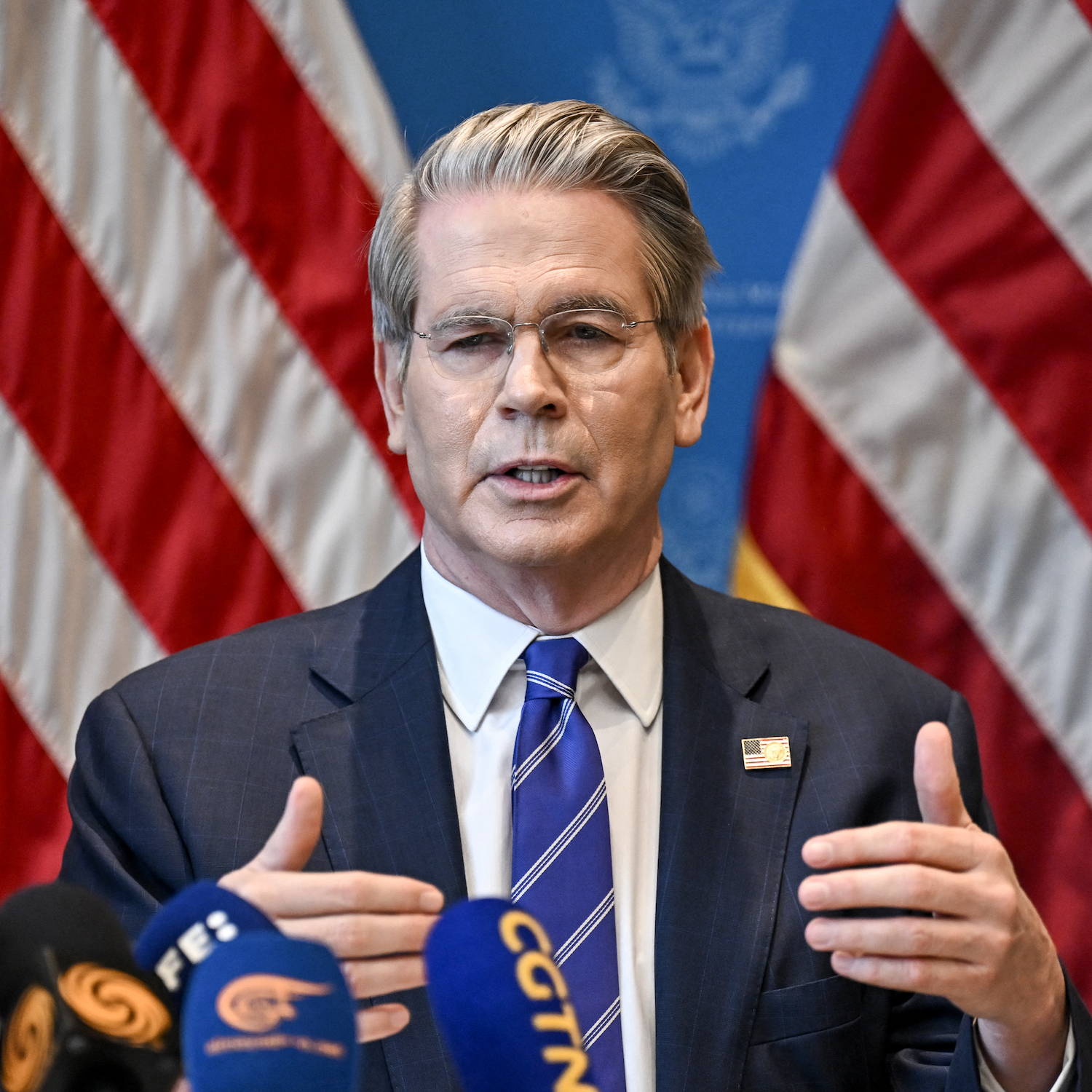
Hey there, it's shemitha. I've got a quick request for you. If Apple News Today is an essential part of your morning routine, follow the show in Apple Podcasts. And if you have another 30 seconds, leave us a rating and a review, too. It helps other people find our show and it helps us know what you like about it. Thanks. Good morning. It's Monday, May 12th. I'm Shemitah Basu. This is Apple News Today. On today's show, the administration's threat to suspend a core constitutional right why the chaos at Newark could soon spread to other airports, plus why Trump accepting a Qatari jet is raising ethics concerns. But first, to major breaking news on tariffs. The US And China reached an agreement to temporarily lower tariffs on each other's products to By Wednesday, the US says it will reduce its 145% tariff rate on most Chinese imports to 30%. And China says it will reduce its 125% tariff rate on US goods to 10%. Here's US Treasury Secretary Scott Besant speaking from Geneva.
- [01:18]
Scott Besant
We concluded that we have shared interest and we both have an interest in balanced trade. The US Will continue moving towards that.
- [01:31]
Shemitah Basu
The reduced tariff rates between the world's two largest economies will last for 90 days while the two sides continue negotiations, offering a major sigh of relief to the global economy. Global trade was effectively halted because of the previous tariff rates. Here's CNN's international correspondent Mark Stewart reporting from Beijing for the Network this morning.
- [01:53]
Scott Besant
There's also a very symbolic accomplishment that's important. Number one, we are having this joint statement. The fact that both of these nations put out a statement together to say that they are committed to some kind of economic fairness between them, that's a very big deal. It's just not something we see that often.
- [02:13]
Shemitah Basu
Also important, Stewart points out there's now an established open line of communication between Washington and Beijing.
- [02:20]
Scott Besant
China really prefers diplomacy. 101 back channel conversations, whereas President Trump, if he had his way, he would call President Xi directly. That's just not in the Chinese style. But while there are certainly high hopes, a lot of optimism, there's also some caution. We're hearing very guarded statements from Chinese.
- [02:40]
Shemitah Basu
Government officials, like this statement from China's vice premier.
- [02:43]
Scott Besant
We're going to promote new development in the China U.S. trade and economic relations and inject more certainty and stability into the world economy. China's position towards this trade war has been clear and consistent. And that is China doesn't want to fight a trade war because trade wars produce no winners. But if the US Insists on forcing this war upon us. China will not be afraid of it and will fight to the end.
- [03:10]
Shemitah Basu
This 90 day pause is sure to be well received by many businesses in both the US And China, but there's still a lot of uncertainty ahead. As the president of the European Union Chamber of Commerce in China said of this development, businesses need predictability to maintain normal operations and make investment decisions. And the New York Times reports that it's likely that the cost of transporting goods will soar as companies race to schedule shipments during the 90 day window. Just in case of whatever comes next, let's turn now to immigration. A group of white South Africans is arriving in the United States. They were invited here on a US Funded charter plane by President Donald Trump, who says he's offering refugee status to white people in South Africa who say they have been victims of discrimination. Their welcome from the Trump administration, which has expedited the refugee process for this group, is in stark contrast to the immigration policy being imposed on most other groups that once had refugee status, whether that's people fleeing famine in Sudan or economic hardship and political violence in South America. It also comes as Trump's deputy chief of staff, Stephen Miller says the administration is actively looking at suspending habeas corpus, the constitutional right for people to legally challenge their detention by the government. The Constitution dictates that this right cannot be suspended unless there is a rebellion or invasion. Trump has referred to recent record levels of migration as an invasion, whether those migrants qualify as refugees or not, and invoked the Alien Enemies act to accelerate the deportations of some groups of people, which the Supreme Court has blocked for now. Miller recently took aim at judges opposing deportations while speaking to reporters. The courts aren't just at war with the executive branch. The courts are at war these radical rogue judges with the legislative branch as well, too. So all of that will inform the choices the president ultimately makes. Although Miller framed this as a Trump decision, it would need congressional approval. The same day that Miller made those comments, a federal judge ordered the release of a Turkish student at Tufts University who had spent the last six weeks in a Louisiana ICE detention center. Rumeysa Ozturk was detained back in March after her student visa was revoked. The only reason given was her support for pro Palestine causes. She has now been released on bail and is challenging the decision to revoke her visa, saying she has faith in the American system of justice. Her congresswoman, Ayanna Pressley, who is a Democrat from Massachusetts, spoke out this weekend about her situation. She should never have had her visa revoked. She should never have been transported almost 2,000 miles away to an ICE facility in rural Louisiana and subjected to squalid, inhumane conditions. We also saw tensions over migration spill over in New Jersey this weekend, where Newark Mayor Ross Baraka was arrested while protesting at a newly opened privately run federal immigration detention. Cent. Baraka was charged with misdemeanor trespassing and has since been released. The arrest happened while three other New Jersey congressional Democrats were on site for an unannounced inspection. The House representatives were not arrested, but the Department of Homeland Security claimed they were part of a group of demonstrators who tried to force their way into the facility. When a bus of detainees arrived, DHS officials accuse one of them, Congresswoman Bonnie Watson Coleman, of body slamming officials, a claim which she denies. Here she is on cnn.
- [06:59]
Scott Besant
Nothing happened other than the chaos that they created themselves. If anything, we were pushed and shoved in a very vulnerable situation for the three of us.
- [07:11]
Shemitah Basu
And there have been videos going viral on social media of chaotic scenes in Worcester, Massachusetts, after crowds of people showed up to try to stop from detaining people from that community.
- [07:23]
Scott Besant
Stop, ma' am, stop.
- [07:25]
Shemitah Basu
Stop. At least two people were arrested, including a 16 year old girl whose mother had been detained by ICE. Hundreds of protesters gathered yesterday afternoon to oppose the arrests and ICE presence. Meanwhile, Trump is showing no signs of slowing down any of these efforts. He recently announced an order for 20,000 more deportation officers, though as yet, it's unclear how that would be funded. That would mean more than quadrupling the number of ICE officers who focus solely on rounding up and deporting immigrants. Now let's turn to major disruptions at US Airports. On Friday, there was another complete radar outage at a facility in Philadelphia that lasted about 90 seconds. And it comes after a similar outage the week before. The outages meant that for those 90 seconds, air traffic controllers at Newark Airport could not communicate with airplanes, a critical function that ensures that planes don't crash into one another. And the fallout lasts for days. Speaking to NBC's Meet the Press on Sunday, Transportation Secretary Sean Duffy warned that these problems caused by aging infrastructure could soon go beyond Newark.
- [08:44]
Scott Besant
Congress and the country haven't paid attention to it. Right. They expect it to work. And so now I think the lights are blinking, the sirens are turning, and they're saying, listen, we have to fix this, because what you see in Newark is going to happen in other places across the country. It has to be fixed.
- [08:58]
Shemitah Basu
There were other issues this weekend, too. Yesterday on Mother's Day, Newark had to ground flights for about 45 minutes due to an air traffic equipment issue. According to the Federal Aviation Administration, there was also a ground stop at Atlanta's airport on Sunday due to a Runway equipment issue. Duffy said that it is safe to fly, but stressed just how dated some of our technology is.
- [09:22]
Scott Besant
I'm concerned about the whole airspace, right? The equipment that we use, much of it. We can't buy parts for new. We have to go on ebay and buy parts. If one part goes down, you're dealing with really old equipment. We're dealing with copper wires, not fiber, not high speed fiber. And so this is concerning.
- [09:39]
Shemitah Basu
Duffy has proposed a multibillion dollar plan to modernize and overhaul the country's air traffic control system. He wants to upgrade radio systems, raise the mandatory retirement age for air traffic controllers, and invest in digitizing data management tools. But even if Congress approves his proposals, don't expect a quick fix.
- [09:59]
Scott Besant
It takes time to build the infrastructure. I say it's going to be three to four years to build it all. But we're going to focus on Newark first. We're going to start to see Newark be far resilient in the near term. But air traffic controllers were 3,000 short on air traffic control. I can't snap my fingers and bring in these highly skilled air traffic controllers.
- [10:19]
Shemitah Basu
Meanwhile, he said travelers shouldn't be surprised if there are disruptions through the summer. Some passengers at Newark expressed their frustration on msnbc.
- [10:28]
Scott Besant
I was delayed getting in here on.
- [10:30]
Shemitah Basu
United and I'm getting delayed getting out of here on JetBlue. I'm just a little annoyed because I've never been delayed so much in my life.
- [10:37]
Scott Besant
We found out when we were down in baggage claim and they said that the flight, you know, you know, we.
- [10:41]
Shemitah Basu
Looked at the United app and they said the flight had been canceled. I can't believe that something like this could happen like this, you know what I mean? On Wednesday, Duffy is scheduled to meet with some of the industry's top leaders where they'll discuss a plan to possibly scale back the number of flights going in and out of Newark. Before we let you go, a few other stories we're following. Trump is preparing to accept a luxury jet from the Qatari royal family that will be used as Air Force One. According to ABC News, it could be the most valuable gift ever given to the United States by a foreign government. A commercial Boeing 7478 costs roughly $400 million. ABC News spoke with officials with knowledge of the matter who say that Trump plans to transfer ownership of the plane to the Trump presidential Library foundation when he leaves office. Democrats and experts in government ethics expressed outrage over the conflicts of interest it could raise as Trump represents America's interests in the region. A Qatari media spokesperson denied that the jet would be a gift and described it as a possible transfer of an aircraft between Qatar's Ministry of Defense and the US Defense Department. Staying in the Middle East, Hamas is releasing the last living American hostage as Trump prepares to visit the region tomorrow. 21 year old Idan Alexander is an Israeli soldier with dual citizenship, and his release comes after days of secret talks between the US And Hamas. Gazans are currently enduring an aid blockade now in its third month, which the UN described as a cruel collective punishment, while Israel has long claimed that aid is being hijacked by Hamas. And finally, Pope Leo delivered his first Sunday Mass this weekend, where he appealed for, quote, no more war to crowds in St. Peter's Square. He also called for authentic and lasting peace in Ukraine, a ceasefire in Gaza, and called on Hamas to release all remaining hostages. Meanwhile, the Verge has the story of how the pope chose his name, Leo. He said he took inspiration from Pope Leo xiii, who presided over the church during the rise of the Industrial Revolution, when society went through major upheaval. The pope said he feels the world is going through another such era with the rise of AI that will pose, quote, new challenges for the defense of human dignity, justice and labor. You can find all these stories and more in the Apple News app. And if you're already listening in the News app right now, we've got a narrated article coming up next. Vox has a deep dive into the growing health concerns over e cigarettes and why it's causing a public health conundrum. If you're listening in the podcast app, follow Apple News plus Narrated to find that story. And I'll be back with the news tomorrow.