Loading summary
Transcript27 lines
- [00:05]
A
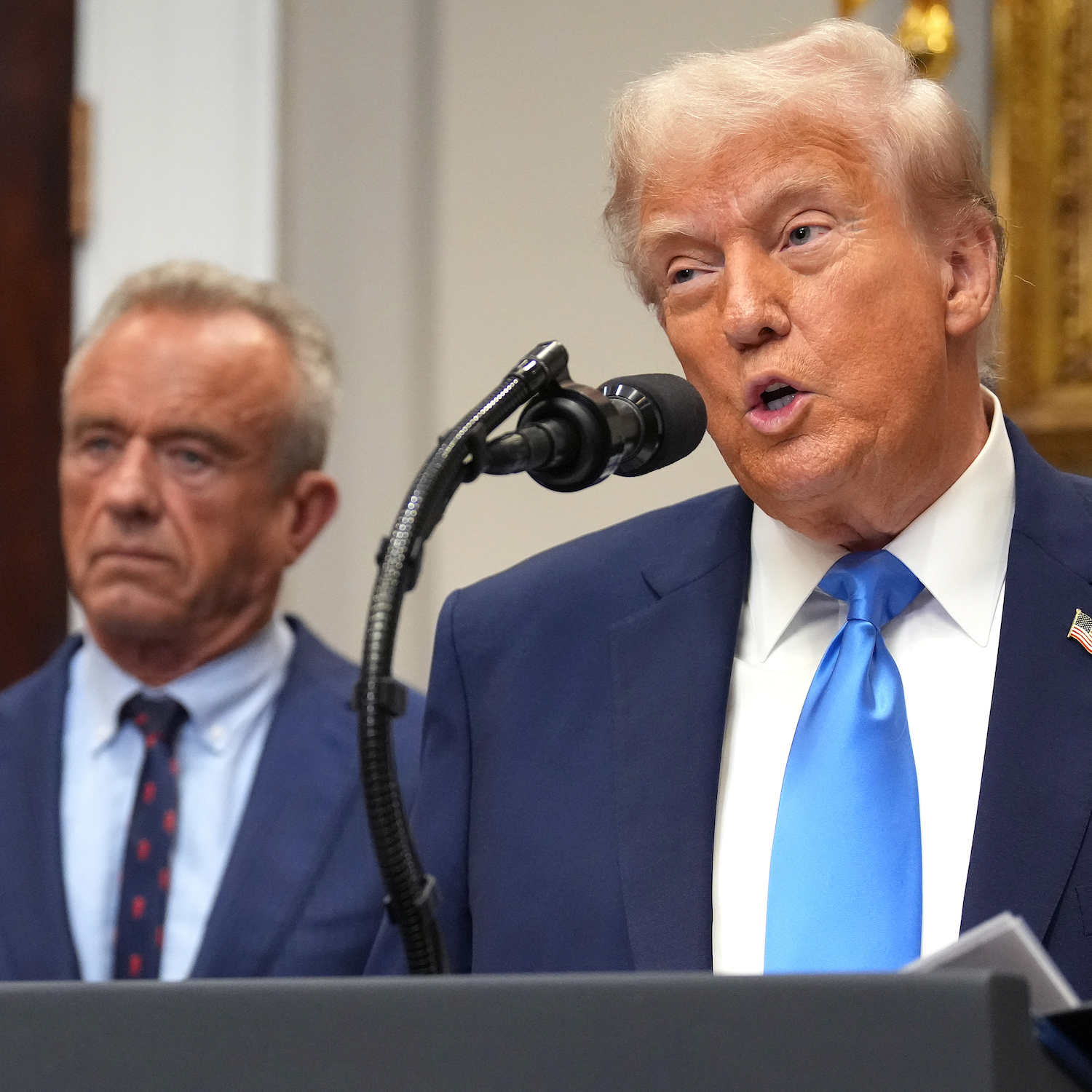
Good morning. It's Tuesday, September 23rd. I'm Shamita Basu. This is Apple News today. On today's show, the chaotic fallout from the H1B visa announcement, the last minute intervention that saved a conscious patient from organ donation, and Jimmy Kimmel is back, kind of. But first to the White House announcement on autism. Yesterday, President Trump and Health Secretary Robert F. Kennedy, Jr. Said they would be warning doctors against recommending Tylenol for pregnant patients, claiming its active ingredient, acetaminophen, was one of the reasons autism rates were rising in the US There is no proven causal link between autism and Tylenol, and it's one of the few pain relief and fever reducing medications considered safe when pregnant and used in line with medical guidance at times. In the announcement, Trump offered his own medical advice and encouraged people to limit their use as much as possible.
- [01:12]
B
All pregnant women should talk to their doctors for more information about limiting the use of this medication while pregnant. So ideally you don't take it at all, but if you have to, if you can't tough it out or if there's a problem, you're going to end up doing it.
- [01:27]
A
Untreated fever or pain can pose risks to a pregnancy and to fetal development. That's why pregnant patients have been directed to use acetaminophen in low doses and short durations. Administration officials did point to recent research that has drawn a potential link between acetaminophen, the active ingredient in Tylenol, autism and adhd. One recent report, for example, from Harvard researchers, suggested there likely was an association. But even in that report, one of its senior authors said further evidence was needed to confirm causality. Now, research related to pregnancy is naturally extremely challenging. It's hard to conduct controlled trials ethically or separate all kinds of environmental and genetic factors. But the body of available evidence, including studies spanning more than two decades of observation, provides no solid scientific basis for the administration's announcement. And the scientific community has been largely critical of it. For its part, Tylenol maker Kenview disputed the administration's claims and said it was, quote, concerned about the health risks and confusion this poses for expecting mothers. There is a consensus that autism is caused by a mix of genetic and environmental factors. And the recent rise in diagnoses has been associated at least partly by a broadening definition of the condition and improved screenings. The other big announcement that came yesterday is that the FDA is set to change the label of the medication leucovorin to make it available to treat autism. The drug is a form of vitamin B9, which is an essential part of neurodevelopment. According to HHS. This establishes the drug as the first FDA recognized therapy for kids with cerebral folate deficiency and symptoms of autism. Dan Diamond, a White House reporter at the Washington Post, told us there is some emerging evidence based on small studies that leucovorin can help autistic children and even some adults.
- [03:29]
C
The theory is that during brain development there might not have been enough folinic acid that got to the brain, sufficient nutrients essentially that would have helped development and as a result led to delays in speech, in understanding language. In these early studies, there has been significant improvement for some who have received this medication.
- [03:50]
A
Similar to the acetaminophen announcement, however, diamond says the administration isn't painting the full picture.
- [03:56]
C
Even the researchers who have been doing this work say it's too early to say for sure that this is the miracle drug that the Trump administration wants to hold it up as.
- [04:06]
A
Diamond says that while parts of the research presented by the administration are valid, politics also played a role in all of this.
- [04:14]
C
And I've spoken with former federal officials who say they're aghast that the formal recommendation from the government is coming on such thin evidence. Again, everyone is optimistic and wants to believe that there are treatments for autism out there and that perhaps this is going to be one. But it's so early and the data is so slight that moving this quickly could lead to problems in the future if it turns out that it's not the wonder treatment that the Trump administration wants to believe it is.
- [04:45]
B
Foreign.
- [04:52]
A
Now onto the impact of another recent White House announcement unrelated about H1B visas. The Trump administration said that it would be making big changes to this type of visa, which allows highly skilled international workers to come to the US to work. There will soon be a $100,000 application fee for new applicants, a big increase from the typical costs of around 2,000 to 5,000 dol. The H1B visa works by lottery system. It's especially popular with tech companies including Apple, financial institutions and consultancies, and the majority of H1B visa holders come from India. When the announcement was made last Friday, it raised a lot of questions.
- [05:34]
D
The response initially was real panic and concern even for large businesses that could stomach higher fees.
- [05:45]
A
That's Andrew Kregbom, an immigration reporter at Bloomberg Law. He told us that it was clear a lot of details were still being worked out. At first, the Commerce Secretary, Howard Lutnick, said it would be an annual fee. So many companies, including JP Morgan and Amazon, not knowing whether this applied to future applicants or current visa holders sent frantic emails to their employees urging them to return from any travels and clear U.S. customs before midnight on Sunday, when the new rule was assumed to be coming into effect. But by Saturday, press secretary Caroline Levitt had clarified that it was a one off fee for new applicants not beginning until next year. Overall, H1B recipients represent a very small percentage of the inward migration number. There's an annual cap of 85,000 people per year, but according to Craig Baum, they have an outsized impact on the U.S. economy.
- [06:40]
D
This program is really the primary pathway for young international talent to start careers in the US and so major overhaul to the H1B program would have pretty huge impacts for a lot of employers and the economy.
- [06:59]
A
This issue doesn't have broad support across Trump's allies. People like Steve Bannon advocate for dropping this specific visa program entirely, arguing that it allows sought after jobs to go to international graduates who will accept lower salaries and that companies could try harder to find skilled workers domestically. A 2020 study by the Economic Policy Institute found that most H1B employers pay migrant workers less than market rate salaries. Here's Lutnick explaining the rationale of the.
- [07:30]
E
Administration no more will these big tech companies or other big companies train foreign workers. They have to pay the government $100,000. Then they have to pay the employee. So it's just non economic. If you're going to train somebody, you're going to train one of the recent graduates from one of the great universities across our land.
- [07:52]
A
But many of President Trump's supporters from the tech world remain strong advocates for H1BS. Bloomberg reports that tech companies rely on H1B visas to make up for the shortfall in science, math and computer skills stateside. Craig Baum told us what it might mean to put a $100,000 price tag on each visa applicant.
- [08:13]
D
It looks like as of right now that the fee would apply to cap exempt employers, which include research institutions, hospitals, universities, nonprofits. It would basically price them out of the program entirely.
- [08:31]
A
With this announcement, Trump also signed an executive order to create so called gold cards for foreigners willing to pay $1 million to live and work in the U.S. perman. Let's turn now to a story about organ donation and harvesting and the thorny issues that arise when a donor written off and prepped for surgery actually shows signs of life. Organ transplants are saving a growing number of lives in the US every year, with more than 48,000 transplants performed in 2024 alone. Yet a number of reports have revealed issues a federal Investigation into a Kentucky nonprofit, for example, found that over the course of four years, medical providers had planned to harvest organs of dozens of patients despite them showing signs of neurological activity. Though the operations didn't take place, it has led federal health officials to promise an overhaul of the system. Kara Anthony is a Midwest health correspondent for KFF Health News. She told us about one case out of St. Louis in 2019 that took a dramatic turn when a neurosurgeon named Dr. Zoni Zoni stopped an organ harvesting moments before it was set to occur.
- [09:53]
F
He runs quite breathlessly into the OR saying, get him off the table. This is my patient. He shouldn't be here.
- [10:04]
A
The patient was 22 year old Larry Black Jr. Who had arrived at the hospital with a gunshot wound to his head and was placed in a medically induced coma.
- [10:13]
F
It was his medical opinion that it was too soon for Larry to be even considered as an organ donor candidate because he hadn't done a brain death exam. Larry's heart was still beating and he was really certain that Larry had a chance at life.
- [10:37]
A
Anthony said that it's still not totally clear how Black ended up in the operating room under the conditions that he did. The hospital hospital declined to comment on the details of this case to KFF Health News. Black attests that he attempted to communicate while in the coma.
- [10:53]
F
He desperately tried to show his family that he was still there, that he could hear them even though he couldn't speak. He attempted several times to tap on the side of the bed, but when the family raised this and told the nurses and different hospital staffers what was going on, it was written off as involuntary. That possibly was a reaction to the medicine that he was given.
- [11:21]
A
Zoni says looking at scans of Black's brain led him to believe that he could potentially recover with the help of therapy. And that's exactly what happened. Black still has some health issues today, but recovered his ability to walk and talk and is now a musician and father of three. Anthony stressed that stories like this shouldn't put people off organ donation.
- [11:44]
F
I interviewed one doctor who said it's not one thing that a medical professional did or didn't do, that we have an issue in medicine at large and it's going to take time to fix. And it's okay to speak about the stories that we're hearing, to talk about these things, even if they're hard to listen to, even if they're scary to listen to.
- [12:09]
A
Zoni, meanwhile, is working on new research to help quantify human consciousness. A crucial question to answer in determining whether someone should be declared brain dead and therefore suitable for organ donation. Before we let you go, a few other stories we're following. Jimmy Kimmel is back. Sort of. Disney announced the late night host would be returning to duties starting tonight after making the decision to suspend him last week for comments related to Charlie Kirk. But Sinclair, one of the country's biggest owners of local stations, said ABC affiliates will preempt the show, airing news programming in the time slot instead. In their statement, Disney said they had made the decision to suspend Kimmel to, quote, avoid further inflaming a tense situation at an emotional moment for our country. And it said they reached the decision to bring him back after days of thoughtful conversations with Jimmy Nvidia, the world's most valuable company, has announced a huge investment deal with OpenAI, the firm behind ChatGPT. Nvidia will supply the high performance chips ChatGPT needs to expand, committing to put up to $100 billion. The deal will allow OpenAI to build at least 10 gigawatts of Nvidia systems. The Wall Street Journal reports that the amount of electricity required is roughly comparable to what's produced by more than 4H dams or the power consumed by 8 million homes. And finally, what is cute, furry and outpacing some of the most successful IPOs in the world, including Nvidia. For that matter, the answer is Build a Bear. The Washington Post reports that over a five year period the company's stock price has surged more than 2000%. While these gains are coming from an all time low in 2020, analysts project that Build a Bear will actually keep growing despite the toy industry writ large dealing with the impact of tariffs. The company attributes its success to its in store experience of assembling your own personalized teddy and renewed interest from adults who are attracted to collectibles and cross brand deals. One collector told the Post that her parents couldn't afford the toys when she was a kid and now it's nice to be able to splurge a little. You can find all these stories and more in the Apple News app. And if you're already listening in the News app right now, we've got a narrated article coming up next. New York Magazine has been exploring the colorful online world of Roblox and asks whether it's becoming a hyper commercial dystopia for its population of kid gamers. If you're listening in the podcast app, follow Apple News plus Narrated to find that story and I'll be back with the news tomorrow.
- [15:03]
B
Sam.