Loading summary
Transcript40 lines
- [00:05]
A
Good morning. Insults, threats and finally, what appears to be signs of a deal at Davos on Greenland.
- [00:12]
B
There's still a lot of work to be done. We'll do it step by step, but with thoughtful diplomacy we will get this done.
- [00:17]
A
Why? Some Iranians are hoping for US Military intervention in their country and brutal winter weather is set to bluster through large parts of the U.S. bloomberg's weather reporter tells us how to prepare.
- [00:29]
C
It doesn't take much for a storm to ramp up in intensity, so folks need to be checking the forecast and have multiple ways to get alerts in case they do lose power.
- [00:38]
A
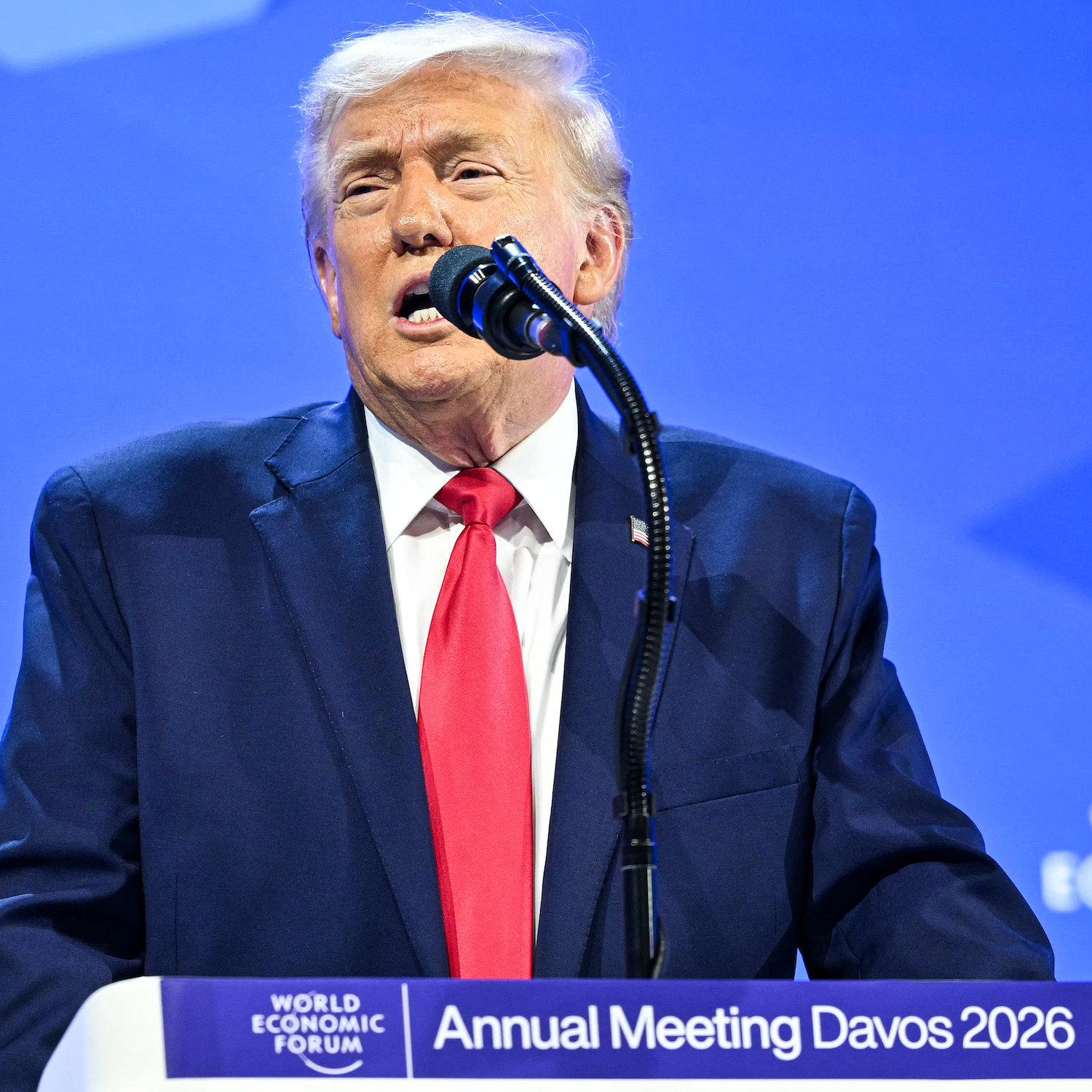
It's Thursday, January 22nd. I'm Shemitah Basu. This is Apple News Today. It's been a bewildering 24 hours in Davos. Relations between the US and Europe over the future of Greenland have dominated the entire summit, but the tone appears to have shifted dramatically. It went went from this the rules.
- [01:06]
D
Based order is fading. The strong can do what they can.
- [01:10]
A
And the weak must suffer what they must, an endless accumulation of new tariffs.
- [01:15]
B
That are fundamentally unacceptable.
- [01:17]
E
You're crossing red lines here. We either stand together or we will stand divided.
- [01:22]
A
To yesterday, which ended with Trump announcing this to CNBC's Joe Kernan.
- [01:27]
D
It looks like we have pretty much the concept of a deal, a deal of ownership. A deal, well, it's a little bit complex, but we'll explain it down the line.
- [01:36]
A
He confirmed that tariffs were off the table, but that was pretty much all he would give away. Axios reports that the deal ultimately respects Denmark's sovereignty, which would mean that Trump has conceded on his core demand to take over Greenland. When asked how long a deal would last, Trump replied simply, with forever. The agreement was, according to Trump, negotiated with NATO's Secretary General Mark Rutte, who stressed to AFP there was still a lot of work to be done. NATO has no formal role over the sovereignty of countries, but appears to be driving the negotiations rather than Denmark or Greenland. From here, the Wall Street Journal suggested talks could focus on expanded US Military presence in Greenland, commitments for Europeans to focus on securing the region from adversaries, and American access to its mineral resources. The breakthrough boosted U.S. stocks, which had suffered badly in recent days over the uncertainty. And Denmark's foreign minister said the day had end better than it began. That's because it began on a decidedly sour note with a 70 minute speech from Trump attacking European allies. He asked why the US Ever quote, gave back Greenland to Denmark following World War II, even though legally it belonged to the Danes before the war. He told the audience at Davos they would be speaking German were it not for American intervention, a line which reportedly got some moans from the crowd and questioned whether Europe would support the US in the event of an attack.
- [03:08]
D
The problem with NATO is that we'll be there for them 100%, but I'm not sure that they'd be there for us if we gave them the call. Gentlemen, we are being attacked. We're under attack by such and such a nation. I know them all very well. I'm not sure that they'd be there.
- [03:30]
A
Secretary General Rutte sat with Trump on the sidelines yesterday in a mostly warm encounter. But Ruta did take the opportunity to challenge Trump.
- [03:38]
B
There's one thing I heard you say yesterday and today, you are not absolutely sure that the Europeans would come to the rescue of the US if you will be attacked, let me tell you, they will, and they did in Afghanistan. As you know, for every American, for every two Americans who paid the ultimate price, there was one soldier from another NATO country who did not come back to his family.
- [04:00]
A
The temperature may have been brought down for now, but the strain on U.S. relations with its closest allies may prove to be long lasting. Canada's Prime Minister, Mark Carney has been explicit that his country needs to find new allies and about his desire to work closer with China. Speaking to NBC's Meet the Press yesterday, the U.S. ambassador to NATO under George W. Bush, Nicholas Burns, said he expected tensions to continue.
- [04:26]
F
I think there's been a lot of damage done and the Europeans and Canadians are not going to forget the repeated threats of the use of military force by the president himself. How can they forget that when that's the first time since 1949 that any NATO ally has threatened to attack another? I think the administration did not calculate how tough and united the European response has been and will continue to be.
- [05:01]
A
If you live in the Midwest, east coast or Southeast, get ready for some extremely cold weather over the next few.
- [05:08]
D
Days, probably sleet and freezing rain for most of North Georgia, including metro Atlanta. This is when things start to get dicey with travel.
- [05:15]
A
Spots in Southern New England will likely be feeling 11, 12, 13 degrees below zero.
- [05:22]
D
Governor Greg Abbott declared a state of.
- [05:23]
A
Emergency to help Texans prepare for this weekend's Arctic blast.
- [05:27]
C
The directive activates emergency response resources like.
- [05:30]
A
Pre forecasters predict an oncoming winter storm will produce ice, heavy snow and other dangerous conditions from New England all the way down to Texas.
- [05:40]
C
We're talking about, like more than 175 million people likely to see some snow, slush, ice, kind of garbage. Winter Weather Depending on how you feel about winter, it's going to be record breaking cold in some parts of the country.
- [05:55]
A
Lauren Rosenthal is a weather reporter for Bloomberg.
- [05:58]
C
There's sort of a band of wind that keeps Arctic air up north and provides a buffer for those of us living below the Arctic Circle down south in the U.S. it's been a little bit wobbly lately and we're getting these sort of repeated outbreaks of Arctic cold kind of bouncing over that protective band of wind.
- [06:15]
A
That band of Arctic air, Rosenthal says, is also coupled with enough moisture to produce some pretty significant snowfall. The coldest weather is expected to begin Friday and a large swath of the east coast could See Temperatures below 20 degr. The wintry mix will also dip south into the Southern Plains and the Mississippi Valley. Cities including Dallas, Albuquerque, Little Rock, Memphis and Asheville are all likely to get hit. The National Weather Service says hazardous conditions like tree damage, snowy roads and reduced visibility will make it tough to travel. And because conditions are reaching farther south, air travel won't be spared.
- [06:55]
C
Atlanta is one of the biggest airline hubs in the US and right now about a 5050 chance of getting like a decent glaze of ice on Saturday. That could make flying pretty challenging if you're headed in and out of that part of the country. Airlines in the south just don't tend to have as much de icer and equipment on hand to handle this kind of stuff. You know, why would they? This isn't a kind of storm. They see a lot as all of.
- [07:21]
A
This is happening, rosenthal says there are some things you can do to prepare yourself, whether you're a winter hardened person from the Northeast or in a place that is used to milder winters. Local forecast offices are telling people to prepare to stay home, put off travel plans and check conditions beforehand if you absolutely have to hit the road. You should also prepare for potential power.
- [07:43]
C
Outages, the same way that folks might stock up on food and water, put batteries and flashlights, make sure devices are charged ahead of a hurricane or a big flood kind of storm that people are more used to in the Southeast. You need to make those same kinds of preparations. And then of course, dress warmly, break out those winter sweaters and coats and, you know, be careful about how much time you spend outside in the cold, especially if you're not really used to it.
- [08:15]
A
President Trump's unpredictability over Greenland and Venezuela these past few weeks raised major questions about what he might be willing to do in the Middle East. In Iran, protests appear to have been suppressed for now, at enormous human cost. Rough estimates from one NGO conservatively puts the death toll at around 4,500. And a human rights group says nearly 20,000 people have been arrested. President Trump has repeatedly refused to rule out military action should the situation worsen, and called for the ayatollah to go. The Wall Street Journal reported Tuesday that Trump was still pushing for what he called decisive actions. The same day, the regime warned the US Quote, if any hand of aggression is extended toward our leader, we not only cut that hand, but also we will set fire to their world. Trump's threats might not be as straightforward to carry out in Iran as they were in Venezuela. It has a far stronger security state built around the ayatollah's role. And the extent to which Trump could do anything to unilaterally change the circumstances in the country is up for debate. But his words may have had an impact. Arash Azizi is an Iranian American contributing writer at the Atlantic and a lecturer at Yale University.
- [09:32]
E
A lot of people went on the streets with the hope that somehow Trump will be behind them, whatever that means. But of course, that didn't quite materialize. So Iranians now face a situation in which they have been killed in very high numbers by the regime. The policies of the regime continues to be untenable, the status quo is untenable, and now a river of blood separates the regime and the people, which it already did. But even more than ever before, he.
- [09:57]
A
Spoke to around a dozen Iranians to ask them generally what they think of the regime's worst atrocity in decades. Azizi was surprised to learn that some favored intervention from the United States.
- [10:08]
E
These are people who are very wary of the examples of Iraq, of the examples of Libya. They'll talk in detail about them, but they were interested in a more limited, actually, US Intervention in the form of, for example, taking the life of Supreme Leader Ayatollah Khamenei. This is just very striking. A country assassinating another country's leader seems to go against a preceptus of international law. It's also just very outlandish.
- [10:32]
A
Here's what one young woman in her 20s, Shahzad, told Azizi.
- [10:37]
E
She had seen two of her friends die. She knew, again, friends and friends of friends who had been killed. So she was very shocked. And she was also just actually portraying the mood in the streets, saying that people really liked Trump to do to Khamenei what he had done to Maduro, what she called the Venezuela style operation.
- [10:53]
A
Another student activist who fled the country in 2022 told Azizi that tying the destiny of Iranian people to foreign intervention is, quote, dangerous and irresponsible. And finally, a few other stories were following. ICE officials are forcing their way into people's homes without judicial warrants against long standing guideline. That's according to an internal memo obtained by the Associated Press. The Department of Homeland Security memo authorizes officers to enter residences solely on a more narrow administrative warrant, which advocates say goes against Fourth Amendment protections upheld by the Supreme Court. Lawyers, advocates and rights groups for years have told immigrants not to open their doors unless they see a warrant signed by a judge. AP Reporters recently witnessed one case of ICE ramming a front door down without a judicial warrant in Minneapolis, and the instruction is apparently being used to train new officers. A DHS spokesperson said ICE officers already had, quote, full due process and a final order of removal in those cases where they lacked a judge's signature. The former school police officer charged with inaction over the Uvalde mass shooting was found not guilty. As we mentioned yesterday, Adrian Gonzalez had been charged in what had become an unusual case. Prosecutors alleged he had endangered lives by not following his active shooter training, but after seven hours of deliberation, the jury did not agree. Investigations into how the events of that day unfolded have sharply criticized the overall police response, but only Gonzalez and one other officer ultimately faced charges and the Sundance Film Festival kicks off today for the final time at its original home in Park City, Utah. The annual festival, which features films that often go on to be big hits, is moving to Boulder, Colorado, in 2027. Plans this year include screenings of some of the festival's notable past movies like Little Miss Sunshine and founder Robert Redford's Downhill Racer, a film he produced in which he played an arrogant champion skier. A Redford who died in September will also be honored at a gala. Here he is speaking about the origins of the festival in an interview from 2015. And one thing that people often got.
- [13:29]
F
Wrong about it, that the festival was anti Hollywood, that it was forming a group of insurgents in the mountains in Utah to attack Hollywood. It was never that. It was always about keeping alive an alternative, which is independent films.
- [13:44]
A
The Sundance Institute says the festival is moving so that it can grow. You can find all these stories and more in the Apple news app. And if you're already listening in the news app right now, we've got a narrated article coming up next. Texas Monthly reports on how the overuse of water in South Texas is leading to tensions with Mexico and why, despite sending billions of of gallons north of the border, it still may not be enough. If you're listening in the podcast app, follow Apple News plus Narrated to find that story. And I'll be back with the news tomorrow.