Loading summary
Transcript40 lines
- [00:05]
Gideon Reznick
Good morning. It's Monday, June 23rd. I'm Gideon Reznick in for Shamita Basu. This is Apple News today. On today's show, we'll assess perhaps the most consequential days of the Trump administration so far.
- [00:16]
Donald Trump
There will be either peace or there will be tragedy for Iran far greater than we have witnessed over the last eight days.
- [00:25]
Benjamin Netanyahu
America has been truly unsurpassed. It has done what no other country on earth could do.
- [00:32]
Gideon Reznick
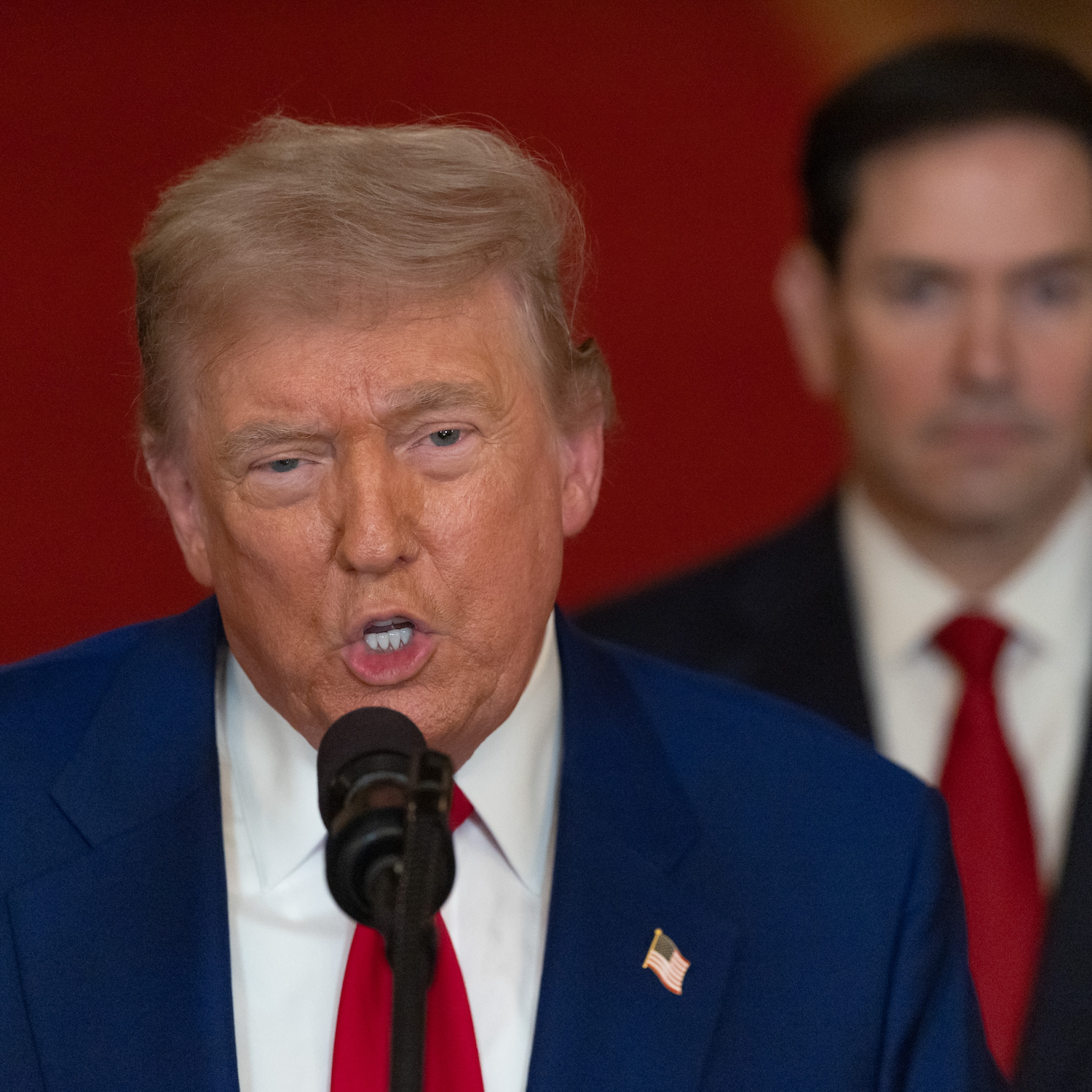
The United States itself has now also opted for a dangerous military operation and aggression against the people of Iran. Violence and destruction could reach unthinkable levels and the global non proliferation regime as we know it could crumble and fall. We're going to examine major questions about President Trump's decision to strike three Iranian nuclear facilities over the weekend. The first question we'll were the strikes successful? The second how close is Iran to obtaining a nuclear weapon? And third, was Trump's unilateral action legal? Let's start with the basics of what happened. The strikes began with an attempted fake out. The US sent a group of B2 bombers west over the Pacific on Saturday, where they were picked up by flight trackers. A number of those bombers split off from the group and started heading east to Iran. At the Fordo nuclear site south of Tehran, US Officials say that warplanes dropped roughly a dozen so called bunker buster bombs. It was the first time that these 30,000 pound bombs have been used in war. Fordo is Iran's most advanced and critical nuclear facility, in part because it's like a fortress located 300ft under a mountain. Warplanes and submarines fire dozens of cruise missiles at Natanz, Iran's largest uranium enrichment center. And submarine missiles hit Isfahan, a nuclear fuel research and production center where intelligence officials believe that Iran has been storing nuclear fuel that is near bomb grade. The United States and Iran are offering contradictory assessments of the damage done. Trump, in his address to the country on Saturday night, described the strikes as a spectacular military success.
- [02:23]
Donald Trump
Iran's key nuclear enrichment facilities have been completely and totally obliterated. Iran, the bully of the Middle east, must now make peace. If they do not, future attacks will be far greater and a lot easier.
- [02:37]
Gideon Reznick
That assessment is not accurate, according to Israeli and US Officials. The US Military's most senior, general, Dan Kaine, said that there had been severe damage at the three sites, but that it was too early to say if Iran retained some capability. And as for Fordeau, officials from both Israel and the US Told the New York Times that it had not been completely destroyed, though assessments are still ongoing. Iranian state media, meanwhile, says the attacks only did minor damage to entrance tunnels. And both Israeli and Iranian officials have suggested that Iran had enough advance warning about the strikes that it was able to move nuclear material away from these facilities ahead of time. After the strikes, Iran's Atomic Energy Organization said it would continue working on its nuclear program. So it's ultimately unclear to what degree the attacks actually damaged Iran's nuclear capabilities. Both Trump and Israeli Prime Minister Benjamin Netanyahu have defended their attacks on Iran by saying they have intelligence indicating Iran is close to creating a nuclear bomb, which Iran denies. But as CNN points out, this is something Netanyahu has been claiming about Iran for decades. Here is Netanyahu issuing this warning to the United nations back in 2012.
- [03:47]
Benjamin Netanyahu
By next spring at most, by next summer, at current enrichment rates, they will have finished the medium enrichment and move on to the final stage. From there, it's only a few months, possibly a few weeks, before they get enough enriched uranium for the first bomb.
- [04:09]
Gideon Reznick
He's made similar warnings half a dozen more times over the past 30 years. At the same time, American intelligence has suggested Iran is not nearly as close as Netanyahu claims, including as recently as March of this year when Director of National Intelligence Tulsi Gabbard testified to Congress.
- [04:25]
Tulsi Gabbard
The IC continues to assess that Iran is not building a nuclear weapon and Supreme Leader Khamenei has not authorized the nuclear weapons program that he suspended in 2003.
- [04:35]
Gideon Reznick
When asked about Gabbard's testimony on Saturday, here's what Trump had to say.
- [04:40]
Donald Trump
My intelligence community is wrong. Who in the intelligence community said that?
- [04:44]
Gideon Reznick
Your Director of National Intelligence, Tulsi Gabbard.
- [04:46]
Donald Trump
She's wrong.
- [04:48]
Gideon Reznick
Yesterday, reporters asked Defense Secretary Pete Hegseth to explain the turnaround in the US Position and what new intelligence they obtained to justify the strikes.
- [04:57]
Pete Hegseth
Well, I would just simply say that the President's made it very clear he's looked at all of this, all of the intelligence, all the information, and come to the conclusion that the Iranian nuclear program, the threat, and was willing to take this precision operation to neutralize that threat in order to advance American national interests, reduce the Iranian nuclear program and obviously collective self defense of ourself and our allies.
- [05:19]
Gideon Reznick
NBC's Kristen Welker asked Vice President Vance the same question on Meet the Press.
- [05:24]
Vance
There's of course an open question about whether they were weeks away, whether they were months away, but they were way too close to nuclear weapon for the comfort of the President of the United States, which is why he took this action. Now, there's another element here too, Kristen, which is that we had a narrow.
- [05:39]
Gideon Reznick
Window of opportunity and Vance insisted this was not the beginning of another long term mission in the Middle East.
- [05:45]
Vance
This is not going to be some long drawn out thing we've got in. We've done the job of setting their nuclear program back. We're going to now work to permanently dismantle that nuclear program over the coming years.
- [05:56]
Gideon Reznick
While Hegseth, Vance and Secretary of State Marco Rubio have all denied that regime change was the goal, Trump opened the door to that as a possible end game in a social media post on Sunday. Let's turn now to the legality of all of this and the reaction from lawmakers. It appears that some of the Republican congressional leadership, though not their Democratic counterparts, were briefed ahead of time. And since then, many senior Republicans have come out in support of the strikes. Here's Senator Lindsey Graham on NBC's Meet the Press.
- [06:25]
Benjamin Netanyahu
This was the right call at the right time. It stopped their program from advancing even further. Iran, with a nuclear weapon, is an existential threat to the state of Israel.
- [06:36]
Gideon Reznick
But notably, a handful of Republicans have questioned the move. Representative Thomas Massie declared it unconstitutional and has sponsored a bipartisan resolution to prevent US Involvement in Iran, while Representative Marjorie Taylor Greene said, quote, this is not our fight. Many Democrats, meanwhile, have focused their criticism on the intelligence driving the decision and the lack of congressional involvement. Here's Senator Mark Kelly.
- [06:59]
Mark Kelly
There was no clear, present immediate danger to us and our troops and even to Israel with regards to the nuclear capability.
- [07:10]
Gideon Reznick
He also told me at the press he didn't understand the administration's rationale for attacking.
- [07:15]
Mark Kelly
Now, we could have tried to restart these negotiations in weeks or even a month. It was not, it did not have to be, had to be done like this right now.
- [07:26]
Gideon Reznick
Meanwhile, Senate Minority Leader Chuck Schumer called on Congress to enforce the War Powers Act, a Vietnam War era law designed to restrict the president's capacity to engage in long term conflict without congressional authorization. The legality of Trump's attack will be a highly debated question in the days to come. As commander in chief of the armed forces, he does have certain war power privileges in the Constitution. But it's Congress that ultimately holds the authority to declare war. Under the War Powers act, there are several requirements a president must meet before taking action. Presidents must coordinate with Congress before making an offensive move, at minimum notifying lawmakers within 48 hours. Absent a declaration of war, they can only deploy US Troops if the US Is attacked or if Congress passes a resolution declaring war. And if troops are deployed without the authorization of Congress, a 60 day clock starts and the military engagement can only last that long unless Congress approves an extension. It is worth noting, however, that presidents of both parties have found ways to skirt this law in the past and to authorize strikes without congressional approval. At Sunday's emergency UN Security Council meeting, the Secretary General called for an end to, quote, another cycle of destruction. CNN's Christian Amanpour, a journalist with a long history reporting on the region, notes that it's hard to see how diplomatic talks can now reopen.
- [08:45]
Tulsi Gabbard
Not only have they been struck, but there is a huge amount of mistrust, let's say, between all parties. So how anybody comes to the t right now is going to take some very creative handling. The real question now is will Iran hit in retaliation to American targets? And if so, where? How, what, when? How will they telegraph it?
- [09:09]
Gideon Reznick
For Trump, the decision to strike Iran could bear political consequences for him as well. As part of his appeal to a contingent of his voters had been a promise to break with the political orthodoxy of foreign entanglements. He mentioned that aspiration in his inaugural address earlier this year.
- [09:24]
Donald Trump
We will measure our success not only by the battles we win, but also by the wars that we end and perhaps most importantly, the wars we never get into.
- [09:46]
Gideon Reznick
Lets turn now to the dangerous heat wave sweeping large parts of the country this week, impacting millions of Americans. With the east coast and Midwest facing the worst of it. It's only the start of what is expected to be a very hot summer. In fact, the national oceanic and Atmospheric Administration projected that basically the whole country outside of Alaska is likely to experience warmer than usual temperatures.
- [10:07]
Eric Holthaus
People working in emergency management are a little concerned this year because there's a lot of question marks in terms of our federal national capacity to respond to extreme weather events.
- [10:19]
Gideon Reznick
That's Eric Holthouse, a meteorologist with the Guardian, who told us about how Trump administration cuts to FEMA are impacting our ability to cope with extreme heat.
- [10:28]
Eric Holthaus
FEMA is going through a big reorganization right now. I know state budgets are tight because they've lost federal funding in a lot of different ways. The National Weather Service, about half of the offices nationwide are critically understaffed right now. We don't have any experience as a country dealing with these kinds of temperatures being this understaffed. So it's honestly an open question what's going to happen. But I know the changes that have happened at the federal level will make these events more deadly.
- [11:01]
Gideon Reznick
Heat is already the number one cause of weather related deaths in the U.S. according to government experts. And a study published last year in the Journal of the American Medical association found that heat related deaths have doubled in recent decades. Some people are at higher risk than others, like children, seniors, people who are unhoused, and people who are incarcerated in prisons without air conditioning.
- [11:21]
Eric Holthaus
A lot of people don't have a place to escape that heat, and especially if you are working outdoors, it can be deadly.
- [11:28]
Gideon Reznick
This week, the Trump administration will weigh the future of a federal rule that aims to protect workers from extreme heat. It was proposed last summer by the Biden administration and it would require employers to provide water and rest breaks when temperatures exceed certain levels. Some states already have their own work related heat rules in place, but this rule, if implemented, would override those and it would be the first of its kind at the federal level. And the administration, meanwhile, is trying to rehire employees that it fired at the National Weather Service to stabilize operations at their field offices around the country, which help to make sure that the public gets advance warning of extreme weather. Holthaus says that heeding those warnings and preparing for heat is the most important thing you can do when temperatures climb this high.
- [12:10]
Eric Holthaus
So that means just making sure that you have spare batteries, spare water, you know, prepare to go without electricity in case there's a blackout and it's really hot outside, knowing where a cooling shelter is around you, making sure that your phone is charged so you can receive those messages. Those are all good things that we can do as individuals.
- [12:40]
Gideon Reznick
Before we let you go, a few other stories we're following. Mahmoud Khalil, a graduate of Columbia University who became a prominent face in pro Palestinian activism on campus, was released from ICE custody on Friday. He had spent more than three months in detention and missed the birth of his son. Federal agents detained Khalil without a warrant on March 8, the first of several international student activists to be arrested and targeted for deportation. A federal judge in New Jersey ordered the government to release Khalil, saying that his continued detainment was, quote, highly unusual. Khalil was reunited with his wife and newborn son Saturday afternoon at Newark Airport, telling a crowd of supporters and others that he plans to keep speaking out against Israel's war on Gaza.
- [13:21]
Mahmoud Khalil
Israel is still waging a full war across Palestine. The US Government is funding this genocide, and Columbia University is investing in this genocide. This is why I was protesting. This is why I will continue to protest with every one of you.
- [13:44]
Gideon Reznick
The administration is still seeking to deport Khalil as his case winds through the legal system. Sticking with immigration, Senegal's women's basketball team was forced to cancel a training camp in the United States this week after the State Department denied visas for some of the players and staff. This comes as President Trump issued travel bans earlier this month for 12 countries, not including Senegal, citing national security reasons. A number of outlets have reported that the administration is considering adding other countries, including Senegal, to that list. The travel ban had included exemptions for certain sporting events, including the World cup and the Olympics. A State Department official declined to provide more information, citing confidentiality of visa records and finally, last night, a new NBA champion was crowned. The Oklahoma City Thunder prevailed over the Indiana Pacers in a thrilling seven game series. Early on, the Pacers star guard Tyrese Halliburton had to leave the game with an Achilles injury. This is the first time the Thunder have won since 1979, when they were located in Seattle and they were known as the supersonics. You can find all these stories and more in the Apple News app. And if you're already listening to the News app right now, we have a narrated article coming up next. Wired has the story of a young man who was shot by his father, rendering him blind, his prolific gaming career, and how he's trying to make video games more accessible to people like him. If you're listening in the podcast app, you can follow Apple News Narrated to find that story and I'll be back with the news tomorrow.