Loading summary
Transcript36 lines
- [00:05]
A
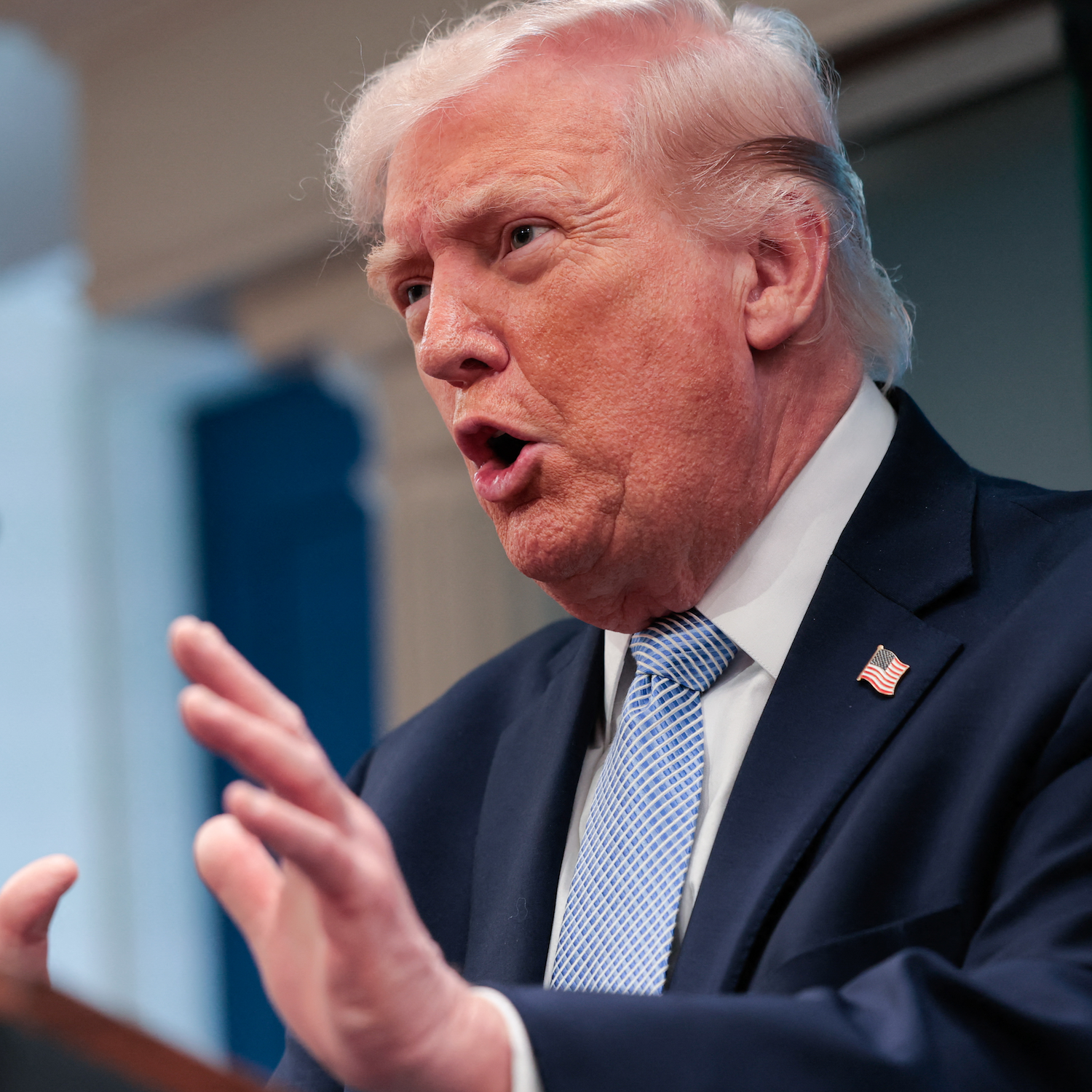
Good morning. President Trump announces a two week ceasefire with Iran. Reuters explains how the deal unfolded.
- [00:12]
B
Well, you know, the day has been quite extraordinary, but for the moment, it looks like Trump has found an acceptable off ramp. At least that will buy some time for negotiations.
- [00:24]
A
Also, Vice President J.D. vance tries to help Hungarian leader Viktor Orban avoid election defeats.
- [00:30]
C
And why, if you're a parent, you shouldn't write off landline phones just yet. It's Wednesday, April 8th. I'm Cecilia Ley.
- [00:38]
A
And I'm Gideon Resnick. This is Apple News.
- [00:41]
B
Today,
- [00:45]
A
Hours after that ceasefire announcement, Defense Secretary Pete Hegseth was triumphant at a press conference this morning.
- [00:51]
D
No other president has shown the courage and resolve of this commander in chief. President Trump forged this moment. Iran begged for this ceasefire and we all know it as the president Truth this morning, a big day for world peace. Iran wants it to happen. They've had enough.
- [01:14]
A
General Dan Kaine, Chairman of the Joint Chiefs of Staff, also added that this marked a pause and that military operations could restart should the conditions change.
- [01:23]
D
We hope that Iran chooses a lasting peace. But as Secretary Hegseth said, let us be clear, a ceasefire is a pause and the Joint Force remains ready, if ordered or called upon, to resume combat operations with the same speed and precision as we've demonstrated over the last 38 days. And we hope that that is not the case.
- [01:45]
A
To that end, there has been some uncertainty amid the international relief after the ceasefire announcement. Initially, passage through the Strait of Hormuz did not dramatically change Wednesday and Israel continued strikes in Lebanon as the ceasefire didn't extend to operations against Hezbollah there. There are also still questions about the fate of Iran's enriched uranium, as President Trump said on social media that the US Would work with Iran to remove it. Even if some details were uncertain, it signaled a remarkable turn over the last 24 hours. Cecilia picks up the story from here.
- [02:17]
C
World leaders spent much of yesterday watching and waiting to see if President Trump would carry out his threats against Iran. He had given the country until 8:00pm Eastern Time to open up the Strait of Har, or face, as he put it, the destruction of its whole civilization. As the day went on, the calls for restraint grew from world leaders, the Pope, the UN and even parts of his own party. Less than two hours before the deadline, Trump had an announcement. He had agreed to a two week ceasefire with Iran, conditional on the country allowing safe passage through the Strait. He claimed their military objectives had been met and they were making progress towards long term peace. Soon after, Iran formally agreed to open up the strait if attacks stopped and 10 minutes before the deadline, Pakistan's prime minister, who had been acting as a mediator, said a ceasefire was, quote, effective immediately.
- [03:12]
B
It's unclear whether either side has really had any kind of meaningful concession from their initial starting point in negotiations.
- [03:21]
C
Phil Stewart is Reuters national Security correspondent.
- [03:24]
B
We're in this kind of bizarre moment right now where after coming to the brink of, we don't know what kind of military operation was about to unfold, but after coming to this rhetorical brink, at the minimum, we are now in some phase of negotiations.
- [03:39]
C
Iran described the deal as a victory and state TV called it a humiliating retreat from Trump. The regime put out a statement to say the US has agreed to their ten point plan. That included, among other things, Iran's continued control over the strait, financial compensation, the lifting of sanctions and an acceptance of uranium enrichment. Trump would only say they had received the plan and it was, quote, a workable basis on which to negotiate. Stewart told us that these concessions were a long way from anything the White House had previously suggested and might agree to.
- [04:14]
B
This is not an end to the war, it's a ceasefire. The initial problems that created the impasse still exist. The United States still has concerns about Iran's military capabilities. It still has concerns about Iran's stockpile of highly enriched uranium, or at least they have had those concerns in the past.
- [04:32]
C
Senate Minority Leader Chuck Schumer said the President was, quote, desperately searching for any sort of exit ramp. And speaking to CNN last night, Democratic Senator Chris Murphy said Trump's threats earlier in the day suggested he had lost touch with reality. He was among those calling for Congress to invoke the 25th Amendment yesterday to remove Trump from office. He said that the ultimate agreement could leave the US In a worse position than before the war.
- [04:58]
D
He thinks, I guess, that the threat of mass scale war crimes has achieved some success. But as we're learning in the last few minutes, the success seems to be that Iran has more power over global commerce than ever before in our lifetime. And so the combination of the threat of war crimes along with the outcome of this so called ceasefire, it's just really hard to get your head wrapped around.
- [05:25]
C
The news caused oil prices to plunge, but Stewart cautioned that it was still too early to make any firm pronouncements.
- [05:32]
B
I would not jump to the conclusion that we are the beginning of the end. Don't forget that there are thousands of troops that are still heading right now toward the Middle East. There's a couple thousand Marines that are in course and actually this two week timeline does coincide with when they would more or less be arriving in the region. That said, I honestly, from the conversations I've had, I honestly don't think that this is part of some grand design. I think that what's happened right now is a decision that was taken by the president at the last minute to call off a planned, intense night of bombing. And I think that the world is still taking stock of what's just occurred.
- [06:10]
C
Stewart told us that Trump has swung between every possible opinion on the conflict since it began, and that has made the job of reporting on this White House and interpreting its decisions in these moments incredibly difficult.
- [06:23]
B
As reporters right now, we're left struggling to understand whether this too, the ceasefire and these negotiations too, are just sort of a momentary episode of relief or hope or whether or not it's just something that will pass. And then in a new news cycle, we'll all be back to wondering about US Ground forces or another military operation.
- [06:46]
C
Iran has said that face to face talks will begin on Friday in Pakistan's capital, Islamabad. Vice President JD Vance was on the campaign trail yesterday, but this time he was a long way from the US he was in Budapest to throw his weight behind Viktor Orban, the Hungarian prime minister with close ties to Trump. Vance urged voters to support Orban during a rally ahead of this Sunday's national election.
- [07:18]
D
Victor and this entire political leadership, they become a target of the bureaucrats because he shows that real sovereignty is possible. He shows you can be pro Europe, you can be pro America, and you can be pro your own people. And it's showing it in spades.
- [07:37]
C
Mantis visit demonstrated an unusual interest in a foreign election by the White House. While a spokesperson said the visit was to strengthen existing ties between Orban and Trump, some Western officials say that it's a sign that Orban has become important for certain MAGA circles. Katherine Belton has been covering the election for the Washington Post.
- [07:57]
E
Orban has been a leader in Europe who has really kind of tried to galvanize support for the MAGA movement. He has poured a lot of money, a lot of government money, into a network of think tanks which has become home to many leading MAGA ideologists. The election that he's facing on Sunday is almost a test for the Trump movement in itself.
- [08:24]
C
Orban has led Hungary for 16 years. He characterizes his leadership as an illiberal democracy. But critics say he has chipped away at democratic norms and reshaped institutions to serve his party. Trump has heaped praise on Orban's leadership, but now he faces the very real prospect of getting kicked out by the voters. He's fighting an uphill battle against center right candidate Peter Magyar, who's campaigned against the country's corruption and economic malaise. Some polling in Europe has Maguyar's party leading by double digits.
- [08:56]
E
It's very tricky for Viktor Orban because traditionally he's always faced off against liberals. So he has been able to kind of deploy his anti migrant traditional values view on things against liberals. But now his rival, Peter Maguillar is actually a former member of Orban's own party.
- [09:20]
C
Orban's campaign has been accused of cracking down on dissent and colluding with Russia. That especially came to light last week when audio from a phone call between Russian Foreign Minister Sergey Lavrov and his Hungarian counterpart Peter Sierto was leaked. In it, Lavrov passed along the request of a Russian businessman whose sister had ended up on the EU sanctions list.
- [09:43]
F
He just asked me to remind you that you were doing something about his sister. Yeah, absolutely. Together with the Slovaks, we are submitting a proposal to the European Union to delist her. We will submit it next week. And as the new review period is going to be started, it's going to be put on the agenda and we will do our best in order to get her off.
- [10:08]
C
Belton says behavior like this is why many within the European Union want Orban's leadership to end.
- [10:15]
E
Precisely because Orban has been very often cooperating with Russia time and again since the war in Ukraine. His government has really helped Russia in trying to put a spike in the wheels of EU efforts to impose sanctions, really tough sanctions on Russia. And he's also slowed down efforts to kind of provide more EU funding for Ukraine.
- [10:43]
C
Hungary has tried to keep gas bills in check by embracing cheap Russian energy. But with the war in Iran, their citizens remain exposed to higher prices. The visit by Vance was intended to bolster Iran's campaign. But Belton says strong links to the White House might not be so helpful anymore.
- [11:00]
E
When you have J.D. vance in Budapest this week saying how great a job Hungary has done in helping secure energy security for its own country. That kind of really rings hollow when the reason why everyone is getting crushed from high energy prices right now is because of the Trump administration's actions in Iran. Playing the trump card is not very popular at the moment.
- [11:37]
C
And finally, a few other stories were following. In Georgia, Republican prosecutor Clay Fuller won a special election runoff to fill a House seat that was vacated by former Representative Marjorie Taylor Greene. Fuller was endorsed by Trump and was strongly favored to win against Sean Harris, a moderate Democrat who tried to appeal to disaffected Trump voters. Fuller is a US Air National Guard veteran who pitched himself as the best choice for people who, quote, 100% support President Trump. The contest was called by several major outlets less than an hour and a half after polls closed, and it was seen as a measure of Trump's support. With his base ahead of the midterms, Fuller replaces Greene, a former Trump ally who resigned in January after breaking with the president over his handling of the Epstein files. Fuller will fill out the rest of Greene's term, which ends next January, and will need to campaign again for the midterm elections this November in order to hold onto the seat in Congress. The wireless music festival abruptly canceled its entire London event this summer after UK Authorities denied entry into the country for headliner Kanye West. The rapper's ban is a result of anti semitic comments that he's made in the past. Before the festival's cancellation, a number of major sponsors had dropped out for the same reasons, including Pepsi and Rockstar Energy. Organizers of the festival defended booking west, now known as Ye, for the event and encouraged people to forgive him. British Prime Minister Keir Starmer posted on X that he should never have been invited to perform. West is promoting his new album Bully, and has been trying to repair his image. He has offered apologies and an invitation to meet with Britain's Jewish community to listen to their concerns. In January, he also took out a full page ad in the Wall Street Journal to express regrets for his past comments attributing it to his mental health issues. Despite the setbacks, he still has a robust following, according to Bloomberg. He reportedly grossed a record breaking $33 million in two nights after selling out shows at Sofi Stadium in Los Angeles last week. And finally, there might be some use for those old landline phones collecting dust in storage. The Wall Street Journal reports on how landline Wi fi replicas have become a low tech strategy to help parents who aren't in a rush to hand their kid a smartphone with unfettered access to the Internet, that has resulted in some fumbling from the younger generation. Fifth grader Elsie didn't know what a dial tone was, so she kept hanging up and another child had to be taught to hold the phone to her ear. Elsie's mother told the Journal that this strategy felt like a safer option, especially since her nephew took his own life after being bullied online. She later worked with a digital health nonprofit to turn her daughter's school into a massive landline pod. Next up on Elsie's list of things to learn to do by landline ordering a pizza. You can find all these stories and more in the Apple News app. And if you're already listening in the News app right now, we've got a narrated article coming up next. Fortune visits Bentonville, Arkansas, the birthplace of Walmart, and explores how the retail giant's founding family, the Waltons, have reshaped the city and why some residents are expressing skepticism over their future plans. If you're listening in the podcast app, follow Apple News Narrated to find that story. And I'll be back with the news tomorrow.