Loading summary
Transcript23 lines
- [00:05]
Shemitah Basu
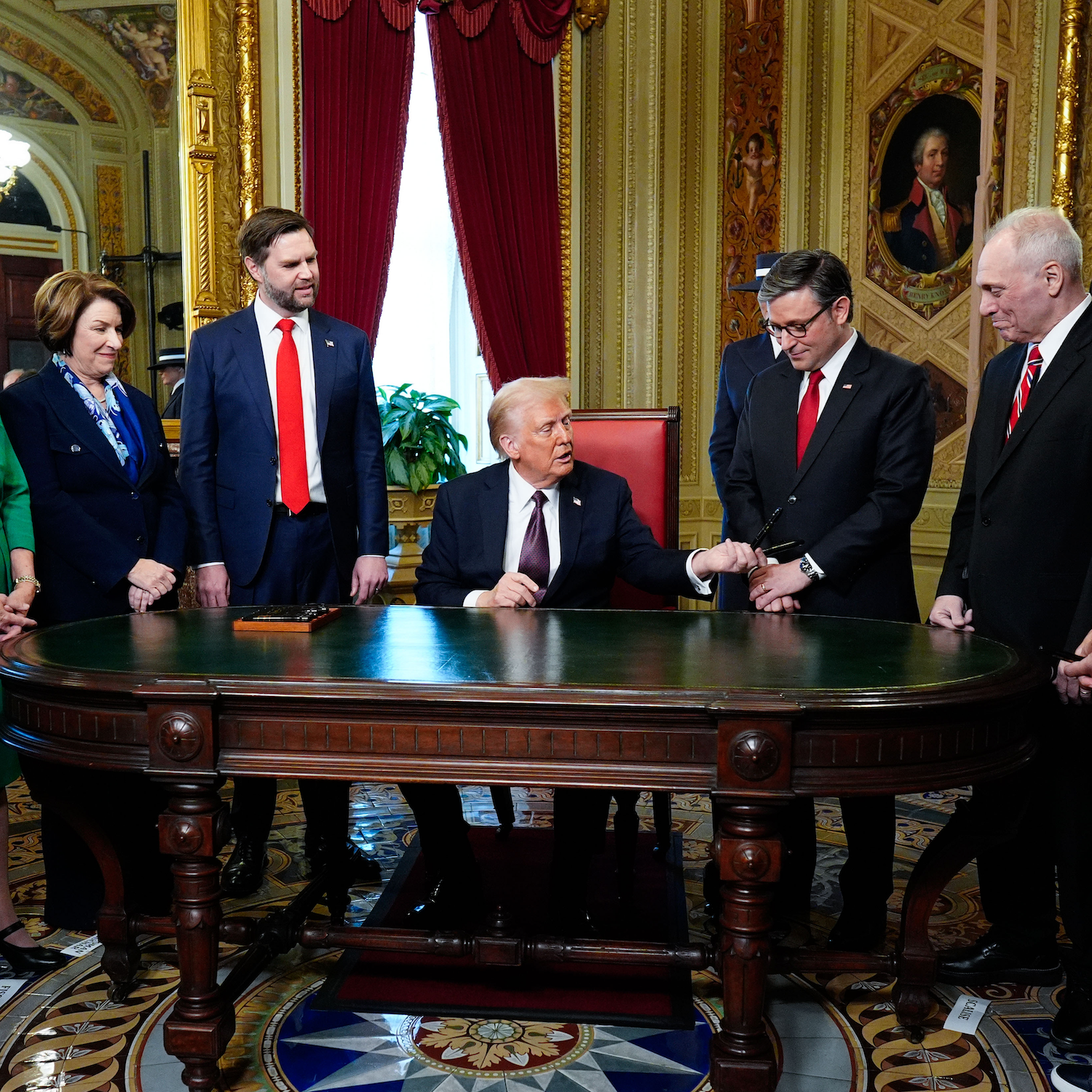
Good morning. It's Thursday, January 23rd. I'm Shemitah Basu. This is Apple News today. On today's show, how the ACLU is gearing up for the next four years under Trump. The case for awards season to go on amid the LA fires and drama between the players and the media at the Australian Open. But first, President Trump has issued a flurry of executive orders in his first few days in office, touching everything from immigration to international trade to transgender rights and more. It can give the impression, as the early days of many administrations do, that a president alone can run the government by signing orders behind a desk. That, of course, isn't true. And President Trump will need Congress to move much of his agenda forward. Republicans seem ready to do that, but with a very narrow majority in the House and a growing rift between GOP leadership in both chambers, there's likely to be some internal party tension around how to achieve Trump's policy goals.
- [01:13]
Sahil Kapoor
So there's still a dispute and honestly a growing clash within the Republican Party that's been going on for about a month and a half now. And there's no path to a resolution here.
- [01:22]
Shemitah Basu
That's Sahil Kapoor, senior national political reporter at NBC News. He told us that Trump will need buy in from Congress to make things like his orders on immigration and border security a reality, namely funding.
- [01:35]
Sahil Kapoor
He's going to need a lot of resources from Congress to be able to implement even existing law, let alone, you know, additional laws.
- [01:44]
Shemitah Basu
The House did pass a bill yesterday that would allow ICE to detain undocumented migrants accused of theft related crimes. Immigrant rights groups and some Democrats say this would effectively take away the right to due process for undocumented immigrants accused of a crime. Others support the bill with 46 Democrats joining Republicans in passing it. But what comes next on the agenda is an open question. At the moment. Republicans in Congress want to do a whole host of things, including approving more border security funding, repealing some Biden era clean energy grants, and extending the 2017 Trump tax cuts. But Kapoor explained that for now at least, there's no real consensus on how to proceed.
- [02:25]
Sahil Kapoor
Speaker Mike Johnson disagrees with Senate Majority Leader John Thune. Johnson wants to do it all in one bill in the next few months. John Thune thinks that's not gonna happen, that they're gonna need more time for complicated things like taxes and they should split it up into two bills, do border security and maybe throw in some energy stuff on the front end, the low hanging fruit essentially, and take their time with taxes and do a second bill later in the year, for that.
- [02:47]
Shemitah Basu
Timing is a big part of the challenge. Republicans are keenly aware that there is a narrow window for action before the next midterm elections, when they could potentially lo majorities and presidents often have a brief honeymoon period when they first take office to use political capital before public approval can change. For now, Kapoor says that Trump is really only worried about what he wants to happen, not how it'll get done.
- [03:13]
Sahil Kapoor
The reality here is that Trump has never really concerned himself with the nuances of, you know, legislative machinations. He is just telling the Republicans to do it. And it turns out it's not quite that simple.
- [03:28]
Shemitah Basu
As for other things Trump says he'll do, like changing the name of Mount Denali back to Mount McKinley, that is something he actually can do alone. But larger pieces of legislation that require resources are going to need lawmakers to get on board. Back in 2017, a week into President Trump's first term in office, he he issued an executive order barring people from a number of Muslim majority countries from entering the US People stepping off international flights in the United States were detained and sent back home. Visas were canceled. Protests broke out. The American Civil Liberties Union filed the first lawsuit against the ban and successfully blocked it. The organization's membership numbers skyrocketed and money came pouring in. In the lead up to Trump's second term in office, Laura Kasisto, a reporter for the Wall Street Journal, found a very different kind of political reality.
- [04:27]
Laura Kasisto
We haven't seen a lot of sort of civil uprising thus far. At least groups on the left are not seeing an uptick in fundraising the way that they did the last time. And there's just a kind of sense of exhaustion and acceptance. And also, Trump has grown in popularity. This time, Trump won the popular vote. He gained in a number of regions where you would think the ACL would be strong places. New York.
- [04:52]
Shemitah Basu
What's more is that the judicial landscape has changed. And Kisto said there is an expectation that lawyers involved in drafting and defending executive orders this time around won't make as many mistakes. None of this is to say that the ACLU intends to back down. In fact, they've already filed a suit challenging Trump's executive order that seeks to end birthright citizenship. And Kisto said this time around, a big focus for the ACLU has been on local efforts to provide legal protection for people who may be subject to promised immigration rates at their workplaces, for example.
- [05:26]
Laura Kasisto
One of the things they're doing is hiring people in local areas in order to respond to that and then another thing that they're doing is they're really kind of working on how can we recruit people to be interested in our cause, how can we get people interested in this, you know, getting involved in their local community? But it's definitely a different kind of challenge than the last time.
- [05:44]
Shemitah Basu
The public perception of the ACLU might be at stake as well. Critics say the organization has shifted from one that protected free speech and civil rights no matter what party was affiliated with a given policy, to a more left aligned outfit.
- [05:59]
Laura Kasisto
The ACLU to a certain degree changed Trump during his first administration. They were really a thorn in sigh. But Trump also changed the aclu. They became more political. They staffed up much more on the political side than they did on the legal side during his administration.
- [06:15]
Shemitah Basu
New York magazine writes about this tension as well. The magazine is out with a story about a small group of people formerly aligned with the ACLU who are critical of its current approach. They cite the 2017 Charlottesville rally as a turning point. At the time, the ACLU successfully defended white nationalists right to hold a rally in a downtown park. But when the rally happened and turned violent, injuring dozens of people and killing one counter protester, Heather Heyer, the mood inside the organization shifted. According to New York Mag, about 200 ACLU staff members signed an open letter to the organization demanding the ACLU take into account the impact of their positions on marginalized communities. As one former board president of a local chapter told the magazine, the group's longtime executive director, Anthony Romero, is, quote, a progressive activist. But the ACLU takes issue with this and insists it still is very much nonpartisan. As Romero told the Journal, shame on us if the ACLU abandons its core mandate out of fear of appearing too partisan. Now to Los Angeles, where a new fire broke out yesterday. The Hughes fire spread quickly near Castaic, just northwest of downtown, prompting new evacuation orders for tens of thousands of people in surrounding areas. But as firefighters continue to battle this and other wildfires still blazing, there's a growing question around how the city's main economic engine, Hollywood, should proceed with awards season. The Grammys are just over a week away. Oscar nominations drop Today, Washington Post culture reporter Jada Yuan told us about how these conversations are playing out.
- [08:09]
Jada Yuan
The city itself has just been completely upended by this. So it's hard to think about the awards season that was supposed to take over January to March. I think everyone is in agreement that what we need to be concentrating on are the relief efforts and the efforts of the first responders and all these people who are just completely bereft and just had their lives completely upended.
- [08:36]
Shemitah Basu
At the same time, it's not as simple as canceling all of these ceremonies out of respect for fire victims. Awards shows are a huge source of income for many people in la, from production staff to event planners, caterers, drivers, stylists, and so many others who are connected to the entertainment world. So Yuan says there are real concerns that canceling the awards could make the economic impact of the fires worse for people who are already suffering.
- [09:04]
Jada Yuan
The Oscars are among the biggest money making months of the year for many gig workers in Los Angeles. So, you know, it takes a thousand people to put it on and you've got florists and security guards and valets and if you take that away, you're dealing a blow to not the stars. But like the support staff, there's tourism.
- [09:28]
Shemitah Basu
Revenue to consider too. These shows typically attract a lot of travelers who make reservations at hotels and restaurants and visit local businesses. Hotels in LA have been offering space to fire evacuees in recent weeks, and there are questions around the ethics of out of towners potentially taking away a room from someone in need. The president of the hotel association in LA told Page Six she believes they have enough capacity to accommodate everyone. So for now, the Grammys and the Oscars and other awards are scheduled to carry on. But viewers will notice some changes. Organizers plan to raise money for Wildfire Relief at the Grammys on February 2, and Yuan told us the Oscars, which happen in early March, may follow that model.
- [10:11]
Jada Yuan
I think that what we're going to see is a paring down of the Oscars, less finery, fewer ancillary events, a more somber tone, possibly a fundraising effort, a lot of acknowledgment on the stage. Hollywood isn't unfamiliar with a pivot. This is, you know, a show must go on kind of industry. The real question is, can we continue these events where they're about frivolity and fun and celebrating at a time and in a city where so much destruction has taken place and so many people are hurting.
- [10:58]
Shemitah Basu
A few other stories we're watching today. It's strange to see a sign that reads welcome to Florida covered in snow. But that's exactly what some areas in the south look like right now. A major winter storm slammed parts of the Deep south and Gulf coast, causing widespread travel disruptions, school closures and power outages. Outages. The weather is being blamed for the deaths of 10 people. New Orleans got 8 inches of snow, not only a record for the city, but as CNN notes that's more snow than Anchorage, Alaska has gotten this month. Winter weather is expected to continue in those areas, NBC News reports. Many communities on the Gulf coast lack the right equipment like snow plows to deal with this type of weather, meaning disruptions are likely to go on for days. On the other side of the globe, where it's the dead of summer, Australia is in the midst of their tennis major, the Australian Open. And this year there's been some drama between the players and the media. It started when a television commentator made disparaging remarks about Serbian tennis fans that resulted in one of the world's top players, Novak Djokovic, who is Serbian, refusing to speak with the broadcaster until they apologized. Then America's Ben Shelton called out Australian broadcasters for a number of other incidents.
- [12:15]
Ben Shelton
There are some comments that have been made to me in post match interviews by a couple different guys, whether it was hey, Monfilce is old enough to be your dad. Maybe he is your dad or today on the court, hey Ben, how does it feel that no matter who you play in your next match, no one's going to be cheering for you? I mean, maybe true, but I just don't think a comment that's respectful from a guy I've never met before in my life. And I feel like broadcasters should be helping us grow our sport and help these athletes who just won matches on the biggest stage enjoy one of their biggest moments.
- [12:51]
Shemitah Basu
The Telegraph reports that the Australian Open is known for this type of disrespect coming from the sports journalists. The paper recalls a 2015 interview when a female player was asked by a male journalist to, quote, give us a twirl. And finally, after the Eaton Fire destroyed the Pasadena Jewish Temple and Center, an institution that served its community for more than a hundred years, an amazing discovery was made. A mural that had been covered up by bricks and stucco for decades was left intact despite the destruction of its surrounding structure. The mural shows men and women walking in the desert with animals in the middle, a lone palm tree, a symbol of triumph in the Bible. Although the paint is faint, the LA Times has a stunning photo of the sun shining on this mural. As one member of the temple told the Times, the fire took everything, but somehow this mural stands. You can find all these stories and more in the Apple News app. And if you're already listening in the news app right now, we've got New York Magazine's reporting about the ACLU queued up to play for next. If you're listening in the podcast app, follow Apple News plus narrated to find that story, and I'll be back with the news tomorrow.