Loading summary
Transcript25 lines
- [00:05]
Shemitah Basu
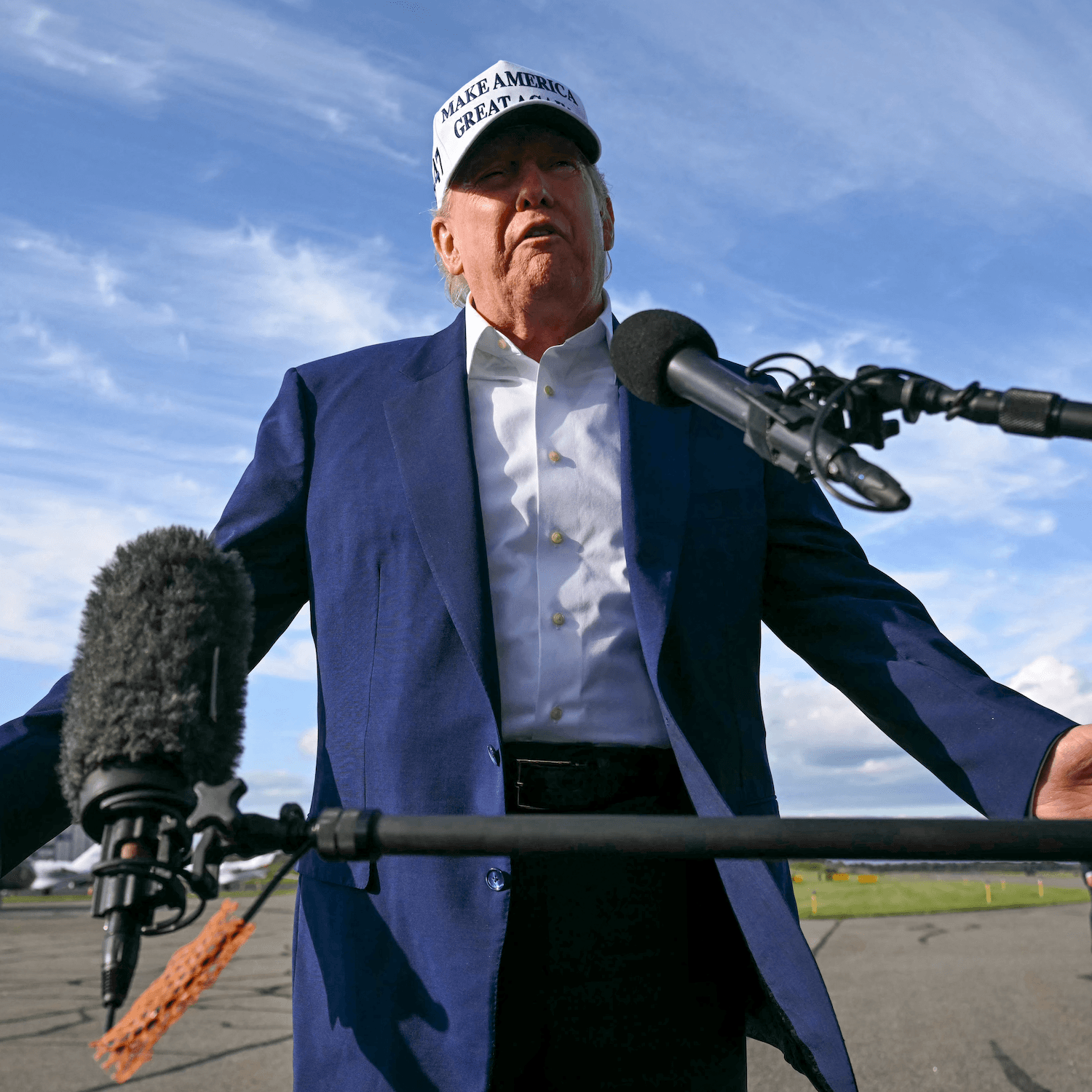
Good morning. It's Tuesday, May 27th. I'm Shemitah Basu. This is Apple News today. On today's show, some college students are using commencement as a last effort to protest university leadership. How police used facial recognition technology to secretly surveil New Orleans and the not so fresh names, breaking box office records. But first, Russia's war in Ukraine took dramatic military and diplomatic turns. Over the weekend, Russia struck Kyiv and launched its largest combined aerial attack since the start of its full scale invasion in February of 2022, killing at least 13 people. In response, President Trump came out attacking Russian President Vladimir Putin.
- [00:56]
Donald Trump
I'm not happy with what Putin's doing. He's killing a lot of people and I don't know what the hell happened to Putin. I've known him a long time, always gotten along with him, but he's sending rockets into cities and killing people and I don't like it at all.
- [01:11]
Shemitah Basu
Later on social media, he said Putin had gone, quote, absolutely crazy. But he also took aim at Ukrainian President Volodymyr Zelensky, saying he was doing his country no favors. Trump's unpredictability with Russia has left analysts, allies and enemies alike searching for a strategy. He has, on the one hand, denounced the democratically elected Zelensky as a dictator and suggested Ukraine is at least partly responsible for the war. On the other hand, Trump has, with some caveats, allowed military aid to continue flowing into the country and signed a minerals deal that could tie the two countries closer together. Meanwhile, his latest outburst comes just a week after he celebrated a, quote, very good call with Putin. Now, relations appear to have gone cold again, with Putin's spokesperson describing this as a moment prone to emotional overload. Given the ambiguity of the administration's diplomacy, it can be difficult to know what to pay attention to and predict where things might go next. But one place to look might be to those who did this for a living and who worked for the Trump administration in his first term. He here's retired Lt. Gen. H.R. mcMaster, Trump's former national security adviser, speaking to CNN last week as Trump was preparing to call Putin, even though he.
- [02:30]
Donald Trump
Would make statements at the time when I was national security adviser that I found unseemly about Putin. He took strong action against him. And I think what's going to happen here is that President Trump is going to be faced with the decision to either accommodate Putin or put a hell of a lot more pressure on him. And I think really the path that he'll ultimately take is to put a hell of a lot more pressure on him.
- [02:51]
Shemitah Basu
But McMaster's optimism that Trump will eventually pivot to a more conventional US Approach and help Ukraine isn't shared by everyone but Trump.
- [03:01]
Fiona Hill
He wants Ukraine just off the docket. There's a kind of if they don't make any progress, then they're just going to move beyond it.
- [03:08]
Shemitah Basu
That's Fiona Hill, one of the Trump administration's most senior Russia advisers in his first term, speaking recently to Radio Free Europe.
- [03:16]
Fiona Hill
We have a president in the form of Donald Trump who actually has the same worldview, or a very similar worldview to Vladimir Putin. He sees the world in terms of big powers carving everything up. And from the very beginning, he said, ukraine's not my war. I don't want anything to do with that. I want to get on with meeting with Putin and sorting out other issues.
- [03:34]
Shemitah Basu
If Trump's actions in recent weeks show any consistency, it's in their deviation from diplomatic expectations and an attraction to bilateral deals in one sense. A staunch defender of Israel, Trump sidelined the country in recent hostage talks with Hamas. He made a deal with the Houthis in Yemen, despite their ongoing conflict with Israel. And in Syria, he warmly embraced the new president, a former member of a group the US Regards as terrorists, and unilaterally dropped sanctions, a move the EU followed shortly after. Here's Fiona Hill.
- [04:09]
Fiona Hill
Again, I think the doctrine is fairly clear, and Trump has been very consistent. Making America great again means America first, or rather him and his immediate circle first. Everything is a sort of a dealing with him as a sovereign, you know, really, rather than even a unified executive branch representative. He's definitely pulling everything back to home. And if he does indeed make deals with Russia, with China, with Iran, then North Korea again, I think his argument would be that, well, we've basically cut off any risks for the United States. This is the end of the international system as we know it. I mean, frankly, it's been crumbling for quite a long period of time.
- [04:55]
Shemitah Basu
In recent days and weeks, college and university graduates across the country have walked the stage and received their diplomas. It comes at a time of mounting uncertainty within higher ed institutions, grappling with Trump administration policies toward international students and its attacks on pro Palestinian protests. For some 20, 25 grads, these commencement ceremonies have become a place to voice frustration over how schools have responded to the conflict in Gaza and conflict with the Trump administration. At George Washington University in D.C. student speaker Cecilia Culver used her graduation speech to express solidarity with Palestinians and to criticize the school's ties to Israel. I cannot celebrate my own graduation without a heavy heart knowing how many students in Palestine have been forced to stop their studies, expelled from their homes and killed for simply remaining in the country of their ancestors. The university issued an apology for Culver's remarks and banned her from GW's campus and other university events for not following her pre approved speech At New York University, student graduation speaker Logan Rozos had his degree withheld after deviating from previously approved remarks to add this the only thing that is appropriate to say in this time and to a group this large is a recognition of the atrocities currently happening in Palestine. In a statement, a university spokesperson said that NYU is withholding his diploma while they pursue disciplinary actions, and recent detentions and deportations of students have also been a focal point for commencement ceremony protests. Mohsen Mahdawi, a lawful permanent U.S. resident and Columbia student who was arrested by immigration officials during a naturalization interview and eventually released on bail, walked across the graduation stage last week with his classmates. The Palestinian student wore a keffiyeh with his cap and gown as he crossed the stage after he spoke at a vigil for students targeted for deportations.
- [07:12]
Donald Trump
It's much larger than Democrats or Republicans, much larger than Israelis or Palestinians. This is our humanity, and what this university has done to Mahmoud and to me is a betrayal to the values and the principles that we come to this university to learn and to study.
- [07:33]
Shemitah Basu
The student he name checked there was Mahmoud Khalil, a fellow Columbia student and U.S. green card holder who's currently detained by Immigration and Customs Enforcement in Louisiana. His name was also evoked by Columbia's acting President Claire Shipman, while addressing graduates. Columbia has faced fierce student criticism for agreeing to many of Trump's demands on policing its protests in the face of funding cut threats. She was booed last week at commencement. We firmly believe that our international students.
- [08:03]
Fiona Hill
Have the same rights to freedom of speech as everyone else, and they should not be targeted by the government for exercising that right. And let me also say that I know many in our community today are mourning the absence of our graduate Mahmoud.
- [08:24]
Shemitah Basu
Khalil, while some of the other students who were detained have since been released. Khalil remains in custody because a federal judge in New Jersey has yet to make a decision on whether or not to release him on bail. Meanwhile, he appeared in immigration court in Louisiana last week, where he made the case that he's been mislabeled as anti Semitic or as a Hamas supporter, which isn't true, and that if he is eventually deported to the Middle east, he would be fearful of being targeted by Israel. His lawyers have said they will take his case all the way to the Supreme Court if necessary. Let's turn now to an investigation from the Washington Post. Reporters learned that police in New Orleans were secretly monitoring people for two years and using facial recognition cameras and software. Now, facial recognition software is something that police nationwide are increasingly using. Officers typically scan still images from surveillance cameras to support their search for suspects. But the Post learned police in New Orleans had been taking this technology a step further.
- [09:38]
Doug McMillan
Rather than relying on a still image of something that happened in the past, they are now running facial recognition behind a live surveillance camera that is pointing at the street.
- [09:51]
Shemitah Basu
Doug McMillan is a business and tech investigations reporter who broke this story with colleagues after filing public record requests for months.
- [10:00]
Doug McMillan
There's over 200 of these cameras pointed at the streets, various places in New Orleans, but I think primarily in the French Quarter, which is a very tourist rich area. It's important to the economy of New Orleans, but it's also a very crime laden area.
- [10:14]
Shemitah Basu
If this facial recognition software detected a possible match in a list of crime suspects, officers would get a notification on their phones through an app.
- [10:23]
Doug McMillan
The officer will take a quick beat to try to just make sure that this is the right guy, visually compare the pictures, quickly check if this person has an active warrant, and then rush out to the scene to try to approach this person and make an arrest.
- [10:38]
Shemitah Basu
Since early 2023, police have made dozens of arrests in New Orleans using this technology. But McMillan learned it might violate city laws around how this type of tech can be used. For one, the Post learns that the company that manages the bulk of the cameras, Project nola, a nonprofit run by a former police officer, has no formal contract with the city. The chief public defender for New Orleans told the Post that the lack of formal relationship means that Project NOLA is not required to share information about their suspect matches that could be evidence in a courtroom. Officers who were involved in many of the arrests that used this technology didn't disclose that fact in their police reports following the Post's requests for records. In reporting the story, the New Orleans Police Department at least partially paused the program back in April.
- [11:29]
Doug McMillan
They said that they had done their own internal review. They were concerned about this may or may not be in violation of local law. And so they decided to pause the automatic alerts. They're no longer getting those right now.
- [11:40]
Shemitah Basu
But there are still facial recognition cameras all over New Orleans. For now, those alerts go to Project nola, who can then call or email police to alert them to the presence of possible suspects. Recently, authorities told ABC that it was used to capture at least one fugitive in a high profile jailbreak in New Orleans. Before we let you go, a few other stories we're following. The leader of an organization set to distribute aid in Gaza has resigned. The Gaza Humanitarian foundation, which is backed by the US And Israel, said it began operations on Monday, but its now former head Jake Wood stated that the outlined plan would be impossible to implement without compromising on basic humanitarian rules. Humanitarian groups that have been working in Gaza, including the United nations, have warned that this change to how aid is dispersed runs the risk of weaponizing the future of aid. This comes as Israel launched another wave of attacks over the weekend, with strikes hitting a school building where dozens of Palestinians sheltering inside were killed. Now to England, where celebrations turned to horror as a car drove straight into a parade celebrating Liverpool soccer club's Premier League title. Thousands were gathered in the city to celebrate as a 53 year old white man swerved a car into fans. Videos showed people protesting to the driver before he accelerated. Dozens have been injured, including several children. BBC correspondent Matt Cole was attending the parade with his family and says the car missed them by inches.
- [13:27]
Fiona Hill
Adrenaline kicked in. I grabbed my daughter and I jumped out of the way. My wife thankfully did the same behind me with our son and it missed us by about a foot. The soundscape, which had been songs and celebrations, flares and fireworks, just became sirens, sirens and more siren.
- [13:45]
Shemitah Basu
Police say they're treating this as an isolated incident, not as an act of terrorism, and they have detained the driver. And finally, here in the US it was a Memorial Day weekend comeback for Hollywood with Disney's Lilo and Stitch remake and Tom Cruise's eighth Impossible breaking box office records for the holiday, according to the Wall Street Journal. It was the news the film industry needed, coming off the back of a poor first quarter with flops like the Snow white remake and Mickey 17. The success of Lilo and Stitch may come as a surprise to those who remember the 2002 original, which was only a modest hit. But over the last two decades, its social media fandom has made it one of the most profitable brands for the company, and it's now on track to GROSS Close to $1 billion. You can find all these stories and more in the Apple News app. And if you're already listening in the news app right now, we've got a narrated article coming up next. Dozens of religious leaders tried magic mushrooms for a university study. The New Yorker explains how that experience turned many of them into psychedelic evangelists if you're listening in the podcast app, follow Apple News plus Narrated to find that story. I'll be back with the news tomorrow.