Loading summary
Transcript23 lines
- [00:05]
Shemit Sebastu
Good morning. It's Friday, February 21st. I'm Shemit Sebastu. This is Apple News Today. On today's show, testing the boundaries of executive power, why Trump's labor secretary nominee might not win full Republican support. And a change in the asteroid forecast means we're safe for now. But first, as the Trump administration continues to deport undocumented immigrants, some are being flown to places they never called home and getting detained upon arrival. One flight that landed in Costa Rica on Thursday carried about 135 people. Almost half were children, and there were at least two pregnant women. They're mostly from countries like China, India, Pakistan, and Afghanistan. NBC reports that some of those countries, like China and Afghanistan, will not easily agree to repatriate people. So US Officials say Costa Rica is a bridge arrangement until international authorities can figure out how to get people back to their home countries. None of these migrants have criminal records, but they are undocumented, according to Costa Rican authorities. Meanwhile, the BBC reports that around 300 deported people, predominantly from Asian countries, are being held in Panama under a similar bridge agreement with the U.S. u.S. At first, they were locked up in a hotel for roughly a week with no access to phones, Internet, or legal counsel. Images emerged in recent days of people standing by the windows, trapped in their rooms. One person wrote help us on their window using lipstick. Another held up a message that said, we are not safe in our country. Panama's government previously said these migrants had no criminal records. Reporters at the New York Times were able to contact some of them. Here's Andy's bureau chief, Julie Turkowitz, speaking with msnbc.
- [02:04]
Julie Turkowitz
Working with my colleagues. I'm working with several other colleagues who have a broad variety of language skills and have been able to speak. All of us have been able to speak to a group of these people who have said that they are being held against their will. They came to the United States to seek asylum, were swiftly deported by the United States, and wound up in Panama, never expecting, of course, to be there.
- [02:28]
Shemit Sebastu
Some people in this group, including eight children, were recently moved to a camp on the outskirts of the jungle in the Darien Province. That's a region connecting Panama and Colombia, infamous as a dangerous crossing route for migrants traveling north to the United States. One Panamanian official insisted, it's not a detention camp, but a migrant camp. Here's Turkowitz again.
- [02:51]
Julie Turkowitz
Another hundred or so of them have said, no, we don't feel that it's safe to go back to our countries. And those are the folks who have now been transferred to this camp near the Darien jungle.
- [03:03]
Shemit Sebastu
These people told the Times the camp looks like a zoo and described sweltering conditions with little food and fenced cages. Panamanian officials have disputed that account. Panama's security minister said in an interview on Wednesday that migrants were being held, quote, for their own protection and because officials need to verify their identities. But lawyers told the Times it's illegal to be detained in Panama for more than 24 hours without a court order. And in Costa Rica, NBC reports that the country typically allows up to 30 days to repatriate deported migrants, although officials say that timeline could be extended. For the United States, sending migrants to Panama and Costa Rica effectively means these people are no longer subject to US Law. Analysts told the New York Times that Panama is under intense pressure by Trump, who has threatened to seize the Panama Canal. So Turkowitz explained to MSNBC this agreement could be an effort to appease him.
- [04:02]
Julie Turkowitz
The Panamanian government says, okay, we'll take your most difficult cases. Now, those most difficult cases are the challenge of the Panamanian government.
- [04:11]
Shemit Sebastu
Similar questions have been raised about Costa Rica's motivations for entering into this agreement. The Costa Rican president, in a news conference on Wednesday, spoke about his fears that the United States could impose a tax and said this is a way of helping their, quote, economically powerful brother from the north. International authorities are now responsible for transferring them. The United States is paying for all costs in Panama, and it's footing the bill for every flight, including those that will eventually take migrants to their home countries. It's been just about a month of Trump's second term in office, and so far we've seen him make big moves, implementing deportations, as we've mentioned, freezing foreign aid, proposing an end to birthright citizenship, making sweeping cuts to federal agency workforces and spending. The legality of some of these actions is being brought before federal courts. And some lawmakers are fighting Trump on the issue of frozen funds that were already approved by Congress. If this seems like a big shift in the balance of our government, well.
- [05:20]
Ankush Khadori
It is historically, and our Constitution relies on this. There is supposed to be a healthy amount of tension and competition between our three branches of government, with each branch exercising its power to check the other branches and without just rolling over.
- [05:36]
Shemit Sebastu
That's Ankush Khadori, a former federal prosecutor and a senior writer at Politico magazine. He's my guest this week on Apple News. In conversation, he told me that impoundment, which is when the president essentially overrides Congress by deciding not to spend money that's already been appropriated by the legislature. This tension in his mind is the one that's most worth paying attention to because it could radically change the relationship between the three branches.
- [06:04]
Ankush Khadori
It would completely usurp the power of the purse from Congress. And there is a reason that Congress, our legislature, has that power, right? Because they are far more responsive and representative of the country as a whole and can aggregate the interests of their constituents throughout the country, which vary across demographics and geography and things like that. And we have this very complex process. It's messy, it's far from perfect, right? But that is the process that is supposed to generate our budget.
- [06:32]
Shemit Sebastu
There's a law in place to prevent presidential impoundment. Back in the 70s, under Nixon, Congress passed an Impoundment Control Act. President Bill Clinton tried to amend it in the 90s by introducing line item veto power, which allowed him to reject specific parts of a bill without having to veto the whole thing. That law had broad bipartisan support, but the Supreme Court struck it down after just two years, ruling that it was unconstitutional. However, if the issue of presidential impoundment ends up back in front of the highest court during this administration, Cardore told me, Trump might find this court to be much more open to the idea.
- [07:12]
Ankush Khadori
This is a moment that the Republican Party has been waiting for for a long time. Decades, right? They have been waiting to have a Supreme Court that is stacked with their appointees, which they now have six to three, including three Trump appointees, and five of whom have very probably some inclination toward expansive views of executive power, and also a president who is willing to push those boundaries.
- [07:37]
Shemit Sebastu
Kadore says changing how our government decides to spend its funds has broad implications, ones that will carry over into future administrations.
- [07:47]
Ankush Khadori
One thing that Trump and I think the Supreme Court are gonna need to grapple with is that when a president tries to acquire one of these new tools, it's not just a tool for him, it's a tool for his successors, too. This is a mistake that many presidents have made throughout American history. Not really appreciating that the power that they want for themselves is a power that goes to their successors, too.
- [08:09]
Shemit Sebastu
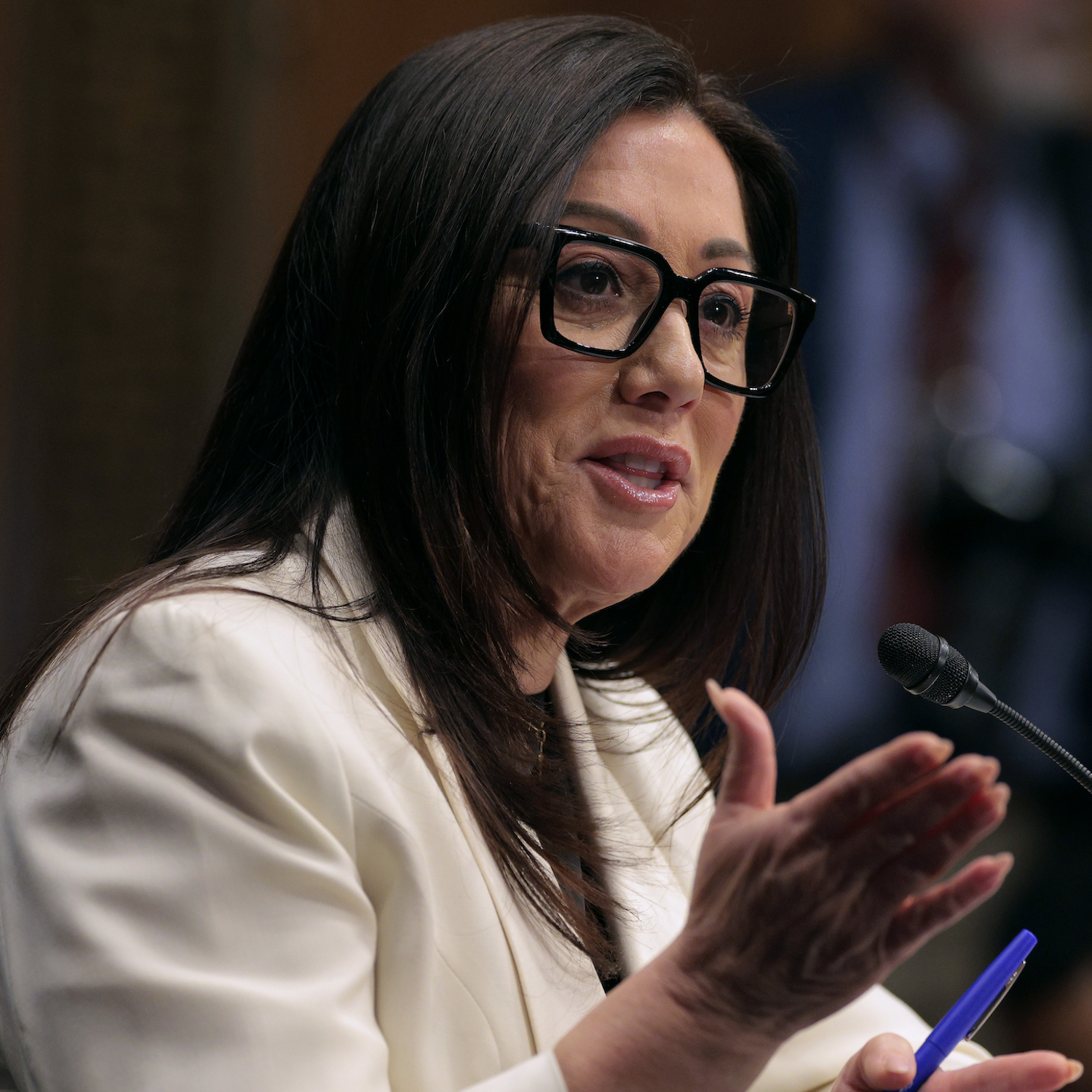
To hear our full conversation, stick around after today's show. If you're listening in the news app, that episode of Apple News in Conversation will be queued up to play for you. Yesterday, the Senate voted to confirm Cash Patel as FBI director. That means up until this point, all of Trump's nominees have been confirmed, most with relative ease, despite some facing questions about their character or lack of experience, which speaks both to the numerical advantage Republicans have in the Senate and their eagerness to appease President Trump. But one nominee is getting more pushback from Republicans than others. Former Representative Laurie Chavez Durimer, a Republican who served for one term in the House. When Trump nominated her for labor secretary, some Democrats were pleasantly surprised because in Congress she was a co sponsor of a piece of legislation called the PRO Act, a sweeping labor bill that aimed to strengthen collective bargaining rights. She was one of just a few Republicans to back the bill. A number of unions were excited about her nomination too, including teamster president Sean O'Brien, because Chavez Darimer's father was a Teamster himself. In her hearing on Wednesday, she was asked how she feels about the PRO act now. She called the bill imperfect and avoided saying much else about it, like in this exchange with Vermont Senator Bernie Sanders.
- [09:36]
Laurie Chavez Durimer
Do you support the PRO act?
- [09:38]
Bernie Sanders
Thank you, Ranking Member Sanders and I appreciate the conversation. I support the American Worker. President Trump.
- [09:46]
Laurie Chavez Durimer
Okay, I don't mean to be rude. We don't have a lot of time. I am gathering that you no longer support the PRO act is what I hear, that you support the American Worker. That's what everybody here will say.
- [09:58]
Shemit Sebastu
Several senators asked her about her stance on right to work laws which limit union organizing. Here's her exchange with Kentucky Senator Rand Paul.
- [10:07]
Bernie Sanders
I signed on to the PRO act because I was representing Oregon's 5th district, but I also signed on to the PROACT because I wanted to be at that table and have those conversations. But I fully, fairly and support states who want to protect their right to work. I have said that to every senator that I have visited.
- [10:24]
Laurie Chavez Durimer
So you no longer support the aspect of the PRO act that would have overturned state right to work laws?
- [10:29]
Bernie Sanders
Yeah, there were so many parts. That's a yes, yes, yes, sir.
- [10:33]
Shemit Sebastu
The overall impression of her hearing, according to the Washington Post, was that Chavez Darimer was distancing herself from her past support of pro union ledger legislation. Democrats in the Senate who initially seemed ready to support her now appear less likely to. And interestingly, Republicans are torn between her pro union voting record as a one term congresswoman and what she's now saying about letting states decide their own labor laws. Meanwhile, advocates for workers rights have questioned how much power Chavez Darimer might have as labor secretary in an increasingly diminishing landscape of federal oversight. In his first few weeks in office, Trump fired two of three Democratic commissioners on the Equal Employment Opportunity Commission, which enforces civil rights in the workplace. He also fired the acting chair of the National Labor Relations Board, which protects employees rights to organize and fight unfair labor practices. Chavez de Rimmer's nomination will be up for a committee vote next week. Before we let you go, a few other stories we're watching Israeli officials say a body handed over by Hamas on Thursday isn't who Hamas claimed it is. Authorities confirmed the identities of remains belonging to two children, Kfir and Ariel Bibis, but say the body reportedly belonging to their mother, Shiri, was not hers or that of any other hostage. That's according to the Associated Press. The Israeli military called it a violation of the utmost severity and demanded Hamas return Shiri Beavis body. As of Thursday night, Hamas had not commented. It's unclear what this means for Saturday's scheduled release of the six remaining living hostages. New York governor Kathy Hochul says she will not remove New York City Mayor Eric Adams from office. Hochul said she would let New Yorkers make their choice clear at the polls and announced an inspector general to oversee the mayor. Adams is charged with a number of corruption crimes, which the Trump administration says it will drop. In a statement responding to Hochul's announcement, Adams said he believes there is no legal basis for the governor to place limits on his power, but he is willing to work with her. The former head of the Spanish soccer federation, Luis Rubialis, was convicted Thursday of sexual assault for forcibly kissing player Jenny Hermoso after the team won the Women's World cup in 2023. Rubiales was fined but not sentenced to any prison time. He was also acquitted of a coercion charge for allegedly trying to get Hermoso to say the kiss was consensual. And lastly, if you've seen headlines about an asteroid potentially coming for Earth in a few years, you can rest easy. Just a few days ago, the odds of the roughly football field sized rock colliding with Earth were at about a 3.1% chance, but that number has since dropped to essentially zero, according to scientists at NASA's center for Near Earth Objects Studies. The Washington Post reports chances of this asteroid impacting Earth were always low, but it was important to track because its size triggered a global warning for the first time since the warning system was created in 2012. So the good news? The system works Even better news Turns out we don't need it. At least not this time. You can find all these stories and more in the Apple News app. And if you're already listening in the news app, stick around for my full interview with Ankish Kadori about how we're watching Trump expand the reach of presidential power. If you're listening in the Apple News app right now. That episode of Apple News in Conversation is queued up to play for you next. Enjoy your weekend and we'll be back with the news on Monday.