Loading summary
Transcript11 lines
- [00:05]
Shemitah Basu
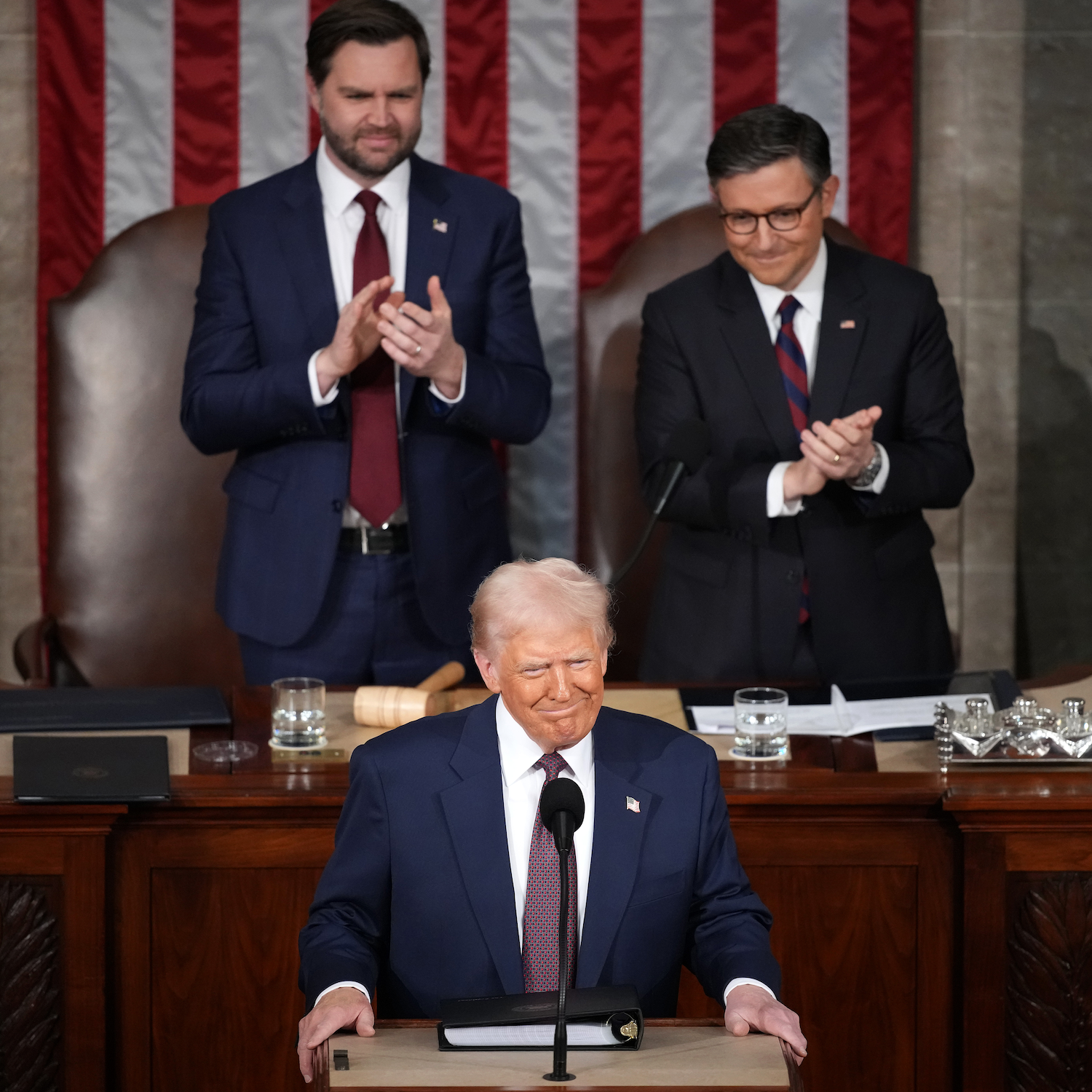
Good morning. It's Wednesday, March 5th. I'm Shemitah Basu. This is Apple News today. On today's show, Trump touts his early victories before Congress, the Arab state's proposal to rebuild Gaza after the war ends and the astronauts stuck at the International Space Station are finally getting ready to come home. Foreign let's start with President Donald Trump's address last night to a joint session of Congress, his first since taking office in January. From the moment he entered the chamber, he was greeted by Republican cheers and Democrats protesting. Several dozen held up signs reading things like Musk Steals and Protect Veterans. Texas Congressman Al Green stood up to disrupt the president's speech and protest threats to Medicaid, and he was escorted out by the sergeant at arms. The chair now directs the sergeant at arms to restore order. Remove this gentleman from the chamber. For much of his speech, Trump suggested he had a sweeping mandate to enact these changes from the American people. At one point, he said that God had spared his life from assassination in order for him to return to the presidency. With that mandate, Trump touted his long list of early actions, everything from dismantling DEI programs and US Government agencies like USAID to increasing resources at the southern border and renaming key landmarks like the Gulf of Mexico and Mount Denali.
- [01:45]
Donald Trump
We have accomplished more in 43 days than most administrations accomplished in four years or eight years, and we are just getting started.
- [01:56]
Shemitah Basu
Trump also celebrated Elon Musk's work with the Department of Government Efficiency, claiming Doge has found hundreds of billions of dollars of fraud, a figure that's been hard for journalists to verify, though many outlets have found instances of Doge overstating its savings. Trump attacked federal workers, though notably he didn't mention how much the government is saving with mass layoffs. And he said the days of being ruled by unelected bureaucrats are over. To which Democrats respond by pointing to Elon Musk sitting up in the gallery. Trump later turned to his plans for the future, spending quite a bit of time on tariffs and the economy. His speech came just a day after he implemented tariffs on Canada, Mexico and China, moves that sent stocks tumbling for a second day and have some notable economists, including from the International Chamber of Commerce, warning of a recession. But Trump defended his decision, claimed it will be good for American farmers, even though farmers have sounded the alarm, saying they produce more than Americans consume and need foreign markets to buy their goods. And Trump also announced his intention to impose reciprocal tariffs on a whole host of countries on April 2.
- [03:09]
Donald Trump
Tariffs are not just about protecting American jobs. They're about protecting the soul of our country. Tariffs are about making America rich again and making America great again. And it's happening, and it will happen rather quickly. There'll be a little disturbance, but we're okay with that. It won't be much.
- [03:32]
Shemitah Basu
Trump spent just a few minutes on foreign policy with a passing mention of Gaza and calling for the war in Ukraine to end. He tempered the recent hostility we've seen toward Ukrainian President Volodymyr Zelenskyy instead, noting that he appreciated a letter he recently received, Zelensky saying he's ready to come to the negotiating table and sign the minerals deal. And Trump reiterated his desire to expand the United States, saying he intends to take the Panama Canal and inviting the people of Greenland to join our country.
- [04:05]
Donald Trump
We need Greenland for national security and even international security, and we're working with everybody involved to try and get it. But we need it really for international world security. And I think we're going to get it. One way or the other, we're going to get it.
- [04:22]
Shemitah Basu
Since this was, after all, a speech addressing Congress, Trump did call on the lawmakers to support his agenda by removing taxes on tips, among other things, by funding his deportation agenda without delay, and by agreeing to pass laws criminalizing parents who allow their children to undergo gender affirming medical operations. Two opposing dynamics were on display, all Republican exuberance for the president's agenda and Democratic objection, which Trump called attention to. Several times, some Democrats held up signs that said false, acting as a sort of live fact check on Trump. At one point, a small group of Democrats staged a small protest before walking out. Others filed out at various other points during the speech. Trump's speech was the longest ever given by a president to a joint session of Congress in modern history, eclipsing Bill Clinton's one hour and 29 minute record set in 2000. According to the American Presidency Project, Trump's address clocked in at one hour and 39 minutes. Senator Elissa Slotkin, a Democrat from Michigan, provided the Democratic Party response following Trump's speech.
- [05:34]
Elissa Slotkin
Look, the president talked a big game on the economy, but it's always important to read the fine print. So do his plans actually help Americans get ahead? Not even close. President Trump is trying to deliver an unprecedented giveaway to his billionaire friends. He's on the hunt to find trillions of dollars to pass along to the wealthiest in America. And to do that, he's going to make you pay in every part of your life. Grocery and home prices are going up, not down, and he hasn't laid out a credible plan to deal with either of those.
- [06:08]
Shemitah Basu
While President Trump touted his popular vote victory in the presidential election, a trio of recent polls found that Americans are largely split on the president so far and economic concerns still dominate with many. In one of these recent polls, conducted By CBS and YouGov, 82% said they want the president to make the economy a high priority. And in an NPR Marist survey, a majority of Americans said that they expect prices to climb higher in the next six months. Months now to the Middle east, where leaders of the Arab League states held an emergency summit in Cairo yesterday to discuss a post war plan for Gaza and to counter President Trump's proposed plan for a Middle east riviera. In January, the president floated the idea of the United States taking control of Gaza to develop the enclave into a tourism destination, forcing millions of Palestinians to leave their land with no guarantees they could return. His suggestions have been widely denounced by leaders across the Middle east and worldwide, with some saying it's equivalent to ethnic cleansing. At yesterday's summit, Arab leaders endorsed a plan proposed by Egypt that would allow Palestinians to remain in Gaza after the war between Israel and Hamas ends. Egypt, which neighbors both Israel and Gaza has been heavily involved in peace negotiations since this conflict started. International correspondent Ehya Batrawi, reporting from Cairo, explained for NPR what their proposal includes.
- [07:46]
Elissa Slotkin
It has actually several plans along several tracks. The first is basic reconstruction. You have tens of thousands of Palestinians killed in Gaza, more than 90% of homes damaged or destroyed. Basic infrastructure there needs to be rebuilt. So this plan looks at how do you repurpose the rubble, how do you bring in temporary homes for Palestinians to live in, and other technical details.
- [08:05]
Shemitah Basu
Egypt's plan to rebuild Gaza would cost an estimated $53 billion and take about five years to complete. But the plan didn't specify who would fund reconstruction. The Guardian notes it would likely require money from oil rich Gulf countries like Saudi Arabia, Qatar and the United Arab Emirates. The first phase of reconstruction would focus on clearing debris and unexploded bombs and creating temporary shelters. The second phase would focus on restoring critical infrastructure and rebuilding homes. The Egyptian government presented a 112 page document full of AI generated images of housing developments, gardens and community centers, plus plans for a commercial harbor, a technology hub, hotels along the beach and an airport. But critically, the plan still doesn't give a clear answer to one of the biggest unanswered questions of this who will govern Gaza if the war ends? Egypt proposed an independent administrative committee would temporarily govern and be responsible for managing aid while preparing for the return of the Palestinian Authority. This leaves Hamas out of the power equation. The Trump administration has not responded to Egypt's proposal. United Nations Secretary Antonio Guterres, who attended the summit, endorsed the plan. However, the Guardian reports the proposal does not have the support of Hamas or Israel. A senior Hamas official said while they support ideas that do not displace any Palestinians, the group will reject attempts to impose development projects on people in Gaza. And Israeli Prime Minister Benjamin Netanyahu has previously said he wants Israel to permanently control all Palestinian territories. The Arab summit and proposal comes as the delicate ceasefire deal between Israel and Hamas reaches a crucial juncture to see whether the parties can agree to proceed with phase two of the ceasefire and commit to ending the war. Before we let you go, a few other stories we're following. The Wall Street Journal reports that Republican leadership in Washington have advised their members to stop holding town hall style events after viral videos of angry constituents confronting their representatives about issues like government layoffs and feared cuts to Medicaid spread across the Internet. The guidance came from Representative Richard Hudson, chair of the National Republican Congressional Committee, who warned that it could have negative consequences for the midterms. House Speaker Mike Johnson, meanwhile, said lawmakers should still communicate with their constituents, but not in ways that, quote, give the other side soundbites in some good news, the American astronauts who've been at the International Space Station since June of 2024, when the original stay was only supposed to last a few days, are finally scheduled to come home. NASA's Butch Wilmore and Suni Williams are expected to return to Earth on a SpaceX capsule later this month. Recently, SpaceX founder Elon Musk said the ISS has served its purpose and should be taken out of orbit as soon as possible. The station is set to be decommissioned in 2030. In a press briefing from space yesterday, Williams told reporters that she thinks it would be a mistake to halt the work happening on board any sooner. I actually was extremely impressed coming up here and seeing how much science is going on. I mean, this place is ticking. It's just really amazing. We're actually in our prime right now. We've got all the power, all of the facilities up and operating. So I would think that right now is probably not the right time to say call it quits. And finally, the famous Iditarod dog sled race across the Alaskan wilderness is underway this week after it was delayed for a second year in a row due to warm temperatures and too little snowfall. This year, the lack of snow impacted a particularly dangerous portion of the course forcing organizers to move the starting line several hundred miles to the north. This is the fourth time in recent years organizers have been forced to make changes due to rising global temperatures and it means the mushers and their dogs will have to race longer. The course change added more than 100 miles to their usual route. You can find all these stories and more in the Apple News app. And if you're already listening in the news app right now, we've got a narrated article coming up next. A report released last month found the amount of plastic making its way into the human brain today is roughly 50% higher than just eight years ago. Give you a visual that's about the size of a disposable spoon. New York magazine looked into the research and what we know know about how microplastics affect our bodies. If you're listening in the podcast app, follow Apple News plus narrated to find that story. And I'll be back with the news tomorrow.