Loading summary
Transcript24 lines
- [00:05]
Shemitah Basu
Good morning. It's Monday, March 24th. I'm Shemitah Basu. This is Apple News today. On today's show, what closing the Department of Education would mean for low income school districts, why American chicken farms are particularly vulnerable to bird flu and a community rallies behind a teacher who was told her classroom decor violates policy. But first, we're learning more about the Venezuelan migrants deported by the United States and sent to El Salvador with no due process. CBS News has obtained an internal government list with the names of the 238 men, more than half of whom President Trump and his administration have accused of being part of the Trend Gang, a group that Trump has called a foreign terrorist group and wartime enemy. He used those terms again when he invoked the Alien enemies Act of 1798, a move that allowed him to give these men no chance to defend themselves in court and has set off a legal battle. And now many of their family members and friends are speaking out, saying they are not part of any gang and have committed no crimes. One of the men is Jersey Reyes Barrios, a Venezuelan soccer player who was in the US Waiting for a ruling on his asylum claim. According to his attorney, he was suspected of being part of a gang because of his tattoo, which he says is a nod to his favorite soccer team, Real Madrid, not to any gang. Washington Post immigration reporter Sylvia Foster Frau told us about 29 year old Mervinha Marte, who came to the US to escape Venezuela's political and economic crisis and to send money to his partner and child back home.
- [01:50]
Sylvia Foster Frau
And so he came up through Central America, crossed the border, was detained for a few days, released, and then got a home in Dallas, Texas, where he began working at a tortilla making factory. He lived there with his three friends and was working there. They formed a soccer team and they played soccer together in the afternoons and really just kind of made a life for himself in the year and a half that he's been in the United States.
- [02:20]
Shemitah Basu
Armed officers showed up at their Texas home and brought all four of them to a detention center. Yamarte's family told the Post he and his friends were asked to sign deportation papers and they agreed to it, thinking they were going home to their loved ones in Venezuela. But that wasn't the case.
- [02:37]
Sylvia Foster Frau
He was put on a plane and actually sent to El Salvador's mega prison, which is a notorious and huge complex that has been at the center of allegations of human rights abuses and has been part of the crackdown on crime there in El Salvador.
- [02:56]
Shemitah Basu
Yamarte's mom realized her son was in El Salvador from seeing a video shared by Salvadoran President Nayib Bukele that depicted gang members being violently pulled from airplanes and brought to this infamous prison.
- [03:09]
Sylvia Foster Frau
We found, you know, the still that the moment where she recognized her son. It's a very close up part of the video where you see his face and he appears to be wincing. He, he's kneeling down wearing this like ripped black shirt. His head has been shaven. There had been footage earlier in the video of them shaving all of the new prisoners heads. And there's an officer behind him kind of gripping him on the shoulder. And as you can imagine how hard that would be for a mother to see.
- [03:41]
Shemitah Basu
Neither the White House nor the Department of Homeland Security would confirm whether Humarte and his friends had ties to gangs.
- [03:47]
Sylvia Foster Frau
We asked the local ICE in Dallas, we asked the federal agencies, Homeland Security and Immigration Customs Enforcement. At the federal level, we asked the White House, what evidence do you have that these folks are tied to Trenderagua? Can you kind of give us a rundown? Do you have any proof? What are you using to determine this? And we got no response. We also scoured court records on the national, state and local level trying to find if these people had been charged with any crime. And we could not find any crime. And then we also spoke to family members and girlfriends and friends of these four immigrants. And they were very vehement in their insistence that these men were not members of the gang.
- [04:35]
Shemitah Basu
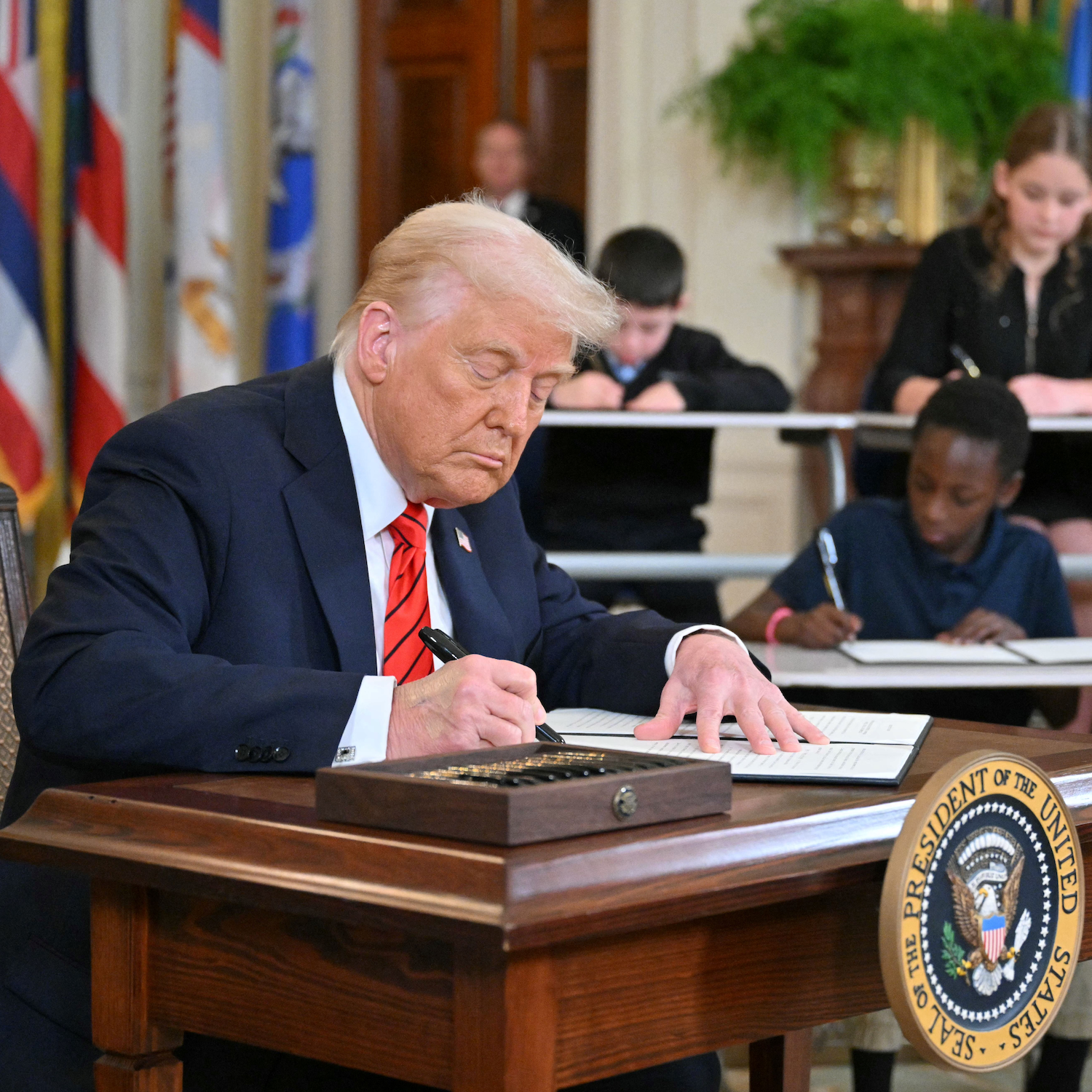
The administration has so far provided no evidence supporting their claim that everyone on that plane had gang affiliations. And it's becoming increasingly clear some, if not many, likely were not gang members. Still, the administration has continued to defend the deportations. Meanwhile, the judge who ordered the administration to turn around the planes flying these men to El Salvador in order that was not followed. He said in a separate hearing on Friday that he was skeptical the Justice Department has grounds to invoke the Alien Enemies act at all, saying the administration has stretched and distorted the intent of the statute. As President Trump makes moves to end the Department of Education, even though Congress is supposed to get the last word on eliminating it. Let's talk about what kind of impact that might have on students, particularly in low income districts. We've said it before, but it's worth saying again, the DOE isn't in charge of curricula. That's up to the states. Funding also largely comes from states, with only about 8% coming from the federal government. And the Trump administration has said it would maintain federal funding streams for two of the DOE's key programs Title I, which serves low income communities, and the Individuals with Disabilities Education Act. But some educators and policy experts worry that disruptions to these and other programs are inevitable if the DOE is eliminated and its functions assigned assigned to other parts of state and federal government. One coming change with the potential for big impact, A data arm of the Education Department called the national center for Education Statistics will soon see its staff reduced from more than 100 earlier this year to just three employees. This is a department that tracks the condition of education in the country, identifies gaps in achievement, and assigns grants for rural and low income schools. But with a severely short staff, it's unclear how money will be allocated in the future. And that money is really important. Title I and rural schools can use it for basics like teachers salaries, technology and school buses, Axios reports. The states that have the most to lose if the DOE is dismantled are mostly states that voted for Trump. Take, for example, Mississippi. In the 2021-2022 school year, about 23% of its public school funding came from federal dollars, one policy expert told Axios. Lower wealth States like Mississippi will struggle to make up for lost federal funding. Meanwhile, educators themselves, many who are already tired of super tight budgets in the classroom, say that they're fed up. Chloe Ireman is a third grade teacher in the Denver area. She spoke with NBC News at a teachers rally against federal cuts to education last week.
- [07:33]
Sylvia Foster Frau
I think the scariest part is that we don't know that uncertainty is terrifying and it's drawing away from what really matters here, which is the education of our youth and our future Americans.
- [07:44]
Shemitah Basu
The administration, for its part, says this is all about eliminating bureaucracy and returning power to the states. Here's Education Secretary Linda McMahon speaking to Fox News after Trump signed the order.
- [07:56]
Sylvia Foster Frau
We want to raise scores, not continue to let scores get lower. And the president is really convinced that the bureaucracy of the Department of Education is a hindrance in that.
- [08:06]
Shemitah Basu
But even officials in some Republican states say they aren't sure Trump's order actually does that. Kevin Huffman led Tennessee's Education Department under a Republican governor. Here's what he told npr.
- [08:18]
Kevin Huffman
I think the whole thing is based on a false premise that somehow federal bureaucracy is the barrier and the reason why kids aren't learning more. But in my experience, that's not true. States already have lots of autonomy and some use it well and some do not.
- [08:36]
Shemitah Basu
Aside from administering Federal aid to K through 12 schools, the Education Department is also the largest source of loans for college students. The Trump administration says loans will Instead be overseen by the Small business administration, which McMahon headed up during Trump's first term. Let's turn now to egg prices, an American staple that's been causing a lot of pain for grocery shoppers. It's outrageous. I just don't understand why egg prices gotta be so high. At Waffle Houses across the country. The menus now say there will be a tem 50 cent surcharge for every egg you order. A tough hit since eggs are Waffle House's most ordered item.
- [09:22]
Sylvia Foster Frau
It's extremely high.
- [09:24]
Kevin Huffman
Like the price of anything.
- [09:25]
Shemitah Basu
They've gone up substantially over the last few years, skyrocketed in the last six, seven months. Made us a lot more conscious of, like, how much we're using them. Those omelets are going to become a luxury item. It feels like people are eating gold now. Now there is some good news on the horizon. The Department of Agriculture reported last week that Americans should soon start to see the price of eggs come down a bit. They wholesale egg prices have fallen significantly and consumers should start to notice it on their grocery shelves in the next few weeks. Meanwhile, NPR looks at our neighbor to the north, Canada, and how they have managed to keep egg prices at bay. According to npr, Canadian chickens haven't been affected by bird flu the way American chickens have. That's primarily because egg farms in Canada exist on a much smaller scale. The typical egg farm up north has around 25,000 egg laying hens, while many farms in the U.S. here's how Mike von Massau, a food economist in Ontario, put it to npr.
- [10:25]
Kevin Huffman
If individual farms represent a larger proportion of production than when an individual farm is affected, you're taking more of that supply, right?
- [10:34]
Shemitah Basu
Since the 1990s, the average farm in the US has quadrupled in size. That's because pressure to produce cheap goods meant that farmers had to make up the difference with volume. Dairy farmers in Canada don't have the same incentive to produce more because they're protected by a federal system that sets production quotas. It keeps prices stable. Here's von Massow again on npr.
- [10:56]
Kevin Huffman
There is less incentive to grow because I can make money at this size. There is still incentive to be efficient, but there is not a requirement to get as big.
- [11:09]
Shemitah Basu
There are a few more factors beyond size. Barns in Canada are sealed more tightly because of the colder weather that's also kept out the virus. There are fewer free range chickens in Canada, a group that's more likely to become infected. Also, Canada doesn't allow the import of eggs and dairy from the US which is a source of contention in the ongoing trade war. Now. While the Department of Agriculture reports that American prices should drop soon, there's also an effort underway in Congress to get egg prices under control. A bipartisan bill was introduced in the House that proposes reining in regulation for farmers, which currently requires them to discard eggs that don't meet certain ref duration requirements. Supporters of this bill say that rule has led to hundreds of millions of eggs each year being thrown away. And at a time when there's fewer to spare, every egg counts. Before we let you go, a few other stories we're following. Canadians are headed to the polls early after newly sworn in Prime Minister Mark Carney called for snap elections to be held in April. Carney on Sunday asked Canadian voters to send a strong mandate to deal with an escalating trade war over tariffs, with President Trump, saying Trump wants to, quote, break us. Carney and Canada's Liberal Party will face Conservatives and their leader Pierre Poliev, who has sought to distance himself from Trump since Trump announced steep tariffs. Canada's Liberals have done increasingly better in national polling. In other news, Pope Francis is out of the hospital. The 88 year old pontiff thanked the crowds and gave a blessing in a brief public appearance on Sunday after his discharge from a hospital in Rome. The pope has been hospitalized for five weeks, first with a microbial infection, then double pneumonia. Officials say he'll continue his recovery at his residence in Vatican City. And finally, a teacher in Idaho is refusing to take down classroom signs that her district said violates policy. On content neutral displays, the poster reads everyone is welcome here and has hands in an array of skin tones. Sarah Enama teaches world Civilizations at Lewis and Clark Middle School. Here she is talking with msnbc.
- [13:31]
Sarah Enama
I would do anything to protect my students. I love all of them unconditionally. We protect them from danger. Quite literally would take a bullet for these students. And this is the one small thing that I feel like I can do to speak out against this and stand up for them, to protect them from being affected by racist sentiments affecting their classroom.
- [13:54]
Shemitah Basu
Today, local advocacy groups have encouraged people to wear Everyone is welcome here T shirts to work or school. A local screen printing shop worked through the weekend to try to meet demand with thousands of shirts ordered. You can find all these stories and more in the Apple news app. And if you're already listening in the news app right now, we've got a narrated article coming up next. The New Yorker examines why the MAGA movement has appealed to so many young men in recent years and what it might take for the left to reach them again. If you're listening in the podcast app, follow Apple News narrated to find that story and I'll be back with the news tomorrow.