Loading summary
Transcript27 lines
- [00:05]
Shemitah Basu
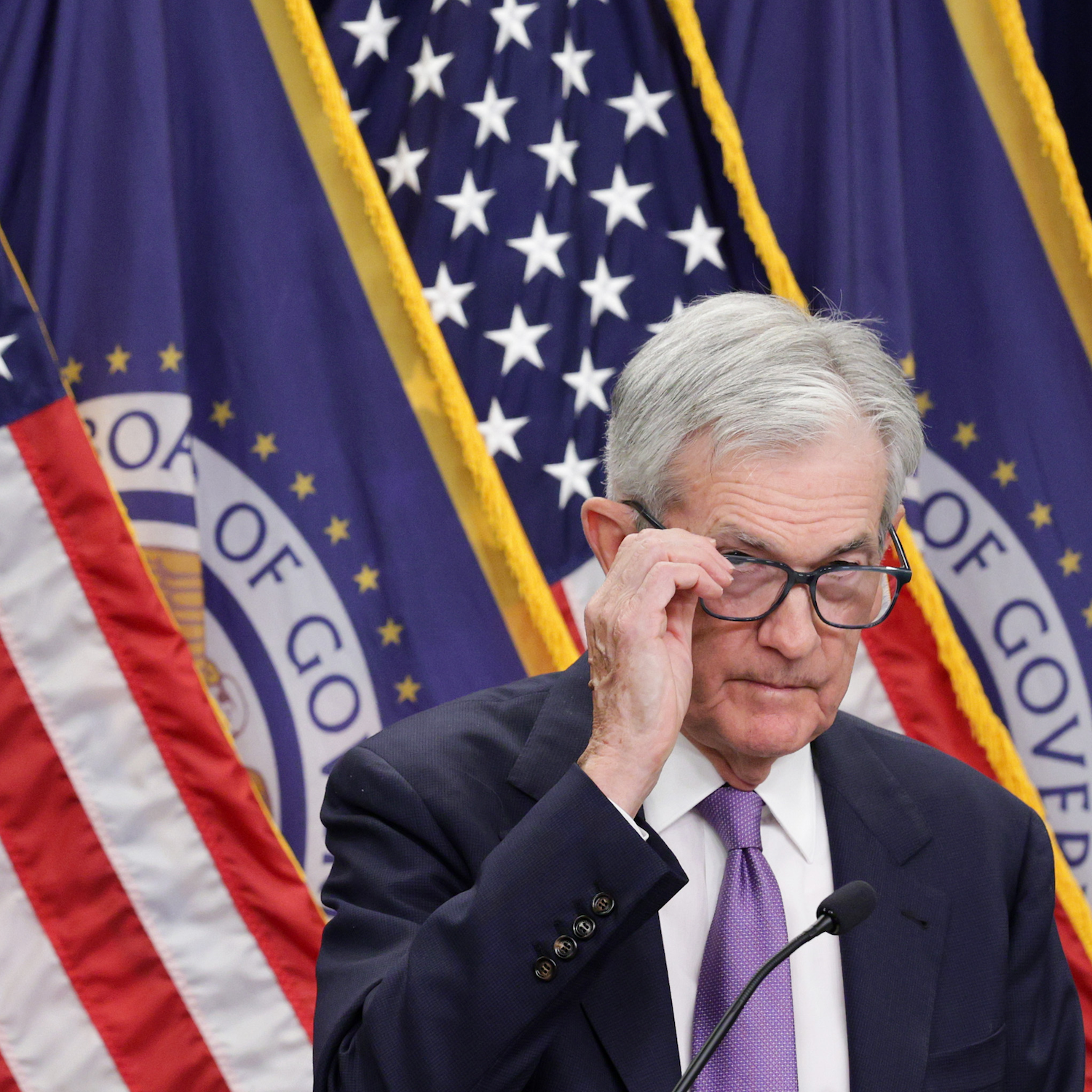
Good morning. It's Thursday, October 30th. I'm Shemitah Basu. This is Apple News today. On today's show, why the public face of federal immigration enforcement is facing court scrutiny. Rio in shock after police carry out its deadliest ever raid. And a newly discovered Dr. Seuss manuscript will soon be published. But first, the Federal Reserve made another interest rate cut for the second month in a row yesterday. The quarter point reduction was expected and long priced into market expectations. What was more surprising was Fed Chair Jay Powell's warning on the road ahead.
- [00:49]
Jay Powell
In the committee's discussions at this meeting, there were strongly differing views about how to proceed in December. A further reduction in the policy rate at the December meeting is not a foregone conclusion. Far from it.
- [01:03]
Shemitah Basu
His wording here, characterized by the Wall Street Journal as an unusually pointed intervention, was seen as an attempt to rein in markets that had already begun to price in another rate cut, something President Trump is eager to see. Wall street dipped following Powell's comments. Powell also acknowledged uncertainty owing to the shutdown, which has led to a big gap in fresh economic data for them to draw concl from.
- [01:28]
Jay Powell
What do you do if you're driving in the fog? You slow down. So that could or could not. I don't, I don't know how that's going to play into things. The data may come back, but there's a possibility that it would make sense to be more cautious about moving.
- [01:41]
Shemitah Basu
Officials described inflation as somewhat elevated, still at 3% above the Fed's target, though rising at a slower pace than the last three months. But the rate cut decision shows the Fed are continuing to prioritize the softening jobs market. On that front, there appears to be a shift in perception among some labor experts. Throughout much of the year, economists had been talking about a no hire, no fire environment, essentially meaning that job seekers were having a difficult time getting work, but those who did have jobs were holding onto them. In recent days, though, a few major corporations have announced job cuts that challenge that thesis. Amazon announced it was letting 14,000 workers go, and UPS reduced its workforce by about 48,000 compared to last year. Target said last week that it was cutting about 1,000 corporate jobs and leaving another 800 unfilled. End jobs in the federal workforce have declined this year, with more expected to fall off payrolls after this month. Daniel Zao, senior economist at Glassdoor, characterized what he was seeing in a CNBC interview.
- [02:46]
Daniel Zao
I think we're starting to move into an environment that's more low. Hire some fire. So we're starting to see layoffs tick up to where they were compared to pre pandemic levels. And the fact that we are starting to see more of those layoffs and we are seeing hiring still at a pretty sluggish rate perhaps indicates that we are going to see the unemployment rate rise a little bit. We are going to see some more weakening in the job market. And so I do think that some of these announced layoffs are signs of a trend of the job market continuing to slow.
- [03:14]
Shemitah Basu
Even with Powell's comments yesterday, this has been a sky high period for Wall street, powered in large part by AI focused companies like Nvidia, which became an unprecedented $5 trillion company Y. The market boom over the course of this year has contributed to a K shaped economy where wealthier Americans benefiting from the stock market gains are spending more and lower. And middle income Americans impacted most by stubbornly high prices of everyday goods are spending less. Heather Long, the chief economist at the Navy Federal Credit Union, recently explained this phenomenon to PBS NewsHour.
- [03:50]
Heather Long
This economy right now is being driven by spending from the top 20% of Americans. So that dividing line is roughly $175,000. Families that earn above that mark, they're living la vida loca. You know, they're out there. They're spending on birthday parties and lavish weddings and big trips abroad and growing their spending month after month. And the rest of America, the bottom 80%, they're cautious right now.
- [04:19]
Shemitah Basu
This kind of wealth inequality and spending power is nothing new in the United States. But Long said that it has become more pronounced.
- [04:27]
Heather Long
You can go back to kind of the early 90s and the top 10%, the wealthiest Americans, you know, they would account for 35% of overall spending. So a pretty good chunk was reliant on the top. But today that number is basically 50%. Half of spending is now dependent on just the top 10%.
- [04:48]
Shemitah Basu
Even if another cut doesn't come in December, this week's decision brought interest rates below 4% for the first time in three years. Now to the man who's become the public face of President Trump's escalating federal law enforcement tactics. Gregory Bovino is a Customs and Border Patrol commander and he's been heading up federal activity taking place in democratically led cities like Los Angeles and Chicago, leading the charge even in cases where local officials have objected to federal presence. His efforts have resulted in multiple lawsuits and a strict ban on certain enforcement tactics from a federal judge. Jason Meisner covers the federal courts for the Chicago Tribune.
- [05:39]
Jason Meisner
The federal judge, Sarah Ellis in Chicago, entered a restraining order against the Department of Homeland Security earlier this month, restricting the use of tear gas indiscriminately and without warning on the streets, and also requiring agents to be using body cameras when they're out interacting with the public and to have identification on their uniforms.
- [06:02]
Shemitah Basu
And on Tuesday, the same judge, Judge Ellis, cited concerns that the restraining order had not been followed and took the rare step of ordering Bevino to come in and brief her on immigration enforcement efforts every day.
- [06:15]
Jason Meisner
It was a very kind of dramatic moment where he came in in full uniform and protesters were outside the courthouse in downtown Chicago, on both sides, actually, ICE supporters and protesters against the immigration agents. And he sat in court for a little over an hour and listened to the judge lecture him and ask him questions.
- [06:35]
Shemitah Basu
During that Tuesday appearance, Ella specifically pressed Bavino on one incident that occurred on a residential street where children were getting ready to go to a Halloween parade this past weekend.
- [06:46]
Jason Meisner
Agents went in the neighborhood heavily armed, chased a day laborer down the street who they had just randomly come upon, apparently. And that led to a confrontation. Neighbors coming out of their houses still in their pajamas, filming. It got pretty ugly and people were yelling and people were tackled by the agents and then tear gas was deployed. The judge was very upset about this incident. She went on at length about it and she told Greg Bovino, this is no way that anybody wants to live.
- [07:13]
Shemitah Basu
Meisner said that Bovino did say that he would abide by the orders. And DHS said of this specific incident that agents were, quote, surrounded and boxed in by a group of agitators. Bavino himself has defended his aggressive tactics, including in an interview with CNN earlier this month.
- [07:31]
Jay Powell
Folks are free to criticize. They're free to arm chair quarterback. When they don't walk a mile in the shoes of law enforcement, then they might want to think a second before full blown criticism. I've heard a lot of that. Our officers act legally, ethically and morally in all law enforcement actions, whether it's Los Angeles or Chicago.
- [07:51]
Shemitah Basu
Meisner described the moment he left the courthouse on Tuesday.
- [07:54]
Jason Meisner
He had a bunch of his armed agents around him. He jumped up onto a pickup truck and waved and motioned for his agents to move out as protesters were chanting. So it was kind of like two sides of him once he got out of court. The Greg Bevino that we've seen. And the news was back.
- [08:11]
Shemitah Basu
The Department of Justice appealed Judge Ellis's order requiring daily check ins. And just an hour before his first check in on Wednesday was due to happen, the 7th Circuit Court of Appeals put a pause on the order, according to ABC 7 Chicago. The pause is temporary until the court considers the matter further before making a final ruling. Bavino is scheduled to sit for a deposition in the lawsuit over federal agents use of aggressive behavior against peaceful protesters in Chicago today. It was the deadliest police raid in Brazil's history, which left at least 132 people dead and drew condemnation from the UN the sound there of police in Rio firing during Tuesday's raid, which was targeting one of the country's biggest drug gangs, the Commando Vermejo, or Red Command. Police said gang members weaponized drones in response, dropping explosives onto officers. And local media reported people blocking roads and using burning cars as barricades into the city. The city's governor, Claudio Castro, said the raid was designed to target narco terrorism and police said they arrested over 100 suspects and seized large quantities of firearms. O Globo newspaper called it the deadliest blow to the Red Command gang since its creation. Here's CNN correspondent Mariana Giangiacomo describing on the network what things looked like on the ground.
- [09:44]
Heather Long
Just scenes of pure chaos and shootings happening in the middle of the city. During the night, residents of the city went to scene search for bodies in the woods, where a big part of the operation also happened. They then took the bodies to a central square and lined them down so that people could identify the bodies.
- [10:02]
Shemitah Basu
The scale of the violence unleashed by the raid has raised questions from international human rights groups as well as national leadership. Brazil's President Lula da Silva said he was astonished by the news and expressed surprise at not being given prior warning. Some speculated whether politics might have played a part in the operation. Tim Vickery is a correspondent for France 24 in Rio. Here he is speaking on the network.
- [10:27]
Tim Vickery
This security operation was carried out by the governor of the state of Rio. Now he is a right wing figure. He is saying that this operation was a success and with the exception of the four dead police officers, everyone else here is a member of the Red Command. Now this very much plays into a very strong rationale here. This is a city traumatized by the reality of urban crime, that the only good bandit is a dead bandit. Specialists, however, would argue that such operations do nothing to combat the real problem.
- [11:06]
Shemitah Basu
Vickery added. Many think the raid was more about the theater.
- [11:09]
Tim Vickery
This has much more to do with the politics of spectacle than it really does with the politics of of public safety. Specialists will argue. Let's assume that all of the dead, with the exception of four police, are members of the Red Command. They can be replaced very, very quickly, and the rifles and weapons captured by the police can also be replaced quickly because we are dealing with a major social force here in this criminal group.
- [11:37]
Shemitah Basu
The UN's Human Rights Office said the killings added to a larger trend of increasingly lethal police raids in Brazil's marginalized communities and urged investigation. It comes as the country prepares to welcome the UN as it hosts COP, the Global Climate Summit next week. Before we let you go, a few other stories we're following. It's days away before enrollment opens for people shopping for healthcare through the Affordable Care act marketplaces, and a new analysis from health policy think tank KFF says the average price is set to go up by 26%, which would confirm it as one of the sharpest rises since the healthcare program launched over a decade ago. Consumers using the healthcare.gov platform could face even higher jumps at 30% on average. The added pain to millions of household budgets come November 1st puts the spotlight back on the COVID era. Subsidies at the center of the shutdown debate in Congress, Democrats want to extend subsidies, while Trump and Republicans have said they will not negotiate on health care until the government is back up and running. Residents in Jamaica are beginning to get a better picture of the devastation left behind by Hurricane Melissa. Critical infrastructure was severely damaged and most of the island was without power as of yesterday. Officials say some places could be uninhabitable for weeks. Two of Jamaica's airports will reopen today for commercial flights. Meanwhile, in Cuba, significant damage to homes and critical crops were reported in the province of Santiago de Cuba. Flooding and overflowing reservoirs were also a concern. And in Haiti, at least least 25 people are dead from flooding. It's now been downgraded to a Category 1 storm as it continues through the Caribbean. And finally, a new book by beloved children's author Dr. Seuss will soon go on sale. And yes, I said new because although Dr. Seuss, born Theodore Seuss Geisel, died in 1991, a manuscript, sketches and storyboards were recently discovered at the University of California, San Diego's Geisel Library. The book, titled Sing the 50 United States, features the author's famous Cat in the Hat character and will include some original sketches. An executive from Random House Children's Book said finding an original Dr. Seuss story is something we dream of. The book will be out next year. You can find all these stories and more in the Apple News app. And if you're already listening in the news app right now, we've got a narrated article coming up next. Vox has the story of how the collapse of coral reefs off of Madagascar is endangering the livelihood of those who live there. But researchers are now trying an unexpected method to bring back the island's most vital source of food. If you're listening in the podcast app, follow Apple News Narrated to find that story. And I'll be back with the news tomorrow.