Loading summary
Transcript35 lines
- [00:05]
Gideon Resnick
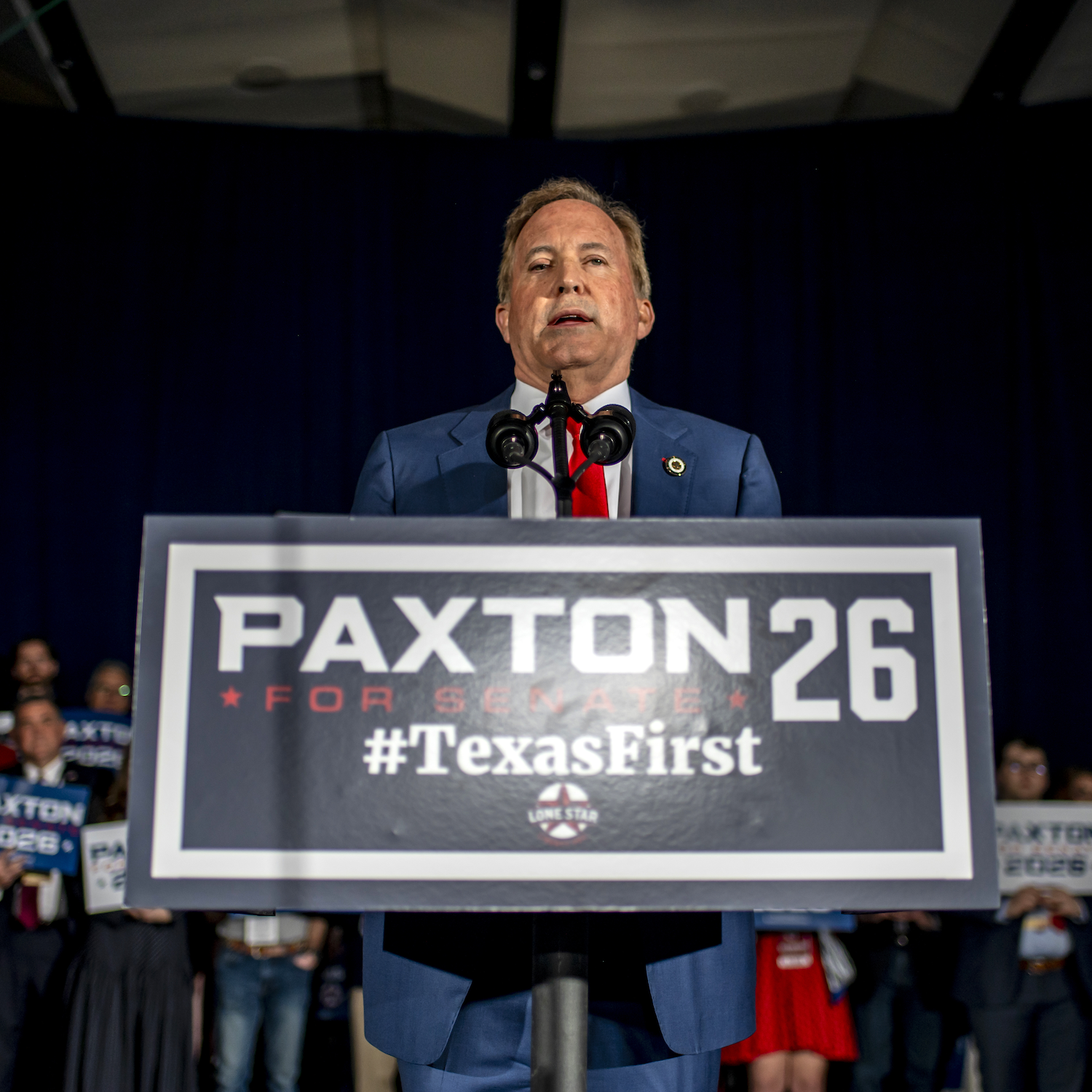
Good morning. President Trump helps force out another party veteran in a key Senate primary.
- [00:10]
Ken Paxton
When everyone in Washington told him to abandon me and abandon the people of Texas, he didn't listen. Instead, he gave his complete and total endorsement.
- [00:19]
Gideon Resnick
The Texas Tribune tells us what to expect from the scandal prone winner, Ken Paxton. The Ebola outbreak is rapidly spreading. The Washington Post looks at why it's proving so difficult to contain and why it's harder than ever to get off those college workers wait lists. It's Wednesday, May 27th. I'm Gideon Resnick in for Shemitah Basu. This is Apple News today. In the end, it wasn't even close. President Trump's handpicked insurgent, Ken Paxton, Texas's Attorney general, trounced Senator John Cornyn in last night's Texas primary runoff, providing further proof of the president's influence over his base tonight.
- [01:01]
Ken Paxton
We just sent a Texas sized message to Washington. I said it in March and I'll say it again now. Today, change was on the ballot and change won. Let me be clear, this is not just my win, this is your win.
- [01:17]
Gideon Resnick
Cornyn, who has served for more than 20 years in the Senate, quickly conceded and said that he would support Paxton.
- [01:23]
Ken Paxton
I've spent most of my time in the Senate, building the Republican Party in Texas and, and in the U.S. senate, and I've always supported the Republican ticket and I intend to do so again in this general election. I've said throughout this race that I trust the voters of Texas and they've made their decision and I must respect it.
- [01:46]
Gideon Resnick
The Senate primary was the most expensive in history, according to the Washington Post. Cornyn was not exactly a rebel. He campaigned on a record of supporting Trump and was a prolific fundraiser for the party and well liked among his colleagues. But Trump ultimately took to Paxton, whose firebrand style and MAGA enthusiasm charmed the president.
- [02:05]
Gabby Berenbaum
His brand is not dissimilar from Trump's, I would say. I think that's part of why there's sort of synergy between them.
- [02:10]
Gideon Resnick
Gabby Berenbaum is the Washington correspondent for the Texas Tribune.
- [02:13]
Gabby Berenbaum
Paxton first ran for the State House in 2002. He took down sort of a more establishment Republican, and that's sort of been his ethos ever since, is taking on the Republican establishment and he's managed to
- [02:24]
Gideon Resnick
brush off a long list of controversies. As the state's Attorney general, Paxton was impeached for a host of charges, including bribery and obstruction of justice, before being acquitted by lawmakers. He's been the subject of a fraud investigation and his wife has filed for Divorce, accusing him of adultery. Beirenbaum told us that Paxton had become something of a pariah to some in the state. And Senate leadership in Washington has hardly welcomed Trump's endorsement. But last night, the only Republicans who really mattered were the primary voters.
- [02:54]
Gabby Berenbaum
I think if you're a true believer, as Republican, as a conservative, he's delivered for the cause, right? I mean, he sued the Biden administration, I think over a hundred times, was successful on a lot of cases, including on environmental issues, things like that. He's just been part of this sort of making Texas sort of the epicenter of the conservative legal movement and using the state AG's office as a sort of base to take on either left wing presidents or sort of left wing causes and nonprofits.
- [03:21]
Gideon Resnick
For Cornyn, the dynamic was different.
- [03:24]
Gabby Berenbaum
I think his brand is much more of an elder statesman, right? I mean, he came to the Senate in the Bush era. He was the AG of Texas starting in the 90s. So he's been around and sort of helped build this Republican Party into this ascendant dominant party in Texas. But it's sort of a classic case for when you're so used to dominance in power for 30 years, what often ends up happening is the dominant party ends up fighting each other, Right?
- [03:47]
Gideon Resnick
National Republicans worried that intraparty fighting would not only alienate voters, but leave them having to spend much more money on backing Paxton in November, who might struggle more with independent voters. Democrats hope to test that theory come November. Their Senate candidate is State House Representative James Talarico, someone who's proving to be a gifted fundraiser. Last month, he reported raising $27 million, which is the most for any Senate candidate ever in the first quarter of an election year.
- [04:15]
Gabby Berenbaum
I think what's interesting is that we've already seen polls where Talarico is leading in the general election. And that's really unique because in the Beto O', Rourke, Ted Cruz 2018 race, where O' Rourke came within two and a half points of beating Ted Cruz, I think of like 70 polls that cycle, there was only one that ever showed o' Rourke leading. And we've already seen multiple showing Talarinko leading. So I think that's just like a different reality where Republicans are going into the summer having to make up ground after Paxton won.
- [04:41]
Gideon Resnick
Yesterday, the Cook Political Report changed its rating of the Senate race from likely to to lean Republican. Still, Berenbaum notes that Talarico has an uphill battle. Texas hasn't elected a Democrat to statewide office in more than 30 years. The Ebola outbreak in Africa is now the third largest in history. And the World Health Organization is warning that the epidemic is outpacing response efforts.
- [05:12]
Lauren Weber
There's been a lot of alarm about the speed at which the case count has grown and likely will continue to grow.
- [05:19]
Gideon Resnick
Lauren Weber covers health and science for the Washington Post. At this point, over 900 suspected cases have been reported, with at least 220 deaths as of Monday.
- [05:29]
Lauren Weber
Health officials have been very upfront that they do not have this outbreak under control.
- [05:33]
Gideon Resnick
The WHO does not believe there is a risk of a global pandemic at this time, but it said that right now it expects the outbreak to, quote, get worse before it gets better, and that it could take months to contain. The vast majority of cases have been in the Democratic Republic of Congo, and a handful have been reported in Uganda. Weber told us that these countries are not well set up to contain such a dangerous disease. Hospitals initially lacked the equipment to test patients for what is a rare strain and one without a vaccine. Political instability in the region is also complicating the response.
- [06:05]
Lauren Weber
This area of northeast Congo is riven with conflict. There's been attacks wiping out of villages. It's not a safe place. And when you have that kind of insecurity, it makes it much harder to deploy global health resources. And it makes a lot harder for communities to also trust outsiders. You have folks who they send their family members to the hospital thinking they may have malaria. And when they're told that they have Ebola, they can become violent with healthcare workers. They don't believe them. They think they've been taken.
- [06:37]
Gideon Resnick
In recent days, there have been attacks on hospitals treating Ebola patients. Some were reportedly frustrated that they couldn't access the bodies of loved ones over fears of transmission. Local police fired warning shots to disperse protesters as some set fire to treatment facilities, causing patients to flee. Doctors on the front lines are also facing a shortage of essential supplies to treat patients. Weber spoke with one American doctor who was recently in the DRC but is now quarantining about the conditions that he experienced. His hospital was overrun with patients who were crammed in next to each other.
- [07:18]
Lauren Weber
These physicians are running low on gloves, they're running low on soap, and they're watching their fellow colleagues fall ill and in some cases, die.
- [07:28]
Gideon Resnick
The State Department, for its part, announced last week that it will send $23 million to support the response, fund up to 50 treatment clinics across the DRC in Uganda and ship protective equipment to healthcare workers. But Weber notes that the US Is no longer playing the role that it once did. The Trump administration shut down USAID last year. Now the DRC receives a fraction of what it did only two years ago, and the US has withdrawn altogether from the body leading the public health response.
- [07:56]
Lauren Weber
The difference between this and previous Ebola outbreaks is that the the US Is no longer a member of the World Health Organization, and this is a much larger outbreak than we've seen in the past rise very, very quickly. So there's a lot of concern among public health officials, public health experts, that this could get a lot worse if a lot more intervention isn't targeted at it quick.
- [08:28]
Gideon Resnick
It is a stressful time of year for one group of students who plan to start college in the fall, those who have landed on a wait list. Schools are making decisions right now about who to accept, and Wall Street Journal reporter Roshan Fernandez told us, escaping waitlist purgatory is much harder than it used to be.
- [08:45]
Roshan Fernandez
At some schools, we've seen 10,000 kids on the waitlist and they're admitting 10 or 20 of them.
- [08:50]
Gideon Resnick
In fact, at some schools, the waitlist is now far more selective than the overall acceptance rate. Fernandez says that's because the admissions process has turned into an elaborate game of cat and mouse, with schools inflating their waitlists to accomplish a few to avoid under enrollment, to maintain relationships with donors, legacy families and college counselors, to tick some very specific boxes like enrolling more students who are willing to pay full price tuition or can fill a niche major. And schools want to be able to say that a high percentage of students they offer admission to actually say yes.
- [09:23]
Roshan Fernandez
And as a result, you see colleges also adding a significant buffer where just for example, at UC Berkeley last year they had 6,500 or almost 6,500 students accept a spot on the waitlist, and they weren't able to take any of them.
- [09:39]
Gideon Resnick
For students, meanwhile, it's gotten way easier to submit college applications and to get on a waitlist, thanks in part to the Common app, which students can use to send one application to lots of different schools. And Fernandez says many students don't mind getting put on a waitlist because they're curious to see if that offer maybe does turn into a yes.
- [09:57]
Roshan Fernandez
You think, oh, there's really no downside to accepting this. I'll agree to basically stand in line and wait and see what happens.
- [10:03]
Gideon Resnick
But when thousands of students follow that logic in the waitlist balloon, a former admissions officer told Fernandez, it can raise their hopes too high. That's what happened with one student from Maryland on Boston University's waitlist.
- [10:15]
Roshan Fernandez
He was kind of describing for me as he looked into the Data. They had 9,000 applicants on the wait list and the school enrolled 18 of them. And he was kind of just saying to me at that point, like, why are they stringing me along?
- [10:26]
Gideon Resnick
College counselors say students should exit a wait list if they're not truly interested in the school or if they are, to write a letter to reiterate their enthusiasm to go. And to a few other stories we're following, Republicans suffered two gerrymandering setbacks yesterday in Alabama. Federal judges blocked the state's attempts to redraw its maps before the midterms. That map would have potentially handed an extra seat to the gop. But the judges ruled it, quote, intentionally discriminated based on race by including only one black majority district. That's a case that could still end up in front of the Supreme Court. But in South Carolina, the state Senate put a definitive end to speculation about their maps. Some Republicans had hoped to pass a new map that would have eliminated the majority black district that has long been held by Democratic Congressman Jim Clyburn. But they opted not to, in part because early voting had already begun there for some primaries. Despite these setbacks, tracking sites believe Republicans have still emerged from the gerrymandering battles with an advantage of several additional House seats. In Iran, a devastating Internet blackout could finally be coming to an end. The regime had cut off its citizens for a record 88 days, costing the economy an estimated 30 to 40 million dollars a day. Internet reached more than a third of its previous normal level yesterday, though digital rights analysts noted the return was selective and spotty so far. For now, the ceasefire between Iran and the US Remains in place despite Monday's attacks on Iranian targets. And finally, U.S. soccer has announced the 26 players who will represent the country at the World cup this summer. There were few surprises beyond the omission of Real Salt Lake midfielder Diego Luna, who was at one point a regular during Mauricio Pochettino's tenure as head coach. And we have a World cup announcement of our own to make. Our podcast after the Whistle, will be back to cover all the action. It's hosted by Brendan Hunt, who you might know as Coach Beard on Ted Lasso and Rebecca Lowe. She hosts the Premier League coverage for NBC Sports and will be part of the Fox Sports team covering the World cup this summer. If you're listening in the news app right now, a sneak peek of the new season of after the Whistle is coming up next. Don't forget to follow the show in the podcast app and I'll be back with the news tomorrow.