Loading summary
Transcript33 lines
- [00:05]
Yasmeen Khan
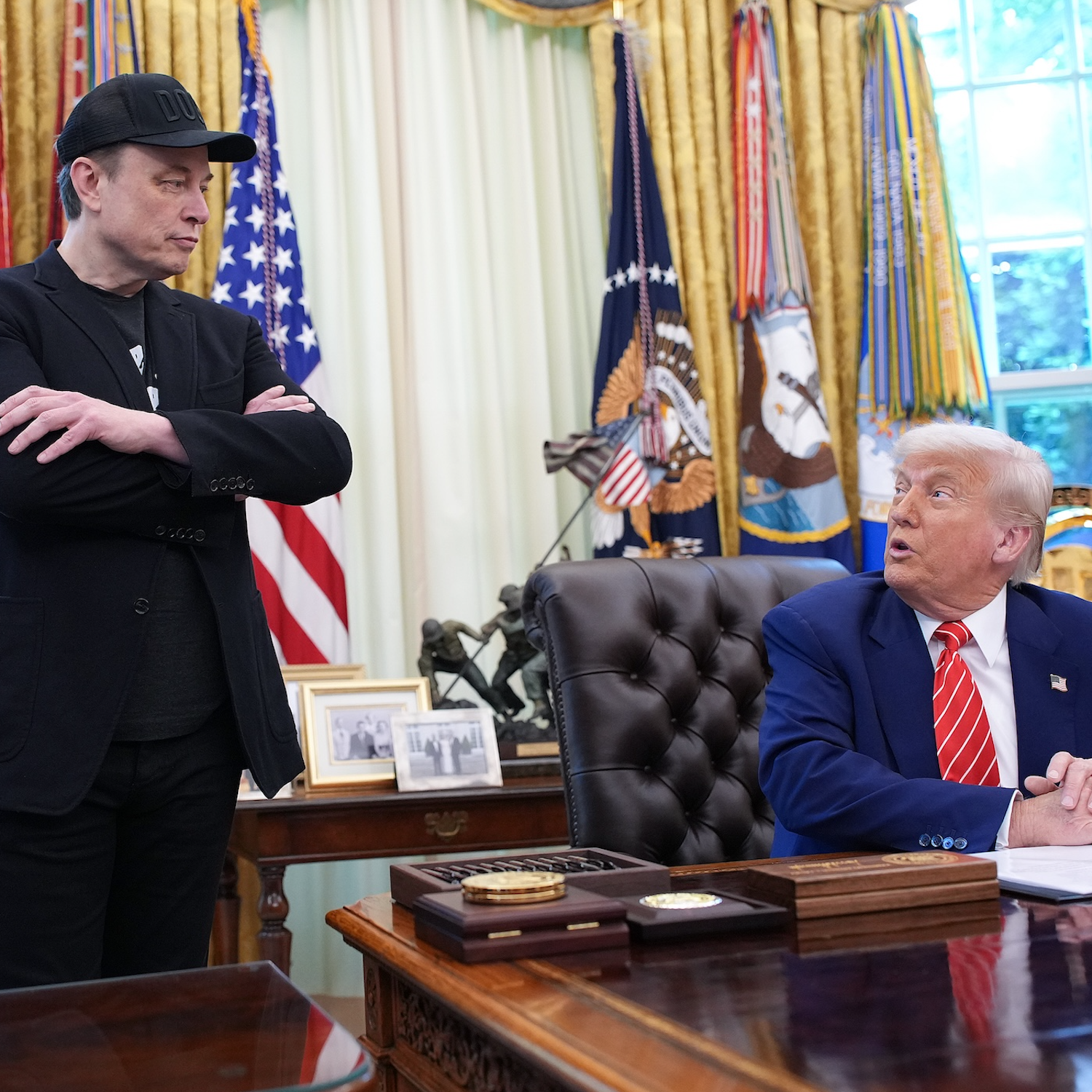
Good morning. It's Friday, June 6th. I'm Yasmeen Khan in for Shamita Basu. This is Apple News today. On today's show, we learn more about the Venezuelan migrants at the center of a deportation dispute. What the travel ban means for those who fled the Taliban, and what a Supreme Court ruling means for so called reverse discrimination cases. But first, to an epic fallout between perhaps the world's most powerful man and the world's richest man. It started around midday yesterday when President Donald Trump was asked by a reporter about Elon Musk's description of his major spending bill as a disgusting abomination. At first, Trump was somewhat reluctant to be too critical of his former ally.
- [00:58]
Donald Trump
Elon and I had a great relationship. I don't know if we're well anymore. I was surprised because you were here. Everybody in this room practically was here as we had a wonderful send off. He said wonderful things about me, but.
- [01:12]
Yasmeen Khan
He seemed to predict where things were heading.
- [01:15]
Donald Trump
He hasn't said bad about me personally, but I'm sure that'll be next. But I'm very disappointed in Elon.
- [01:21]
Yasmeen Khan
I've helped Elon a lot from there. It all escalated quickly as Musk appeared infuriated by Trump's suggestion that his real problem was with a decision to remove electric vehicle mandates. Musk took to X to directly attack the president. Then Trump took to his own social media company, Truth Social, to threaten Musk with canceling government contracts linked to his companies. To that, Musk said go ahead, and later said he would be discontinuing a spacecraft important to the US Space program. By late afternoon, Musk was posting that Trump should be impeached and warned that Trump's tariffs will cause a recession. He also claimed, without evidence, that Trump was named in files relating to Jeffrey Epstein. And he asked his millions of followers whether it's time to create a new political party. Trump, meanwhile, called Musk crazy and claimed he had asked him to leave the government. A very different account of his departure to what we've previously heard on Fox News. Commentator Juan Williams predicted things will only get rougher from here.
- [02:25]
Juan Williams
I don't think anybody should be surprised that you have these two personalities blowing up. I mean, clearly Musk is the one guy that Trump can't control. You know, who has the money, right? Who has more followers on Twitter? It's Musk.
- [02:39]
Yasmeen Khan
And Williams said Musk's threats to go after Trump politically should be taken seriously.
- [02:45]
Juan Williams
He could start primarying Republicans who are voting for the big, beautiful, bad whatever bill and say, I'm going to go over and challenge you in a way that I think Trump can't control. So clearly, Trump doesn't control Musk.
- [03:02]
Yasmeen Khan
Both billionaires have a lot to lose politically and economically. By the end of the day, Tesla's stock price dropped 14%. Trump's crypto coin also took a hit. And according to Gwynne Shotwell, president and COO of SpaceX, the company has about $22 billion in government contracts. That's a lot of money to pull. But it also signals something of a mutual dependency. The spacecraft Musk threatened to decommission, called Dragon, is the only reliable route to the International Space Station. Longtime Trump ally Steve Bannon also got into the fray. He called on Trump to look into deporting Musk, who was an immigrant, and to act aggressively on SpaceX.
- [03:47]
Donald Trump
President Trump tonight should sign an executive order calling for the Defense Production act.
- [03:53]
Yasmeen Khan
To be called in SpaceX and seize SpaceX.
- [03:56]
Donald Trump
Tonight, before midnight, the US government should seize it.
- [04:00]
Yasmeen Khan
While people predicted Musk would distance himself from the administration after leaving, many are surprised that it's happened so quickly and in such a public fashion. In fact, only days earlier, Musk was on CNBC saying he still agreed with most of the president's agenda and that he was torn on whether to criticize the administration. Newt Gingrich, the former Republican House speaker and vocal Trump supporter, told Fox he backed the president in any future battles.
- [04:29]
Donald Trump
Musk is the wealthiest guy in the world, but Donald Trump is the most powerful person in the world. And I think probably that Musk kind of forgot that. And in that kind of a contest, there's no question in my mind that two, three, four, five months from now, Donald Trump will still be president, and Musk may or may not be relevant.
- [04:49]
Yasmeen Khan
It's hard to believe how different things were just a few months ago when Musk posted on X in February, quote, I love Donald Trump as much as a straight man can love another man. It was Kara Swisher, a veteran tech journalist who knows Musk well and has long predicted he and Trump would clash, who summed things up on CNN last night.
- [05:09]
Juan Williams
You know, at some point it was going to break. And Elon outside the tent is not.
- [05:13]
Yasmeen Khan
A good Elon to have.
- [05:14]
Juan Williams
In the words of Neil Sadaka, the.
- [05:16]
Yasmeen Khan
Immortal words, breaking up is hard to do, I guess. Let's turn now to the travel ban we spoke about yesterday, which bars People from 12 countries, primarily in Africa and the Middle east, from entering the United States. An additional seven countries are subject to restrictions that stop short of a full ban. The Trump administration has cited visa overstays as one rationale for imposing the ban, though some countries responsible for even higher numbers of visa overstays are not on the list. Overstays have come under higher scrutiny in recent days because of the man accused of attacking demonstrators since seeking the release of Israeli hostages in Colorado. He reportedly overstayed his visa after traveling to the US From Egypt, which was also not on the ban list. It's worth noting here that the ban exempts people with existing visas, and there are other carve outs for green card holders and athletes traveling to the US for major international sporting events. Many of the countries that are subject to the ban face or have faced civil war or unrest. That includes Afghanistan, where more than 3 million people fled the country in the year after the Taliban's takeover in 2021. We called up Rick Nowak, the Afghanistan bureau chief for the Washington Post. He told us about what he's heard from Afghan refugees in recent days.
- [06:45]
Rick Nowak
When I reached out to Afghan refugees who are still hoping to resettle to the United States, a lot of them expressed really shock. A lot of them found out about this ban on travel to the United States on social media. They woke up to the news and to a lot of them it feels like the end of their dreams really to resettle to the US There is.
- [07:07]
Yasmeen Khan
An exception to the ban for individuals with special immigrant visas granted to Afghans who supported the U.S. s 20 year war, people who served as military interpreters, for example. Still, Nowak explains that the Trump administration's ban will most likely have the biggest impact on people who fled the Taliban's regime after after they were promised relocation.
- [07:28]
Rick Nowak
To the U.S. a lot of them were encouraged by American officials to move from Afghanistan to places like Pakistan to process their cases there. And a lot of them have been stuck in these countries for years now with no assistance from the United States. And this ban essentially feels like the final blow that will make it impossible for them to make it to the.
- [07:50]
Yasmeen Khan
US Nowak told us about a 35 year old afghan man named Amal who moved to Pakistan with his wife and two daughters a few years years ago. The decision to relocate to Pakistan was prompted by fears that he may be detained by the Taliban.
- [08:05]
Rick Nowak
He's been essentially stuck in Pakistan waiting for his case to be processed by US Authorities. When he found out about the travel ban this week, he told us that essentially this puts him back to point zero. He doesn't know what to do. Obviously the refugee admissions program was suspended a while ago by the Trump administration. That was the first blow, but this really does feel like the final blow to him.
- [08:29]
Yasmeen Khan
There are estimated to be thousands of Afghans in Pakistan who fled their country. Many of those people had been allowed into the US following the withdrawal of US Troops from Afghanistan, though Trump has rescinded some of those routes. Let's stick with immigration policy and turn now to reporting from ProPublica, the Texas Tribune, and two Venezuelan news outlets. Reporters learned that the Trump administration was aware and kept private that the majority of the Venezuelan immigrants it deported back in March to a maximum security prison in El Salvador had not committed any offenses, barring the violation of immigration law. That's in stark contrast to the picture President Trump and his aides have painted publicly about these men to explain their deportations, the labeling them as terrorists and gang members without evidence and calling them the worst of the worst.
- [09:30]
Melissa Sanchez
And it's kind of led, I think, a lot of people in the American public to think that there are a lot of violent criminals who we send down there.
- [09:37]
Yasmeen Khan
That's Melissa Sanchez with ProPublica, one of the reporters involved with this investigation. When she and her colleagues reviewed data from the Department of Homeland Security court records and police records, they learned out of the 238 men sent to El Salvador, more than half had no convictions or pending charges. 32 had criminal records in the US but the vast majority were for low level nonviolent crimes like retail theft or traffic violations. As Sanchez and her reporting team looked for foreign offenses on these men's records, they found evidence of just 20 arrests or convictions, 11 of which were for violent crimes. And none of these men were listed on watch lists that Interpol and Venezuelan law enforcement uses to track alleged gang members.
- [10:25]
Melissa Sanchez
I think what the data that we obtained shows is the government knew when it sent all these people out and publicly has described them all as criminals, that that information just simply wasn't true.
- [10:38]
Yasmeen Khan
In response to this reporting, the White House said ProPublica should, quote, be embarrassed, and it repeated its claims that all of the men it deported are criminals. A spokesperson for DHS described the men as dangerous, but did not provide any evidence. When Trump deported these men to the notorious Sakat prison in El Salvador, he justified it by invoking the Alien Enemies Act. He claimed the Trende Aragua gang had invaded the United States. He labeled the group a terrorist organization. He claimed that these men were members, which journalists have since disproven, and he deported them with little or no due process.
- [11:15]
Melissa Sanchez
Advocates say a lot of these were guys who never even stepped foot in this country as free People, they have always been detained and then they were shipped away from this country without having committed any crimes and sent to like a maximum security prison in a country that many of them never even walked through on their way here from Venezuela. One of them was this guy, Leonardo, whose family I spoke with, and he was a soccer coach for children in Venezuela. He left because of the economy and he was detained since last October at the border.
- [11:43]
Yasmeen Khan
He and other men deported by the administration are still in El Salvador today. It's been over two months since they've been able to speak to their families or their lawyers. The prison typically allows zero communication with the outside world. The Supreme Court has temporarily blocked the administration from deporting Venezuelan immigrants under the Alien Enemies Act. And a federal judge ruled this week that the administration had stripped deportees of their rights by not allowing them to appeal. He gave the administration a week to come up with a way to allow nearly 140 of these men, those who were in flight to El Salvador, as a judge ordered the planes to turn around to challenge their removals in court. Before we let you go, a few other stories were following. Donald Trump spoke with Chinese President Xi Jinping by phone yesterday, marking the first known conversation between the two leaders since Trump retook office. The call was intended to help bring both countries closer to a deal on trade negotiations. But Ling Ling Wei, the chief China correspondent for the Wall Street Journal, told us yesterday's call didn't lead to much progress. Fundamentally, it's not really changing much. You know, no one's expecting one call can solve all the problems. And though both sides do seem to have softened their tones, by Trump's own admission, making a deal with China is proving much harder than he thought. Clearly, what Xi Jinping wants is a different kind of negotiation. So he is playing hardball and we expect him to continue to play hardball. And finally, two unanimous Supreme Court judgments yesterday. In one case out of Ohio, the court ruled to make it easier for people from majority groups to sue for discrimination. Marlene Ames, a heterosexual woman, alleged that she was discriminated against at work when her supervisor, who's gay, passed her over for promotion and demoted her with a pay cut. She argued that he was favoring her gay colleagues. A lower court had previously ruled that she would need a heightened standard to prove discrimination because she's straight. But the Supreme Court yesterday overruled that decision. And in the second ruling, the court blocked the Mexican government from proceeding with a claim that US Gun manufacturers were helping arm Mexican drug cartels through unlawful sales. The court concluded that although US Gun makers likely knew that some of their guns were being resold in the illegal market and that they were being designed specifically to appeal to cartel members, Mexico did not sufficiently prove US Gunmakers should be held liable for how their weapons were used. You can find all these stories and more in the Apple News app. And if you're already listening in the News app right now, stick around for the latest episode of Apple News and Conversation this week. In light of the recent news that Taylor Swift has reclaimed full ownership of her back catalog, we're revisiting Shamita's conversation with her Rolling Stone's Rob Sheffield.
- [14:55]
Rick Nowak
Taylor is really, really fond of taking up impossible challenges that any rational, sane, sensible person would talk her out of, but she's just determined to do them. As she said once at the Tribeca Film Festival, people often underestimate how much I will inconvenience myself to prove a point.
- [15:15]
Yasmeen Khan
If you're listening in the podcasts app, you can find it by searching for Apple News and Conversation. Enjoy the weekend and I'll be back with the news on Monday.