Loading summary
Transcript27 lines
- [00:05]
Shemitah Basu
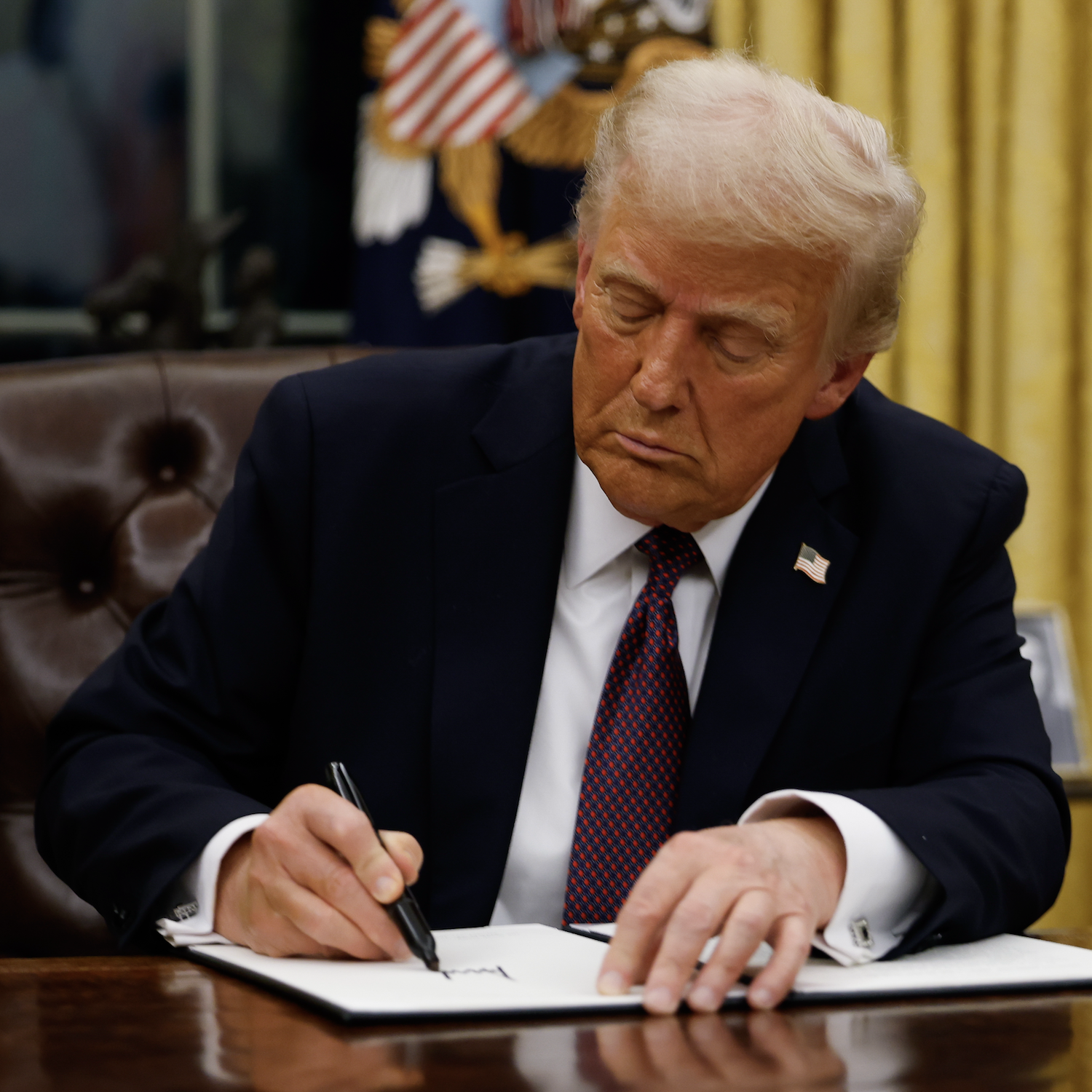
Good morning. It's Monday, January 27th. I'm Shemitah Basu. This is Apple News Today. On today's show, Trump's promised immigration raids begin, how to rebuild a better Los Angeles. And the super bowl lineup is set foreign. But first, President Trump is moving quickly to change the federal government, sidelining hundreds of government workers and paving the way to potentially fire hundreds of thousands more in a rapid series of moves. In his first week in office, Trump is requiring federal employees to return to the office five days a week. He's shuttered diversity, equality and inclusion programs and environmental justice programs and cleared the way for people who work in those programs to be fired. And he temporarily blocked health officials from communicating with the public. A spokesperson from the Office of Personnel Management called these steps exciting and said they are in the interest of making the government more effective and efficient. Then, late on Friday night, Trump fired 18 inspectors general. These are the independent government watchdogs that work in federal agencies to investigate allegations of fraud, waste, and abuse. When asked why, a White House official told NBC they were cleaning house and aligning. Under the new Trump administration, by law, the president is required to give Congress 30 days notice and a good reason for firing inspectors general. Some Republicans have acknowledged that Trump broke the law with this move, but still defend it. Here's Republican Senator Lindsey Graham on NBC's Meet the Press.
- [01:52]
Lindsey Graham
You know, I'm not overly worried about that. It's not the first time people have come in and put their team in. When you win an election, you need people in your administration that reflect your views, so I'm not really worried about that.
- [02:04]
Shemitah Basu
Later on the program, California Senator Adam Schiff, a Democrat, pushed back.
- [02:09]
Lindsey Graham
The American people. If we don't have good and independent inspector generals are gonna see the swamp refill. They're gonna see rampant waste, fraud. They're gonna see corruption.
- [02:21]
Shemitah Basu
This isn't the first time a president has come in and shaken up inspector general positions. In 1981, Ronald Reagan fired 16 inspectors general shortly after his INAU and ended up rehiring several of them after Congress objected. Beyond those moves, the Trump administration also sent home 160 National Security Council aides, reassigned about 20 senior career attorneys at the Justice Department, and fired the heads of the US Coast Guard and tsa. It's not uncommon for a president to quickly get to work to hire and fire. But many observers have pointed out that the breadth and speed of the changes to the federal government imposed by Trump in his first week in office were a remarkable test of the limits of presidential power. Speaking to PBS News. The Washington Post's Jonathan Capehart commented on the nature of some of these early moves.
- [03:15]
Lindsey Graham
He told us exactly how these first few days were going to go. So that is not what's what's surprising. What is surprising to me is just sort of the level of meanness in some parts, smallness in other parts, but also aggressiveness in other ways.
- [03:32]
Shemitah Basu
Reuters reports on the range of responses to Trump's actions. His supporters have cheered it on. Others are shocked and scared, particularly those federal employees who don't know what's coming next. Mark Lee Greenblatt, who was fired from his position as the Interior Department's inspector general, told NBC he's concerned about Trump politicizing inspector general positions. He said, quote, we are the so called watchdogs inside the federal agency. So does he appoint true watchdogs or does he appoint lap dogs? Another big headline from Trump's first week in office, immigration raids. Several hundred people have been arrested per day nationwide starting last Tuesday. Over the weekend, raids were carried out in major cities like in Atlanta, where the Atlanta Journal Constitution reports ICE authorities pulled a person out of church to arrest them, and in Denver, where officials say dozens of undocumented people with ties to drug trafficking and Venezuelan gangs were taken into custody. Let's zoom in now on Chicago, a sanctuary city which is estimated to have about 400,000 undocumented immigrants living in the region. A spokesperson for ICE said their operation there targeted only, quote, dangerous criminal aliens. Hours before the raids started, Illinois Governor J.B. pritzker went on CNN's State of the Union to explain what he hoped that meant.
- [05:04]
J.B. Pritzker
When we're talking about violent criminals who've been convicted and who are undocumented, we don't want them in our state. We want them out of the country. We hope they do get deported. And if that's who they're picking up, we're all for it.
- [05:17]
Shemitah Basu
But Pritzker also said he believed the raids are going beyond that scope.
- [05:21]
J.B. Pritzker
What they're also doing, though, and it's quite disturbing, is they're going after people who are law abiding, who are holding down jobs, who have families here who may have been here for a decade or two decades. And they're often our neighbors and our friends, friends. And why are we going after them?
- [05:38]
Shemitah Basu
During the raids in Chicago, Trump's appointed border czar Tom Homan had an unexpected companion. TV personality Dr. Phil rode alongside immigration authorities as they conducted raids on several homes. Here's Dr. Phil talking with Homan on his TV channel, Merit TV.
- [05:55]
Lindsey Graham
Well, straight up Are you going into schools and arresting children at schools? No. Is anything like that happening? No, sir. Are you going into businesses and sweeping through there and taking anybody with a tan and seeing where they're from? We go into businesses for a criminal enforcement operation. But again, sweeps don't occur anywhere.
- [06:17]
Shemitah Basu
Dr. Phil was asking those questions because the Trump administration recently revoked a ban on arrests in sensitive areas, meaning immigration authorities can now detain people in and around schools, churches, hospitals, small businesses, even during funerals and weddings. That has led to widespread fear and panic in cities around the country that ICE officials could show up anywhere, anytime. Many undocumented people in Chicago have been hiding at home in fear in recent days, leaving major corridors looking like ghost towns. On Sunday, Vice President J.D. vance defended the policy, even going after the U.S. conference of Catholic Bishops, who spoke out against opening churches to potential sweeps. Here's vance talking to CBS's Face of the Nation.
- [07:04]
Lindsey Graham
I think that the U.S. conference of Catholic Bishops needs to actually look in the mirror a little bit and recognize that when they receive over $100 million to help resettle illegal immigrants, are they worried about humanitarian concerns or are they actually worried about their bottom line? I think the U.S. conference of Catholic Bishops has frankly not been a good partner in common sense immigration enforcement that the American people voted for. And I hope again, as a devout Catholic, that they'll do better.
- [07:32]
Shemitah Basu
The Justice Department has said it would investigate and prosecute any official who refuses to assist federal authorities with deportations. Governor Pritzker told CNN he'll follow federal.
- [07:43]
J.B. Pritzker
Law, but we also have a law on the books in Illinois that says that our local law enforcement will stand up for those law abiding, undocumented people in our state who are doing the right thing. And we're not going to help federal officials just drag them away because somebody pointed at them and said, oh, that person's brown or that person's not here.
- [08:05]
Shemitah Basu
Several immigrant advocacy groups have filed lawsuits against the raids. One group filed an emergency injunction to stop them, calling their harms, quote, imminent and irreparable. The Trump administration has issued quotas to ICE field offices. The Washington Post reports Trump is disappointed in the number of current arrests and wants officials to detain between 1200 and 1500 people a day. A significant increase now to Los Angeles, though several fires are still burning. Mayor Bass and Governor Newsom are eager to start the process of rebuilding. They've reduced some bureaucratic hurdles so things like building permits are issued more quickly instead of taking years. But the LA Times reports it's not quite that simple to just start rebuilding. LA will need to consider how to deal with its pre existing housing shortage and future threats of fires. LA Times reporter Doug Smith told us how one former city analyst put it.
- [09:08]
Doug Smith
To him, just to stop everything, evaluate, learn the lessons of this fire and incorporate those into the building code before we start building.
- [09:17]
Shemitah Basu
Some urban planners say this time around, the city needs to seriously consider leaving more space between homes, planting vegetation that's capable of absorbing embers, and creating more common spaces in neighborhoods. A study that examined the town of paradise in Northern California after the 2018 Camp Fire found adopting some of those tactics could reduce fire risk in the new community by 75%. Beyond fire safety, the other big issue is how to make sure there's enough housing for everyone who needs it.
- [09:49]
Doug Smith
Los Angeles has this tremendous deficit in housing and so there's been a ongoing conversation for a decade really about the need to produce more multifamily housing in Los Angeles, which is a very controversial topic because people who live in single family residential zones like to keep them that way.
- [10:09]
Shemitah Basu
The city's zoning laws have historically favored single family units. In fact, over 70% of residential land is zoned only for single family use. And just last fall, the city's planning commission voted to keep protections in place for single family housing zones. But there is a state mandate that requires LA to plan nearly half a million new homes by 2029, which is why some see this moment an opportunity.
- [10:35]
Doug Smith
Los Angeles was built in a fairly haphazard way. Communities were built in different places and then joined together in ways that don't make any sense. So people who study urban design said, well, isn't this an opportunity to look at these vast areas and redesign them in a more rational way?
- [10:52]
Shemitah Basu
There's also the question of how LA will afford the cost of rebuilding. Some estimates have put the total economic loss at over $250 billion, and that number is sure to go up with fires still burning. California has a reserve fund for emergencies like these, and it's asking the federal government for assistance. But at one point last week, both the president and a number of Republicans in Congress threatened to put conditions on any federal aid. Trump also floated the idea of eliminating FEMA altogether, saying he would prefer it if federal money were handed over to states to handle disasters themselves. A number of California Republicans in the House have pushed back on Trump's suggestions. Here's Representative Young Kim, whose district is southeast east of Los Angeles in another fire prone area, speaking with Fox in la. When natural disaster hits your communities, it is not partisan.
- [11:46]
Doug Smith
It's not a blue or red issue.
- [11:48]
Shemitah Basu
We are talking about life and death. We're talking about communities that are hurting. So there shouldn't be any condition other than making sure that we bring the.
- [11:57]
Doug Smith
Resources and the aid as soon as possible to our communities.
- [12:08]
Shemitah Basu
A few other stories we're watching today. On Sunday, President Trump got into an altercation with the president of Colombia on social media. It came as the United States attempted to land two planes carrying deported migrants in Colombia. Colombia's president blocked those flights from landing, posting on X the US Cannot treat Colombian migrants like criminals. In response, Trump announced he would impose a 25% tariff on Colombian goods and that he would ban Colombian officials from coming to the US In a press release late Sunday, however, the White House said Colombian officials had accepted Trump's terms and that Trump expects other nations to fully cooperate with accepting deported people from the US In Gaza, tens of thousands of displaced Palestinians are finally making their way back into northern Gaza. They were initially blocked by Israeli authorities after Israel accused Hamas of violating the terms of the ceasefire deal, causing a snag as mediators worked to resolve the dispute. By the end of the weekend, Hamas released four women Israeli soldiers and Israel released 200 prisoners. President Trump, meanwhile, speaking to reporters, described Gaza as a demolition site, saying it should be, quote, cleaned out. He also called on Jordan and Egypt to accept more displaced Palestinians. Both countries rejected that idea in separate statements, saying Palestinian statehood is the only way forward. And finally, the super bowl matchup is set. The Philadelphia Eagles will face off against the Kansas City Chiefs for a chance to bring home the trophy at Super Bowl 59. The Eagles put up a whopping 55 points against the Washington Commanders at Sunday's NFC Championship game. Meanwhile, in Kansas City, the Chiefs are looking for their third championship in a row. The super bowl will be played on February 9th in New Orleans. You can find all these stories and more in the Apple News app. And if you're already listening in the news app right now, we've got a narrated article coming up next. New York magazine has the story of a mom in Michigan who's facing charges for allegedly cyberbullying teenagers, among them her own daughter. If you're listening in the podcast app, follow Apple News plus narrated to find that story. And I'll be back with the news tomorrow.