Loading summary
Transcript22 lines
- [00:05]
Shemitah Basu
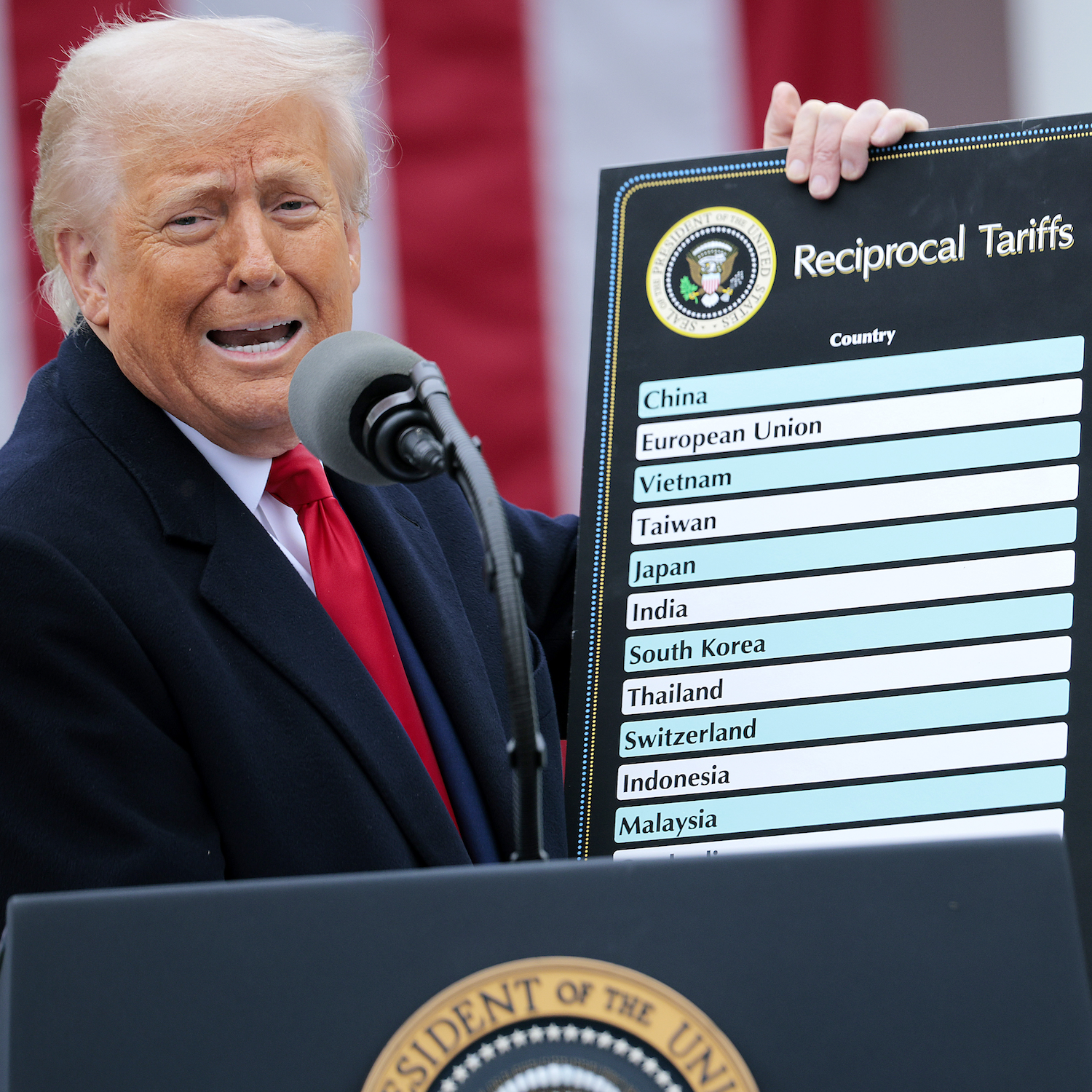
Good morning. It's Thursday, May 29th. I'm Shemitah Basu. This is Apple News today. On today's show, the running theme among the people Trump is pardoning as Harvard students graduate its president speaks out and Elon Musk hands in his special government employee pass. But first, a federal trade court has struck down President Trump's sweeping tariffs, ruling that he exceeded his legal authority in a major setback to the administration's economic agenda. The three person panel, made up of Obama, Reagan and Trump appointees, unanimously declared his use of an Emergency Powers act did not give him the power to levy tariffs unilaterally. The case was brought forward in Oregon by a group of small businesses and a coalition of states and was heard by a relatively obscure court taking many by surprise. In its announcement, a White House spokesperson said they would appeal the decision. The ruling puts at least a temporary halt to most of the recently announced tariffs, although many of the most eye catching moves had already been paused or dramatically scaled back. It means an end to the 30% tariffs on China, the 25% tariff on Mexico and Canada, and the across the board 10% tariffs for all nations. Trump had argued that the country was facing a national emergency due to a persistent trade deficit, which he said justified the decision to act without Congress. Ryan Goodman is the editor of Just Security, a nonpartisan website that analyzes legal cases focused on democracy. He spoke to CNN following the news.
- [01:50]
Ryan Goodman
The court's argument basically says this goes back to Congress. It boils down to the idea that there was always a poor fit for the tariffs being invoked by the administration because the administration says they were operating under this emergency National Security act. And the court says, no, you aren't. The National Security act was not built for something like this. It's really Congress's authority to give it to you and you don't have it.
- [02:16]
Liz Oyer
Yet.
- [02:17]
Shemitah Basu
CNN notes that the 25% auto tariffs stay in place as a different law had been used in that case. Yesterday, shortly before this news broke, President Trump took issue with a reporter asking for his reaction to a phrase coined by a Financial Times writer to describe Trump's tariff threats, followed by walkbacks. Taco Trade, an acronym short for Trump always chickens out.
- [02:41]
Donald Trump
Six months ago, this country was stone cold dead. We had a dead country. We had a country, people didn't think it was going to survive. And you ask a nasty question like that, it's called negotiation.
- [02:53]
Shemitah Basu
And he defended his tariffs, describing them as crucial to his trade talks.
- [02:57]
Donald Trump
I can promise you and I have great respect for the people at the European Union. They wouldn't be over here today negotiating if I didn't put a 50% tariff on. The sad thing is, now when I make a deal with them, it's something much more reasonable. They'll say, oh, he was chicken, he was chicken. That's so unbelievable.
- [03:18]
Shemitah Basu
The ruling last night raises big questions as to what happens to those plans to negotiate new trade agreements and what happens to the few trade deals that were already made. Now to a series of pardons recently announced or issued by President Trump that appear to have some similar themes. There's either money, personal connections or loyalty involved. Yesterday we told you about the president's plans to pardon a couple made famous by reality tv, Todd and Julie Chrisley, who were found guilty of tax evasion, fraud and conspiring to swindle community banks of more than $30 million. They have denied the charges and were sentenced to a combined 19 years in federal prison. Both are Trump supporters, and so is their daughter, Savannah, a social media influencer who campaigned on his behalf and spoke at the Republican national convention in 20. After Trump announced their pardon on Tuesday, Savannah thanked him on Instagram. President Trump didn't just commute their sentences, he gave them a full unconditional pardon. So for that I am forever grateful. Trump also pardoned Scott Jenkins, a longstanding supporter and former Virginia sheriff who was convicted of fraud and accepting over $75,000 in bribes. In exchange for those bribes, Jenkins appointed businessmen as deputy sheriffs without training them to prosecutors. He's now one of at least four former public officials who have supported Trump, been convicted of financial improprieties and been pardoned. Jenkins was set to report to prison on Tuesday. He's denied any wrongdoing, and reporting from the New York Times revealed that Trump also recently pardoned a former nursing home executive who pleaded guilty to tax crimes just a few weeks after his mother went to a fundraising dinner for the president in April that cost $1 million per person to attend. The Paul Walzack admitted that he withheld more than $10 million from the paychecks of nurses, doctors and others who worked at his facilities under the pretext of using it for their Social Security, Medicare and federal income taxes. He instead used some of that money to buy himself a yacht. Trump's pardon spared Walzack from having to serve any of his 18 month prison sentence. Now it's not unusual for a president to issue pardons. Almost every president has, and some of their choices were controversial, like President Biden pardoning his son Hunter, who was convicted on federal gun charges and pled guilty to tax evasion. But Liz Oyer, a former pardon attorney at the Department of Justice who was fired by the administration earlier this year, told PBS she's seeing something unusual in Trump's second term approach.
- [06:09]
Liz Oyer
This administration appears to be using pardons in a completely different and new way, which is to reward people who demonstrate political loyalty to the administration. And that is unprecedented. Pardons are normally reserved for people who show remorse for a crime they've been convicted of and who have actually served at least some and typically all of their sentence and have shown personal growth and rehabilitation during that time.
- [06:36]
Shemitah Basu
And she says this is a departure from how Trump handled pardons in his first term, where the profile and number of people he gave clemency was broadly in line with other presidents, even if some were high profile people he had personal connections to like Paul Manafort and Roger Stone.
- [06:52]
Liz Oyer
But now the ordinary people seem to have been completely forgotten. There are applications piled up at the office of the pardon attorney from individuals who are incarcerated around the country, some of whom have been waiting years for their applications to be considered. And those are being ignored in favor of the wealthy and well connected.
- [07:11]
Shemitah Basu
There are two people primarily supporting Trump's pardon efforts in this term. A newly appointed pardon czar named Alice Marie Johnson. She's in charge of recommending individuals for commutations. She herself was pardoned by Trump in his first term after serving 21 years in prison for cocaine trafficking. And Ed Martin has taken on the role of a pardon attorney at the doj. He's a Trump loyalist who, the Wall Street Journal reports, has been working to turn his office into a pipeline for political allies to get their cases in front of the president. Yesterday, news of high profile pardons continued. This time it was Michael Grimm, the former Republican congressman who was convicted of tax fraud in 2014 and served an eight month sentence. Let's turn to higher education and specifically to Harvard, which has its commencement ceremony later today.
- [08:10]
Alan Garber
Harvard's voice is loud and clear.
- [08:12]
Shemitah Basu
Harvard's voice is loud and clear. Crowds of students and supporters filled Harvard's Science Center Plaza on Tuesday to protest the Trump administration's attempt to ban international students. The same day, the administration announced its plans to cancel another $100 million in federal funding to the university. Yesterday, CNN anchor Christian Amanpour delivered an address to students at Harvard's Kennedy School of Business and urged the audience to champion public service and defend the free expression of ideas.
- [08:44]
Christian Amanpour
Make no mistake about it, academics, education are on the front lines of the current struggle between the two halves of America. Dissent is not disloyalty. Dissent is actually an invaluable part of our democratic process. We cannot surrender to any system that deems only power approved speech or thought is allowed.
- [09:08]
Shemitah Basu
Before the latest funding cut, Trump had already cut $450 million in grants, frozen $2 billion in federal funding pending a lawsuit, and threatened to scrap the university's tax exempt status. A judge has temporarily halted the attempt to block international students from attending the institution. But current and incoming students are left feeling confused and worried about what that means. The administration wants Harvard to agree to a list of demands, including admission policy overhauls and what they describe as audits of academic programs and staff. With an endowment of $53 billion, Harvard can afford to absorb some of these blows as the price for continued independence. But it remains difficult position for Harvard's president, Alan Garber. He spoke to NPR's Morning Edition, which aired on Tuesday.
- [09:59]
Alan Garber
I don't know fully what the motivations are, but I do know that there are people who are fighting a cultural battle. They don't like what's happened to campuses and sometimes they don't like what we represent. What I can tell you is Harvard is a very old institution, much older than the country. And as long as there has been a United States of America, Harvard has thought that its role is to serve the nation.
- [10:28]
Shemitah Basu
In his interview, he acknowledged some of the criticism of Harvard, pointing to a recent internal report that conceded that antisemitism has infiltrated parts of academic and social life. But he said the university is taking steps to encourage a more respectful exchange of ideas and that this school year is ending more peacefully than the year before. He also said these attacks on higher ed institutions go beyond Harvard.
- [10:53]
Alan Garber
It is a warning. They see this as a message that if you don't comply with what we're demanding, these will be the consequences.
- [11:11]
Shemitah Basu
Before we let you go, a few other stories we're following. Elon Musk has announced he's officially leaving the Trump administration, telling X followers that the Doge mission will only strengthen over time. The move is not a complete surprise. As a so called special government employee, Musk could only work for the administration for 130 days in a calendar year and the end of May marks 130 days since inauguration. That said, the announcement comes only a day after Musk criticized Republicans upcoming tax and spending bill in an interview with cbs.
- [11:45]
Elon Musk
I was like disappointed to see the massive spending bill frankly, which increases the budget deficit, not doesn't decrease it and undermines the work that the Doge team is doing. I think a bill can be big or it can be beautiful, but I don't know if it could be both. My personal opinion.
- [12:05]
Shemitah Basu
Musk will return to his various companies, including Tesla, which he promised he would devote more time to. Yesterday, data revealed sales of the car had tumbled by nearly 50% in Europe. In international news, Israel says it has killed Hamas's leader Mohammed Sinwar in a targeted attack on a hospital. Sinwar was the younger brother of deceased leader and Mastermind of the October 7, 2023 attack, Yahya Sinwar. Hamas has yet to confirm his death, which Netanyahu announced in Parliament on Tuesday. Israel regarded Sinwar as just as hardline as his brother. Two weeks ago, the Israel Defense Forces carried out a massive strike on a European run hospital a day after Hamas released Israeli American soldier Idan Alexander. The strike killed 28 people, the Gaza Health Ministry said at the time. And finally, in Turkey, airlines are fighting back against impatient customers. Those flying Turkish Airlines will be fined nearly US$70 if they stand up before the seatbelt sign is turned off. A Turkish aviation official issued a note declaring the behavior poses a risk to passenger and baggage safety and security, along with affecting the satisfaction and exit priority of others. So if you're someone who has long been bothered by this breach of plane etiquette but held your tongue, rejoice. At least on Turkish Airlines, someone else will be doing the enforcing for you. You can find all these stories and more in the Apple News app. And if you're already listening in the news app right now, we've got a narrated article coming up next. Scientific American traveled to the Arctic to follow one startup company's efforts to geoengineer and refreeze the sea ice above the Arctic Circle. If you're listening in the podcast app, follow Apple News plus Narrated to find that story. And I'll be back with the news tomorrow.