Loading summary
Transcript27 lines
- [00:05]
Shemitah Basu
Good morning. It's Friday, February 28th. I'm Shemitah Basu. This is Apple News today. On today's show, a lawsuit that could sink Greenpeace, this year's Oscars, wild Cards and Katy Perry is going to space. But first to Washington, where Ukrainian President Volodymyr Zelensky is expected to meet with President Trump to discuss and potentially sign an agreement for Ukraine to share rare minerals with the United States, which are estimated to be worth trillions of dollars. This was an idea proposed by Zelensky last fall, though at the time, he suggested Kiev would, in return, want assurance that the US Would provide ongoing support for Ukraine in its def against Russia. Trump has criticized US Aid for Kyiv as a drain on resources. And disagreements over the terms of this mineral deal are a big reason why the relationship between the United States and Ukraine has soured in recent weeks. Zelensky rejected an earlier version of the agreement because it didn't include security guarantees for Ukraine. And the United States initially asked for the rights to up to $500 billion in revenue from mineral development, which is roughly five times more money than the US has contributed Ukraine during the war so far. Zelensky spoke at a news conference about why he rejected the initial offer. I'm not signing something that will have to be repaid by generations and generations of the Ukrainians. The new version of the deal that could be signed today does not include that revenue stipulation, and it also still does not include security guarantees for Ukraine. Trump has said that it would include a form of peacekeeping that's acceptable to everybody, but did not specify what that meant. However, the Wall Street Journal's Ian Lovett told us Ukraine ultimately agreed to this version of the deal in the hopes that it could reset their relationship with Trump.
- [02:13]
Ian Lovett
They really want to keep the US on the Ukrainian side, which seems much less clear since Trump took office. They want the US to be invested in Ukraine economically and ideally also militarily.
- [02:25]
Shemitah Basu
So far, the Trump administration has seemed to reverse the U.S. s position as a strong ally of Ukraine. Defense Secretary Pete Hegseth has said that Ukraine will accept that it will not get back the land that Russia has seized. That's roughly 20% of the country. Last week, Trump falsely suggested that Ukraine, not Russia, was the aggressor. And in his first Cabinet meeting this week, Trump said that Russia will have to make concessions to end the war, but did not specify what kind. Trump has maintained that his objective is to establish peace in the region, but Lovett told us it's not entirely clear what that means.
- [03:03]
Ian Lovett
There have been a lot of questions about what Trump's goal is exactly, whether it's just to end the conflict as fast as possible, even if that means Ukraine giving up not only territory but perhaps other concessions to Russia. And Ukraine has been working with European allies to try to come up with a contingency plan basically to continue to be able to fight if the US Pulls its backing.
- [03:27]
Shemitah Basu
Trump has also been meeting with European allies. Yesterday, he met with UK Prime Minister Keir Starmer at the White House, who urged the president to stand by Ukraine.
- [03:36]
Keir Starmer
Because it can't be peace that rewards the aggressor. We agree history must be on the side of the peacemaker, not the invader.
- [03:45]
Shemitah Basu
In that same speech, Starmer said the UK Is ready to put boots on the ground and planes in the air to support a peace deal. If the US And Ukraine sign today's mineral deal, one outstanding question will be how the US plans to extract the resources. Up to 40% of Ukraine's rare mineral deposits are in parts of the country currently under Russian occupation, a member of the Council on Foreign Relations told the Journal. That means if the US Wants to access these deposits, it'll have no choice but to get involved in defending and protecting Ukraine's physical security. Now to a trial that started this week involving Greenpeace, which environmentalists have warned could bankrupt the group and threaten the future of advocacy work.
- [04:39]
Mary Steuer
One of the concerns not only voiced by Greenpeace but other climate activists is that, like a negative ruling against Greenpeace would be really serious for the fate of the climate movement going forward.
- [04:52]
Shemitah Basu
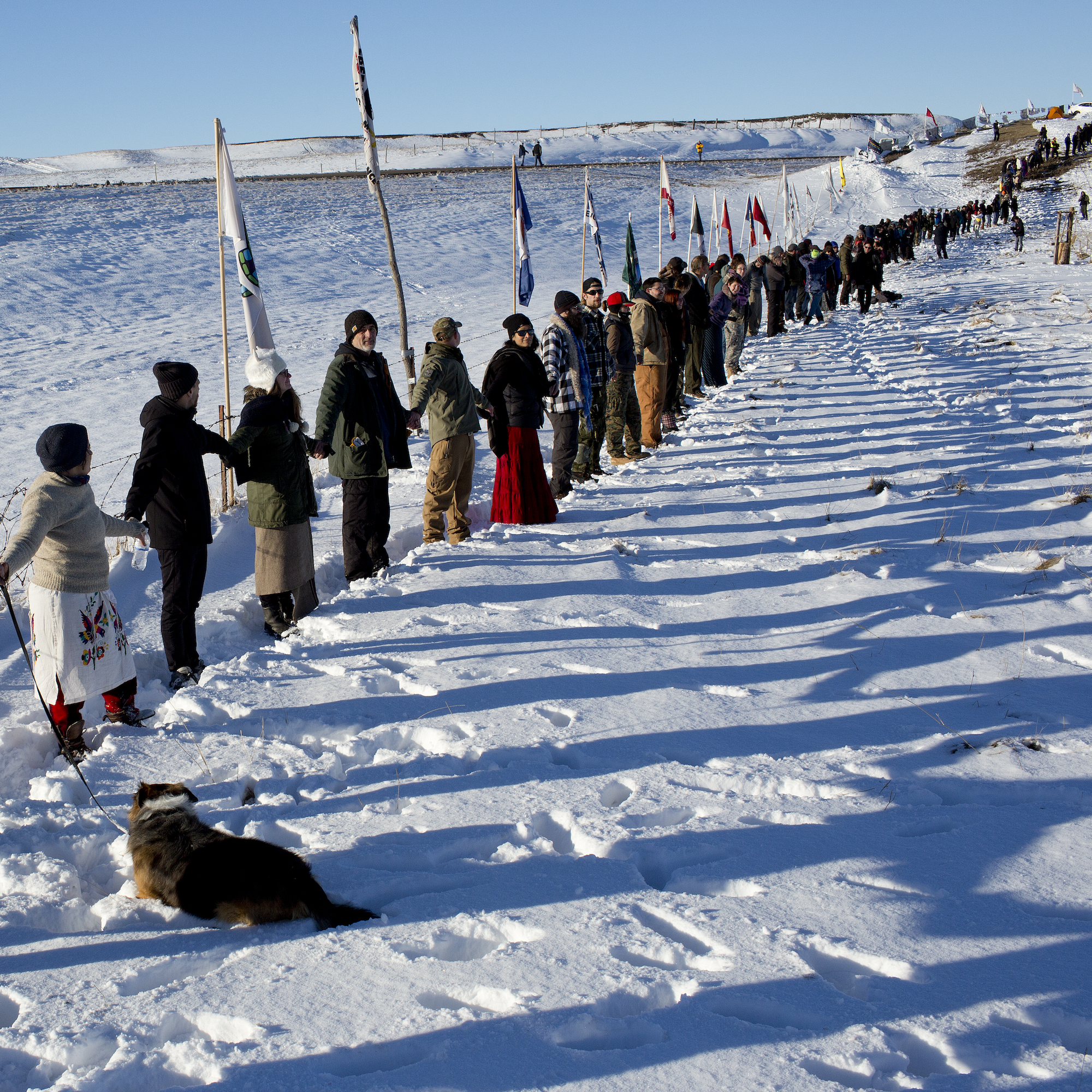
That's Mary Steuer, a reporter at the North Dakota Monitor who's been following the trial. This is a civil case related to the Dakota Access pipeline that was brought by the company Energy Transfer, which sued Greenpeace for $300 million, alleging the environmental advocacy group disrupted construction of the pipeline, which was completed in 2017. That dollar amount, according to the New York Times, is more than 10 times the group's annual budget. Protests against the pipeline project started the year prior, when the Standing Rock Sioux tribe said a portion of the pipeline would endanger their water supply and sacred sites in the area. The demonstrations gained international attention, especially after clashes between police and protesters. Police used water cannons on protesters in freezing temperatures, deployed tear gas and shot them with rubber bullets. Medical professionals supporting the protesters say dozens of people were hospitalized and more than 300 people were injured. Police at the time said that protesters set fires in the area and threw rocks at officers. In their lawsuit against Greenpeace, Energy Transfer claims the group supported protesters and encouraged violence.
- [06:04]
Mary Steuer
Everything from, you know, paying people, training them to cause mayhem and destruction during the protests, like property damage, trespassing and harassing workers in order to stop the pipeline.
- [06:17]
Shemitah Basu
Greenpeace denies those claims and says it played a very small role in the protests, and the group says Energy Transfer is unfairly targeting them in an effort to intimidate environmental activists.
- [06:29]
Mary Steuer
They also say that they've always adhered to a philosophy of nonviolence and so that they never supported or endorsed or financed any sort of destructive behavior by protesters.
- [06:42]
Shemitah Basu
An associate law professor at Pace University told npr, this case appears to be an example of a strategic lawsuit against public participation, otherwise known as slap. Those are anti free speech cases that are typically designed to cost the defendants both time and money in court. More than 30 states have protections against these types of lawsuits, but the Washington Post reports that North Dakota is not one of them.
- [07:08]
Mary Steuer
And that's kind of an issue that they've raised, that a ruling against Greenpeace could set precedent that could shrink free speech rights and First Amendment rights in the United States more broadly. So something that could affect any protest group, journalists, et cetera.
- [07:28]
Shemitah Basu
A spokesperson for Energy Transfer told the Post they do not believe this case is about free speech, but about Greenpeace not following the law. Greenpeace tried unsuccessfully to move the case to another court because the jury pool was drawn from a community where many people work in the oil and gas industry. The Guardian reports more than half of the seated jurors have ties to the fossil fuel industry. The trial is expected to last at least five weeks. Sunday is the movie industry's biggest night, the Oscars. The ceremony caps what's been an interesting awards season. A number of controversies have dominated the conversation, including the use of AI in the brutalist backlash over the absence of intimacy coordinators on the film Anora and the past use of blackface by one of this year's best actress nominees.
- [08:29]
Glenn Whipp
It has been a strange Oscar season.
- [08:31]
Shemitah Basu
Glenn Whipp covers film and television for the LA Times.
- [08:35]
Glenn Whipp
We're heading into a ceremony where, because of just these wild momentum shifts that we've seen in some of the races, there's just a lot of categories sort of up for grabs.
- [08:49]
Shemitah Basu
One of the most talked about storylines heading into the awards is the star of Emilia Perez, Carla Sofia Gascone, who, after old racist and Islamophobic tweets of hers resurfaced, deleted her social media accounts and was scrubbed from Netflix's awards campaign. Gascon is the first openly transgender woman ever to be nominated for an Oscar.
- [09:10]
Glenn Whipp
I don't think there has been a time when something of the scale of what happened with Carlos Sofia Gascon has happened. I mean, just in the sense that this was a movie that led the field with 13 Oscar nominations and had it had a chance to win best picture. And when it was discovered that Gascon had a history of making offensive social media posts denigrating Muslims, Black Lives Matter, even the Oscars themselves, it kind of really scuttled the movie's chances to win best Picture.
- [09:49]
Shemitah Basu
Aside from the controversies, the absence of a big budget frontrunner also makes this year's ceremony unique.
- [09:56]
Glenn Whipp
Last year we had Barbenheimer at the Oscars and we had Oppenheimer winning best picture. Barbie was really prominent in the ceremony and this year's best picture lineup very much more on the indie side, although you still have blockbusters like Wicked and Dune Part two in there.
- [10:17]
Shemitah Basu
We asked Whip who he thinks is taking home the night's biggest prizes.
- [10:21]
Glenn Whipp
I'm predicting that Honora will win best picture and its director, Sean Baker will prevail as director as well. The lead actress race, I'm going with Demi Moore for the substance actor race is kind of a toss up between Timothee Chalamet in a complete unknown playing Bob Dylan and then Adrien Brody, who's this, who's starring in the Brutalist, and I'm going with Adrien Brody.
- [10:52]
Shemitah Basu
The Oscars start Sunday at 7pm Eastern. Before we let you go, a few other stories we're following. Academy Award winning actor Gene Hackman, his wife Betsy Arakawa and their dog were all found dead Thursday at their home in New Mexico. Authorities have opened an investigation after the bodies were found in a state of decomposition. Initially, a gas leak was suspected, but the Associated Press reports no signs of a gas or carbon monoxide leak were detected. Hackman had a decorated acting career from his Oscar winning roles in the French Connection and Unforgiven to the title character in Wes Anderson's the Royal Tenenbaums. In space news, the planets are aligning sort of in a phenomenon known as a planet parade. All seven of the other planets in our solar system will be visible in a line in the night sky. Astronomers say to look for the planets about a half hour after sunset. And hey, it's Friday, so let's do some more space news. Jeff Bezos Space company Blue Origin announced it's sending its first all female flight crew into space. That crew will include singer Katy Perry. And getting extraterrestrial with her will be Bezos fiance Lauren Sanchez and CBS anchor Gayle King. The flight will take the crew to the Karman Line, which is the boundary line between Earth's upper atmosphere and space, Reuters reports. When they reach the line, the crew will experience a few minutes of microgravity before returning to Earth in a parachute assisted landing. And last thing, here's what's coming up on this week's episode of Apple News In Conversation, a look at how Donald Trump and Dana White, the CE of the Ultimate Fighting Championship, the ufc, go way, way back and how they've helped each other rise for a story in Rolling Stone. Jack Crosby tells me when Dana White was building up the UFC and struggling to find venues for it, Trump welcomed him at the Trump Taj Mahal in Atlantic City. And then many years later, Trump called in a favor to White that would end up taking their friendship to the next level.
- [13:07]
Keir Starmer
I'm running for president and I would be honored if you would introduce me at the Republican National Convention. And Dana White thinks it over and as he told me, look, this guy was here for me when I had nothing. I have to be there for him. And so he does it.
- [13:25]
Shemitah Basu
If you're listening in the Apple News app right now, that episode is queued up to play for you next. Enjoy the weekend and I'll be back with the news on Monday.