Loading summary
Transcript25 lines
- [00:05]
Shemitah Basu
Good morning. It's Thursday, June 26th. I'm Shemitah Basu. This is Apple News Today. On today's show, how businesses are being impacted by ICE workplace rates. How hot is too hot for kids to play outside. And it's the big day for Jeff Bezos and Lauren Sanchez in Venice. But not all the locals are happy. But first, today marks one month since the US Israeli backed private contractor Gaza Humanitarian foundation, or ghf, took over aid distribution in Gaza. And accounts from the ground continue to describe it as insufficient, chaotic and deadly.
- [00:50]
Nabi Boulos
So this aid is actually placed quite a distance away from where people are allowed to gather here. And so when they are finally allowed to go towards the aid, they actually have to run the last few miles.
- [01:01]
Shemitah Basu
Nabi Boulos, the Middle east bureau chief for the Los Angeles Times, spoke to Palestinians for his latest reporting.
- [01:07]
Nabi Boulos
Because there is so much chaos in the running and people are going off prescribed paths, what happens is that the Israeli military starts to fire at them. And when that happens, everyone hits the ground, right? And then like once the firing stops, they can run again and then the firing starts again and they hit the ground once more. So really, every day we are hearing about dozens being killed. I mean, of course, it's a recipe for disaster, and it has been.
- [01:27]
Shemitah Basu
Israel has claimed that under the previous system, aid was being stolen by Hamas, an allegation they've never provided evidence for. Gaza's health officials say in the months since GHF took control of aid distribution, more than 400 people have been killed and more than 3,000 wounded. The Israeli military has repeatedly responded to killings near aid hubs by saying it would look into reports of civilian casualties. Despite the concerns, the US pledged $30 million to GHF, the first known financial contribution from the US government. As UN agencies describe the distribution sites as an abomination and a death trap, aid is being delivered at only four hubs in southern Gaza instead of across hundreds of smaller centers. Once used by the UN and other groups, this change means that hungry people have to walk through miles of active combat zones for a chance at food and supplies.
- [02:24]
Nabi Boulos
It should also be said that the UN was also using a registration system whereby everyone would receive a message to their phone telling them that aid was now available instead of having again to wait for this opaque system where they're told, oh, it's available now in this spot, you know, 6am and then they go to it and then it's been open beforehand, so all data's gone or they simply cannot get to it in time. Etc. Etc.
- [02:44]
Shemitah Basu
Boulos told us about 30 year old Mohamed Al Shakra, who was seriously injured while trying to secure a box of aid supplies to bring back for his parents, siblings and their kids.
- [02:55]
Nabi Boulos
So this was actually his third attempt. He went in with his father and he was going through and then suddenly he just starts to hear the bullets and he ends up with shrapnel in his abdomen and a shattering to his left arm. And he basically manages to hobble some distance until he can finally find some donkey cart that will take him to a clinic.
- [03:14]
Shemitah Basu
Doctors were able to save his arm. His father, who was with him that day and also was injured, told Boulos they were just trying to get bread for his grandchildren. He said, quote, we're supposed to protect them. We're risking lives just to keep them from starving. Now to the impact of President Trump's deportation strategy. According to NBC News, which obtained internal ICE data, nearly half of the people currently in ICE custody have neither been convicted of nor charged with any crime. That's despite Trump's promises to go after the worst of the worst. And so far, ICE has arrested only 6% of the known immigrants without legal status who have committed murder. Now, one strategy deployed by ICE to meet its goal of deporting at least a million undocumented people this year is ramping up workplace raids across the country. Many of the people that ICE is pursuing in these big sweeps are crucial to the U.S. economy, which has created a conflict in Washington between anti immigration advocates and and Business first politicians.
- [04:26]
Ariane Campo Flores
Trump has a wide base, and it's not just the immigration hardliners that make that up.
- [04:32]
Shemitah Basu
That's Ariane Campo Flores, a staff reporter for the Wall Street Journal.
- [04:36]
Ariane Campo Flores
There are business interests that, you know, support him and their priority is to continue to function and operate as businesses and make money and continue to produce products in the way they have been.
- [04:48]
Shemitah Basu
Recent raids on places like meatpacking plants, family farms and construction sites have left some of those businesses shorthanded.
- [04:55]
Ariane Campo Flores
In the example of, you know, the agriculture sector. These farm lobbying groups made the point that if this continues, that workforce shortage could yield to higher food prices for Americans. And if these policies were to continue in a similar fashion, you can expect to see more and more and more of that.
- [05:15]
Shemitah Basu
Campo Flores told us about a meatpacking plant in Omaha, Nebraska that was raided by ICE agents earlier this month. About 75 workers were detained.
- [05:24]
Ariane Campo Flores
The CEO told me he lost half of his production line from one day to the next. The following day, the remaining half that were not arrested. Two thirds of them didn't show up because they were fearful of coming back to the workplace. And so he was operating the next day at 15% of capacity.
- [05:42]
Shemitah Basu
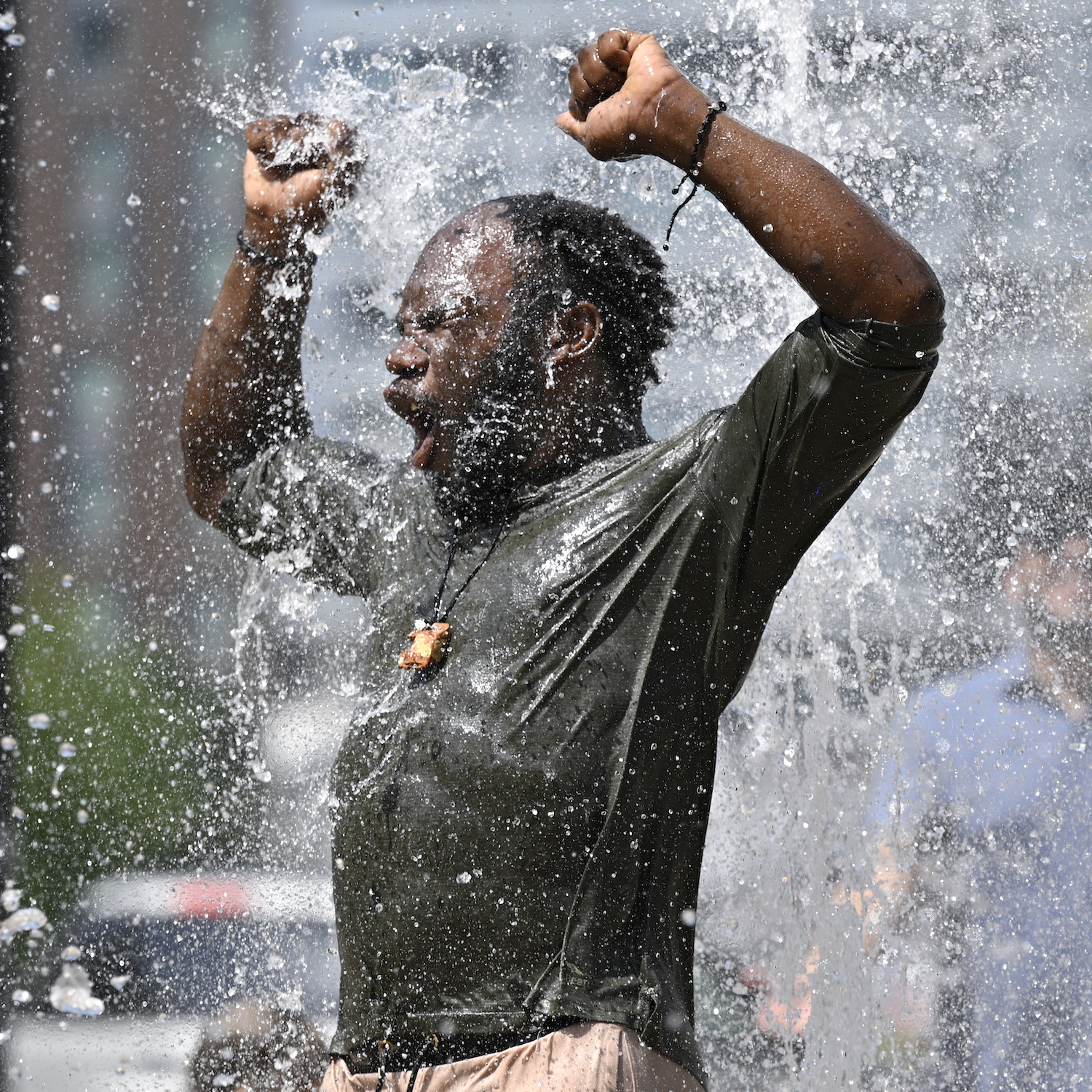
The Department of Homeland Security told ICE officers earlier this month to stop arrests at farms, restaurants and hotels. But only a few days later, Homeland Security Secretary Kristi Noem reversed that decision and directed ICE to resume and speed up workplace raids. The administration is defending their approach, arguing that once undocumented people are out of the country, the jobs, wages and public resources going back to American workers will strengthen the economy. Now to the weather. It's been a week of appropriate, oppressive, dangerous, and often record breaking heat for large parts of America. Here's some numbers for you. Over 400 heat records for calendar days were broken in the last week and seven states tied or broke their all time heat record for June. Over 128 million people were under heat advisories yesterday, warnings that have appeared in at least 26 states in the past few days. But of course, for those who are experiencing it, you already knew this was turning out to be a sweltering end to June. That's because of something called a heat dump.
- [06:56]
Emily Walls
It's basically an upper level high pressure system that's acting as a lid to hold in that hot air. So all of this hot air, it's just stuck over the eastern half of.
- [07:06]
Shemitah Basu
The U.S. that's meteorologist Emily Walls speaking on Fox 32 Chicago. She explained why those living in cities are facing tougher conditions than the suburbs due to a phenomenon known as the urban heat island.
- [07:19]
Emily Walls
You have a lot of concrete, you have a lot of asphalt that's going to be holding on to a lot more heat than what grass can do or other sorts of vegetation. So it's not unheard of that in a city, if your temperature is during the daytime, when the sun's out, can be about 4 to 8 degrees warmer than surrounding areas.
- [07:37]
Shemitah Basu
As global warming takes hold, we can expect more stifling heat outside of peak summer months. And according to the nonpartisan group Climate Nexus, these heat waves are 3 to 5 degrees warmer than they would be without climate change. So as we continue to face these weather events, we thought we would round up and share some of the advice that we're seeing on how to stay safe in the heat. First, with many kids now out of school, how hot is too hot to play outside? NPR spoke to Dr. Jess Weiss, a pediatrician in Washington, D.C. who said she would start to worry about temperatures above 95 degrees and advises constant reminders for water, hats and plenty of sunscreen kids.
- [08:19]
Dr. Jess Weiss
Are more likely to play than to be disciplined enough to take breaks, so some of that is where your parenting has to come in. Keeping outdoor time outside of those really hot hours between 10am and 3pm if they're able to do more outdoor activity first thing in the morning or in the later afternoon when it's less hot, can be safer.
- [08:37]
Shemitah Basu
For those with pets, the BBC has a handy guide. They spoke to a veterinary surgeon who notes that dogs rely on panting for temperature control, which is less effective than sweating. And much like excited kids, they are also not so good at regulating their energy levels, so you need to do that for them. If you're worried about pavement heat, try putting your palm to the ground. If you can hold it for five seconds, it's probably safe. Otherwise, stick to the grass and shade. Beyond that, it is a good idea in general to check on elderly friends and relatives, keep a lookout for community cooling centers and stick to exercise early in the mornings or late at night. If you are an outdoor employer, the Occupational Safety and Health administration recommends a 20% rule where you ensure that workers spend no more than a fifth of their shift working at full intensity in the heat. Now, one somewhat counterintuitive thought if you step outside and think, oh good, there's a little breeze, that may not be helpful. As CBS Philadelphia's Grant Gilmore explained to.
- [09:40]
Grant Gilmore
His followers, there is actually a point where wind will not make it feel better, but actually make you feel hotter. And that point is when the air temperature reaches your body temperature 98.6 degrees or around that. If the air temperature is warmer than that, then as the wind blows in, it'll actually take away the air that's immediately surrounding the skin of your body, blow it away and replace it with even hotter air.
- [10:08]
Shemitah Basu
As of this morning, things are supposed to get a little cooler, a relief for most of us under the heat dome. For Bostonians, it might be a mixed Blessing. They endear 13 straight weekends of rain before the heat wave and can expect showers again come Saturday. Before we let you go, a few other stories we're following. NATO leaders concluded their summit yesterday with a unanimous agreement to increase their country's defense spending to 5% of output over the next 10 years. President Trump described the decision as a big win for Europe and for western civilization. The US currently spends 3.4% of its GDP on its defense, while the rest of NATO is around 2% on average. There had been some early resistance, especially from Spain, the lowest spender of the alliance. Their prime minister, Pedro Sanchez, said the discussion over percentages was misguided, leading Trump to threaten tougher trade talks if they failed to up their spending. But a target is one thing, delivering it is another. And with many NATO allies struggling to achieve growth while at the same time struggling to unload large quantities of debt, finding the money to double or even triple their defense budget will demand difficult choices for politicians. In other news Robert F. Kennedy Jr's newly appointed vaccine committee met for the first time on Wednesday. As we mentioned on yesterday's show, it comes after he removed members of the panel and replaced them with some individuals who have ties to anti vaxx groups and vaccine skepticism. But even before the meeting took place, they were one member down. Dr. Michael Ross, a Virginia physician, withdrew over a conflict of interest review, a spokesperson told a Guardian. At the meeting itself, the panel said that it would study the schedule of childhood and adolescent immunizations and review the use of older vaccines. A scheduled vote on the RSV vaccine was postponed. They meet again today, where a presentation will be led by Lynn Redwood, a former leader of an anti vaccine group founded by Kennedy called Children's Health Defense. And finally, the lavish wedding, sparking a spirited backlash. Jeff Bezos and Lauren Sanchez are tying the knot in Venice this week, with festivities expected to cost well over $20 million. The Washington Post, which Bezos owns, reported that Venice's airport is expecting the arrival of 100 private jets and air five star hotels are sold out and paparazzi are on the hunt for rumored guests ranging from Oprah to Ivanka Trump. Now, there will be some economic benefits for the city, but the wedding has prompted a lot of protest from environmental activists and those against the ostentatious display from the super wealthy. And what do you get for the couple that has everything? Well, apparently nothing. Their wedding invite says no gifts. You can find all these stories and more in the app Apple News App. And if you're already listening in the News app right now, we've got a narrated article coming up next. You might not think that HR software creators live a life of high drama, but Bloomberg businessweek examined a major legal scandal in which one company accused the other of hiring a staff member as a mole. Things took a turn from there. If you're listening in the podcast app, follow Apple News plus narrated to find that story. And I'll be back with the News News tomorrow.