Loading summary
Transcript38 lines
- [00:05]
A
Good morning. The Trump administration has ramped up using local police to carry out immigration enforcement. But now some states are pushing back.
- [00:14]
B
We will not allow untrained, unqualified, and unaccountable agents to deputize our brave local law enforcement officers.
- [00:21]
A
After New Epstein files revelations, the Los Angeles mayor is calling for the Olympics chairman to resign. The LA Times explains why. And the Chicago Sun Times reflects on the legacy of Jesse Jackson, who has died at the age of 84. It's Wednesday, February 18th. I'm Cecilia Ley and this is Apple News. Today, Yesterday, Maryland became the latest state to push against President Trump's immigration crackdown by prohibiting enforcement agreements, partnerships that allow local law enforcement officers to carry out federal immigration duties. The state follows similar moves in other Democratic led states like Virginia, New Mexico, and Maine. Here's a Democratic Governor, Wes Moore.
- [01:06]
B
We believe in due process here in the state of Maryland, and we refuse to blur the lines between state and federal authority in ways that undermine the trust between law enforcement and the communities that they serve. And the best way to address crime is by making sure that the communities feel safe and want to be involved in the process to stop it in the first place.
- [01:28]
A
The law comes, as NPR reports, that partnerships between local police and ICE have skyrocketed this past year under powers derived from a program with a wonky title 287. Jacqueline Diaz, a correspondent with NPR, told us how it works.
- [01:43]
C
This gives the local police officers the power to question, investigate, or arrest people for perceived or set immigration violations. And that's unique because it's power that's only really traditionally reserved for federal officers.
- [01:59]
A
The program itself is not new. In fact, it was President Bill Clinton who signed it into law back in 1996. In Maryland, for example, until yesterday, the county jail has for a long time asked inmates whether they were in the country illegally and then passed the information to a federal authority. But there's been a clear change in how these agreements are being used in Trump's second term. NPR reports that there were just 45 of these agreements in place back in 2019. And as of this week, ICE says that there are nearly 1500 active agreements. It varies massively across the country. Red states like Texas and Florida have hundreds in place. Blue states like Illinois or California have zero. The agreements come in different forms, but Diaz said that one was particularly common.
- [02:47]
C
The biggest and most powerful version of these agreements is a task force model. And DHS says that under 287 agreements, local officers can stop people, question them, and make arrests for immigration violations. And under Trump. We found that the task force model is the most often used agreement to encourage cooperation.
- [03:09]
A
Financial incentives are offered to local law.
- [03:11]
C
Enforcement under the Big Beautiful bill. They actually included an element in that bill that gives more funding to ICE generally, but also specifically for 287 agreements where local police can essentially be reimbursed for participating in this program.
- [03:30]
A
Diaz said that according to some officials, enforcement agreements were less common under previous administrations. One official who worked under Clinton said she couldn't recall it being used. The program expanded under President Bush after 9 11, and President Obama, who deported more people than any of his predecessors, also employed the practice. But in 2012, 287 practices were suspended after a number of documented civil rights abuses. NPR reports that the program was basically left intact, but not really used under President Biden. Now, ICE says there are agreements active in 40 states and territories.
- [04:08]
C
DHS is a big proponent of these agreements. In response to some of my questions, they said that it helps, you know, take some of the most violent offenders off the streets of the U.S. they say it makes it safer. It's also, they said, a critical resource for the Trump administration's immigration enforcement efforts.
- [04:29]
A
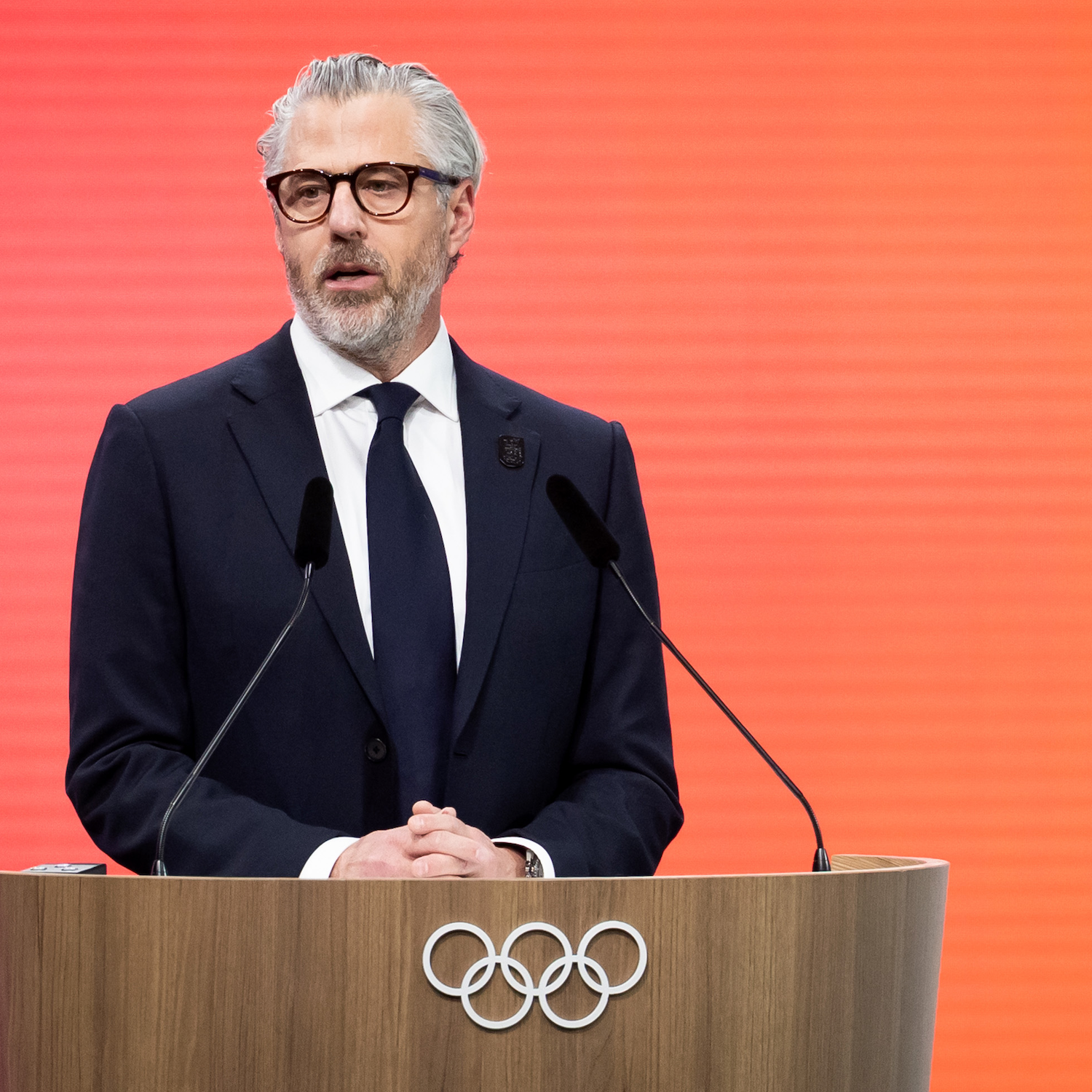
Meanwhile, those who oppose this kind of local federal cooperation warn that in addition to draining local resources, these agreements risk racial profiling and civil rights violations, as well as making local police navigate complicated immigration laws. As the Winter Olympics enters its final stretch, some media and political attention is turning to the Los Angeles summer games in 2020. That's because the Hollywood mogul leading the planning and execution of the event is facing pressure to step aside because of the latest batch of Epstein files. Casey Wasserman is the chair of LA28, the nonprofit organizing committee for the upcoming Summer Games. Here he is back in 2024, speaking to NBC about the job he was taking on as the Paris Games wrapped up. We are what we are. We are in many ways the cultural capital of the world. And I think you see a lot of star power, a lot of excitement, a lot of energy, and a place that is truly diverse and brings the world together. But his relationship with Ghislaine Maxwell, the infamous associate of convicted sex offender Jeffrey Epstein, is now under scrutiny following new revelations. While the board of LA28 has given him full confidence, he's lost the support of the LA mayor, Karen Bass. She doesn't have the authority to fire him, but she's become the most senior public official yet to call for his resignation. In a CNN interview this week, the board made a decision. I think that decision was unfortunate. I don't support the decision.
- [06:02]
D
My opinion is, is that he should step down.
- [06:04]
A
The documents revealed that in 2003 Wasserman traveled to Africa on a humanitarian mission with Maxwell along with former President Bill Clinton.
- [06:13]
E
And it showed that at some point after the trip he exchanged these risque sounding emails with Maxwell after.
- [06:22]
A
Dakota Smith is a reporter for the Los Angeles Times now.
- [06:25]
E
This is before their crimes became known. At this point there wasn't anything that was in the news about the two of them and their sex trafficking that they were carrying out.
- [06:38]
A
Wasserman, who was married at the time, discussed a possible rendezvous with Maxwell and told her that he thought of her all the time. Wasserman has not been charged with any crime in connection with Epstein or Maxwell and the documents don't suggest illegal conduct. But after the story came to light, his talent agency faced some high profile splits including retired US Soccer star Abby Wambach, singer Chapel Roan and country star Orville Peck.
- [07:05]
E
It was not a huge number but it was enough that it really started to feel like the pressure was growing. And then last Friday night he sent out a memo to his staff saying that he was selling his company, which was really just a shock I think.
- [07:20]
A
In his memo, Wasserman said he deeply regretted what he called limited interactions with Maxwell and apologized to his staff for the distraction. But he's showing no deference to Mayor Bass. Smith told us that her intervention followed similar calls from a political rival as well as other city officials who have turned against him.
- [07:38]
E
There's a feeling that Casey Wasserman never has made a huge effort to become particularly close or make the sort of relationships with the local politicians that would have led to them defending.
- [07:53]
A
The LA28 executive committee said they made their decision to back Wasserman following an independent review. He was an icon of the civil rights movement, an international and ambitious politician and a charismatic faith leader. The death of 84 year old Reverend Jesse Jackson yesterday has drawn tributes from across the political spectrum and around the world and a reminder of his enormous influence over several decades. Past presidents were united in their praise. Barack Obama called him a true giant. Donald Trump described him as a force of nature like few others. And Joe Biden said he was, quote, determined and tenacious, unafraid of the work to redeem the soul of our nation. And speaking yesterday, his close friend Reverend Al Sharpton talked about how Jackson influenced him.
- [08:47]
B
He opened my eyes that we could make a difference, we could make change, that we could not be cynical. I believe that we could make a difference. We could change laws and which is Why? I went from just being bitter to trying to be better.
- [09:02]
A
Jackson was a protege of Dr. Martin Luther King Jr. Who sought to continue his mission after his assassination. He ran two groundbreaking, though ultimately unsuccessful campaigns for the presidency in the 80s and started the Rainbow Push Coalition, a multiracial advocacy organization. Jackson was known for the call and response poem he would deliver for more than half a century. Sometimes it would sound more like a call to action, as it did here at an event in 1963.
- [09:30]
F
I may be poor, but I am somebody. I may be on welfare, but I am somebody. I may be in jail. When I am somebody, I may be an advocate.
- [09:50]
D
His message, in a way was amazingly consistent for 70 years. I mean, what is racism? Racism strips a person of their dignity. And he said, no, no, you have dignity. You can be a single mother on welfare. You have dignity. His message, you are somebody. He said to other people. And he said to himself, I am somebody. I'm Jesse Jackson. I'm important.
- [10:12]
A
Neil Steinberg is a news columnist for the Chicago Sun Times and wrote Jackson's obituary. In it, he describes the Reverend as a Chicago institution, a complex figure who left footprints across the world and often found his attempts to wield his own political power thwarted.
- [10:28]
D
Where I contrast him to King, who in a way was simplified and beatified by dying so young. He was well spoken, he was a martyr, he was an idol. And Jackson lived a long time and his legacy became very complicated over the years.
- [10:43]
A
He faced criticism for what was seen as self seeking behavior. Jackson said he was the last person to speak to King before his death and claimed to have cradled his head. But his version of events was challenged and in a TV appearance the following day, he wore clothes stained with King's blood, a move that infuriated some of King's inner circle. Later, his 1984 run for presidency was marred by derogatory comments towards Jewish people. And infidelity in his personal life also complicated his public image. Writing his obituary, Steinberg points to one incident early on that might have influenced Jackson's career in civil rights. It took place when Jackson returned home to Greenville, South Carolina when he was.
- [11:24]
D
A student, a college student, he had to write a speech actually on patriotism, ironically. And he went to the Greenville Public Library and tried to check out a book and they turned him away. And the humiliation rankled Jesse Jackson. And he returned with seven friends and became the Greenville Eight and was arrested.
- [11:44]
A
The group of black students staged a sit in to protest the whites only library, which ultimately led to the desegregation of the local county's library system. Towards the end of his life, Jackson's rare neurodegenerative condition impacted his movement and speech, but his words never lost their influence on the national stage. Perhaps his most famous piece of rhetoric was a speech he delivered at the 1988 DNC convention.
- [12:10]
F
We must never surrender. America will get better and better. Keep hope alive. Keep hope alive. Keep hope alive on tomorrow night and beyond. Keep hope alive. I love you very much.
- [12:36]
A
Before we let you go, a few other stories we're following. A federal judge ruled on Tuesday that the Trump administration cannot redetain Kilmar Abrego Garcia because the detention period expired and the government has no viable plan for deporting him. The Salvadoran national was mistakenly deported to his home country last year, and his case became a focal point in the immigration debate. Abrego Garcia had immigrated to the US illegally as a teenager, and in 2019, an immigration judge ruled that he couldn't be deported to El Salvador because because he would face danger there. Since returning to the US Last June, he's been fighting a second deportation to an African country. In her ruling, US District Judge Paul Azinis noted that the government had ignored Costa Rica, the one country that had offered to accept Abrego Garcia. The Department of Homeland Security criticized the ruling, saying, quote, if this matter were actually about the law or due process, Kilmore Abrego Garcia would already be deported and would never set foot in this country again. On Monday night, Late show host Stephen Colbert opened his show by announcing that CBS told him he couldn't broadcast an interview with Texas Democratic lawmaker James Talarico, who's running in a competitive primary for a U.S. senate seat. He suggested the network's move was because of a crackdown from the FCC, the government's media regulator. The FCC's equal time rule says that if a radio or broadcast television program has a political candidate on during an election, then the candidate's opponents have to be on as well. Up until January, talk shows like the Late show have typically been exempt from the rule and are entitled to editorial discretion. In response, Colbert criticized FCC chair Brendan Carr, who has recently gone after a number of major networks for being critical of Trump. You are dutch ovening America's airwaves. Let's just call this what it is.
- [14:28]
B
Donald Trump's administration wants to silence anyone.
- [14:31]
A
Who says anything bad about Trump on TV because all Trump does is watch tv. CBS said in a statement that Colbert was not prohibited from airing the Talarico interview, but that the show was, quote, presented options for how the equal time for other candidates could be fulfilled. The Late show published the interview with talarico on its YouTube page instead. And finally, bobsledder Ilana Meyers Taylor became the oldest individual champion in Winter Olympics history. The 41 year old had competed in four previous Winter Games, earning three silvers and two bronzes, but the gold always eluded her until Monday night. In the fourth and final heat of the women's monobob, a competition that she helped bring into the Winter Olympics, Myers Taylor won gold over Germany's Laura Nolte by 0.04 seconds, the closest women's bobsleigh finish in Olympic history. Myers has two young boys, both with disabilities, and has been open about the challenge of raising kids while training. She dedicated her win to everyone who supported her I can't.
- [15:34]
F
I can't put it into words. I can't believe it. It took so many people to get here. There's so much work for everybody, like my husband, my kids, my nanny Macy, my nannies along the way, my parents, everybody. I'm just so grateful right now. It's just so amazing to finally have done it.
- [15:50]
A
You can find all these stories and more in the Apple News app. And if you're already listening in the News app right now, we've got a narrated article coming up next. GQ reports on the ever growing price of tickets to live events and why it's never been harder to see a big show at an affordable price. If you're listening in the podcast app, follow Apple News Narrated to find that story and I'll be back with the news tomorrow.