Loading summary
Transcript132 lines
- [00:05]
A
Good morning. Republicans could be forced into a politically.
- [00:08]
B
Difficult choice on health care this week.
- [00:11]
A
But as the Washington Post tells us.
- [00:13]
B
Americans in the real world are already facing tough choices of their own.
- [00:17]
C
Premiums are rising. Subsidies are going away. That means the healthiest people are going to say, look, it's really expensive. I am just going to ride this out. I'm not going to get insurance.
- [00:27]
A
The latest on Venezuela.
- [00:29]
B
And we'll speak to the Wall Street Journal about a controversial Maduro's capture that's raised questions of insider trading.
- [00:36]
A
Plus, NBC tells us why everyone's sick.
- [00:39]
B
With the flu this season.
- [00:40]
D
We have not seen rates of people going to the doctor this high in nearly 30 years.
- [00:47]
A
It's Wednesday, January 7th.
- [00:49]
B
I'm Shemitah Basu.
- [00:50]
A
This is Apple News Today. With the start of the new year.
- [01:02]
B
Health care costs skyrocketed for millions of Americans as the much fought over ACA subsidies expired.
- [01:09]
A
Without a deal, there will likely be another vote on whether to extend the subsidies. This week after some Republicans rebelled against.
- [01:16]
B
Their leadership, adding more pressure to come up with a deal. To mark the new congressional term, Trump gathered House Republicans for a retreat in Washington, D.C. there, he urged members to.
- [01:28]
A
Be flexible on their demands.
- [01:29]
B
Demands to prevent taxpayer funds from going to abortion services.
- [01:33]
A
And he pushed his own idea of.
- [01:35]
B
More health savings accounts.
- [01:38]
E
You can own health care. Let figure it out. Let the money go directly to the people. It goes in a health care account. It does. There are numerous things you can do, but you have to let no money for the insurance companies.
- [01:55]
A
But House Republicans still can't seem to.
- [01:57]
B
Rally behind a single way forward.
- [01:59]
A
Even if they do, proposals would face.
- [02:01]
B
An uncertain future in the Senate.
- [02:04]
A
In the meantime, the nonprofit KFF found.
- [02:07]
B
That more than 20 million enrollees who relied on ACA subsidies have premium costs jumping by 114% on average this year.
- [02:16]
A
In North Texas, a CBS affiliate spoke.
- [02:19]
B
To Richard Hernandez, a man who's had cancer twice. He dropped his coverage after being informed that his monthly premium would go from about $900 to almost $2,300 a month.
- [02:32]
F
Totally unaffordable. So I'm gambling until I'm old enough to get on Medicare and hopefully nothing will happen.
- [02:42]
A
Peter Wariske is a reporter with the.
- [02:44]
B
Washington Post who told us why more Americans feel as though they're running out of options.
- [02:50]
C
Premiums are rising, their subsidies are going away. And at the same time, some insurers are scared enough of the new market that they're pulling out le people to face a monopoly. There's only one company in the area where they live. And as economics dictates, prices will go up when you have a monopoly.
- [03:09]
A
He profiled a family in Jackson Hole.
- [03:11]
B
Wyoming, who's facing that exact scenario. One company offering ACA plans at exorbitant costs.
- [03:18]
A
Stacy and Derek Newton both run independent businesses.
- [03:22]
B
She's in sales and he outfits vans. They have two teenagers.
- [03:26]
A
When they went to enroll for this.
- [03:28]
B
Year, they found that the cost of their policy jumped by 34%.
- [03:32]
C
They are being asked by the only insurer left in that area to pay $43,000 a year for health insurance. And that's about one third of their gross income. So they've decided they can't afford that. And the problem for that family especially is that the mom, Stacy, was diagnosed last year with leukemia. So she's taking a pretty big risk by leaving standard insurance policy.
- [03:57]
A
If there is no deal made on.
- [03:59]
B
How to move forward this week, the.
- [04:01]
A
Issue of healthcare subsidies could be back.
- [04:03]
B
Again come the next government funding deadline at the end of this month.
- [04:15]
A
I don't know about you, but seemingly everyone I know is sick, was sick.
- [04:20]
B
Or thinks they might be getting sick.
- [04:22]
A
It's flu season, sure, but the data.
- [04:24]
B
Shows that this winter we've been hit particularly hard.
- [04:28]
A
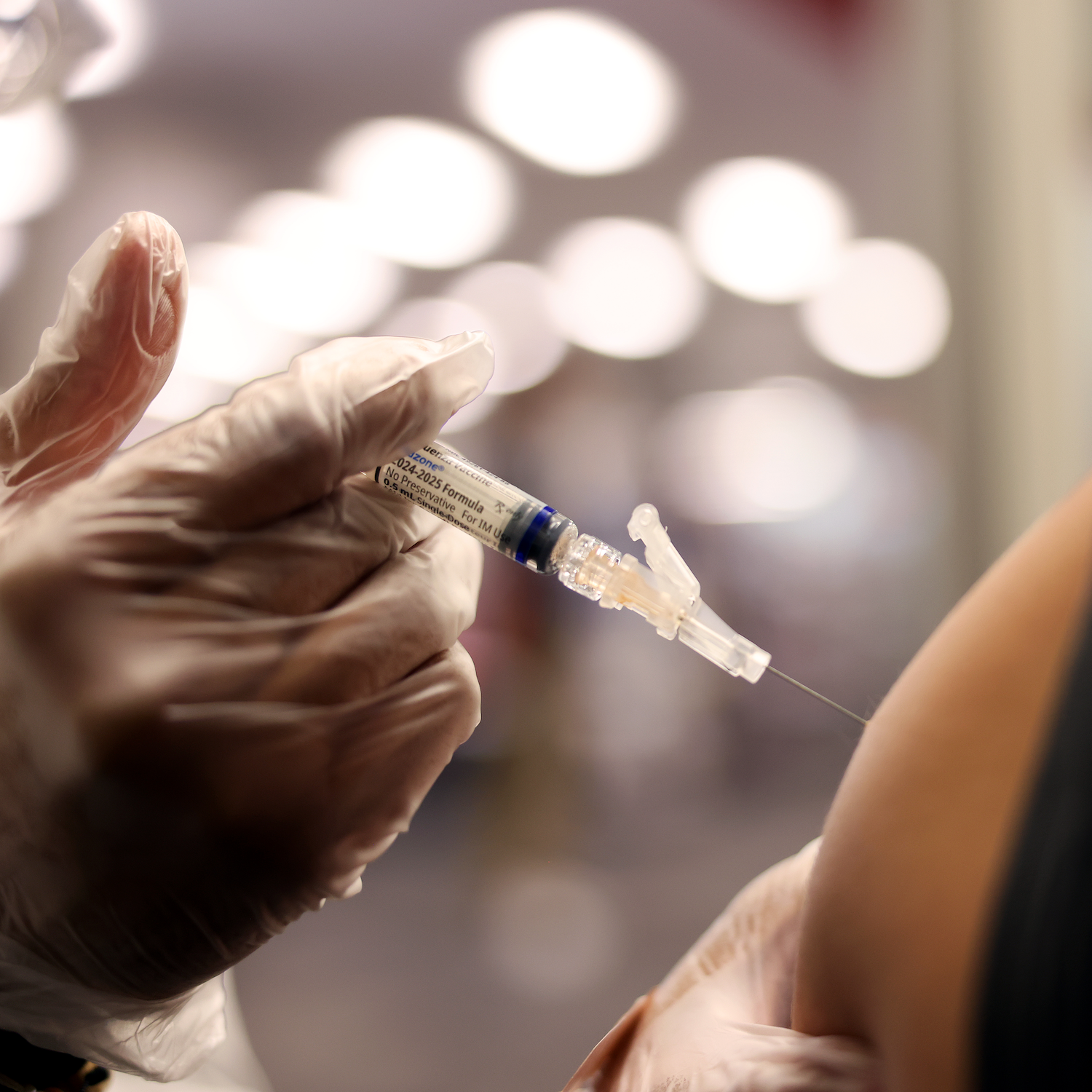
The CDC says doctor visits for the.
- [04:30]
B
Flu are at the highest level in 30 years and are likely to continue to rise. Erica Edwards is a health reporter for NBC News.
- [04:39]
D
When people go to their doctor, they are generally going for high fevers, meaning really anywhere from like 101 to 104 that you can't really bring down with Tylenol, Motrin, things like that. Sore throat, lots of sniffles. Some people are having some stomach upset as well, which might even be another virus on top of the flu. And then those really bone crushing body aches. That's really what doctors are seeing right now.
- [05:04]
A
One possible reason things are so bad.
- [05:07]
B
Is the current variant of the flu going around called subclade K. It made.
- [05:12]
D
A change to the surface protein of the flu virus. And the surface protein is important because that's what the body uses to see if it recognizes a new illness coming at it. So the theory is that if the body can't recognize that surface protein of the flu virus, it might not be able to do a good enough job to fight it off. We might become sicker if we are infected.
- [05:35]
A
Edwards told us that experts had noted that the strain had shifted after this season's flu shots were already in production. It wasn't on the radar when influenza.
- [05:44]
B
Experts gathered to decide which strains to target.
- [05:46]
D
Last February, the Flu virus is a master shape shifter, right? It's always mutating, so it just wants to infect as many people as possible.
- [05:56]
A
But that doesn't mean that those who took their shots are completely unprotected.
- [06:01]
D
I saw an analogy the other day that I thought was really cool. It was, you know, the flu vaccine, it's notoriously imperfect, right, because as we said, the viruses are always changing, so it's hard to kind of keep up. But having that vaccine is sort of like putting on a bit of armor before you go into war. It's not necessarily gonna help you win the war, but it can help protect you from becoming really injured while you're trying to do that.
- [06:25]
A
The national foundation for Infectious Diseases reported.
- [06:27]
B
In December that fewer than half of adults in the US have been immunized against any respiratory virus.
- [06:34]
A
Just 34% received flu shots. Retail pharmacies also saw falling numbers in.
- [06:39]
B
Vaccinations for the three major respiratory diseases, which are the flu, RSV and COVID 19.
- [06:46]
A
The CDC reports at least 5,000 people.
- [06:49]
B
Have died from the flu in the US this season alone, including nine children. Right now, 45 states have high to very high levels of flu circulating in communities. And Edwards told us that epidemiologists expect things to get worse before they get better.
- [07:14]
A
While much of the world appeared stunned.
- [07:16]
B
By the US Capture of Venezuela's Nicolas Maduro, it seems at least one person saw it coming around.
- [07:23]
F
A week before the US Attacked Venezuela and captured Nicolas Maduro, somebody created an account on polymarket, which is a crypto based betting platform.
- [07:35]
A
That's Alexander Osipovich, a reporter with the Wall Street Journal. He told us the account essentially started.
- [07:42]
B
Making bets predicting Maduro's downfall before the end of January.
- [07:47]
F
Then suddenly the news came out about the operation. We learned that Maduro had been taken back to the and this person cashed out and made a bit over $400,000 worth of profits.
- [08:01]
A
In fact, according to the Journal's timeline, the final bets were placed less than.
- [08:05]
B
An hour before President Trump ordered the strikes on Caracas.
- [08:09]
A
At that point, based on Poly Market.
- [08:11]
B
User probability, there was only an 8% chance of Maduro losing power this month.
- [08:17]
A
And while you can't rule out lucky.
- [08:19]
B
Timing, it has raised some eyebrows and shone a light on what is a controversial financial platform.
- [08:25]
F
There is clearly concern that maybe somebody who had knowledge of US Government policy, the Trump administration's plans before they were public used it to make a bit of money on the side. And obviously that would be a crime and unethical. My understanding from speaking to lawyers is that if it were an insider using non public US government information to place such a trade, that could be considered insider trading in the swaps market. And that is an offense that could be could lead to a civil lawsuit from a regulator or a DOJ criminal case.
- [09:04]
A
Polymarket has exploded in popularity since it.
- [09:07]
B
Was created back in 2020.
- [09:09]
A
It's a betting market for future events.
- [09:11]
B
Where you can gamble on anything from.
- [09:14]
A
Major global elections to when a sitcom.
- [09:17]
B
Character might be killed off.
- [09:18]
A
Its 28 year old CEO Shane Copland.
- [09:21]
B
Spoke to 60 Minutes last November.
- [09:24]
G
It's the most accurate thing we have as mankind right now until someone else creates some sort of super crystal ball.
- [09:30]
A
But not everyone is convinced by its value. It's paid out fines for regulatory breaches and Americans are for now technically blocked.
- [09:38]
B
From using the platform, though many circumvent that with a vpn.
- [09:42]
A
Critics say that unlike the stock market.
- [09:44]
B
The anonymity of the platform and its reliance on crypto makes it harder to root out insider trading.
- [09:52]
A
Osipovich told us that Kaplan has previously.
- [09:54]
B
Said the level of transparency in the market allows for visibility into possible insider trading.
- [10:01]
F
His argument is that there's kind of this ecosystem of people looking out for potential insider traders. If you have a market where clearly there's some inside group of people that might know the outcome and suddenly you see somebody with very high conviction putting down a lot of money towards a particular outcome, you might infer that that's an insider.
- [10:22]
A
In July, the Trump administration dropped a.
- [10:24]
B
Biden era investigation into polymarket.
- [10:27]
A
The White House has shown a warmer.
- [10:29]
B
Attitude toward crypto markets and President Trump's son Don Jr. Now sits on the company's advisory board. Recent regulatory changes means it could soon officially return to the US.
- [10:49]
A
Let's end today on a few stories.
- [10:51]
B
Related to Venezuela that we're watching.
- [10:54]
A
Last night, Trump announced a deal for.
- [10:56]
B
Venezuela to export up to $2 billion worth of crude oil to the U.S.
- [11:01]
A
Trump posted to social media that the.
- [11:03]
B
Oil would be sold at quote market.
- [11:05]
A
Price to benefit both Venezuela and the United States, though it's unclear how that.
- [11:10]
B
Will work in practice. The Wall Street Journal reports the amount of oil represents up to 15% of Venezuela's annual production, a significant it's the.
- [11:20]
A
First major announcement on the country's reserves.
- [11:22]
B
Since Trump pledged to oversee and revive its oil industry.
- [11:26]
A
The president says he will meet on.
- [11:28]
B
Friday with major oil producers like Chevron, ConocoPhillips and Exxon Mobil about investing billions of dollars to develop Venezuela's oil infrastructure.
- [11:39]
A
Meanwhile, the Washington Post is reporting that.
- [11:41]
B
The US government says about 75 people were killed during the US raid in Caracas to detain Maduro.
- [11:48]
A
That figure includes Venezuelan and Cuban security.
- [11:51]
B
For forces as well as some number of civilians. Some half a dozen US Troops were injured in the operation.
- [11:59]
A
The Post also reports that after some.
- [12:01]
B
Initial celebration from Venezuelans inside the country, fear and uncertainty have taken over as the government cracks down on public expressions of support for Maduro's detainment. That includes the jailing of journalists and arrests of civilians.
- [12:18]
A
And since Maduro's capture, there have been.
- [12:21]
B
More questions about how far President Trump is willing to go in his ambition to control Greenland.
- [12:27]
A
The semi autonomous territory is part of.
- [12:29]
B
Denmark, a NATO ally.
- [12:31]
A
The White House said utilizing the military.
- [12:34]
B
Was, quote, always an option.
- [12:36]
A
Yesterday, European allies felt compelled to issue.
- [12:39]
B
A joint statement reaffirming their support for Greenland's sovereignty, declaring that Greenland belongs to its people.
- [12:49]
A
You can find all these stories and.
- [12:51]
B
More in the Apple News app.
- [12:53]
A
And if you're already listening in the.
- [12:54]
B
News app right now, we've got a narrated article coming up next. New York magazine profiles Judah Smith, a pastor to the stars who boasts Justin Bieber as one of his friends and followers.
- [13:05]
A
But as part of the nation turns.
- [13:07]
B
To a more conservative Christianity, Smith's brand of millennial evangelicalism may be on the way out.
- [13:15]
A
If you're listening in the podcast app.
- [13:16]
B
Follow Apple News plus Narrated to find that story. And I'll be back with the news tomorrow.