← Art + Audience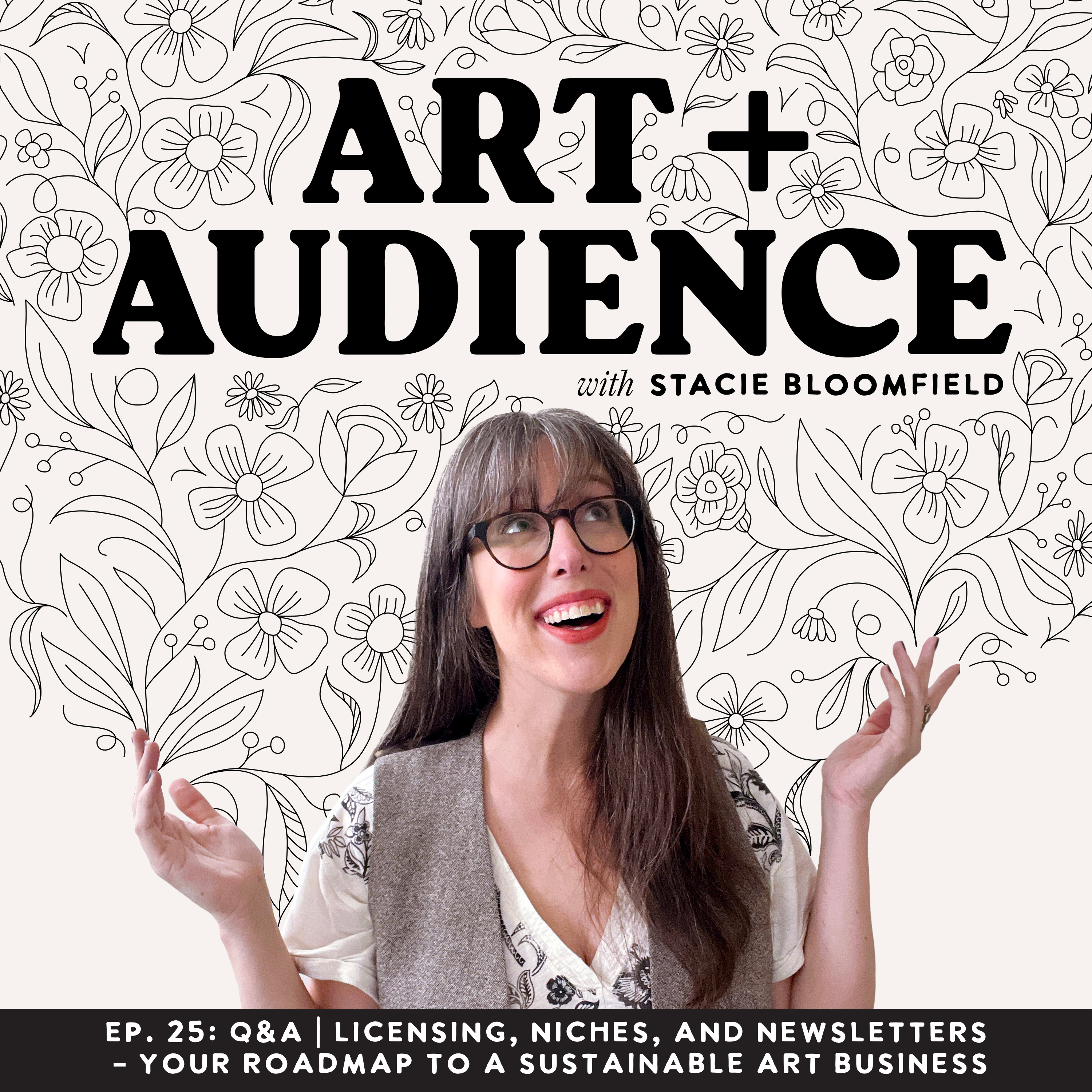
Art + Audience
Ep. 25: Q&A | Licensing, Niches, and Newsletters – Your Roadmap to a Sustainable Art Business
00:11:54
In this episode, Stacie answers real listener questions and dives into how artists can move from feeling overwhelmed by possibilities to finding strategic clarity. She offers empowering advice on balancing multiple passions, making smart licensing...
Loading summary
Transcript11 lines
- [00:00]
Progressive Insurance
This episode is brought to you by Progressive Insurance. Do you ever think about switching insurance companies to see if you could save some cash? Progressive makes it easy to see if you could save when you bundle your home and auto policies. Try it@progressive.com Progressive Casualty Insurance Company and affiliates. Potential savings will vary. Not available in all states.
- [00:20]
Stacy Bloomfield
Ask yourself what would future Sarah, the one who's already running the 502525 business, wish I had focused on first. That version of you has focus. She's confident. She builds one stream at a time with intention. She's not scattered. She's strategic. And you, you're already becoming her. You're not lost. You're just standing at the beginning of your next breakthrough.
- [00:41]
Unknown Host
Wouldn't it be nice if your art business loved you back?
- [00:44]
Stacy Bloomfield
Hi, I'm Stacy Bloomfield.
- [00:46]
Unknown Host
After years of trial and error and.
- [00:48]
Stacy Bloomfield
Late night doodling, I went from being.
- [00:50]
Unknown Host
A coffee shop manager to running a vibrant seven figure art business that I love. And now I'm on a mission to help more artists create an art business that they love too. So I invite you to find a cozy spot, pull out your favorite sketchbook and listen in. It's never too late to chase your creative dreams. Welcome to the Art plus Audience Podcast.
- [01:13]
Stacy Bloomfield
Hey there and welcome back to Art Audience, the podcast where we talk about growing a thriving, sustainable art business that feels like you. I'm your host, Stacey Bloomfield, and I am so glad you're here. Every now and then I get the sweetest voicemails from listeners like you and I answer them right here on the show. If you've got a question about your art business, your next steps, or you just want some honest feedback, you can call me anytime at 479-966-9561. That's our art Audience hotline and I'd love to hear from you. Let's jump into today's question. Today's message is from a listener named Sarah. She's a graphic designer who's ready to branch out. She's recently fallen in love with pattern design a especially for quilting fabric. She also adores needle felting and is thinking about teaching classes online like on Skillshare. Her dream is to transition her business from being 100% graphic design to something like 50% design, 25% pattern design, and 25% needle felting. But here's the thing. She feels stuck in indecision. She's overwhelmed by all the directions she could go. She's wondering if she's taking on too much and if starting a newsletter to talk about all of it is a smart first move. First of all, Sarah, I just want to say thank you for such a thoughtful and honest question. Your heart for your work shines through, and I know so many listeners are nodding along with you right now. That feeling of I could do so many things, but where do I even start? That's real. Let me share something I wish someone had told me early on. You can do everything, just not all at once. Success doesn't come from doing more. It comes from doing the right thing. Next, let's walk through this together. First, keep the thing that's working. Graphic design is paying the bills right now, and there's no shame in that. In fact, that's your launchpad. It gives you freedom to be creative elsewhere without panicking over income. So don't drop it. Use it. Second, pick one creative branch to water first. You don't need to abandon the other ideas. You just need to give one of them a season of growth. Pattern design feels like it has momentum. You're lit up by it. There's a niche, a market, and a natural extension of your design background. So plant your flag there. First, build your pattern portfolio. Pitch one collection, then another. That's how clarity builds through movement. Third, yes to the newsletter, but make it about the journey. I'm a huge fan of starting a newsletter early, not because you have everything figured out, but because you don't let people walk with you. As you figure it out, it builds connection, credibility, and community. You can say, hey, I'm a designer. Exploring what it might look like to add pattern design and fiber art to my creative life. Here's what I'm learning this week that is so magnetic. Fourth, Experiment with intention. If needle felting is tugging at your heart, try this. Create one skillshare class. See how it feels. You don't need a needle felting empire tomorrow. Just run one Experiment, reflect, and decide if you want to scale that piece next quarter or next year. 5. Speak to your future self. The CEO version of you. Ask yourself, what would future Sarah, the one who's already running the 502525 business, wish I had focused on first? That version of you has focus. She's confident. She builds one stream at a time with intention. She's not scattered. She's strategic. And you? You're already becoming her. You're not lost. You're just standing at the beginning of your next breakthrough. Don't confuse options with obstacles. Every dream you just named is possible, but your job is to pick one and go all in until the next one is ready to bloom. Sarah, you've got this. And to anyone else listening, you don't have to wait until things are perfect to start. You just have to begin alright, let's jump into our next question. This one comes from Mackenzie Nelson of Mackenzie Nelson Art. Mackenzie called in to ask I've learned that not all licensing deals are the same and I would love to know what markets are the most lucrative for art licensing and what should I be thinking about when it comes to choosing the right licensing deals? This is such a great question, especially for artists who are starting to dip their toes into licensing and want to build a more strategic, profitable path. MacKenzie, you are 100% right. Not all licensing deals are created equal. Some have higher payouts, some are more about visibility and others, well, they're learning experiences in disguise. Let's break it down so you can feel empowered to make smarter, more strategic decisions moving forward. 1. What markets are the most lucrative for art licensing? Here's what I've seen over the years. Home Decor plus Fabric Licensing Think bedding, pillows, tea towels. You know I love that one. Or quilting fabric. These tend to have solid royalty potential because they sell in volume. If your work fits into the home lifestyle space, this is a strong contender. Gift plus Stationery Calendars, Greeting cards, journals, puzzles. These can be great especially around seasonal buying and sometimes offer nice repeat deals if you become a go to artist for a company to be on apparel and accessories. Bags, socks, baby clothes, T shirts. These can have decent payouts if you're licensing with a company that really understands branding and distribution. Surface design for big box stores. Think of Target, Walmart or World Market. These deals can be very lucrative but often require an agent or inside connections and you'll likely need a solid track record or unique style to stand out. 2. What makes a licensing deal worth it? Beyond the category, here are the deal terms to pay close attention to Royalty rate. Most range between 4 and 10% of wholesale. Higher rates are often found in fabric and stationery. Exclusivity Is the company asking for exclusive rights and for how long? Non exclusive is better for recurring income on one design across multiple platforms. Territory plus duration. Make sure you know where and for how long your art will be licensed. A three year worldwide exclusive might sound exciting, but it might actually limit your future income if it's not with the right partner, product fit and brand alignment. Even a high paying deal isn't worth it. If it doesn't feel aligned with your values or your art style, you're building a reputation and a legacy. 3. The strategy I recommend Instead of jumping into every opportunity that comes your way, pause and ask does this opportunity build income, visibility or momentum toward the kind of brand I want to be known for? Start by identifying your sweet spot. What products would your art feel most natural on? What kinds of stores would you be excited to see your work in? And then build a portfolio around that. Don't wait for the perfect licensing deal to knock. Go show them why you are the perfect artist for them. Licensing isn't about saying yes to everything. It's about saying yes to the right things. The most profitable deal is the one that pays you and positions you. And here's a bold statement I've decided to double down on in my own teaching and mentoring. Licensing is not your whole pie. It's just one slice. It's a part time income stream even when you're doing it full time. If you want a sustainable art business, you need multiple revenue streams working together. That's how you build a real lasting income, not just a lucky break. Your style is valuable, Mackenzie. When you pair it with strategy, you become unstoppable. Thanks again for your question. It's one that so many artists are asking right now. I hope this gives you clarity, confidence and a renewed sense of direction. And to anyone else listening, you're allowed to be both creative and calculated. That's how we grow. Alright, for our last question in this episode, we're hearing from Hachiko Yoshikawa. Hachiko is part of the Creative Powerhouse Society and an alum of Leverage youe Art. She's been doing children's book illustration for many years and her current style is whimsical and colorful. But recently she's been feeling a creative pull toward new themes. She's curious about exploring floral motifs, antique Asian design, and even European mosaic inspired patterns. Her question is her work feels all over the place right now. She doesn't want to give up the whimsical and colorful art she's known for, but she also wants to explore these new stylistic directions. She's asking how do I present these two very different styles in a way that makes sense and how can I market both of them without confusing people? First off, Hachiko, I want to say how normal and even beautiful this moment in your creative journey is. Growth often looks like messiness before it looks like mastery. This isn't a problem, this is proof you're evolving. Let's reframe it. Instead of seeing two clashing styles, I want you to see one artist with a range. What you're really Exploring is your aesthetic voice, and that can hold more than one vibe. So here's my advice. Start by creating a clear distinction between your styles, not as separate identities, but as separate collections or bodies of work. You don't need two websites. You need clarity in how you present the work. So for example, you could have a section on your site or in your portfolio labeled whimsical and playful and and another called botanical and ornamental. Give people containers so they can explore the range without feeling confused. On social media, rotate what you share, but tell your audience why you're exploring something new. Bring them into the story. You might say, this week I'm painting tiny florals inspired by Japanese antiques, and next week I'm back to big eyed storybook critters. This is all me, just different parts of what I love. People are smarter than we give them credit for. They're craving artists who grow, not just those who repeat the same style over and over again. And if you're worried about marketing both styles, focus on the through line. What is your signature? Is it your color palette? Your use of texture? Your sense of wonder? If you stay rooted in that through line, your style will feel cohesive, even across genres. Here's the don't have to choose one forever style. You just need to be intentional in how you present each one and confident that your audience can follow your lead. They're here for you, not just your art. Your art can hold more than one style because you hold more than one story. Don't shrink to fit a box you've already outgrown. This is your creative expansion. Lean into it. Hachiko, thank you for asking this. And thank you for the beautiful work you've already created and the work still to come. And to everyone else listening, if you've got a question about your art business, you, your next creative step, or the mindset stuff we all wrestle with, call our art audience voicemail at 479-966-9561. That's 479-966-9561. Leave your question, I might answer it on a future episode. Until next time, keep showing up for your art and for your audience.
- [11:47]
Unknown Host
Thanks so much for tuning in. Hey, could you do me a favor? Could you subscribe to this podcast and then share it with one of your best art friends? I'd really appreciate it. And then head on over to Instagram and follow me at the Leverage your art account and you can keep up with all of our future episodes. Thank you so much for your support. It means everything to have you here listening and learning.
- [12:10]
Progressive Insurance
Bye.
- [12:13]
Libsyn Ads
Marketing is hard, but I'll tell you a little secret. It doesn't have to be. Let me point something out. You're listening to a podcast right now and it's great. You love the host. You seek it out and download it. You listen to it while driving, working out, cooking, even going to the bathroom. Podcasts are a pretty close companion. And this is a podcast ad. Did I get your attention? You can reach great listeners like yourself with podcast advertising from Libsyn Ads. Choose from hundreds of top podcasts offering host endorsements, or run a pre produced ad like this one across thousands of shows. To reach your target audience in their favorite podcasts with Libsyn Ads, go to libsynads. Com. That's L, I B S Y N Ads. Com. Today.