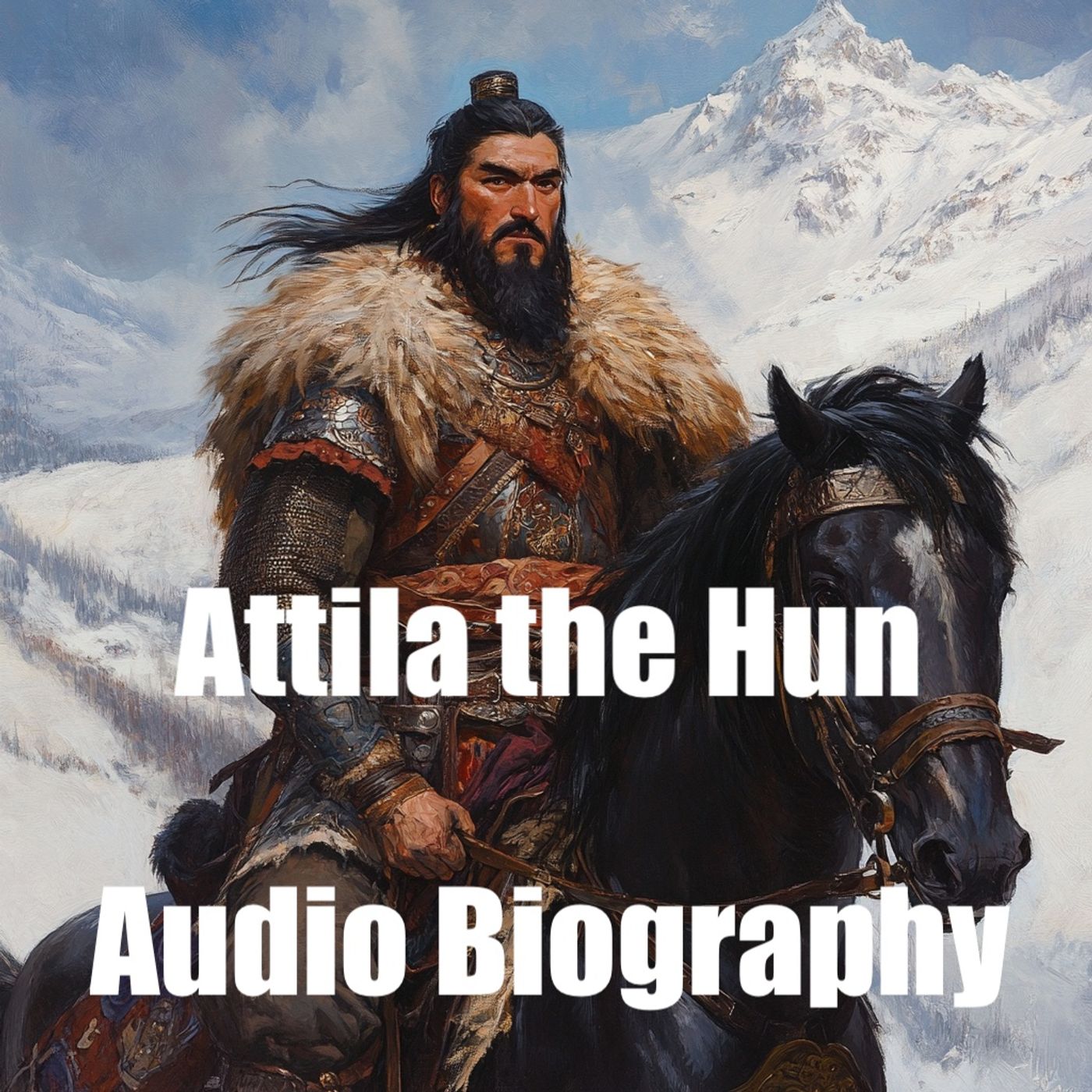
Attila the Hun - Audio Biography
Nov 22, 2024·00:08:34·Tap to summarize
Attila the Hun, often referred to as the "Scourge of God," was one of history's most feared and enigmatic conquerors. As the ruler of the Huns during the 5th century CE, Attila led a confederation of nomadic tribes that terrorized the Roman Empire, both East and West. His name became synonymous with ruthless ambition and unrelenting warfare, yet his life and reign were also marked by strategic brilliance, diplomatic cunning, and an ability to unite disparate peoples under his leadership. Attila’s legacy as both a destroyer and a unifier has echoed through history, shaping perceptions of barbarian leadership and the decline of the Roman world. Attila was born around 406 CE into the ruling family of the Huns, a nomadic people of Central Asian origin who had migrated westward into the steppes of Eastern Europe. The Huns were known for their horsemanship, archery, and ability to wage lightning-fast raids, which made them a formidable force in battle. Attila’s early life remains shrouded in mystery, as much of what is known about him comes from Roman sources, often written with a strong bias against the so-called “barbarians.” However, it is believed that Attila grew up in a world of constant tribal conflict and alliances, honing the skills of leadership, strategy, and negotiation that would later define his rule. Attila rose to power around 434 CE, initially sharing the leadership of the Huns with his elder brother, Bleda. Together, they inherited a vast confederation of tribes that had been solidifying under their uncle, King Rugila. Attila and Bleda expanded their domain through a combination of warfare and diplomacy, securing tribute agreements from the Eastern Roman Empire (Byzantium) and consolidating control over various Germanic and Scythian peoples. The Huns’ military strength was rooted in their mobility, discipline, and psychological warfare, which made them a constant threat to the Roman frontiers. In 445 CE, Attila became the sole ruler of the Huns after Bleda’s death, which some sources suggest was orchestrated by Attila himself. Now unopposed, he embarked on a series of campaigns that would cement his reputation as a fearsome conqueror. His first major move was to renew pressure on the Eastern Roman Empire, exploiting its internal divisions and relative military weakness. In 447 CE, Attila’s forces launched a devastating campaign into the Balkans, sacking cities and forcing Emperor Theodosius II to negotiate a humiliating peace treaty. The Treaty of Margus (434 CE), already in place, was revised to impose even heavier tributes on the Eastern Empire, demonstrating Attila’s dominance and his ability to use diplomacy to secure long-term gains. Attila’s ambitions, however, extended far beyond the Eastern Roman Empire. By the late 440s, he turned his attention to the Western Roman Empire, then under the rule of Emperor Valentinian III. At this time, the Western Empire was in decline, plagued by internal corruption, weak leadership, and external threats from other barbarian tribes such as the Vandals and Visigoths. Attila’s entry into Western Roman affairs was catalyzed by an unusual pretext: a letter from Honoria, the sister of Valentinian III. Honoria, reportedly unhappy with her political situation, sent a plea for help to Attila, offering him her hand in marriage. Attila interpreted this as an invitation to claim a share of the Western Roman Empire as her dowry, a claim Valentinian vehemently rejected. Using Honoria’s plea as a justification, Attila launched a massive invasion of Gaul (modern-day France) in 451 CE. This campaign culminated in the Battle of the Catalaunian Plains, also known as the Battle of Chalons, one of the most significant military engagements of the late Roman Empire. Attila’s forces clashed with a coalition of Roman troops led by the general Flavius Aetius and Visigothic warriors under King Theodoric I. The battle was brutal and indecisive, with both sides suffering heavy losses. Attila ultimately retreated, but the encounter marked one of the few times he was checked in his conquests. Despite this setback, Attila remained a powerful and feared figure. In 452 CE, he turned his attention to Italy, launching a campaign that brought terror to the heart of the Western Roman Empire. His forces sacked several cities, including Aquileia, Milan, and Pavia, leaving a trail of destruction. The Western Empire’s military response was feeble, and Rome itself appeared vulnerable to Hunnic attack. According to legend, Pope Leo I personally met with Attila near the Mincio River and persuaded him to withdraw, possibly through a combination of negotiation, financial incentives, and appeals to divine authority. While the exact reasons for Attila’s retreat remain unclear, the encounter solidified his reputation as both a fearsome warrior and a pragmatic leader willing to engage in diplomacy. Attila’s reign, however, was short-lived. In 453 CE, he died suddenly under mysterious circumstances, reportedly on his wedding night to a young bride named Ildico. Accounts vary, but one popular version suggests he suffered a nosebleed or aneurysm that led to his choking to death. Another theory posits foul play, possibly orchestrated by political rivals or internal dissenters within his court. His death marked the end of the Hunnic Empire’s dominance. Without his unifying leadership, the Huns quickly fragmented, and their empire dissolved within a generation. Attila’s legacy is both controversial and enduring. To the Romans, he was a ruthless barbarian, a symbol of the existential threat posed by the nomadic tribes of the steppes. Yet to his own people and many modern historians, Attila was a skilled leader who united diverse tribes and challenged the declining Roman order. His ability to extract tribute from two of the most powerful empires of his time underscored his political and military acumen. Culturally, Attila has been immortalized in art, literature, and folklore, often as a larger-than-life figure representing the clash between civilization and barbarism. In later centuries, his image was romanticized in Germanic and Hungarian traditions, where he was viewed as a heroic and noble leader. This duality in perception reflects the complexity of his character and the enduring fascination with his life. Attila’s impact on history extends beyond his military conquests. His campaigns accelerated the fragmentation of the Western Roman Empire, contributing to its eventual collapse in 476 CE. The Huns’ movements also displaced other barbarian tribes, triggering a domino effect of migrations and conflicts that reshaped the map of Europe. In this sense, Attila was not merely a destroyer but a catalyst for transformation, ushering in the medieval period and the emergence of new political and cultural identities. In the centuries since his death, Attila has remained a symbol of both fear and respect, a figure who embodied the power and unpredictability of the nomadic world. His life serves as a reminder of the dynamic forces at play during one of history’s most tumultuous eras, a time when the boundaries of empires and civilizations were constantly being redrawn. Whether viewed as a villain or a visionary, Attila the Hun remains one of the most fascinating and influential leaders of antiquity. This has been a Quiet Please production. Head over to Quiet Please dot A I to “Hear What Matters”This content was created in partnership and with the help of Artificial Intelligence AI