Loading summary
Transcript129 lines
- [00:04]
Roland Oliphant
The Telegraph. I'm Roland Oliphan. This is Iran, the Latest. It's Thursday, 18th June, 2026, and possibly the very last day of the war. Donald Trump, the American president, and his counterpart, Masoud Petashkian, have signed an agreement to formally end the conflict. But Donald Trump's former vice president, Mike Pence, has already accused him of appeasement. The backlash is underway. I'll be talking about all of that and more with David Blair, the Telegraph's chief foreign affairs commentator, who's with me in the studio.
- [00:42]
Donald Trump
A short time ago, the United States military began major combat operations in Iran.
- [00:50]
David Blair
Today, President Trump says Iran's supreme leader, Ayatollah Ali Khamenei, was killed in the attacks.
- [01:01]
Roland Oliphant
The Pentagon is weighing a takeover of that island as a way to force the reopening of the street of Hormuz.
- [01:07]
Mike Pence
Iran begged for this ceasefire and we all know it.
- [01:11]
Roland Oliphant
Does anyone really think that someone can
- [01:14]
Donald Trump
tell President Trump what to do?
- [01:16]
Hotels.com Advertiser
Come on. Hotels.com is the place you go to book hundreds of thousands of hotels. It's exactly what it sounds like. Just like Save your way from hotels.com is exactly what it sounds sounds like. Choose to save now with an instant discount or bank that discount as rewards for later. Your trip. Your call. Save your way exclusively@hotels.com it's all in the name.
- [01:40]
Acast Announcer
Acast powers the world's best podcasts. Here's a show that we recommend.
- [01:48]
Naomi Egan
Hey, everybody, I'm Naomi Egan.
- [01:50]
Andy Beckerman
And I'm Andy Beckerman.
- [01:51]
Naomi Egan
We're a real life couple and a real life couple of comedians and we're the hosts of the podcast Couples Therapy.
- [01:56]
Andy Beckerman
We're the only comedy relationship podcast ever. Yeah, I said it. And we're so good. We've been written up and both the New York Times and we made Grindr's list of top podcasts.
- [02:05]
Naomi Egan
Yes, we're giving you that high, low appeal trust on the show. We talk to guests like Bob the
- [02:10]
Andy Beckerman
Drag Queen, Angelica Ross Bowen, Yang, Janelle James, Danny Pudi, Darcy Carden, Paul F. Tompkins, and more.
- [02:18]
Naomi Egan
All about love, mental health and everything in between. And we answer your relationship questions. We are two unlicensed comedians just trying to help you out.
- [02:27]
Andy Beckerman
So open your hearts, loosen your butts because we got a lot of laughs
- [02:31]
Naomi Egan
and a lot of real talk just for you.
- [02:33]
Andy Beckerman
Download Couples Therapy wherever you get your podcasts.
- [02:39]
Acast Announcer
Acast helps creators launch, grow and monetize their podcasts everywhere. Acast.com
- [02:50]
Roland Oliphant
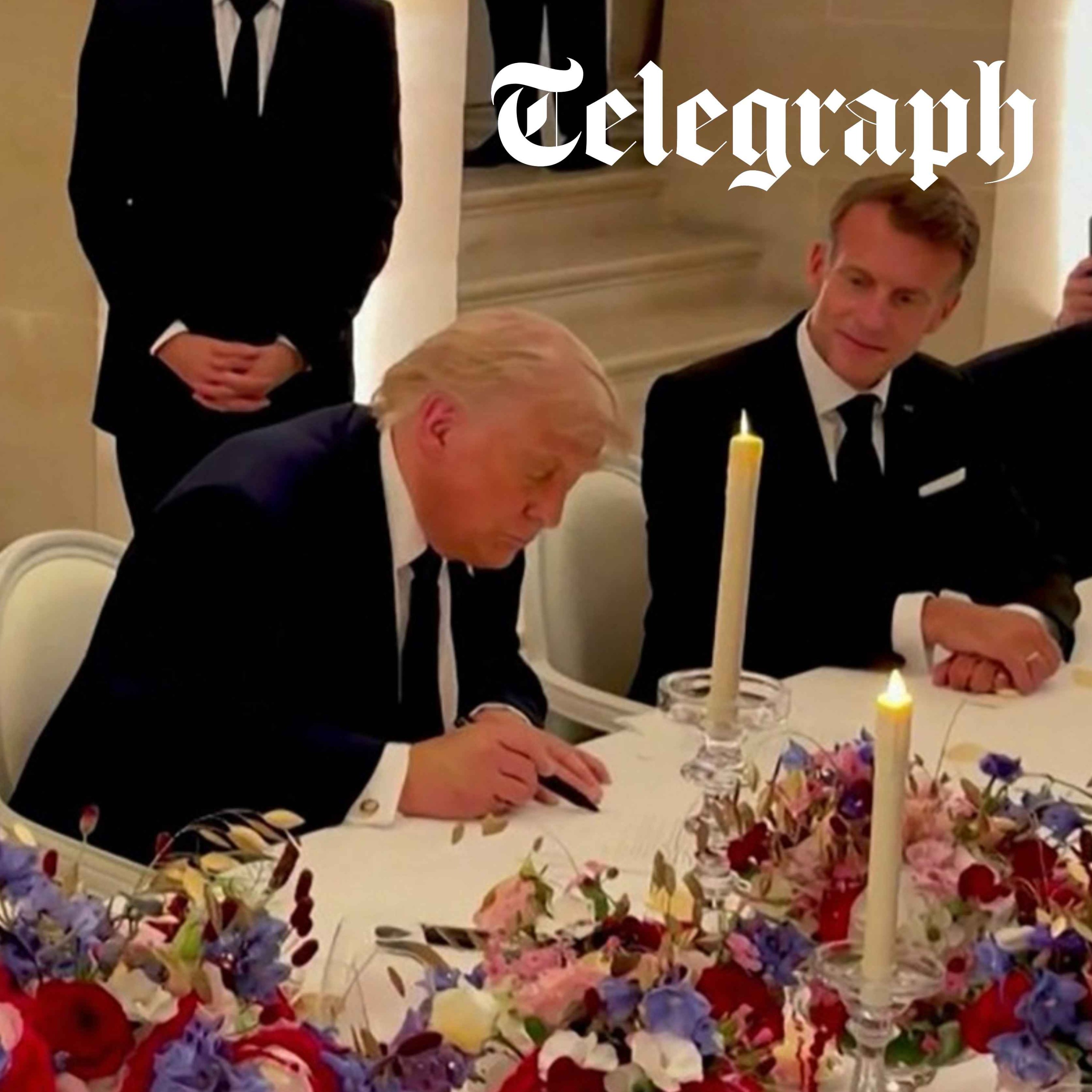
David welcome back to Iran. The latest, and it would have been the 111th day of the war. The 111th day since the bomb started falling on the 28th February. But we now have a peace deal. This was Trump signing his Memorandum of Understanding in the palace of Versailles in France. Iranian President Masud Perseskian also signed the document on Wednesday. Tehran has confirmed. If you thought of peace treaties in the palace of Versailles and your mind went back to the early part of the 20th century, the early 20th century references just kept coming. Donald Trump said he didn't want to end up like Herbert Hoover, who is the US president who presided over the 1929 Wall Street Crash and the Great Depression. That's why he's signing it. And just another little echo of history. 14 points. 14 points in the peace deal. Remind you of Woodrow Wilson? Remind you of your. Of your GCSE history lessons? Looking at the end of the First World War, it's difficult not to pluck these, these references out of the air. David, I was going to ask you to just go through this line by line with me or point by point, because one of the questions here is, who won? Who won this negotiation? And lots of people are saying the Americans have screwed up. Iranian hardliners saying the Iranians have screwed up. So should we just go through it?
- [04:12]
David Blair
Yes, we could. And I think the first point to make is Versailles famously was a punitive peace treaty imposed unconditionally upon a defeated enemy. And that is anything but what has just happened. This is absolutely not a punitive settlement imposed upon a defeated country.
- [04:31]
Roland Oliphant
We'll bear that in mind. Unless it is perhaps punitive for the Americans, come to that. Okay, so without any further ado, I believe that the original Versailles Treaty with those, I think, an absolutely enormous document. This is about page and a half. This is the text that was read out by a US Government official to reporters yesterday. So this is the official text. We understand it's slightly different from the drafts, and I've highlighted a couple of the differences that were published over the past couple of days. But point number one, the United States of America and the Islamic Republic of Iran and their allies in the current war are signing this MoU to declare the immediate and permanent termination of military operations on all fronts, including in Lebanon, and undertake from now not to initiate any war or any military operation against each other, to refrain from the threat or use of force against each other, and ensuring the territorial integrity and sovereignty of Lebanon. The final deal will confirm the permanent termination of war on all fronts, including in Lebanon, and other provisions of this paragraph. Iran win or American win?
- [05:31]
David Blair
Iran win. So under the Terms of point one, Israel has to halt its campaign in Lebanon, which means, in effect, that's a protection for Hezbollah. Because if words mean what they say, Netanyahu has to stop his campaign against Hezbollah now. In fact, that's not going to happen because at this moment, Israeli troops occupy about 200 square miles of southern Lebanon. They're not just going to leave.
- [05:57]
Roland Oliphant
Well, they've said they're not going to leave.
- [05:58]
David Blair
They've said they're not going to leave. And it is an extraordinary thing for America to sign an agreement which binds another country, Israel, without in any way consulting that country or including it in the process. So this, given that the violence in Lebanon is likely to continue, also gives Iran a permanent excuse, permanent get out clause.
- [06:19]
Roland Oliphant
They don't like it. They can just walk away.
- [06:21]
David Blair
Because you can be sure Israeli airstrikes in Lebanon are going to carry on. Israel and Hezbollah are going to carry on fighting in the hills of southern Lebanon. If at any point Iran wishes to walk away from this agreement, they will be able to point to those incidents and say, that is a breach of.
- [06:37]
Roland Oliphant
Okay, big Iran win, then. Put that down. Number two, the United States of America and the Islamic Republic of Iran undertake to respect each other's sovereignty and territorial integrity and to refrain from interfering in each other's internal affairs. I wonder who wanted to put that in there.
- [06:53]
David Blair
Yes, that would have been Iran. Because what that really means is Donald Trump is promising no more efforts at regime change. We will not attempt to interfere any further in the affairs of Iran. And there's just one corollary to that. Remember that the protests against the Iranian regime that took place in January were huge. The regime had to kill tens of thousands of people to get a lid on them. And the regime's conspiracy theory about those protests was that they'd all been stirred up by America and by outsiders. It's what they always say. It's a very convenient thing for them to say. But the fact that America has now come along and promised to stop interfering or refrain from interfering in other countries in Iran's internal affairs, Iran's regime will interpret that as proof that they were previously interfering. And they'll interpret that as proof of their claim that January's protests were in fact got up and inspired by the
- [07:48]
Roland Oliphant
Americans and vast proof that anybody who is taking part in that is a
- [07:51]
David Blair
traitor and probably is going to hack and so forth. So those words are very fateful words.
- [07:57]
Roland Oliphant
Iran win two to Iran. Number three. The United States of America and the Islamic Republic of Iran commit to negotiating and Achieving the final deal in maximum 60 days, extendable with mutual consent.
- [08:09]
David Blair
Neutral on the face of it. However, there is the question of bargaining power in those negotiations for a final agreement. And the next point which you're about to read is effectively America sacrificing one of its key bargaining counters by before those talks even begin.
- [08:28]
Roland Oliphant
So I'm putting this down as a draw number four. And it is. Immediately upon signing of this mou, the United States of America will begin the removal of its naval blockade and any disturbances or impediments against the Islamic Republic of Iran and will fully end the naval blockade within 30 days. During this period, the traffic of vessels will be in proportion to the numbers of pre war traffic being restored by the Islamic Republic of Iran. The United States of America further undertakes to remove its forces from from the proximity of the Islamic Republic of Iran within 30 days after the final deal. So not after this MOU. So that's it. Goodbye, naval blockade.
- [09:03]
David Blair
Yes, how nice of the Americans to give up that card before they've even begun negotiations for a final deal. How nice of the Americans to lift the pressure on the Iranians. All that means that the chances of there ever being a final deal are much diminished. Because if Iran gets an end to the naval blockade anyway, why should they make any further concessions? Another point, just the fact that the disposition of American forces is mentioned in this agreement is an extraordinary thing. Now of course, as you point out, America undertakes to remove its forces from the proximity of Iran within 30 days after the final deal, which may never happen, and all the rest of it. And in context, it's pretty clear that the forces we're talking about are only those that have been used to enforce the blockade on Iranian ports. Or at least that would be a reasonable interpretation. But just the fact that America's deployment of forces is even mentioned in the agreement is an extraordinary thing because any previous American administration would have said, what has that got to do with Iran? How we deploy our own forces amongst our allies, our allies, or in a region or in international waters is nothing whatever to do with you. But here it is in an agreement with Iran.
- [10:15]
Roland Oliphant
All right, we're 4 points into the 14 points and it's 3 nil to Iran. 5. Upon the signing of this MOU, the Islamic Republic of Iran will make arrangements using its best efforts for the safe passage of commercial vessels with no charge for 60 days only. I'm underlining that, David, because that that clause appeared, that's different to the draft that was published the previous day with no charge. For 60 days only from the Persian Gulf to the Sea of Oman and vice versa. The traffic of commercial vessels will immediately start considering the need for removing the technical and military obstacles and de mining by the Islamic Repub of Iran will be reinstated within 30 days. So 30 days from now, the Islamic Republic of Iran will conduct dialogue with the Sultanate of Oman to define the future administration and maritime services in the Strait of Hormuz in discussion with other Persian Gulf literal states in line with the applicable international law and the sovereign rights of coastal states of the Strait of Hormuz. So the strait is open.
- [11:08]
David Blair
Yes. And that's victory for America. That's, that's an American win. However, three qualifications. First, the only reason why the strait was closed was because America and Israel started this war. So all we're doing is returning to the pre war status quo. Second, except we're not really because Iran commits not to charge vessels for passage only for the next 60 days. So perhaps after 60 days they will start charging. There's nothing in the agreement to prevent them from doing that. And in fact they're strong hints that they might well do that. When they talk about dialogue with the Sultan of Oman to define the future administration and maritime services of the Strait of Hormuz. What they're talking about there is some new arrangement different from the one that prevailed before the war. So there's a huge risk there that the Iranians come 60 days are going to say, actually we are going to charge and we're going to call it a service charge or something like that.
- [12:07]
Roland Oliphant
Donald Trump was asked about this in his press conference at the G7 yesterday and his blunt answer was what's going to stop them from doing that? Common sense. The implication being they know what we will do if they try that. Nonetheless, I'm going to put this down as a US win because the straight is open. So it's Iran 3, America 1 at the moment. Number six, the United States of America undertakes with regional partners to develop a definitive, mutually agreed plan with at least 300 billion USD for the reconstruction and economic development of the Islamic Republic of Iran. The mechanism for the implementation of this plan will be finalized as part of a final deal within 60 days. All required licenses, waivers and permissions needed for the relevant financial transactions will be granted by the United States of America. On the face of this, David, this looks, this looks extraordinary. It almost looks like American reparations, but I'm wondering if it really means anything.
- [13:00]
David Blair
I'm not sure it does. First of all, it's conditional on a final deal. And we can all be very skeptical about whether that final deal will ever happen. If it doesn't, then all of this 300 billion figure is pie in the sky. Secondly, Trump has already made clear that America will not be contributing to it. And thirdly, American sanctions legislation, as things stand, will make all of that impossible. So for example, America prescribes the Islamic Revolutionary Ghakor as a terrorist organization. America has also designated Iran's construction industry has been very largely controlled by the irgc. So how could you invest in construction in Iran without falling foul of that anti terrorism?
- [13:44]
Roland Oliphant
We're going to come to sanctions. That's further down the 14 points. I'm going to put this down as a draw in that case because I would say that's neutral, because it sounds dramatic. But again, Donald Trump said they very clearly ruled out like none of that is going to be US Taxpayer money. He seems to be talking about some vague kind of investment vehicle or something with I don't know where the money's been.
- [14:02]
David Blair
The significance is this is America trying to give Iran an incentive to sign a final deal.
- [14:07]
Roland Oliphant
Okay.
- [14:07]
David Blair
But for reasons we'll come onto, Iran may well prefer the revenues it will be sure of rather than the future promise of revenues that may never appear.
- [14:16]
Roland Oliphant
Okay, so match six is a draw. Exactly what you were talking about, David. Point number seven. The United States of America undertakes to terminate all types of sanctions against the Islamic Republic of Iran, including the United Nations Security Council resolutions, IAEA Board of Governors resolutions and all unilateral US Sanctions, primary and secondary, in an agreed upon schedule as part of the final deal. The Islamic Republic of Iran and the United States of America acknowledged the critical importance of the sanctions termination issue above mentioned and expressed their intentions to immediately address these issues in the negotiations in order to achieve mutual agreement on them. So America is promising to lift all those sanctions you just talked about. But again, this word, final deal.
- [15:02]
David Blair
Yes, only in the event of a final settlement. So it depends on the outcome of open ended negotiations which may never get anywhere. So I think this is neutral.
- [15:11]
Roland Oliphant
Okay, a draw again, doesn't mean anything yet. Point number eight, the Islamic Republic of Iran reaffirms that it shall not procure or develop nuclear weapons. This is the crux of the issue, isn't it? The United States of America and the Islamic Republic of Iran have agreed to resolve the disposition of stockpiled enriched material pursuant to a mechanism that will be mutually agreed upon in accordance with the schedule mentioned in paragraph seven. And another addition from the previously leaked draft with the Minimum methodology to be downblended on site under the supervision of the iaea. The two parties also agreed to discuss the issue of enrichment and other mutually agreed matters relating to the Islamic Republic of Iran's nuclear needs based on satisfactory framework being agreed in the final deal. Again, the final deal will confirm provisions of this paragraph. The US and Iran acknowledge the critical importance of nuclear issues above mentioned and express their intention to immediately address these issues in negotiations in order to achieve a mutual agreement on them. The Islamic Republic has promised never to build a nuclear bomb and therefore this war is a success.
- [16:13]
David Blair
That's been their promise all along. That's been their official position for years, if not decades. And it's not just their stated position. It's also their obligation under the existing Nuclear Non Proliferation Treaty to which they are signatories. To which they remain signatories. So simply getting Iran to repeat its long standing position changes nothing. Now, you and I and many other people might well regard Iran's long standing position that they've never any intention of going anywhere near nuclear weapons as being utterly incredible. But simply getting them to say it
- [16:46]
Roland Oliphant
doesn't amount to very doesn't change anything. They've been saying this for years. Okay, fine. I wanted to ask you particularly about this minimum methodology. So this is a line that has appeared in the past 24 hours since that initial draft was leaked to the press yesterday. Minimum methodology to be down blended on site under supervision of the iaea. In plain English, what are they talking about?
- [17:09]
David Blair
They're talking about 440 kilograms of uranium that Iran has enriched to the 60% threshold.
- [17:17]
Roland Oliphant
This is the nuclear dust, the nuclear
- [17:19]
David Blair
dust, as Donald Trump calls it, which is one step away from weapons grade uranium that could be the core of a nuclear weapon. So dealing with that material is absolutely vital. Broadly, there are two ways you can do that. You can remove it or you can leave it where it is. But the phrase is down blended, down blend, which means reducing the enrichment level below 60% to, well, it's not specified, but potentially perhaps to 3.67%, which is the level you require for civilian nuclear power stations.
- [17:52]
Roland Oliphant
There's a question about how this is done.
- [17:54]
Naomi Egan
Is it?
- [17:54]
David Blair
There's a question about how this is done. So essentially what Iran has agreed to in principle is that they will downblend it. When they say that's the minimum methodology, that doesn't exclude the possibility that perhaps it might be removed. But at a minimum, Iran has agreed to downblend it. However, there are three points to be made about that. The first is that formula was more or less on the table back in February when America and Iran were negotiating on this issue in Geneva. It is quite possible that Iran would have agreed to this anyway without the war that we've just been through. The second point is this seems, the wording is very tangled, but it seems to be that this will only be resolved again as part of the final deal.
- [18:43]
Roland Oliphant
The final deal.
- [18:43]
David Blair
In other words, Iran way down the
- [18:45]
Roland Oliphant
line and maybe never way down the
- [18:47]
David Blair
line and Iran is not going to start dispensing with this stockpile immediately. The third point, and here I admit I'm no expert on the technicalities, so
- [18:57]
Roland Oliphant
I, if you are write in, if
- [18:58]
David Blair
you are right in, but if I were Iran, I might say, well, if you're going to ask me to downblend this material, then I need to start rebuilding and repairing the facility, the destroyed facility where it's currently being held cover
- [19:13]
Roland Oliphant
to rebuild your nuclear capabilities.
- [19:16]
David Blair
So if I were Iran, I wonder whether I might be able to say, well, I'm going to have to do some repair work in order to downblend this material.
- [19:24]
Roland Oliphant
If any listeners or viewers know about how to downblend highly enriched uranium, sure, one of you has done it before in your youth perhaps. Do let us know right in. I'm going to put that down as a draw, David. That's a neutral point because it sounds like nothing's really changed there at all. Number nine. Pending the final deal, the United States of America and the Islamic Republic of Iran agree to maintain the status quo. So this is interesting. Agree to maintain the status quo. The Islamic Republic of Iran will maintain the current status quo of its nuclear program and the United States of America will not impose any new sanctions and will not deploy additional forces in the region. The bit that catches my eye here is Iran saying it will maintain the current status of its nuclear program, which has been bombed to smithereens.
- [20:08]
David Blair
Exactly. And that is very important. Iran's three most important nuclear plants, Natanz, Fordo and Isfahan, are now in ruins because they were bombed last June. So if words mean what they say, they will stay in ruins because Iran will maintain the current status quo, which presumably means it won't rebuild those plants. And that's really important because two of those plants, Natanz and Fordeau, were where Iran was conducting uranium enrichment. And of course, the whole heart of the nuclear issue with Iran is the question of enrichment of uranium because that could be used to produce the weapons grade material that you need for a bomb. So on the face of it, Iran's uranium enrichment capacity was destroyed last year and now Iran is agreeing not to recover it, which on the face of it, takes Iran out of the nuclear
- [21:00]
Roland Oliphant
game, which is big, isn't it? Because previously they said, we don't want a nuclear bomb, we promised not to build a nuclear bomb, but we must
- [21:05]
David Blair
have uranium enrichment to 60% exactly.
- [21:08]
Donald Trump
Or whatever.
- [21:09]
Roland Oliphant
And they could say, well, I kept my promise, I haven't built a bomb. But this means they can't enrich to 60%, they can't carry on, they can't enrich at all. So in a way, if they keep to this, this is an American win.
- [21:18]
David Blair
It is an American win. I will qualify it in one way by pointing out that the destruction of Iran's nuclear plants was an achievement not of this war, but of the previous war last June.
- [21:29]
Roland Oliphant
Oh, don't pour cold water on our parade here.
- [21:32]
David Blair
Which is why the nuclear plants were not a priority target during this war. They didn't have to be because they'd already been pulverised last June. And secondly, it is quite possible that in the negotiations that were happening in Geneva in February, before this all began, this kind of formula might have been agreed. But with those two qualifications, yes, it is an American win. The only other point I would add is the point we were discussing one moment ago, which is how is maintaining the current status quo of Iran's nuclear plants compatible with down blending the stockpile of 60%?
- [22:06]
Roland Oliphant
They are. There's the essay question.
- [22:08]
David Blair
And there I don't know enough about the technicalities to be able to answer, but I would simply pose the question.
- [22:14]
Roland Oliphant
A thousand words by Friday morning on my desk, please. America two to America. this point, we're going to take a short break. When we come back, who really came out on top in this conflict? And where does the world, America, Iran and Israel in particular, go from here?
- [22:35]
Acast Advertiser
While every other channel is fighting for your customers attention, podcasts are where they've already given it. No one accidentally listens to a podcast for 45 minutes. They choose to be here. They trust the voice in their ears. And when that voice talks about your brand, it doesn't sound like advertising. It sounds like a recommendation from a friend. Acast gives you that trust at scale, digital precision. Host read authenticity and performance data that proves it worked. Don't fight for attention, buy it with Acast. Learn more by visiting acast.com/advertise.
- [23:13]
Roland Oliphant
Welcome back. You're listening to Iran the latest with me, Roland Oliphant. I'm speaking to David Blair, the Telegraph's chief foreign affairs commentator Number 10. The United States of America undertakes that immediately upon signing of this mou, until termination of sanctions, the US Department of Treasury will issue waivers for the export of Iranian crude oil, petroleum products and derivatives, and all associated services, including banking transactions, insurances, transportation, etc.
- [23:42]
David Blair
Good Lord, it's extraordinary. The most powerful sanction that America has ever imposed on Iran is gone. That's the sanction on their oil industry.
- [23:52]
Roland Oliphant
This is their main, their printed industry.
- [23:54]
David Blair
That's right, gone. I should qualify that. It's waived, which is different from lifting it or abolishing it, but it's waived, which means that as of now, there are no restrictions on the oil.
- [24:05]
Roland Oliphant
That as of today.
- [24:06]
David Blair
As of today.
- [24:07]
Roland Oliphant
Because it was signed today.
- [24:08]
David Blair
Because it was signed. So as of now, Iran is free to sell oil to any willing customer anywhere in the world. Which means that until quite recently, they were exporting 1.8 million barrels a day at current prices. That translates into revenues of about $140 million a day, which translates into four point something billion dollars a month for a regime that was on the brink of bankruptcy. And remember, America is sacrificing that colossal bargaining counter before negotiations on a final agreement even begin. It's an extraordinary thing. You know, Trump is giving away his bargaining counters before he even sits down at the table.
- [24:48]
Roland Oliphant
He's giving away his cards, isn't he? I'm putting that down as an Iranian win in that case. So I think we're now 4:2 to Iran. The United States of America undertakes to make fully available for use the frozen or restricted funds and assets of the Islamic Republic of Iran. Upon implementation of this mou, the United States of America and the Islamic Republic of Iran or mutually agree on the procedures related to the release of these funds during negotiations, such funds, whether retained in the original account or transferred, shall be made fully usable for payment to any ultimate beneficiary. Such small print language here. Central bank of Iran gets to choose who you pay the money to. The United States of America undertakes to issue all necessary licenses and authorization. So in short, upon signing this mou, the United States releases frozen Iranian assets.
- [25:34]
David Blair
No, not signing. Implementation.
- [25:36]
Roland Oliphant
Implementation.
- [25:37]
David Blair
That's impossible. I think this is confused because Iran does not get its money when this MOU is signed. In other words, it doesn't get it. Now the word is implementation. Upon the implementation of the MoU, what does implementation mean? The implementation of all of it by when and then the next sentence. America and Iran will mutually agree on the procedures related to the release of these funds during negotiations. In other words, there have to be further talks and America also has to give its agreement before these funds are released. So to my mind, this looks like a rushed job where the outcome just isn't clear. And if I'm Iran, I'm asking, so when do I get my money? The clear answer from this is not today.
- [26:26]
Roland Oliphant
Hence the grumbling from certain hardliners.
- [26:29]
David Blair
Hence the grumbling.
- [26:30]
Roland Oliphant
So maybe this is, I was going to put this down as Iran win. Maybe that's a draw.
- [26:34]
David Blair
Actually, I think that's a draw. It could turn into an Iran win, but as of now, it is not. America is still withholding Iran's frozen assets, which means that America has retained a bargaining counter there.
- [26:47]
Roland Oliphant
Okay, I'm just going to run through the last, the last three points, which I think are pretty procedural, but we might as well do it for completeness sake. Number 12, the United States of America and the Islamic Republic of Iran agree to that. An executive mechanism will be established to monitor the successful implementation of this MoU and the future compliance of the final deal. That sounds to me, David, like a pretty straightforward, agreed, procedural thing. 13. After signing this MOU and subject to the beginning of the implementation of paragraphs 1, 4, 5, 10 and 11, which is cessation of hostilities, including in Lebanon, end of the US blockade, opening of Hormuz. Let me go from number 10, what's number 10? The waivers. And number 11 that we just said was a fudge about releasing restricted funds. So upon implementation, the beginning of the implementation of those paragraphs of this MoU and the continuing implementation of those measures, the United States of America and the Islamic Republic of Iran will start negotiations regarding the final deal exclusively on the other paragraphs. Hence, those things must be dealt with before the final talks begin. Is this just a neutral procedural thing or is this a spanner that the Iranians throw in the works?
- [28:00]
David Blair
And I think it's probably neutral. However, when phrases like subject at the beginning of the implementation start appearing in an agreement, that does make it conditional. So if either party wishes to drag their feet on beginning final negotiations on a final agreement, they would be able to say that those paragraphs, the five paragraphs that are stated there, have not been implemented fully. It gives an opening for either party to delay the beginning of final negotiations.
- [28:32]
Roland Oliphant
Okay. It's a break either can pull on.
- [28:36]
David Blair
I would say that was neutral.
- [28:37]
Roland Oliphant
A bit like continuing fighting in Lebanon is probably a break that either could pull on to get out of this. And 14, the final deal will be endorsed by a binding UN Security Council resolution. That sounds pretty neutral procedure and there
- [28:50]
David Blair
will almost certainly be no final deal. So it's entirely theoretical.
- [28:53]
Roland Oliphant
Entirely theoretical. So maybe it's a bit childish and glib of me to put it up on a scoreboard like that, like it's a World cup match, but is that fair? It looks like Iran does come out on top here. Is that really what's happened?
- [29:03]
David Blair
Remember things that are not in the agreement. No restrictions on Iran's ballistic missile arsenal before the war. The biggest and most powerful in the Middle east, used to extraordinary effect during the war against just about all of Iran's Gulf neighbours. No restrictions on that. Second, no restrictions on Iran's sponsorship of terrorism across the Middle East. Those issues aren't even there. No mention of them. And thirdly, perhaps most significantly of all, the regime which Donald Trump and Benjamin Netanyahu pledged to destroy less than four months ago is the same regime with which America has concluded this agreement. That in itself tells you the story. However, it is worth saying that if Iran really does freeze the nuclear program at the current status quo, which is the phrase in the agreement, that means leaving its nuclear plants in ruins. And that does take Iran out of the quest for a nuclear bomb.
- [30:01]
Roland Oliphant
That's good news, isn't it?
- [30:02]
David Blair
It is good news, but as we said earlier, that's a consequence not of this war, but of the previous one last June. My overall conclusion would be this war has been a failure, an abject failure, but the previous war last June was a success in its own terms.
- [30:18]
Roland Oliphant
Donald Trump was asked about the ballistic missiles thing and he had the following to say.
- [30:23]
Donald Trump
So we'll be working on a parallel effort with the Gulf nations to address non nuclear issues such as the conventional ballistic missiles, which we'll be talking about and support. I mean, they have to have some because other people have some. You got to have some. Somebody said you shouldn't give them one. And I have guys, I like some of these guys, but I don't think this, I don't think they're smart, sir, you shouldn't let them have any missile. I said, well, what am I going to do? I'm going to let Saudi Arabia have missiles, but they can't have them. Yes, sir. Can't. Doesn't work that way. You know, it doesn't work that way. And missiles aren't the problem. Missiles are. They hurt a little location, but they don't blow up the planet.
- [31:09]
David Blair
Well, how very nice of Donald Trump to be so fair minded and so understanding of the Islamic Republic of Iran. I think If I was from another Gulf state, I would say none of us have ever fired any missiles at Iran, but Iran fired thousands of its missiles at us over the last few months. And secondly, I would say even if you concede the principle that Iran can have some missiles, that doesn't exclude limitations, you can have all kinds of measures in place to make that arsenal less dangerous and to perhaps monitor it and so forth, all kinds of confidence, arms control, stabilization. I mean, yeah, arms. You know, these agreements have been cooked up all over the world, but none of that is even mentioned in this agreement.
- [31:52]
Roland Oliphant
Obviously, there's been flak. I mean, Venetian Paul Newki, were talking yesterday about the, about the pretty furious, disappointed, shell shocked reaction coming from a lot of people in Israel about this. The criticism is not confined to Israel. So Mike Pence, Mr. Trump's first vice president during his first term, has popped up this morning saying that this is basically akin to appeasement.
- [32:16]
Mike Pence
I believe it smacks of the kind of impeasement that we saw during the Obama years, the kind of appeasement that Joe Biden tried to accomplish and was ignored by the Iranians and we rejected categorically during the first Trump administration. I think the president should simply stand firm, draw that red line. And if the Iranians won't come to those fundamental terms that are in the interest of our security, Israel's security, and the peace and stability of the region, then I think we ought to let the armed forces of the United States open the strait and eliminate the threat on our terms.
- [32:53]
David Blair
So, I mean, pretty bluntly, it sounds like you think from what we know so far, this is a mistake by the Trump administration.
- [33:00]
Mike Pence
Well, it's much bigger than a mistake. I mean, when, when the president took that historic step to strike those nuclear facilities last year, this is the first time in 47 years that an American president had taken the fight directly to the mullahs in Tehran and America was safer. And the fact that he tried diplomacy for the following year to begin to make progress and then finally recognized that we just got to take the fight to them, launched Operation Epic Fury. Our military responded brilliantly. But in this moment, the posture that we're getting from the Iranians, but my concern is what appears to be leaking out these immediate concessions, particularly sanctions waivers, right out of the gate that would put what would essentially be a lifeline to the Iranian regime, I think is ill advised. We ought to keep the pressure on, keep the blockade on, and if need be, let our armed forces get back to work.
- [34:02]
Roland Oliphant
He got a bit of a point Mike Pence, I mean, you yourself seem to be saying this is basically a survival plan for the Islamic Republic.
- [34:10]
David Blair
I think that's the key thing. This agreement and the measures within it significantly increases the chances of Iran's regime surviving in the longer term. A war that was launched to bring them down has, in the end, solidified their grip on power.
- [34:25]
Roland Oliphant
That's solidified. Part of me is sympathetic to Donald Trump in that I don't really see another way out of the situation that he was in at this juncture, his argument. Speaking last night at the G7, he was saying, look, there's all the tough guys say, I should carry on, I should bomb, I should bomb, I should bomb. And his response is, if we didn't
- [34:44]
Donald Trump
do this deal, we could have dropped more bombs for another three weeks, two weeks, four weeks, two years. You would never have the hormone straight open. You would never have success. Your market would have, instead of going up at levels that nobody's ever seen before, would go down at levels that nobody ever saw before, maybe, except for 19, 20, 29 or whatever.
- [35:09]
Roland Oliphant
Isn't he also right about that? It wasn't the verdict of the battlefield that they were in a dead end. Wasn't he right to say to the people like Mike Pence, well, we've tried the military option and it hasn't worked?
- [35:20]
David Blair
Well, it might have been better if he had thought of that before the war actually started. He launched the war and he bombed for 40 days. And now he comes along and says, well, actually, you know, bombing Iran doesn't really change anything. Well, you know, really should have thought of that earlier. And secondly, just the fact that he has said that demonstrates to the Iranian regime that they now have power of deterrence, that their proven ability to close the Strait of Hormuz gives them the ability to deter their enemies. And judging by what Donald Trump has said, the Iranian regime doesn't have to worry about any future American military intervention against them, which is another respect in which this whole episode has strengthened their grip on them.
- [36:01]
Roland Oliphant
It changes the world we were in before, because before this was a sword of Damocles kind of hanging over them.
- [36:06]
David Blair
On 28th February, on the day this war began, the Iranian regime was facing bankruptcy. It had just suppressed an enormous challenge from its own people, and it killed tens of thousands of people to do that. Its desperate unpopularity among its own population had been made at absolutely blindingly clear. There was a supreme leader who was 86 years old, clearly not going to be around that much longer. They had no idea at that stage, how they were going to replace him. And their nuclear plants were in ruins and Hezbollah had been eviscerated and the axis of resistance had been broken, and they were well on their way to being isolated and weakened. And this war, amazingly, has had the effect of transforming their fortunes.
- [36:52]
Roland Oliphant
It's incredible, isn't it?
- [36:53]
David Blair
But it's quite incredible.
- [36:55]
Roland Oliphant
Where do things then go from here? Because I suppose one of the things that strikes me is that this war is finally put to the test. A theory that's been put forward in, you know, in Washington and in Jerusalem for years and years and years, you know, going back to 2012 or even before, the idea that the solution to the Iran problem was bombing Iran and that it's been tried, it hasn't actually worked, and it's maybe made the situation worse. So what does this mean, a recalibration in American and Israeli and just Western?
- [37:25]
David Blair
I think it's a bit more complicated than that. The war last June to destroy the nuclear plants succeeded in its own terms. Those plants were wrecked because I spoke
- [37:33]
Roland Oliphant
to Israeli sources who said, no, actually, that was a failure. And that's why we had to go back to war this time. And that's why Donald Trump should.
- [37:38]
David Blair
I think that's an ex post facto justification for this war. It is very clear that the three key nuclear plants were pulverized last year. And in this agreement, Iran has agreed not to rebuild them. That is an extraordinary change. It's a change in America's favor, but it is a change brought about not by this war, but by the previous one. So I think it's too simplistic to say that, you know, bombing Iran is always futile and all the rest of succeeded in its own terms last year. But what you have is a very straightforward confirmation of a very old rule, which is the first test for successful military action is having a clear, specific objective. Last year, the objective was clear. Here are the nuclear plants. Wipe them out. Force Iran to reevaluate its negotiating position and decide that it's prepared to settle the nuclear issue on your terms. And that objective was more or less achieved this year. What on earth is the objective? Trump begins by saying, this is a new hour of freedom for Iran. We're going to bring down the regime and all the rest of it. Then the objective becomes sorting out the nuclear program, then it becomes reopening the straits, then it becomes unconditional surrender. I mean, it was ridiculous. So no amount of force will ever be successful unless it's tied to a specific objective.
- [38:55]
Roland Oliphant
Donald Trump, responding to his critics on Truth Social, just as we were recording, these fools who think I haven't been tough enough on Iran, when the stock market just hit a record high and oil prices are tumbling down, are either jealous, bad people or stupid. Make America great again. I mean, it's not really a disaster for America, is it? America is still standing. America is still the preeminent military on the planet. A lot of people are making. On social media, you can see people making that cheap shot, oh, he's signing. He's signing his own surrender at Versailles, you know, just like the Germans in 1914, and he's paying the reparations this time. What if it had been a railway carriage instead in a French forest or something? How dramatically does this change the world?
- [39:36]
David Blair
I think it's too early to say. This campaign has been a terrible blunder, that's very clear. Does that mean that American military firepower has somehow diminished? No, it doesn't. I mean, it is true that it will take them quite a few years to recover their stockpiles of precision weapons and make up for all the munitions that they've had to fire during this war. But fundamentally, you know, the United States remains a superpower. Its armed forces are by far the most formidable in the world. Those things remain true. And Donald Trump will not be president forever. And this uniquely erratic and incompetent style of decision making will hopefully not be permanent. So I would hope that this will not cause permanent damage to America's global standing. But certainly, as of now, they've got a lot of lessons to learn, or particularly Donald Trump has got a lot of lessons to learn. He won't, of course.
- [40:29]
Roland Oliphant
David Blair, thank you very much for joining me to discuss all this on on Iran the Latest. We will be back tomorrow. Until then, that was Iran the Latest. Goodbye. Iran the Latest is an original podcast from the Telegraph, created by David Knowles and hosted by me, Roland Oliphant and Venetia Rainey. If you appreciated this podcast, please consider following around the latest in your preferred podcast app and if you have a moment, leave a review as it helps others find the show. For more from our foreign correspondents on the ground, sign up to our new daily newsletter, cables via our website or listen to our sister podcast, Ukraine the Latest. We are still on the same email address battlelineselegraph.co.uk or you can contact us on X. You can find our handles in the show Notes. The producer is Peter Shevelin. The executive producers are Venetia Rainey and Louisa Wells.
- [41:34]
Acast Announcer
Acast Powers the world's best podcasts. Here's the show that we recommend.
- [41:41]
Ira Madison III
I just want to say that I'm back with a new podcast, Feedback with Ira Madison iii. Every Thursday, I'll dissect whatever's taking over my group chat, like who West Wilson from Summerhouse is banging this week, whether film criticism and black art can actually coexist, why every man on a dating app is either illiterate or reading Middlemarch with no in between. And whatever the hell is going on with heated rivalry fans on the Internet, you know exactly who you are. I'll be joined by friends and other culture makers to dissect pop culture politics and the media and all the ways the Internet has has rewired our brains permanently. New episodes of Feedback drop every Thursday starting June 18th. Subscribe now to Feedback with Ira Madison III. Wherever you get your podcasts. I should get that.
- [42:38]
Acast Announcer
ACAST helps creators launch, grow and monetize their podcasts everywhere. Acast.com.