← Iran: The Latest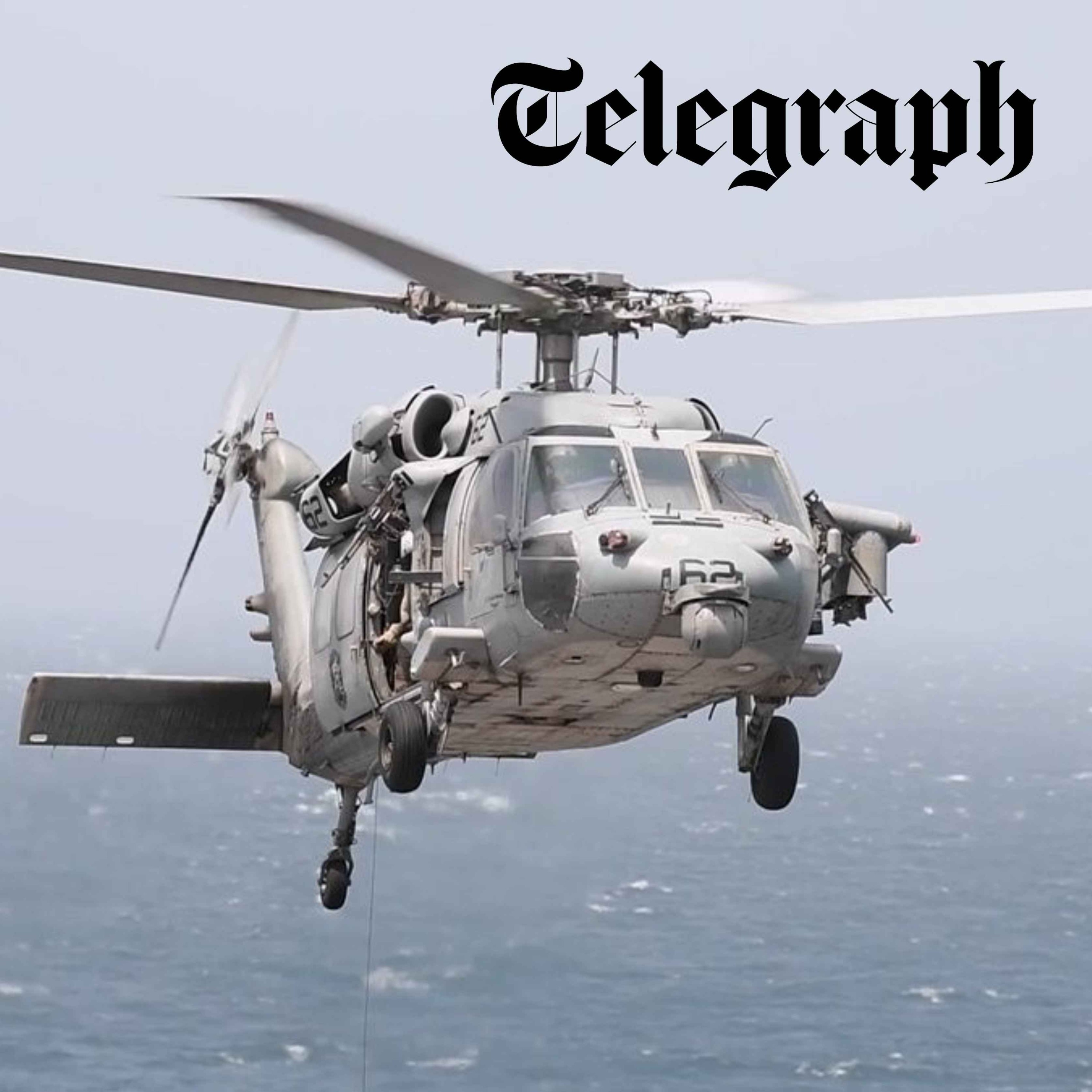
Loading summary
Transcript61 lines
- [00:04]
Venetia Rainey
The telegraph.
- [00:10]
Acast Announcer
Acast powers the world's best podcasts. Here's a show we recommend.
- [00:14]
Tim Collins
Hey, what's up you guys? It's Giro Rafaelo, your host of the Comment Section podcast. Each week I am joined by a special guest to dive deep into all things comedy, pop culture takes and the highs and lows of the Internet.
- [00:28]
Acast Announcer
Mama.
- [00:28]
Tim Collins
Watch new episodes of the Comment Section Every Wednesday on YouTube and listen wherever you get your podcasts.
- [00:34]
Acast Announcer
ACAST helps creators launch, grow and monetize their podcasts everywhere. Acast.com.
- [00:47]
Venetia Rainey
I'm Vanisha Raney and this is Iran. The latest. It's Wednesday, 12th of August 2026. On today's episode, the Houthis kill mariners on a ship in the Red Sea for the first time, marking yet another major escalation in this key waterway. Plus I'm joined by veteran British army officer Tim Collins, best known for his rousing eve of battle speech ahead of taking troops into Iraq. I'll be asking him what he makes of the Iran war and whether the UK's failure to get involved will lead to the end of British bases in the Middle East.
- [01:19]
Tim Collins
A short time ago, the United States military began major combat operations in Iran.
- [01:26]
Venetia Rainey
Iran's supreme leader, Ayatollah Ali Khamenei was
- [01:29]
Tim Collins
killed in the attacks.
- [01:36]
Venetia Rainey
For the first time ever, the US Navy used a surface sea drone in combat to strike Iranian targets. The strait are almost completely closed again.
- [01:47]
Tim Collins
Does anyone really think that someone can tell President Trump what to do?
- [01:51]
Venetia Rainey
Come on Tim. Welcome to Iran. The latest.
- [01:55]
Tim Collins
Very nice to be there.
- [01:57]
Venetia Rainey
You led the 1st Battalion, the Royal Irish Regiment into Iraq in March 2003, famously gave an inspirational speech to your men on the eve of the invasion. I want to discuss that in more depth a little bit later as I think there are some parallels between these two wars. I'd love to get your thoughts on. You've also just come back from a trip to Bahrain and you were meeting with various government and security officials to discuss the war's impact there and how the UK could help more going forward. So there's lots to get into. But let's just start with what's happened on the ground because there has been some activity in the last 24 hours. So as I mentioned at the top, the Iran backed Yemeni militant group the Houthis have claimed what I believe are their first kills of the war. Six people killed and 10 injured in a double tap strike on a cargo ship in the Red Sea. The ship was south of the port of Mokka, which the Yemeni rebel group attacked Repeatedly over the weekend, they've claimed that there are Saudi military assets there or equipment or kit. The Yemeni government said the vessel was hit with three ballistic missiles, causing a fire on board and resulting in the deaths of the crew. And Yemen's Coast Guard said a deadly second missile strike targeted rescuers who tried to evacuate the ships. That's why I called it a double tap strike there. The ship has been identified as flying under the flag of Tanzania. Yemen's Ministry of Transport said it was just a Yem commercial ship, but the Houthis have claimed it was carrying Saudi military equipment. That's been their justification for the growing attacks over the past week. And as I say, it's significant because it's the first deadly attack by this group since the war began. They stayed out of things initially, but as we were discussing on yesterday's podcast, they're increasingly becoming involved under the guise of fighting Saudi Arabia, their longtime foe. But it also definitely serves Iran's interests. So they're trying to pile more pressure on the west amid negotiations over the Strait of Hormuz, which are foundering. Tim, there was previously a multinational effort to deal with this Operation Prosperity Guardian. This was a US led multinational naval mission aimed at protecting merchant shipping passing through the Red sea, launched in 2023, wound up last year. Do you think we're edging closer to something similar being launched again and the UK being involved?
- [03:56]
Tim Collins
Well, the reality is that it's necessary that there should be international naval efforts to keep maritime trade routes open, because you can jolly well have a war, enjoy it, but when that starts to spill over to you, interfering with international trade, then you cross a line and that's where it's a business of the international community, rightly so, to intervene and do something about it. One of the things about the Babel Mand and the Red Sea in particular, and indeed the Straits of Hormuz, is that these have presented a limited corridor which rebel groups and even state actors in the Strait of Hormuz can launch very low cost attacks, very effective, low cost attacks against shipping. And in order to respond that kinetically, you've got to expend very expensive missiles. And that's again, which is a risk to the bottom and one which in many respects is difficult to take part in. So what are you left with? You're left with the options of. And listening to your podcast yesterday with the Yemeni expert talking about going on the ground, that's one option. You go on the ground and deal with it there. And the other option is that the international community as a whole puts pressure on the actors to stop doing it. Now, if there's a limited number of actors, that's one thing, but if it's the entire international community, including India and China, then that's quite another thing. But the difficulty is that the United States has so quickly immediately identified itself with the conflict that began in the Straits of Hormuz with the Iranians and with the Houthis, who I would recognize are a close ally but not under the control of the Iranians. It suits both those parties to carry on. One wonders where the adult in the room is in order to organize and master the international coalition. And if it can't be the United States, who is it? And it's one of the things that makes a mockery of a supposed Europendom diplomacy because the EU is not able to speak as one voice to bring about this. So who is going to organize that coalition? The necessary coalition to keep trade routes open for everyone's interests? And countries may say, well, that doesn't actually affect us. That's a nonsense. Because everything from the goods in the shelf sun loungers to are affected by the price, the interference of these things. One of the big that's been overlooked in the media and even in the commentary is that one of the big effects of this war, and we don't know how it will play out, is that the vital fertilizers which come through the streets, or much of it that is necessary for agriculture in Africa and indeed in South Asia, India, Pakistan, Bangladesh, Sri Lanka and elsewhere, it's simply not available. And even if it's open tomorrow, you couldn't get enough fertilizer out there and in the ground for this year's growing season. And coupled with climatic events, we don't know what the outcome's going to be. I don't think it's going to be good. When there's food insecurity across the world, movement of people and potential famine, then it all becomes all our problems. And that's why we mustn't allow local conflicts to interfere with international trade routes, because it affects the world. And if it does, then we must act as a world to do something about it. And particularly impotent on these conditions are that utterly pointless, frankly. Organization, the United nations, what are they doing about it?
- [07:37]
Venetia Rainey
You mentioned who should be the adult in the room, do you think? It should be the uk? They've previously led on these sorts of things and we know that they're supposed to be leading, potentially even hosting a summit to gather A multinational coalition to go into the Strait of Hormuz along with France. But that seems to have, well, faded away as the war has repeatedly reignited. It's clear the Brits don't want to put any assets into the line of fire. Does the UK have a bigger role to play here?
- [08:04]
Tim Collins
If it was the United Kingdom, then logically it would be the Secretary State for Foreign Affairs. The current Executive State for Foreign affairs has made it very clear and indicated without any shadow of doubt he has no interest whatsoever in diplomacy, unless it's to do with climate change and net zero.
- [08:19]
Venetia Rainey
Ed Miliband. You're talking about the new Foreign Secretary under Andy Burnham.
- [08:23]
Tim Collins
Yeah. He's no interest whatsoever. So it can't be the UK because. Just not interested. In terms of military, there's nothing we could do. There's nothing the French could do, there's nothing anybody can do. If the United States can't get through the Straits of Hornmouth, how could any other nation, including the United Kingdom or even the whole of the European NATO countries, getting together? We couldn't match the military capability that Americans have in the Gulf region, and they can't get through, so therefore we can't get through.
- [08:53]
Venetia Rainey
Is it a case of military capability, though, or is it a case of political will to be able to suffer the almost certain casualties that would be incurred?
- [09:03]
Tim Collins
Well, it's both, really. I'm minded that Field Marshal Sir Henry Wilson, the Great Ulsterman, went, who was a French speaker, went to France in 1914, ahead of the First World War, and said to the French, what help do you need? And he said, we need the British to become involved, and said, how many troops do you need? And the French said, you need one. And he must die in the knowledge that a single British casualty would bring the entire British Empire into the war. You must be prepared for casualties because that's the nature of warfare. That's why warfare is a bad idea. Generally speaking, we're now at a turning point. This is a historic turning point, because there is the striates of Hormuz, but if you look slightly to the right of the Strait of Hormuz, there's a couple of Pakistani ports, one of which is being totally refurbished by the Chinese so they can have an outlet to warm water. And then there's another port further down. My geography doesn't permit me to tell, but look on the map and you'll see the ports, what they actually are. If they wished potential trip points to prevent India getting trade through that region, if that was necessary, this carry on of interfering with trade routes, but one thinks also with the of Malacca. Well, those are being managed by an international coalition. The Straits of Taiwan. Apparently you're not allowed to sail up the Straits of Taiwan because they belong to China. Once we get into this business of interfering with maritime trade, you know, where does it end?
- [10:28]
Venetia Rainey
Short of sending warships into the Strait of Hormuz, the US has instead reinstated its blockade of Iranian ports and Iranian ships. And yesterday or today CENTCOM have disabled a ship as part of that blockade. So I'm just going to read out their statement. They disabled the steering gear of Panama flagged MV Villanova as the cargo Vess attempted to transit the Gulf of Oman and violate the US blockade against Iran by sailing towards an Iranian port. A US Navy MH60 helicopter fired two Hellfire missiles into the Villanova's engine room after the ship's civilian crew ignored repeated warnings from the American forces. The ship is no longer transiting to Iran in violation of the US blockade, which remains in full effect. How effective is this blockade? And is that maybe something that you think the UK should be joining in to try and help reopen the Strait of Hormuz?
- [11:15]
Tim Collins
The blockade is effective in as much as the biggest pressure on the Iranian regime internally is economic pressure. That's what brought about the riots and protests in January of this year when the rial tanked again and they closed the stalls in the souk in the center of Tehran. That's normally a sign that things aren't going well. So for that to happen in January and since January, things haven't gone apart from the oppression and wholesale slaughter of their own people that the regime undertook. What is clear is that the economic position within Iran is not improving. So the lot of the ordinary Iranian is becoming worse. However, what is historically true about Iran and Persia indeed, is that when they are attacked, they pull together. So perhaps attacking them wasn't the best vehicle in order to bring about regime change. Certainly what would not be good for the region or the world would be the collapse of the Iranian nation. We'd all like to see regime change and the removal of the autocratic Mullah regime. But the international community must be stood by if that starts to happen. To give every assistance for a new Iran to arise from that for the benefit of the people of Iran and the people of the region generally.
- [12:40]
Venetia Rainey
Well, let's talk then a bit more broadly about this war and the wisdom of it. Your famous speech to 800 men from your battalion at Fort Blair Main Camp in the Kuwaiti desert about 20 miles from the Iraqi border on Wednesday, 19th of March, 2003, shortly before the invasion. And I just want to read out a few quotes from it. Sorry, you must find this appalling. I'm sure you have to discuss this all the time, but our listeners will love to hear it and our viewers will love to hear it. We go to liberate, not to conquer. We will not fly our flags in their country. We are entering Iraq to be free a people, and the only flag which will be flown in that ancient land is their own. Show respect for them. If you're ferocious in battle, remember to be magnanimous in victory. Iraq is steeped in history. It is the site of the Garden of Eden, of the Great Flood, and the birthplace of Abraham. Tread lightly there. As for ourselves, let's bring everyone home and leave Iraq a better place for us. Having been there, there's two things I want to pull out from that. One is the fact that, well, you were. You were the boots that were about to be going in on the ground. And do you think that's something that was needed to make this Iran war a success? And secondly is that very strong theme of respect for the country that you're going into and for the people that are there and trying to do some good. You weren't just doing war for war's sake. You were trying to help the Iraqi people. And whether or not that was misplaced or how it actually worked out is a whole other debate. But I think that speech is really significant for that. And. And do you think that's something that, for all of Trump's declarations of we're sending help has actually been sorely lacking in this conflict?
- [14:09]
Tim Collins
There's a number of parallels that one has to remember that the Iraqi people had lived under the jackboot of Saddam's Ba' athist regime for 35 years. Many people knew nothing except life under Saddam, so their value systems, et cetera, were affected by that. It was a brutal regime. The Iranian regime has existed for 47 years, since 1979. Probably I wouldn't have the figures at my fingertip, but I would guess it's something of the region of. Between 70 and 75% of all Iranians have been born since the revolution. So the common knowledge and memory of normal life, there is no such thing. They have lived under this. Notwithstanding that they are an ancient people, the people of Iran, and they're made up not just of Persians, but of Azerbaijanis and of Arabs and of Kurds and all sorts, they're an ancient people, and they have a long memory and this is a chapter in their long storied history. But the regime that is in place, the regime of the mullahs, is a death cult. And threatening to kill them is something they'd welcome. When President Ahmadinejad went into office, he actually established a, an office within the ministry. And its job was to answer the phone if the 12th Imam was to turn up. And he'd phone in turn and says, has he appeared today? No. So, I mean, they're in no doubt that the end of time is coming. It's a thing they'd welcome. They're convinced of that and so threatening to kill them. It's a foolishness. In addition, they have also established a deep regime within their country based on the Iranian Revolutionary Guard Corps and the internal security force known as the Beiji Corps. Beiji Corps is made up of the inadequates of society. It's a bit like being a paramilitary in Northern Ireland during the Troubles. If you had no visible genitalia or you couldn't fight or you couldn't get a girlfriend, join the paramilitaries. And that way utter inadequates could have some form of authority. So these people are, they're there. They're on the ground. Any attempt to interfere on the ground in Iran, if you're not Iranian or one of the recognized Iranian groups, would be a terrible mistake and likely to fail. For the reason I explained what we have seen after the initial bombing was that the IRCG were keeping a low profile and many of the Beiji Corps cards weren't turning up for work. Policemen weren't coming to work as well. And for that reason, internally, it was being reported in Iran that there were thugs who didn't speak Farsi or Persian who were manning checkpoints. And clearly these were popular militias coming in from Iraq to a great degree. Now they've stabilized the situation. The Beiji Corps are creeping out of their hides and coming back to work. But it will be the Iranian people themselves who will overturn this, and they mustn't be interfered with or distracted from that.
- [17:21]
Venetia Rainey
We're going to take a short pause. Coming up after the break, Tim reflects on the similarities between the Iran and the Iraq war and his speech on the eve of the invasion.
- [17:35]
Acast Announcer
Are you looking for the best deal on a new home? Discover the Dr. Horton home of the Week. With new construction homes now selling in ellensburg from the mid-3002, Dr. Horton has the right home at the best value for you, offering one and two story homes near Central Washington University. Your new home is within reach. So what are you waiting for? Learn more about the Dr. Horton Home of the Week. Tap your screen now or visit drhorton.com and schedule a tour today. Dr. Horton, America's builder and Equal Housing Opportunity Builder. You're great at protecting your data, but lots of places could still expose you to identity theft.
- [18:10]
Venetia Rainey
I thought it was safe.
- [18:11]
Acast Announcer
If that happens, LifeLock gives you a US based restoration agent who will stick by your side from start to finish. Phone calls, filing documentation, preparing insurance claims. Your agent handles it all. In fact, we're so confident restoration is guaranteed. Pour your money back. Isn't it nice to have someone like that on your side? Save up to 30% your first year@lifelock.com podcast terms apply a dog's love letter to his Squeaky Avocado Dearest squeaky Avocado, my heart yearns to chew thee.
- [18:42]
Tim Collins
Alas, I've devoured a small action figure
- [18:45]
Acast Announcer
and have taken ill, unable to partake in our jubilant squeakings.
- [18:48]
Tim Collins
Worry not, as I am on the
- [18:50]
Acast Announcer
mend and Lemonade pet insurance covered 90%
- [18:53]
Tim Collins
of the veterinarian's cost.
- [18:54]
Acast Announcer
I recommend all the cats and dogs of the land.
- [18:56]
Tim Collins
Get a'@lemonade.com pet soon my tummy will be unburdened and we shall frolic once more. Yours, Jerry.
- [19:09]
Venetia Rainey
Welcome back. You're listening to Iran, the latest with me, Venetia Rainey and former British army officer Tim Collins. Was this war a good idea at all? I know you wrote a book, Rules of engagement back in 2006 and I've seen it summed up your rules. Summed up as know what your objectives are and have a plan. Pick the right team, make sure everyone has a role and that it's been communicated clearly to them and understand your responsibilities as leader, but learn to trust your team. I'm wondering if you think Trump, Hegseth, Kaine, Cooper, they've all fallen afoul of those rules.
- [19:44]
Tim Collins
Well, I'm minded of cataclysmic events of 6 October 1956 when the President Eisenhower told the British and the French to get out of Suez and if not they would collapse their economies quite simply and that left them with no choice but to leave. And they'd got into Suez in the first place with a plan with the Israelis that they would intervene and it would be over in days and the regime would collapse and everything would be sweetness and light. So I just wonder was the actions of lit February 2026 the Suez of the United States? Some people in the Region would say that America's suffered a strategic defeat and that's why it's scrabbling about in order to get some form of peace agreement going. I think there's been my last count, I've lost count now, but it was more than 50 announcements that a deal was imminent. And so it's a bit like crying wolf. I've no doubt there will be a deal at some point, but whatever that deal is, nothing will be resolved whilst the autocratic regime of the mullahs continues to exist. And it might be gone by the end of the year. It might last another 10 years.
- [21:02]
Venetia Rainey
We just don't know the Suez crisis moment for the US by that do you mean that the American military presence in the Middle east has been severely threatened? I mean, we've seen that they drew down personnel in most of their bases which they thought were within Iran's reach ahead of the start of the war. But personnel have been killed in Kuwait, in Jordan. And I know that you've previously commented that you think this could also contribute to the decline of British bases in the Middle East. I mean, we have a sort of proto base in Bahrain which we can talk about a bit later, opened with much fanfare in 2018 and then no longer has any ships in it as far as I understand. But do you think we're going to see a withdrawal of Western military interests in the Middle east and these Gulf states turning to, I don't know, China, Pakistan, Turkey for more protection?
- [21:52]
Tim Collins
Well, I think what has come about as a result of this war, but it was kind of coming anyway, is that it's a change in the outlook of the international, the whole international scene. America is a post industrial debt laden nation that has a massive military budget and wars until it decided and still didn't want to be the leader of many of the coalitions and alliances, military and otherwise, around the world. The United States dollar was the recognized reserve currency. I was talking to a group of investors at a conference in Hong Kong in June and I was reflecting that one of the things that may come to change as a result of this war is a hastening of the time when there will be more than one reserve currency. It won't be the UN because I don't think investors would trust a centrally planned economy. It's unlikely to be the rupee because people often look at India and wonder is it a democracy anymore? But it may well be that the euro could become more influential, even the Swiss franc. And I think we also have to look at things like cryptocurrencies and their viability as a reserve currency. The certainty of the dollar as a reserve currency has been harmed by this conflict. And then that flows into the point at which you have to say to what extent do nations pay homage to the great United States dollar and that which is behind it? Well, if that is which is behind it, shows no interest in leading coalitions, etc. People will look elsewhere.
- [23:32]
Venetia Rainey
You recently returned from a trip in Bahrain. You wrote a very interesting piece for the Telegraph about it and about the role that the UK could play as the Middle east is in the midst of this pivotal moment where it's trying to rethink its security architecture. I think Bahrain is a really interesting country to zoom in on. It's home to the US fifth Fleet headquarters, although that was emptied of vessels at the beginning of the war. And it's also where, as I mentioned, the UK set up its first naval base in decades, back in 2018. It was supposed to be a place to ensure freedom of navigation and the straight of Hormuz ha ha, but has been slowly emptied of all ships over the last few years and I think the last ship left very unfortunately or fortunately I suppose, depending which way you look at it, in January this year. A minesweeper, Bahrain has been repeatedly attacked, particularly in this recent, the recent burst of fighting that we saw a few weeks ago. It was attacked almost every day by Iran. What was the mood there when you went there? What were government officials saying about their place stuck in between Iran, which is a neighbour, a powerful neighbour, in which they have to find, find some way to get along with, and the Western military interests and their wider Gulf regional concerns?
- [24:42]
Tim Collins
Well, it's interesting because they have what you could call the small country perspective. So yes, they were attacked with a thousand missiles, it was literally a thousand rockets within hours of the attacks going in and around. So what that made clear was that the IRCG had delegated the authority and targeting of this much earlier. So the missiles were pre armed and pre aimed, just like the blue touch paper. They took that as a fait accompli. It's remarkable, however, the calmness and the focus which with everyone that I met regards it, they are, I think they feel that normality, the return of freedom of navigation and some form of normality, whatever that is in the Arabian Gulf is inevitable. And so they look forward to that, but they also look forward to a time along with the other countries in the region too. What's going to happen if the Iranian regime changes completely and what are the effects of that going to be. And so, yes, they are thinking about that. But I had a discussion with one individual who very interestingly said to me that all of these things are passing phases and as a small country, they've watched it coming post the Second World War. They saw the rise of the young officers and nationalism and Nasser and everything and that swept over the region and then that came and went and then communism came and it was a great threat and it affected countries like Yemen and it was in the region and indeed the whole Iranian regime was focused on being anti communist. As it turns out, it was looking the wrong direction and that came and went. They take a very long view, but
- [26:27]
Venetia Rainey
I mean, we've let them down, haven't we? Bahrain has not been. Most of the missiles have been intercepted, but there has been damage, there have been casualties, particularly for the uk. We were given this site for this naval base, HMS Jaffa, it was supposed to be called, but I don't think it's ever actually been called that. Bahrain gave it to us because they expected us to be there and we've slowly emptied it out. Is the US and the UK because we're British Podcasts I'm speaking to as a British o'. Brien. Are we still credible security partners for these countries in the Gulf?
- [26:54]
Tim Collins
We definitely disappointed and didn't live up to our promises, not just to the Bahrainis, but to the Emiratis and the Kuwaitis and everyone else. We have stepped up since then and done a certain amount. But I think people in the region and they take the view that that's past, not we need to look at the future. We need to think about what we're going to do to the future and what's that going to look like. And they're the first to be innovative in terms of saying this could work in the future. So United Kingdom can and should and does to a great extent have that relationship with the Bahrain. It's not just military. There's big international exchanges for education between the countries. There's financial aspects as well.
- [27:35]
Venetia Rainey
We also joined csepa, the Comprehensive Security Integration and Prosperity Agreement between the US and Bahrain. We joined that last year. Precisely.
- [27:43]
Tim Collins
Obviously it's broader than just simply boots on the ground or missiles or a ship here or there. And you know, with the change of the way that warfare is fought now, the worst thing any nation in the world could possibly do, be a suicide, is to put a big ship into the Gulf anyway, because as we've seen in the Black Sea, Ukrainians don't have a navy but they've managed to sink 40% of the black Sea Fleet. And the remaining part of the Black Sea Fleet is hidden in harbor and dare not come out because it will be destroyed. So the new form of warfare, reliant on AI, reliant on the electromagnetic spectrum, and characterized by autonomous surface and subsurface and aerial vehicles, is the future. So it may well be that, as I said in my article, that Bahrain would be an ideal hub for the United Kingdom to bring a presence because we're a world leader, as it so happens, in these autonomous vehicles, to start doing that, because the other thing which we have to be aware of, it's not just that ships on the surface can be attacked. Suddenly with these autonomous subsurface things like undersea cables, undersea pipelines, et cetera, suddenly become vulnerable and available for attack. And the assumption is they're down there and they can't be found or attacked. Well, that's different. And that's not just in the Gulf, that's right across the Atlantic as well, which is something we've got to pay attention to. And these need now to be guarded because of the advent of this, by autonomous AI controlled vehicles and vessels, because they do what one naval friend of mine called doing the Ds, the dirty, the dangerous and the dull. In order to have humans to do those things, you'd be great risk being hugely expensive to have constant viewers, people constantly guarding these things. They're not very nice jobs to do. They're in the dark and on the sea floor. So that's where it's ideal to have something that is the unblinking eye, an autonomous subsurface vehicle guarding that as well as other things. And of course, what we've got to remember is that this has opened up a whole new battlefront.
- [29:51]
Venetia Rainey
I just want to pick you up before we end on one thing. You mentioned that about this rise on autonomous warfare, AI assisted warfare, that we've seen in the Iran war. As someone who led troops into battle in Iraq and told them to tread lightly, do you worry that the rise of AI removes any sense of responsibility for the people who are conducting warfare as to the impact that that war is having on the ground?
- [30:16]
Tim Collins
I think it's a terrifying prospect that as we've seen in the war in Ukraine, where it's now increasingly a war of autonomous vehicles and AI, you have the death zone they talk about, and anyone who's foolish enough to the stray into the death zone if they get injured, both sides are using. Well, certainly the Ukrainians are using Robot vehicles to go and recover them. The Russians just push them in as meat grinders, and they don't matter anymore. So this is real science fiction stuff. It's horrendous. It comes back to the point that war is a really bad idea and we need to find other ways to resolving international conflicts. And that's where, again, coming back to Bahrain and talking to people whose whole outlook on life is based on being good neighbors, getting along with people. One of the chaps I was talking to there said to me that they don't like the term peaceful coexistence, because coexistence means that you're just about tolerating each other, and peaceful means that you're doing it in a nonviolent way. And he said, look around you. I walked through the souk. They have the Golden Square nearby, and they have a Hindu temple which Prince Charles visited in 2016. There's a synagogue there. There's every type of Muslim mosque you can imagine. I visited Our lady of Arabia, the cathedral that the king had built in order to prosper good relations, and it was visited by the Pope a few years ago. So they think of themselves as good neighbors in the Gulf, and they'd like everybody else to think increasingly, as opposed to coexisting, which means tolerating each other, actually cooperating as neighbors. Neighborliness is the word. And I was walking around, what struck me is, amongst the languages I could pick up a fragment of walking around the souk, simultaneously, they're speaking English, Arabic, Urdu, Farsi, Hindi and other languages. I had no idea what they were. And everybody's just getting on with it. And it's safe, it's really, really hot. But apart from that, there's such a thing as air conditioning.
- [32:12]
Venetia Rainey
Just finally, if you could give a piece of advice to Trump about how to end this war, what would it be?
- [32:18]
Tim Collins
I would say that he has at his fingertips and his disposal a huge amount of goodwill and sound, sage advice from close allies who have lived this through their existence. And were he to quietly listen and take on board some of that advice, then some very good ideas as to how peace and tranquility could be restored or available. And certainly the goodwill across all countries in the Gulf, including Bahrain, exists. And I would listen carefully to that sage advice.
- [32:50]
Venetia Rainey
That's very good, good advice. Finally, one thing my producers reminded me to ask you about. What did you think of Kenneth Branagh's depiction of your speech in the 2008 BBC drama?
- [33:00]
Tim Collins
If you are ferocious in battle, remember to be magnanimous in victory. Iraq is steeped in history. It is the site of the Garden of Eden, of the Great Flood. It is the birthplace of Abraham. You tread. You tread lightly there. He does a better Tim Collins than I do. I mean he's better looking than and he does have the accent. We were both born in Belfast in 1960. He said to me that the reason he, you know, lost his accent to a certain degree was at the age of 10 or age of 12, he moved to Norfolk and he got bullied because of his accent. So he quickly found that he could change that, but then he could realize he could become a chameleon like people. And that was perhaps the start of his acting career. And he's very good at it.
- [33:54]
Venetia Rainey
Tim Collins, former British Army Officer thanks very much for joining us on around the Latest. Around the Latest is an original podcast from the Telegraph, created by David Knowles and hosted by me, Veneesha Rainey and Roland Oliphant. If you appreciated this podcast, please consider following around the latest on your preferred podcast app. And if you have a moment, leave a review as it helps others find the show. For more from our foreign correspondents on the ground, sign up for our new daily newsletter, Cables, or listen to our sister podcast Ukraine. The Latest we're still on the same email address battleionselegraph.co.uk where you can contact us on X. You can find our handles in the show Notes. The producer is Peter Shevlin. The executive producers are Venetia Rainey and Louisa. Well.
- [34:54]
Acast Announcer
In Orlando, meetings reach another level thanks to a growing list of award winning restaurants, a world class convention center, a great hotel community, easy access through the airport and of course the weather. Andrew Moyes, VP of Fan Expo hq, had this to say about Orlando. Orlando really can be that destination where you can innovate, collaborate and look into the future. And that's what makes Orlando unbelievably real. Learn more@orlandoforbusiness.com Acast powers the world's best podcasts. Here's a show we recommend.
- [35:27]
Venetia Rainey
Welcome To Acast Classics 2026. Four exceptional limited series hand picked for their journalism, craft and storytelling, including Sweet Bobby. I'd caught him red handed.
- [35:39]
Tim Collins
Wes Cork the trial turned on a single witness's testimony. The witness on as I didn't do it, so that's why I'm standing here.
- [35:46]
Venetia Rainey
Carrie Jade does not exist.
- [35:48]
Tim Collins
She offers them exactly that and then just bails.
- [35:52]
Venetia Rainey
To find out more, head to acast.com classics
- [35:58]
Acast Announcer
Acast helps creators launch, grow and monetize their podcasts everywhere. Acast.com.