Loading summary
Transcript90 lines
- [00:04]
Hamish de Bretton Gordon
The telegraph. Amazon Health AI presents Painful Thoughts I I can't stop scratching my downtown. Mm, yeah, but I'm not itching to
- [00:20]
Advertisement Voice
go downtown and tell a receptionist I'm here to talk about my downtown.
- [00:25]
Hamish de Bretton Gordon
Some things you'd rather type than say out loud. There's no question too embarrassing for Amazon Health AI. Chat your symptoms and get virtual care 24. 7 Healthcare just got less painful.
- [00:39]
Advertisement Voice
This is a Monday.com ad, the same Monday.com designed for every team. The same Monday.com with built in AI scaling your work from day one. The same Monday.comwith an easy and intuitive setup. Go to Monday.com and try it for free.
- [00:59]
Hamish de Bretton Gordon
If a tank can operate in this infested battlefield, if you can suppress the drone threat, you can operate again. And that is now happening. Short time ago, the United States military began major combat operations in Iran.
- [01:18]
Advertisement Voice
Today, President Trump says Iran's supreme leader, Ayatollah Ali Khamenei, was killed in the attacks.
- [01:28]
Roland Oliphant
The Pentagon is weighing a takeover of that island as a way to force the reopening of the Strait of Hormuz.
- [01:35]
Jake Stauch
Iran begged for this ceasefire and we all know it.
- [01:39]
Roland Oliphant
Does anyone really think that someone can
- [01:41]
Hamish de Bretton Gordon
tell President Trump what to do?
- [01:44]
Roland Oliphant
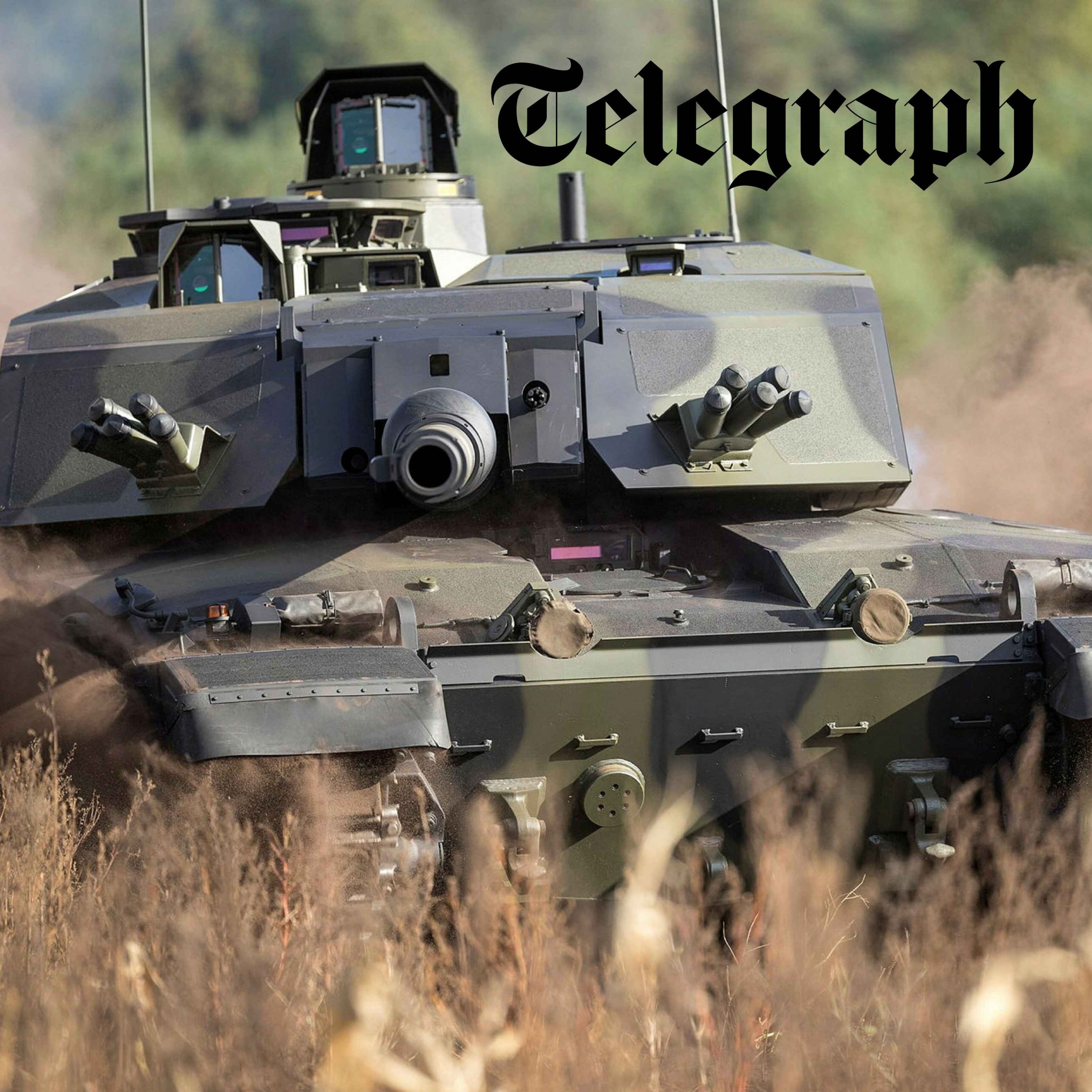
Come on. I'm Roland Oliphant and you're listening to a special bank holiday edition of Iran, the latest in today's episode. We are going to take a break from looking at the daily News of the U.S. iran War and focus instead on one of the principles or elements of modern warfare. Since it first appeared on the somme battlefield in 1916, the tank has dominated and defined modern warfare. It's been such a successful concept that its distinctive silhouette, two tracks, a turret and a gun, has barely changed in 100 years. But can it survive in this new century, the century of the drone? Or will the venerable tank go the way of the armored knight before it? To discuss all these questions, I sat down with Hamish De Breton Gordon, a former commander of the Royal Tank Regiment and the author of a new book on the subject, Tank Command. He took me through the history of armoured warfare. We discussed how or why the tank has been the ultimate instrument of battlefield shock action from World War I to the Arab Israeli war to Ukraine today. And Hamish made the argument that in 100 years from now, armies will still be fielding and and fighting against tanks. Claus Hamish talks about his own experience commanding a challenger fighting in the Middle east and his ultimate petrol head pick for a tank of his own. Were he allowed to buy one? Without further ado, here is our conversation. Tell us about the book.
- [03:12]
Hamish de Bretton Gordon
The book sort of came by accident. I wrote my memoir about four years ago and great surprise to me and I expect everybody else actually it proved incredibly popular and I think actually made money for the publishers, which I now realize is a rarity. So I was then asked to look at another book and my. I suppose I'm best known for my sort of chemical warfare, bio warfare, counterterrorism, but actually I commanded the 1st Royal Tank Regiment and spent most of my life on tanks. So writing. Being asked to write a book on tanks was really an offer I couldn't refuse. And also I think because it is such a discursive point at the moment and has always been. And the sort of strap line in my book is, the tank is dead, long live the tank. It's been written off, you know, all the time. But actually, you know, we wind forward to now and what the basic premise of a tank firepower, protection and mobility to create shock action, which is really the art of warfare. It's been much derided recently because of the drone threat. But actually, you know, I sort of. I go back to the. The first great tank battle, the battle of Cambrai. What was upsetting the tankies in those days? It was the Germans throwing sticky bombs onto the top of the tank where the tank was thinnest in armor. So they built sort of chicken wire cages on them to stop that happening. You know, what are we most recently concerned about is $500 FPV drones dropping hand grenades on the top of tanks where it's weakest. We built metal cages 110 years later. So I think that. And it's the enduring sort of legacy of that and having spent so many thousands of hours in these things, it's a very strange environment, but it is one that keeps going, keeps repeating itself and there are so many great examples. And today, the 20th of May.
- [05:03]
Roland Oliphant
No, you were going to say, is
- [05:04]
Hamish de Bretton Gordon
a pivotal day in history.
- [05:05]
Roland Oliphant
We are speaking listeners on the 20th of May. Tell us, tell us about the 20th of May.
- [05:09]
Hamish de Bretton Gordon
Being a Royal Tank Regiment officer, having commanded the 1st Royal Tank Regiment and having joined the 4th Royal Tank Regiment, the armored cause. I suppose one of the greatest battle honours is the Battle of Arras. 20th, 21st of May 1940, the 4th and the 7th Royal Tank Regiment with the Durham Light Infantry. The time, the sort of rather larger sort of strategic piece is the blitzkrieg is steamed across Europe, through France, through Belgium. The British Expeditionary Force are gathered on the Dunkirk beaches. 400,000 men and equipment trapped by ostensibly blitzkrieg Hitler's tanks and a certain chap called Rommel who people may have heard of, who was steaming forwards and the last sort of gasp hope was this small armored formation who were given orders to attack the night of the 20th of May early 21st, right into the heart of the Panzers, who had many of them had gone past Arras and this relatively small force, Matilda two tanks, the sort of best tank the British had at the time, very well protected, not a huge gun and a bunch of determined men actually split the Rommel's panzers in half and they got dislocated and the tanks destroyed a lot of what we call the echelon, you know, all the vehicles following up with the ammunition and the infantry who were actually bought in trucks rather, and a lot of the artillery too. And Hitler was thrown into panic and it depends whose history you read. But if you read the Royal Tank Regiment history and actually I think the Royal Armored Corps, this caused a 48 hour pause. So Hitler ordered a pause and in those 48 hours really created the conditions to allow Dunkirk to happen.
- [07:04]
Roland Oliphant
It's interesting to hear you say that because when you say France 1940, what you don't think of is anything the British army is very proud of. It's very interesting to hear you mention that. And I hadn't actually heard of that before.
- [07:17]
Hamish de Bretton Gordon
Well, it's, I was hugely fortunate when I was the agent of the 4th Royal Tank Regiment. We amalgamated in 1991 and there were still two people had fought in that battle. One second lieutenant Peter Vaux, who went through the whole war, retired as a brigadier. And in chapter four of my book I used a lot of his notes because he was cutting around as a second lieutenant and with the adjutant and others trying to direct fire and it was huge confusion. I mean it was almost an accident. But in classic counterattack fashion, if you can get behind the enemy and dislocate them, yeah, confusion absolutely reigned. Now Rommel was really hacked off. He wanted to crack on to the, you know, to Calais and to Dunkirk, but Hitler panicked and said no, so they, they stopped for 48 hours. Momentum in warfare is so important and you're right, you know, there are not many good notes. You know, Dunkirk was obviously an incredible operation, but the Battle of Arras I think a lot of people think would agree is one of the great operations almost accidental. And, and throughout my book what I'm trying to do is link things that happen in history to sort of what happens now. And with the telegraph I went and Test drove Challenger 3 a few months ago and also Ajax. And one of the issues is they're great beats of kit digital drones flying all around them, direct to them, just what we require. But there's so few of them. And one of my points is actually it's not necessarily the numbers, but a small determined force like the two tank regiments and two infantry battalions at Arras actually changed the war. I mean, the war could have ended if the British Expeditionary Force had not got off Dunkirk. Then things might have turned out very,
- [09:08]
Roland Oliphant
very, very differently, wouldn't it? Well, I haven't yet reached the end of the book and it's very readable, I must say. I must commend you. Thank you. It's readable. And I suppose the interesting thing is, I suppose what's quite useful about the tank, there's a firm start date. I mean, you start with the First World War because that's when this particular thing appears in response to a very particular problem and is, you know, that's kind of almost like a starting gun. You can chart the century or so since. Let's just start with that. I'm sure lots of listeners are quite familiar with this, but the tank is an answer to a problem. And the problem is the stalemate on
- [09:47]
Hamish de Bretton Gordon
the Western Front entirely. And trench warfare, funny old things come back again. But it was about how do you get across no man's land, how do you get across the barbed wire, how do you get onto the enemy trenches? And lots of things. 1915, my other area was the first time we saw gas chlorine used to try and break the stalemate. But the tank idea, actually Churchill, yet again was very significant in the whole development. He was head of the Admiralty, bizarrely at the time, and the army were a bit sniffy. I mean, the army at the time was very heavily run by the cavalry. You know, the cavalry thought these things were vulgar and, you know, still believed that there was a place for the well bred horse on the battlefield and there was lots of angst. But it's actually the navy who started developing the tank and really by Churchill forcing it on because he.
- [10:43]
Roland Oliphant
The landship didn't they entirely.
- [10:45]
Hamish de Bretton Gordon
And the tank is really deception because in warfare, as you know, operational security is so important. If the enemy knows what you're doing and know what you're likely to do, then the Russians call it Maskarovka. And so it was that they'd had forays with tanks at the Somme in 1916 and it was a bit of a disaster.
- [11:08]
Roland Oliphant
This is it, this is interesting. Right. So the Tank is an answer to the problem. This stalemate with people saying we can't advance against this. Machine guns, barbed wire, artillery, we need some kind of technology to get around this. They come up with the tank, but it doesn't work at first. In fact, it's very disappointing for its first few engagements. So I was wondering if, I suppose if you could tell us what though, why it didn't work and then how they got through that problem. Because I think that's probably. And reading through the bits of the book I've written, it seems like that's what you're going to come back to and back to and back to that. Those lessons that were learned then are still the lessons that are applied now.
- [11:50]
Hamish de Bretton Gordon
The tank core was so, you know, we thought we'd come up with a solution. It was so great. But funny enough, one of the issues was reliability of these tanks. In order to have an armored force that's effective, it needs to be supported by infantry, by, by drones, by artillery, by air power and all the rest of it. And if you do that, then you can make great progress. It's a balance between mass and capability. And at the Somme, they only had 50 or so tanks. Nobody had really trained with them. The infantry didn't know how the hell to use them. And half of them broke down. And because they weren't supported directly by infantry and by air and all the rest of it, a lot of them were knocked out. So, you know, luckily Haig, the overall commander at the time, he still thought it was a good idea, but there were a lot of naysayers around, but people might have heard of names like Little Heart and others who were really great thinkers and they convinced the government to back it. So when we came to Combraic, this is where, and the precursor to Combrai was a lot of training, a lot of training in secret way behind the lines. And in the couple of days before Combrai, you know, A thousand Mark 4 tanks were brought up. So suddenly we had this massive armor supported and it was the main effort. Lots of artillery, lots of infantry. And in those first 12 hours they advanced, I think it was 20, 29 kilometers unheard of. So that was a great success. But then they hadn't quite learned the idea of logistical support and all the rest of it. And people at that time, if you made 29ks, how could you back full that area? So it wasn't then taken. And unfortunately over the next couple of days, the Germans took back at least half of that sort of ground. But it was a fundamental Success, because they had the numbers, people had been trained and they had all the other bits of the battlefield to support it.
- [13:53]
Roland Oliphant
That's the birth of the tank in World War I. It gets going. Cambrai. Finally. I don't want to get too stuck in World War I, but it does play a significant role in the 100 days in 1918.
- [14:04]
Hamish de Bretton Gordon
Absolutely.
- [14:05]
Roland Oliphant
And the final collapse of the German army.
- [14:08]
Hamish de Bretton Gordon
Because one thing before, the Germans hadn't really got tanks by then. You know, the one thing they'd produce was something. If people have seen the Turtle tank in Ukraine, the one thing the Germans have produced is great sort of metal box sort of thing. And they were struggling to catch up. But at the end of the First World War, the Germans absolutely got it. People like Guderian and Rommel and others really threw weight behind it. So they started massively developing when they could. Of course, there was, you know, they got round Treaty of Versailles and everything else, but. But they started develop. Of course, Britain did what we always do. We chucked it all out. We basically had a moratorium to do nothing for 10 years.
- [14:49]
Roland Oliphant
This is another recurring theme of your book, which is that the tank was a great British first that was then kind of relinquished and rather like football, the Germans got better at it entirely.
- [15:00]
Hamish de Bretton Gordon
But also we then, lots of people say we're in a 1939 sort of phase now, and actually, by God, we are. Because, you know, by the time the war started, we were way behind. We had not invested. The peace dividend of the First World War was overspent as much as the peace dividend of the Cold War is now. So we were in this terrible position. But of course, Hitler and the Nazis, you know, they were building, developing and really going at it hammer and tongs.
- [15:30]
Roland Oliphant
When we think of tank wars, we don't really think of the first of all. We think we think of the Second World War as the kind of the heyday of the tank. Why is that? And what was it then? Was there something that made the tank at that moment in history so preeminent?
- [15:45]
Hamish de Bretton Gordon
Well, I think there was a lot of things. The Germans, very importantly, they absolutely embraced it. I mean, they had Porsche and Daimler Benz building tanks. You know, we eventually had Vickers and other shipbuilders building tanks. So, I mean, Porsche was trying to develop electric tanks in the Second World War. I mean, quite unbelievable. He developed all these electric drives and stuff, and people were just saying, he's bonkers. So the Germans really embraced it. They had some, you know, Guderian and others, some real Real proponents of it and, and the, and the blitzkrieg idea, this idea that you move very, very quickly and use the ground. I mean, the, one of the lessons of, of the Germans were going through the Ardennes, you know, back in 1940, you know, they couldn't go through the Ardennes. They were in Perenniferal forests. Well, you know, not for Rommel and his chums. And the great machine line that was supposed to stop the Germans sort of, sort of didn't really work around the Ardennes. So, you know, why was it so important? The Germans put a lot of time and effort into it. Of course, the Russians, hugely significant too. They developed a tank called the T34, which is still, you know, if any child draws a tank, it sort of looks like a T34. But the Germans really went for technology. They probably produced the two best tanks ever, the Tiger and the Panther, that were brilliant tanks.
- [17:06]
Roland Oliphant
When you say best tanks ever, you
- [17:08]
Hamish de Bretton Gordon
mean, you know, if you. The holy Trinity. Firepower, protection, mobility. Tiger tank had an 88 millimeter gun on it, you know, three or four times the size as anything else. It had armor protection that even, you know, the most powerful Shermans couldn't, you know, just bounced off it and were brilliant, but they were unreliable. And because they were so expensive, the Germans only ever built a thousand of them. Now we look to ourselves and the Russians, I mean, the Russian T34, very, very simple to make, had a 76, 75, 76 millimeter gun, pretty good. But you'd need three or four of them to kill a Tiger. But the Russians built thousands and thousands of them and overwhelmed and so did we. The reason the Allies, in my opinion, eventually won the second World War is because we created mass and the Germans just couldn't recreating it. And when you look at the tank, the Sherman, we built 69,000 Sherman tanks. And the great thing about the Sherman, you could build it anywhere. It was so simple and easy. And there's a great story of Patton at Salerno. The opposing German general, I think after he was captured, was going, we were taking out 10 of your Shermans for each one Tiger you were taking out. And Patton said, well, I don't care. I've got 15 Shermans for every one of your Tigers. So eventually attrition worked. So I think that was the element to it and the ability then to, to maneuver with all arms. And you talk about, you know, after Normandy and fighting through the bocage, which, you know, this, this area, these, these
- [18:47]
Roland Oliphant
hedgerows, big hedge ditches and really difficult.
- [18:52]
Hamish de Bretton Gordon
There's a brilliant book called Tank Action by, by, by Stuart Tootle, an army chum of mine with Robert Render who, who was actually the troop leader talking about fighting through the bocage. Absolutely incredible. And that, that ability. And sometimes they, you know, fighting the bocage, sometimes you'd move you know, a couple of hundred meters a day but then if the tanks got ahead of steam and broke through they would move 30 or 40 kilometers. So that was significant. And ultimately you know, Hitler ran out of tanks, ran out of the wherewithal to keep them going and ultimately collapsed.
- [19:29]
Roland Oliphant
As you say, your kind of strap line is the tank is dead, long live the tank. And you kind of make a point of saying that the, the obituary of the tank has been prematurely written several times. After the first World War people decide well actually it's air power, we don't need tanks, it's going to be air power. That's it doesn't matter. Forget about the tank. Is the same in the second World War. And then there's the rise of the anti tank guided missile which changes things in the Cold War kind of era
- [19:56]
Hamish de Bretton Gordon
and that's a really good example. So people would have seen it in the Arab Israeli wars, the anti tank guided missile because they were so effective.
- [20:05]
Roland Oliphant
What is an anti tank guided. I mean I know the clue is in the name but what makes this so, so effective and why did it change everything?
- [20:13]
Hamish de Bretton Gordon
Well it's basically a missile that an infantryman can fire up to sort of three kilometres.
- [20:18]
Roland Oliphant
Right. So are we talking about a tube
- [20:20]
Hamish de Bretton Gordon
on somebody's shoulder basically or, or actually from a mounting but something that fires two to three kilometers will hit a tank. It has a high explosive squash head missile on the front which basically bores a hole in the tank and fries everybody inside. So it was incredibly effective until people discovered reactive armor and then it disappeared from the battlefield basically. Reactive armor and people will see it. You see tanks that look as though they have sort of square plates.
- [20:51]
Roland Oliphant
These are, these are particularly on Russian, Soviet tanks, these little boxes of explosive reactors.
- [20:55]
Hamish de Bretton Gordon
Absolutely. And you know the Israelis started it then we had it and virtually all tanks have it now. So what happens? The anti tank guided missile now hits these explosive boxes that then explode and destroy the anti tank guided missile and it has no impact on the tank. So it's the cycle of evolution, you know, the cycle of threat. You get a threat, if you ignore that threat it's going to really hurt you. But again there is a counter to every single threat. So the anti tank guided missile it was Then countered by the explosive reactive armour and then we move on. And then when people went to what we call fin stabilised round, basically a lump of tungsten flying at 1500 meters per second, punching holes, then the Brits actually developed ceramic armor, something called Chobham, and that negated that. And we're almost in a position now where I think people at Challenger 3 are pretty convinced there is no weapon out there at the moment that will penetrate Challenger three. But there will be, of course, you know, in time.
- [22:00]
Roland Oliphant
In the early days or the early months of the full scale invasion of Ukraine, I do remember people saying, well, once again that the tank is over for various reasons, drones was among them. But I think since then we've seen another, another iteration and it's a really dramatic iteration that is this drone warfare really reaching its kind of mature stage. And I'm wondering if, if you genuinely think that the, the tank as we know it, the big turreted, lumbering monster, can really survive in this age of the drone, because this age of the drone seems, seems different to other threats.
- [22:40]
Hamish de Bretton Gordon
Well, I think all the times when the tank has been written off, it's about maneuver. If a tank can't manoeuvre, then there's no point having it. I mean, I've written a number of times for the paper about the drone infested battlefield, the open battlefield where everything is there. Now, if a tank can operate in this infested battlefield, then it still has utility. And I think very interestingly it is again the dynamic about if you can suppress the drone threat, you can operate again. And that is now happening. So tanks like ajax and Challenger 3 now have what we call active protection Systems, Hard Kill, DAS, Hard Kill defensive aid suites. So if you have 20 drones attacking a tank in 20, 23, you're pretty curtains. Interesting enough, a lot of the western tanks, the Challenger 2s, the Leopard 2s might be damaged, but very few of them were written off like the Russian tanks, they were repaired. Now if you look at ajax and Challenger 3 with their active protection suites, they can operate in this environment because you look at something like Ajax, its gun can knock out Shahid drones between 3 and 6 km. It can acquire them even further. So they are not necessarily the threats that really concerned about, but the FPV drones are. So both Challenger 3 and Ajax are going to be fitted. Not all of them, they all should be with this. There are two types of defensive aid suites, one school trophy and one's called something else. And what they do is as the drones get in the Vicinity, they're then knocked down with hard kill DAs, so basically firing projectiles at them. And if you can do that, then combined with electronic warfare and everything else, that FPV drone threat becomes much less an issue.
- [24:45]
Roland Oliphant
I'm just wondering if you think we're back to General Patton at Salerno. You know, I mean, I have 15 Shermans. The drone is just massively, massively cheaper and can be deployed in mass. And the Ajax is incredibly expensive, is it not? I mean, I just wonder if you can see them being overwhelmed, what happens when Ajax runs out of ammo for its.
- [25:11]
Hamish de Bretton Gordon
Yeah, but it's something like Ajax is an electronic platform that is controlling hundreds of drones and hundreds of autonomous vehicles. So it might be the central node. So if, if you are a drone pilot, you're probably fixated with everything it's controlling rather than itself. So I think. But the other thing is, again, one of my favorite sayings and not unique to me is, you know, whoever controls the electromagnetic spectrum controls the battlefield as we're seeing it now. Who would have thought we would have fiber optic drones on the battlefield? We're going back to the anti tank guided missiles who had long cables behind them. So drones now, in order to be able to operate, have got to tow a fiber optic cable. Now I rather glibly say the person who invents the electronic flying scissors is going to counter that because normal FPV drones can't fly now because they're just jammed out of existence. So there is that too. And there was a tank action a few weeks ago, now Ukraine tank action in the traditional tanks, armor, artillery that made significant gains down in the Donbass. I mean, the strategic defence review says that, you know, the modern British Army, British forces, 80% of our lethality is coming from expendable drones and recoverable drones and just 20% from tanks and artillery and all the rest. And that is probably right, but they must all work very closely together. So that's why I say there's still a bit to go in the tank. And it's not quite, I don't think like Salerno, because the counter to that is something like Challenger 3 at whatever it's £10 million a pop, is a really sophisticated digital platform.
- [26:56]
Roland Oliphant
I was just wondering if you think that if you look at the immense cost of a Challenger 3 or Ajax, I mean, is there a point where you say, look, you can't be spending that much. I know it's brilliant and it sings and it dances, but come on, because you were talking, you began this Talking about mass and affordability and being able to churn stuff out.
- [27:20]
Hamish de Bretton Gordon
I would say, can we afford not to do it? But yeah, you know, the Challenger 3 is probably the last 70 ton tank that Britain will ever make. But as I said at the end of the book, in 100 years time, somebody like me is going to be talking to somebody like you about something called a tank.
- [27:35]
Roland Oliphant
We're going to take a short break now. When we come back, what is the best tank to own, not as a country or as an army, but as an individual driver?
- [27:50]
Advertisement Voice
Movement unlocks something words can barely touch. That rush, that freedom, that feeling of being unapologetically alive. Peloton's Cross Training Tread plus was built to take you there. Powered by Peloton iq, you've got personalized plans, real time insights all in one place. Go from sprints to strength training with the swivel of a screen. Let yourself run, lift, fail. Try and go Explore. Cross training tread +@1peloton.com I'm Jake Stauch,
- [28:23]
Jake Stauch
co founder and CEO of Cervel. We built Cervel to automate the IT work that slows companies down. Onboarding password resets, access to applications. My laptop stopped working. While employees wait for help, their real work is put on hold. It desperately wants to automate this work and that's why they need Serval. You just tell Serval what you want to automate in plain English and it's built. No drag and drop workflows, no expensive consultants. Employees get unblocked and IT teams go from drowning in tickets to building what actually matters. With Cerval, it becomes the AI engine powering the entire company. This is a new way to run it. We guarantee you'll automate 50% of all tickets and we'll prove it to you in a free four week pilot. Go to Acast. That's S E-R-V-A-L.com Acast.
- [29:22]
Advertisement Voice
Summer smells like citrus in the sun. Turn your home into a daily getaway with Pura's new summer collection. Find your flow and fragrance and explore the scents@pura.com.
- [29:37]
Roland Oliphant
Welcome back. You're listening to a special bank holiday edition of Iran, the latest with me, Roland Oliphant and Hamish de Breton Gordon, the author of a new book about tank warfare. Where do we go now then, your prognosis for the vehicle for the tank. What does the future hold? And what should hard pressed ministers of finance around the world be allowing their ministries of defence to buy and order?
- [30:04]
Hamish de Bretton Gordon
People criticise soldiers like me because we don't get too deep into the detail of money and all the rest of it. But of course it is a significant point. But ultimately it's about capability. How can you get the best capability? And it's not so much bang for your buck, it's for your threats. It's no good. And one of the things with Ajax, people saying, oh well, it can't withstand 120 millimeter fire from a tank. It doesn't need to. Why spend 2 billion making it that it's completely protected from a tank when that's the least threat it's worried about? It's worried about drones and everything else. So I think we have got to evolve. I think warfare hasn't changed. The basic principles of warfare, you know, maintenance of the aim, concentration of force, deception, et cetera, et cetera, are the same. Western democracies have forgotten about deterrence. And deterrence, to be a deterrent, has to be effective. So when we go forward, we have to look at our most likely threats and produce an army, tanks or an armored force that will deter potential aggressors.
- [31:13]
Roland Oliphant
What does that look like? Does it look like. I suppose I'm interested in what you think. Like you say there's going to be tanks in 100 years from now.
- [31:20]
Hamish de Bretton Gordon
Something called a tank.
- [31:21]
Roland Oliphant
Something called a tank. What, what do you think the tanks, the coming tanks can. Because you just said to me Challenger 3 is probably the last 70 ton tank of the British are going to build. Is the MBT over the main battle tank? Is it an era of smaller vehicles or, or faster? What's your.
- [31:38]
Hamish de Bretton Gordon
Yeah, no, I think probably all of the above. It depends how the threat evolves. But being able to pack a punch at three to six kilometers, that was the requirement back at Cambrai. I mean, slightly shorter distances and that's still the requirement in Ukraine now until we start flying around in spaceships on Earth and all the rest of it. But something that can fundamentally protect, maneuver and has firepower will suffice. Now, whether it's electronically driven, whether we have hover tanks or whatever it is, but we only look at the recce strike capability, which I've written a lot about recently, is actually tank warfare for the late 2026 and beyondward, because it's all about digitally controlling the battlefield with a whole bunch of different assets to create the shock action to be able to win. And one of the things that is hugely significant, we've discussed before we have to do, we cannot. Our people in this country will not accept the level of casualties that our main aggressor Russia does at the moment, you know, 1.5 million casualties. We know they lost 26 million in the Second World War and Britain lost 335,000. So we cannot fight as the Russians are fighting now. We have to be much smarter and cleverer the way we do it. But it will evolve, I think fundamentally it will evolve less men and women on the front line and will be more done autonomously and that will probably just develop and develop and develop. So the MBT, the Challenger 3, might be the last big crude, crude as in with people in it tank. But there may be something that might be half its size that maybe has one or two people in it and then in 40 years time has nobody in it that can cruise around the battlefield creating that shock action and shock effect. And because it doesn't have people in it, it's going to, you know, it's going to cost less. We all cost a lot of money. Protecting us costs a lot of money training us. It took me a year to learn how to properly fight a tank. And even now, I mean, my own son's going through that process. It will take him a good six months to nine months to learn the technical skills of being a tank commander.
- [33:53]
Roland Oliphant
There's some really interesting points you make about this, and I think one of the things that struck me is you draw a direct kind of line between those early, you know, those vast, hulking kind of lozenge shaped things that appeared on the First World War battlefields and even those modern things that you were driving, even the Challenger Twos, the laser, you can say that they're always incredibly cramped, they still stink of petrol and oil and grease and at least in your day, I don't know if it's still the same in, in the British army, just clogged with cigarette smoke, which is interesting. They're still very uncomfortable things to ride in.
- [34:30]
Hamish de Bretton Gordon
Funny enough, you, you sort of say that, but it's when you get used to it, you know, if you went into a challenge too now, you'd think it's incredibly cramped and uncomfortable and whatever. But I mean, I remember doing an exercise in Canada that lasted four months and you sort of grow into, is something that you sort of get used to. But it does take a while, it does take experience. But I mean, the only difference that I noticed actually being in Challenger 3 the other day is things are moving forward. It's a bit like the Ajax Bree vehicle light tank. You know, people say you get sick from riding around it. Well, yeah, you Sort of do, because you've got flipping screens all around. You know, my day in Challenger one and two, your head up, you're looking for the enemy. Now you're looking at screens because you've got all these incredible sensors that, you know, on Ajax you can detect a drone out to 10 kilometers on your sensors. You're then keying systems up to knock it down. But if you're driving around continually looking at screens, you know, I ask anybody to sit in the back of their car with their laptop and work on that while you're driving around the M25. And if you don't feel a little bit sick after a couple of hours, then, you know, I take my hat off to you.
- [35:41]
Roland Oliphant
This is a regular foreign correspondence experience, trying to try to type in the back of a moving vehicle. And yes, it's uncomfortable.
- [35:49]
Hamish de Bretton Gordon
So that's the sort of point, you know, things are slightly different. And it's this digital world and you'll hear it. I mean, I know the mod talk about it a lot and, you know, I'm not talking for them, but that whole digital networking of being able to, you know, a modern tank will have drones at target end, identifying targets and correcting fall of shot. They'll have drones protecting them from other drones. But if you can imagine, you've got all your sensors working and you've got your drone screens and what. I'm amazed the way that AI is being used now in targeting and things like ajax and Challenger 3 heavily rely on AI. And you'll know as well as I do some of the operations that Ukraine's doing deep in enemy territory, a lot of it is using AI, and that is only going to get better and more usable and more effective.
- [36:39]
Roland Oliphant
So we keep coming back to Ukraine, I suppose, because. Partly because I know you think about it a lot and I think about it a lot, but I think also because the parallel is so familiar from all those things that when we reach into the bookshelves of our minds and we think about tanks, we think about the Western Front and then we think about Blitzkrieg and the Battle of Kursk and European battlefields, and now we look at the stalemate there and it's familiar. But we've also seen a series of wars in the Middle east over the past several decades. There's one going on right now in which, I suppose armour has played a slightly different role. I'm not sure if you can say it's different. Has it been used differently there? And if so, why?
- [37:26]
Hamish de Bretton Gordon
Well, I mean, I was involved in Both the Gulf wars that we were involved in, one in tanks. I think the difference there was the opposition. We destroyed the Iraqi army in 1991 in four days because there was no opposition. But we were doing classic tank warfare. You know, we haven't even talked about mines. I mean, that, you know, whatever I was driving around. That's the thing. You know, the thing. The most frightening, having been in all these wars and everything, most frightening thing I've ever done in the battlefield is in Afghanistan driving around in the back of a warrior vehicle waiting to go over mine or an improvised explosive device. So I think that is, that, that is fundamentally different, you know, and I suppose it's not our focus. We have to focus on a deterrence that is going to deter people from. From attacking in Europe. And, you know, at the moment, that is still the Russians, which is why I think the armor bit still has a part to play.
- [38:24]
Roland Oliphant
The first time I began to see real life tanks doing what they're meant to do in action, they would always been destroyed. They were blackened, charred wrecks. Sometimes the turret was out, sometimes it had been, you know, the tracks had come off or something. And it made me think, I am never ever getting inside one of those things because they just seem to blow up. What's it like doing tanking? Is it not incredibly. I know they're meant to protect you, but it seems to me they're, you know, they attract a lot of firepower.
- [39:01]
Hamish de Bretton Gordon
Yeah, they, they do. But, but I think, I think used properly, we, I think we've seen one or two pictures of hit Challenger twos in Ukraine and even they have been repaired. I, I was involved in a blue and blue in the first Gulf War.
- [39:17]
Roland Oliphant
Blue on blue means friendly fire.
- [39:18]
Hamish de Bretton Gordon
Friendly fire, yeah.
- [39:20]
Roland Oliphant
What happened?
- [39:22]
Hamish de Bretton Gordon
It was actually our, our fu. Our forward observation gunnery officer who, who unloaded 40 rounds of machine gun fire into. I was actually in a recce vehicle, something called a Ferret, and it, it all bounced off. I mean, destroyed our sleeping bags and everything else, but it was not a huge issue. Actually, I talk in the book about James Hewitt of infamy from various celebrity shows. But at one time, James Hewitt was a tank commander in the first Gulf War, commanding a squadron. And as I described in the book, he almost killed us all. He had the opportunity to fire his 14 challengers, that are 14 challengers on a blue on blue in the middle of the night. And as James will admit, you know, he's made a lot of very bad decisions in his life. But the one decision that really mattered, he Got it right. And he. Despite being told repeatedly to fire at us, he didn't. And that would have been very different. But, you know, basically it's. I think it's about training and using the tank properly. Then it's not about being safety, it's about being able to operate. And my final bit on this, you see all the tanks burning in Ukraine. Most of them are Russian tanks because they are not built for protection. You drop a hand grenade in a Russian turret because the ammunition is all stored in the turret, it blows up. In a British or German tank, they're all stored in what we call armored charge bins because they don't want it to blow up. But in the Russians, they don't care. So, yeah, I think warfare is inherently dangerous and when you're in it, you're terrified 99% of the time. But you can persevere, succeed and win as long as you have the training and the right capabilities to do it. You know, another thing I talk about is, you know, women tank commanders and my regiment was the first to have them. And, you know, I sort of think, God, you know, why would anybody. I mean, you can be shut down in these things for 24, 48 hours and, and, and, you know, you're. You're doing everything in the tank. I mean, it's. Yeah, there's no, there's no standing on parade, as it were. I mean, you know, my. My first Glaswegian troop sergeant had got off a murder charge in Glasgow. He had no teeth and bald hair and told me to, you know, exactly what to do. He's now one of my greatest friends. There is no, you know, in, inside a tank, there is no rank or privilege. Everybody is equal and. But of course, they rely on you to keep them alive.
- [41:58]
Roland Oliphant
Does that make it a bit. I don't know. Soldiers always say that, you know, oh, like it's all good. But it does sound quite. Is there something about working in a. In that small, confined space with a small group of people that just. That is a bit of a leveler between. Between you, the public schoolboy and.
- [42:16]
Hamish de Bretton Gordon
Absolutely, you know, I rock up to this Glaswegian regiment, you know, although I'm not, you know, I'm a colonial, I suppose, but, you know, over educated at, you know, the best public schools to, to boys who, you know, barely got a qualification to string together. Some of them, you know, have been in jail. Sky got off a murder charge. Yeah, they are absolutely as hard as nails and. Yeah. But I look for, look back forward 35 years. And these, these are, you know, I'm sure I, I, I'm sure they'd say the same. You know, we're greatest mates and, and that is forged in, you know, common, common hardship and relying on each other. Absolutely. You know, my. I rely on the driver to make sure the bloody tank works. He relies on me to make sure, you know, keep him alive sort of thing.
- [43:07]
Roland Oliphant
Is there a particular, I don't know, are there particular characters who make good tankers or is there something that makes, Is there a secret sauce that makes a good tank crew?
- [43:20]
Hamish de Bretton Gordon
I think basically good soldiers, and a majority of soldiers are good. It's about getting in, mucking it in and not leaving a thing unturned and keep you on going. It's incredibly tiring. Probably more tiring being on a tank than actually walking around as an infant infantry soldier because of the bashing around and everything else.
- [43:40]
Roland Oliphant
If you could have any, an Airfix model of any tank in history to make, which one would you choose?
- [43:48]
Hamish de Bretton Gordon
Well, the most successful British tank ever was a Centurion. You know, about 5,6000 were sold and only recently the least have come out of. And that's the picture on the front of the book with Chinese eyes, which are from the 4th Royal Tank Regiment. And the eyes are there. In the First World War, I think the Malaysian government bought the Royal Tank Corps some tanks, but they said they must have eyes on them as the sort of attack daos do in Malaysia. The idea that the eyes see, and it was, you know, if you can't see, you can't fight. I'm a bit of a petrol head.
- [44:23]
Roland Oliphant
Right.
- [44:24]
Hamish de Bretton Gordon
So the Centurion had the Spitfire engine in.
- [44:27]
Roland Oliphant
It had a Merlin.
- [44:29]
Hamish de Bretton Gordon
Had a Merlin. It was called a Meteor in the Centurion, but basically it was a Merlin engine. So. So the Centurion sounds amazing. And when I finished being commanding officer, the first straw tank regiment, I was driven out of camp in a Centurion.
- [44:43]
Roland Oliphant
So sentimental value there.
- [44:44]
Hamish de Bretton Gordon
But a petrol engine sounds better than diesel every day of the week.
- [44:48]
Roland Oliphant
What's your favorite film about? Tankers.
- [44:52]
Hamish de Bretton Gordon
A lot of people are. I mean. Yeah. Again, might sound a bit trite. Kelly's Heroes, you know, it's difficult to beat there, but. And some of the symbolism is amazing. You know, the fact that, you know, they put, put extra tubing over the barrel to make the gun look bigger. I mean, that was just classic, brilliant stuff and, you know, oddball and some of his ideas. So, yeah, Kelly's Heroes, I think probably is. Is, yeah, is the one that I would watch again.
- [45:20]
Roland Oliphant
That was Hamish de Bretton Gordon, the former Royal Tank Regiment commander and author of two Tank Command, a new book on the history of armoured warfare. That's all for today's episode, but before I go, just a little appeal. If you found this interesting and if you have anything to say, please do get in touch. Perhaps you yourself are a former tanker like Hamish. Maybe you've fought in tanks or indeed against them. Maybe you have other views on the viability of armored warfare. In the future, we'd love to hear from you. It's always very thought provoking to engage in those conversations with our listeners. We'll be back tomorrow with our usual news based edition of Iran the Latest. Until then, that was Iran the Latest. Goodbye. Iran the Latest is an original podcast from the Telegraph, created by David Knowles and hosted by me, Roland Oliphant and Venetia Rainey. If you appreciated this podcast, please consider following around the latest in your preferred podcast app and if you have a moment, leave a review as it helps others find the show. For more from our foreign correspondents on the ground, sign up to our new daily newsletter, Cables via our website or listen to our sister podcast Ukraine the Latest. We are still on the same email address battlelinestelegraph.co.uk or you can contact us on X. You can find our handles in the the Show Notes the producer is Max Bauer, the executive producers of Venetia Rainey and Louisa Wells. Seeking Pushing, Optimizing, Creating, Learning, Discovering At Aramco, we believe in harnessing the power of data to push the limits of what's possible. That's how we deliver reliable energy to
- [47:24]
Hamish de Bretton Gordon
millions across the world.
- [47:26]
Roland Oliphant
Aramco, an integrated energy and chemicals company, Learn more about us@aramco.com
- [47:36]
Advertisement Voice
Movement unlocks something words can barely touch. That rush, that freedom, that feeling of being unapologetically alive. Peloton's Cross Training Tread was built to take you there. Powered by Peloton iq, you've got personalized plans, real time insights all in one place. Go from sprints to strength training with the swivel of a screen. Let yourself run, lift, fail. Try and go. Explore cross training tread +onepelaton.com.