Loading summary
Transcript48 lines
- [00:04]
Roland Oliphant
The telegraph.
- [00:11]
Venetia Rainey
I'm Venetia Rainey and this is Iran, the latest. It's Monday 6th of July, 2026, day 15 of the 60 day deadline to reach a peace deal between the US and Iran. But talks have been on hold because it's also day three of the public funeral for the assassinated Iranian Supreme Leader Ali Khamenei. Incredible scenes coming of Tehran today. And that huge event will be our focus on this episode. We're going to be looking at what the funeral tells us about who controls the Iranian regime today and crucially, why haven't we seen the new Supreme Leader, Mojdab Al Khamenei? That is the million dollar question. A quick aside. If you're listening to this, don't forget we are now in video. So if you want to see what we're talking about, today's a good day. Follow the link in the show notes to our YouTube feed.
- [01:02]
Arash Azizi
A short time ago, the States military began major combat operations in Iran.
- [01:09]
Roland Oliphant
Today, President Trump says Iran's Supreme Leader, Ayatollah Ali Khamenei was killed in the attacks. The Pentagon is weighing a takeover of
- [01:22]
Joe Barnes
that island as a way to force
- [01:24]
Roland Oliphant
the reopening of the Strait of Hormuz. Iran begged for this ceasefire and we all know it.
- [01:31]
Arash Azizi
This is a historic meeting. Never before has the Iranian and American leadership met at such a high level.
- [01:38]
Roland Oliphant
Can we turn over a new leaf? Can we change relations in the Middle east permanently?
- [01:43]
Arash Azizi
Does anyone really think that someone can
- [01:45]
Roland Oliphant
tell President Trump what to do?
- [01:47]
Joe Barnes
Come on.
- [01:50]
Venetia Rainey
Before we look at Iran, there is another massive event this week. There's a NATO summit in Turkey's capital, Ankara. This is possibly the most high stakes NATO summit ever. I mean ever. There will be ramifications for Europe, the US The Middle east and Asia. To explain why this is so important, my co host Roland Oliphant sent this dispatch from a taxi on the way to the airport this morning.
- [02:15]
Joe Barnes
We're on our way to Ankara for the annual NATO summit. And there's a few things that are really going to dominate this. The first of all is Donald Trump and his warnings yet again to NATO allies to do more. Just before the summer began over the weekend and the administration sent yet another signal saying that NATO allies must step up defence spending immediately, that many officials are lagging behind. Matt Whitaker, U.S. ambassador to NATO, speaking on Sunday evening. Just last night, the Poland, Nordic countries, Baltic countries leading the way, but many others are lagging behind. And President Trump expects all allies to step up immediately and not only get on a sustainable path to 5%, but to get to 5% as soon as possible. And that is, that's really the question at the, at the heart of this NATO summit, because over the years, America has first of all talked to Europe about sharing a burden of defense, getting European nations to spend more on their own defense, then to take on more responsibility for defense in the event of a conventional war in Europe. And now it looks like we're getting to the point where the United States is going to shed some of its own responsibility in Europe, is literally going to start withdrawing troops. Pete Hegseth has signaled this. He's talked about a test, a review of each NATO ally spending and those who fail that test may see American troops withdrawn. So that's big test number one. Second major issue for Britain, really uncomfortable because we are very, very low down the league table in terms of how much defence spending has increased over the past couple of years or the past year. I don't think that Keir Starmer and Dan Jarvis are going to find it a very comfortable summit at all. Then you've got the question of Turkey. Its arms industry is going absolutely gangbusters and in fact, they're hosting a big defense industry summit alongside the diplomatic summit here. President Erdogan is great chums with Donald Trump and American officials have kind of let it be known that the way they secured Donald Trump's attendance here was to tell him that he'd be meeting Mr. Erdogan. So Turkey's future inside the alliance, a really interesting question. And then of course, those two raging geopolitical firestorms just over the border from Turkey, Iran. Ali Khamenei's funeral is still going on. It's going to be running throughout this summit. America will be looking or maybe questioning NATO allies role in the Iran war. And in Ukraine, of course, last night, at least seven people dead in the latest massive Russian strike on Kyiv. And against all of that, we've seen these warnings that the paper reported last week. Officials in several European countries telling us that they have intelligence that Russia is thinking about some kind of, of low, below threshold attack against Poland or the Baltic states in order to test the alliance. So a huge amount, a huge amount on the agenda as we go into this.
- [05:36]
Venetia Rainey
So it's a big moment. And to meet the moment, the Telegraph is sending a whole team there this week. We're going to be doing a bunch of joint content across Iran, the latest and Ukraine, the latest. So you're going to be hearing from Roland, plus our diplomatic editor Joe Barnes and senior foreign correspondent Sophia Yan, they're all on the ground for us. You can expect to hear top level interviews, sharp analysis, of course, and a good bit of old British humour. Ukraine, the latest are going to be focusing on Europe. And on this podcast, we're going to be looking at the broader global implications of the summit and of course, anything that impacts the Middle East. For example, we're going to be keeping a very close eye on Turkey, one of the region's quiet superpowers that we've come back to sporadically while we've been. Iran, the latest. As the country rolls out the red carpet for the NATO summit, security is already super tight. President Recep Tayyip Erdogan has been using the event to accelerate a massive crackdown on opponents, with people arrested and even websites blocked. Sophia has traveled to Ankara from Istanbul, where she's normally based, and she sent us this dispatch.
- [06:40]
Roland Oliphant
So I've just arrived in Ankara and it took me quite a while. I took a train from Istanbul to Ankara, this high speed rail, but after I got into the train station here, the taxi took a while because there are so many road closures, he had to take a detour and he was radioing all these other cabbies to figure out which roads were open, which ones were closed, which ones might be open a certain time. And so it took much longer to get here than it would have otherwise. And it's part of all the security measures that are in place right now because the NATO summit that Turkey's hosting starts tomorrow. There's tons of security measures, a lot of beautification measures. Also there are some building facades that have been freshly painted. Gatherings like demonstrations, weddings, sports. Forget about getting married, no concerts, all of this banned. Thousands of stray dogs and cats, also rounded up by the local authorities and the taxi drivers that will be ferrying. Some of the foreign delegations around are wearing uniforms and they've got Turkish delights on offer. So this is really Turkey rolling out the red carpet to host the summit. Leaders from all 32 member states are convening here in the capital. Erdogan has accelerated his crackdown in advance of this summit to ensure there's no dissent during this particular meeting. It's a spectacle that's very convenient for him to hide what he's doing. The democratic backslide that Turkey is seeing in these last few weeks, hundreds of people have been arrested, some of them for supposedly having ties to terror organizations. A lot of them were critical of NATO and of the summit. A lot of people here don't necessarily see the benefit of being in NATO anymore. They feel that it exposes Turkey, that it hurts and hinders their defense, rather than helps. And this is partly because of where Turkey is located geographically in the world, so close to so much of what's going on. Other people who have been rounded up have just been in the wrong place, wrong time. There were elderly bird watchers walking past the demonstration, and they got swept up, too. We're talking lawyers, journalists, even a comedian who cracked some jokes about the Turkish president got arrested. So it's a really tough time. Also, these few days, as the summit gets underway, the one man who could beat Erdogan at the polls in an election is on trial. That's Istanbul Mayor Ekrem Imamoglu. He's been in jail since March 2025, and he will begin his main defense these few days. And this is something that NATO allies are unlikely to speak up about. In fact, Erdogan has faced little to no global repercussions for the democratic backslide that he's overseen in this country. And this is really because all these countries, particularly NATO, need Turkey on side. They need Turkey as a literal buffer to help defend against irregular migration, but they certainly need Turkey as a defense partner. Turkey is the second largest military within NATO. They're also a major defense exporter. And you'll see this on display. I'm sure we're all going to see this on display this week. Turkey trying to sell more of its weapons systems, its drones, to partners, to allies seeking to rearm, given this very critical time in the world. And what that means is that no one will want to risk upsetting Erdogan. This is a huge problem. A lot of human rights advocates are worried about what this means. And interestingly, just shortly after the summit concludes in Turkey, it will be 10 years on since a failed military coup back in 2016 that Erdogan crushed very violently. And so, to a lot of people looking at this right now, it seems like Erdogan's won, that this hosting of the NATO summit is essentially, in a way, a final nail in the coffin for democratic freedoms in Turkey.
- [10:24]
Venetia Rainey
For more on that story, you can read her full article on the Telegraph's website. We'll put a link to that in the show. Notes. We're really excited to be trying something different this week. Do listen to both shows for our full coverage and let us know your thoughts, or if you have any questions about NATO. For our correspondence, you can comment below this episode on YouTube and Spotify, or email us@battlelinestelegraph.co.uk or of course, you can find us on social media. Okay, let's look at Iran now, because one of the most significant events in the country's modern history is unfolding before our eyes. To break down what it all means, I'm joined by Arash Azizi, Iranian American historian and author of the book what Iranians Women, Life, Freedom. So Arash, we'll get onto the who was there, who wasn't and the politics of it all in a minute. But first I'd just like to know your gut reaction to watching this funeral taking place in your home country. How did it make you feel?
- [11:19]
Arash Azizi
So Ayatollah Khamenei's funeral is obviously an important moment in Iran. This is the man who ruled the country for 37 years. But as for my gut reaction, first of all, one goes over the legacy of this man and it's a terrible legacy, I think, from most perspectives. I think regardless of actually what politics you have, even if you were kind of proponent on some, you know, some factions of this regime, he will be seen, he will become to seen to have had a terrible legacy throughout his rule. When he started his rule, Iran had just finished an eight years war with Iraq. It had started the process of economic development. You know, there was the fall of the Soviet Union and China's turn to capitalism in the world. So Iran had every chance to join that global moment and you know, become a better country, more economically developed. And many, many factions inside the Islamic Republic wanted that. They wanted Rafsanjani, the president at the time wanted that and they wanted to democratize Iran. The other factions, but Yit Khamenei stubbornly really stuck to his reactionary revolutionary vision. And this is the Iran that he was killed in this war that he very much brought on himself, I believe. Of course it was, I don't think this was, you know, I oppose this war, but very much it was his policies that led to this war. So he lost his own life, he lost the life of his own family in it. And he leaves our country in a very precarious situation. Iranian sovereignty is threatened today more than it ever was before him. And you know, so I find the country in a very precarious position. And I wonder what is. And the last thing I'd say is this. The people running the regime in Iran today, in the last little while have negotiated with the US Got a pretty good deal for Iran and they're signaling possibility of continuing to talk to us, to getting a deal. Yet we have a funeral in which they call for the killing of Trump, they talk to deaf America, they shout against the mou. So these are the dualities in Islamic Republic that continue to have had it since the 90s. And I'm anxious to see how they'll be resolved because the future of Iran very much depends on that.
- [13:35]
Venetia Rainey
So the million dollar question, Arash, where is Mujtaba Khamenei? We were expecting to see him on Sunday, right? He was supposed to be leading the rights over the body of his father. We did see the entire Iranian leadership and three of his brothers, Mostafa, Meisam and Massoud, but we still haven't seen Mojtaba. I mean, how significant is this?
- [13:56]
Arash Azizi
It's quite significant because for a country to have a head of a state that has never been seen before, you know, this is the guy who we've never seen him give a political expression his entire life, someone Iranians don't know at all. And for him to continue to be hidden effectively, not a video, not an audio, just by these sort of messages that come to media, it's of course very significant. I don't think there's a case anywhere else in the world that there's a head of a state that just is basically invisible and a head of a state that is not a ceremonial head of a state, but one that holds most powers in Iran actually, according to the Constitution. And who's, you know, who decides whether Iran should go to war with America or peace on the paper? He's the one who decides. Although let me tell you, I don't think he's actually the one who makes day to day decisions. Of course, then there are questions. Is he disfigured? Is he dead? Is he a shadow? Is he a phantom? You know, so this will continue. Now? I do think that they might reveal him in Mashhad. I think there is a chance that during the funeral he will make at least some sort of appearance in Mashhad.
- [14:58]
Venetia Rainey
Okay, so that's on Thursday when Khamenei is actually buried, right, in Iran.
- [15:02]
Arash Azizi
Yeah, but also maybe not. I mean, maybe that doesn't happen. I don't know whether they have a surprise Mojtaba reveal for us for this week. We'll see. But if he doesn't appear, that is of course significant.
- [15:16]
Venetia Rainey
So what do you, like, what do you think is there's a lot of conspiracy theories going around, you know, is he dead? Is he in a coma? What do you think is the most likely explanation for why we haven't seen him?
- [15:27]
Arash Azizi
I mean, you know, it's, it's pretty opaque. And, you know, one, I'll tell you what I think is happening. Based on what I know, I think, yeah, he's probably kind of a bit sick and perhaps disfigured and all that. I mean, by sick, I mean, obviously, you know, he was injured in the war and he's still recovering and all that. But I think for whatever reason, they are trying this model of keeping him behind. And while they're making all the sort of major decisions, they keep him in a bound so that he can't actually interfere in the most important decisions, while the regime leadership, led by people like Ali Baf, the Speaker of the Parliament, and other members of National Security Council, they make all the important decisions. And I think they want to make important compromises. They want to probably talk to the US they want to give concessions, they want to help transform even Islamic Republic. And doing it with this, you know, semi secret supreme leader is easier. But I don't think he's, like, dead. But that's because as a person, there's a limit to how much conspiracy I usually accept. You know, it might be true, though. You know, this being Iran, it's. It is not really. It's not out of this world. If this guy is actually dead and they're doing all this in his name. I think it's pretty unlikely, but it's not outright impossible.
- [16:50]
Venetia Rainey
And you don't buy the official Iranian line that he hasn't come out because of security concerns. They don't want to risk him being assassinated like his father.
- [16:57]
Arash Azizi
What the hell does that mean? I mean, first of all, they could release a video of him. Right. But also, they knew Noah's gonna attack that funeral.
- [17:08]
Venetia Rainey
Yeah. And we've seen every other top regime official. I mean.
- [17:12]
Arash Azizi
Yeah, I mean, I guess you could say that, you know, if someone is being moved, and then they'll. They'll see him, and then they'll, you know, I mean, I guess it's possible that any sort of movement for a person is gonna endanger security. But then there could be videos. But then also then questions what kind of a sovereign country, if you have. If you can't show your head of a state because you think they'll claim, you know, bin Laden even issued a video every once in a while. So, you know, and also, what is the meaning of governance and its relationship with the people? This is supposed to be a guy who leads the revolution, leads the country and all that, and people can't have ever even heard him speak. I mean, it's really something if a Man who makes decisions that affects the lives of tens of millions of Iranians. His father never gave media interviews. This is another new level of unaccountability. So the whole point of leadership is that you have to be accountable to your people in some ways. So his father never gave me the interviews, but at least he gave us speeches once in a while. So this guy now is just gonna, you know, all we have from him is AI images and these written declarations. It's obviously a travesty.
- [18:23]
Venetia Rainey
Do you think there could be any consequences from him not appearing, assuming he doesn't pop up in Mashhad later this week? Do you think it could lead to, you know, a coup or something? Or you think this is being managed by the people who are really in charge?
- [18:37]
Arash Azizi
Of course it's being managed by the people who are in charge. I'll tell you, at some point, as they make, if they continue to make these important decisions, which I think they will, I negotiate with America, you know, start opening up to Islamic Republic economically, in some ways, perhaps go toward normalization. The more they do stuff like this, their hardcore base, like many people who were at the funeral, they'd be angry and they come out and they lash out. And most of our not being there makes his lashing out easier. Now, it's very important, you know, in the message Mojitaba endorsing the MoU, he also said, basically, this wasn't my idea. Yeah, right. So which. This kind of gave license to these people, you know, to continue lashing out. So at some point, if they don't see Mojtaba, they might get conspicuous theories as to, oh, why? Why is it that this Ali Baf and others are making all these big decisions and all we get is a text from Mojaba? But what if this is not real? So that would heighten the sort of heighten the contradictions, as they say. And, yeah, we'll prove destabilizing.
- [19:46]
Venetia Rainey
We're going to take a short pause now. Coming up after the break, what Trump got wrong about the funeral. Welcome back. You're listening to Iran, the latest. With me, Veneesha Rainey and Arasha Zizi. Okay, so what about who we have seen at the funeral? Because a former president has popped up, Ahmadinejad.
- [20:09]
Arash Azizi
It's interesting that he was seen, although obviously you should start by the fact that, you know, in the part of the funeral where all the major dignitaries came and paid their respect, none of the three living presidents of the Islamic Quran showed up. This is an absolutely significant fact. Of course. Can you imagine if there was a funeral of the monarch in Britain and none of the former, you know, none of the living prime ministers were invited to sort of attend and pay their respects. It would be unimaginable, right, in any country in the US if there was a former president who dies. All the living presidents show up. I mean, it's a convention. But in Iran, the two major presidents wouldn't show up, Muhammad Khatami and Hassan Rouhani. Of course, they're all people who were sidelined and marginalized by Khamenei. And it appears that those organizing a funeral wanted to give a more hardline, consolidated image and they didn't want even presence of people like Rouhani in particular, because of his rapprochement with the US is really hated by the hardcore and Khatami is hated as seen in the head of the reform movement. Ahmadinejad was also not there and that's important. He also was marginalized by Khamenei repeatedly. Khamenei stopped him from running for president again, even though he had initially called him his son and you know, really backed him heavily against the protesters in 2009. But Ahmadinejad's presence nevertheless on the street is notable, especially because he really was MIA for so long. It means that he's out there and if there's anything we know about this guy, I mean, he could become subject to a political game again. I mean, just means he's out there, he's public and he's, you know, he's well enough and politically sanctioned enough to take part in demonstrations. But again, he was not part of the official ceremony anywhere. He was just one of the passersby on the streets, effectively.
- [21:56]
Venetia Rainey
Particularly interesting given the reporting around this idea that he was a potential puppet figure that the Americans were hoping could be installed, sort of Delsey Rodriguez, Venezuela style. There were some other people who were there in an official capacity. We had officials from Hezbollah in Lebanon, from the Palestinian groups Hamas and Islamic JIH, and from the Houthis in Yemen. They were there on Friday during the state run events. Quite significant that they've pulled in officials from all of their various proxies. It makes a point, right?
- [22:27]
Arash Azizi
Yeah, obviously. So Iran's support for the so called Axis of Resistance, this group of militias is key legacy of Ayatollah Khamenei and they want to project continuity there. Even though I believe the axis is dead in the way that existed under Khamenei, it doesn't exist. It doesn't have anything like the same versatility and Power, but it's also a, you know, it's, you know, this also poses a question like, does Iran want forever for its future to rest on alliance with this bunch of militias? Look at the foreign guests. Despite all the attempts they had, they had only a handful of heads of a state and governments attend from, you know, just what is it? Armenia, Georgia, Pakistan. And Pakistan, I mean, I think because of its close ties to Iran, also because it had played this mediatory role, but they were not even, you know, Turkey sent the vice president, China sent a real. I don't even know who. What level of, you know, this guy is. He was basically kind of a bureaucrat. Russia, definitely, you know, Putin was nowhere to be seen. And, yeah, so there were very few countries that sent really high delegations. And it's a question for the future of Iran. Does it want to rest its relationships and these militias, or does it want to repair its ties with the countries in the region and build its ties better with bigger countries like India and others? But a policy that is primarily aimed at supporting the acts of resistance, effectively destabilizing countries in the Middle east, is not going to secure that.
- [23:54]
Venetia Rainey
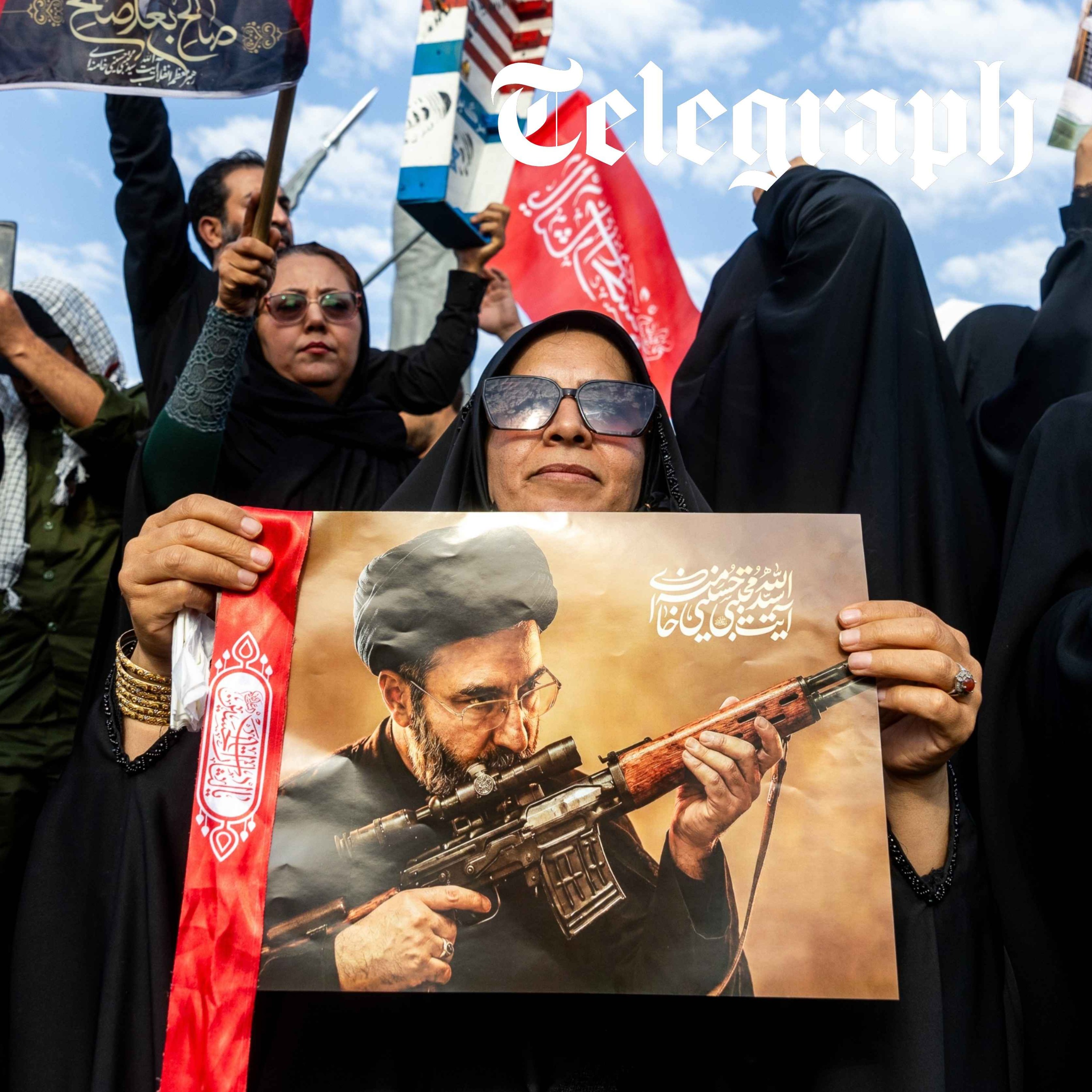
Can you talk us through some of the messaging and symbolism that we saw in the funeral? You know, things like the red and white flags, the official slogan, we must rise, the symbol of Khamenei's clenched fist. What was the message that they were trying to send with all of this stuff?
- [24:09]
Arash Azizi
Well, it's a very good question, actually, generally about the funeral, because his organization does seem to have been done effectively by a more hardline factions in a way. Although the committee to organize it, I think did include all the major leaders of the Islamic Republic, like Aliba of a speaker of Parliament, Pezechi, under the former President Vahidi, the purported head of the Islamic Prohibition Guards Corps, the irgc. But so symbolism, very much wanted to paint it Khamenei as a Shia martyr. Now, Shia as a denomination in Islam is very much organized around the idea of martyrhood. Right. It was in the seventh century where the third Shia Imam, Imam Hussein, fought the Arab ruler Yazid at the time and got killed in the battle of Karbala and became the first grand Shia martyr. And over the years, many Shia clerics who have been killed in different circumstances are known as martyrs. So Khamenei to be killed this dramatically by United States and Israel, two grand enemies of Islam in this definition, is obviously sort of a perfect martyrhood parable. But what is actually notable is how little nationalist imagery you have, even though the regime was supposedly dropping some of its Islamism and adopting more nationalist imagery. I mean, Khamenei was the head of the state of Iran, right? He was. You could see him with a long line of kings going back to Cyrus the great people who get to rule Iran. And he was the last one, whether we like it or not. But there was very little of that attempt to show him as sort of a national figure. The imagery is sort of Shia Islamist. The whole world rise up again seems to be in a Shia Islamist tenor, as, you know, part of the funeral will be in Iraq. And the lack of. There was no attempt to make some sort of national unity gesture, as I said. So no inclusion of even former presidents, let alone more groups of the people. No attempt, for example, to include people with different lifestyles and show that, you know, try to attempt to sort of project, measure national unity. And the whole. The fact that there was someone from the podium calling for the killing of Trump and they were today stoning Trump's image as part of the processions and all that shows that they wanted to give sort of a very hard line, consolidated image. But I don't think that's an actual clue, by the way, as to what direction the leadership of the Islamic Republic will travel. I do firmly believe that they buried Khameneism alongside Khamenei, that they're not going to be able to continue his main policies for. For the long term. Now, maybe I will be proven wrong, but my estimation is that they would not be able to continue his core policies, his inflexible sort of revolutionary crusader mode, and his holding on the power in this absolutist way around himself, like the Islamic Republic constitution had anticipated. I think all of this, both the policies and structures that Islamic Republic developed under his rule, will be transformed in the next period.
- [27:19]
Venetia Rainey
That's interesting. It felt to me like one of the other main themes alongside martyrdom was revenge at the funeral. It felt like it sort of came up repeatedly. You had these massive red flags, right? Maybe you can explain a bit more the detail of that. The red symbolizes revenge. And we also had senior figures giving speeches saying revenge was an obligation that no diplomacy could cancel, renewing their vows of retribution. You know, Trump is invoked multiple times. You mentioned at the top, there was graffiti on the walls saying kill. There was a poet who shouted out, kill. Trump placards, of course, the usual chance of death to America and Israel. How much do you think the Iranian regime is trying to use this funeral as a political event to try and rally people behind the flag, literally, in this sense.
- [28:02]
Arash Azizi
I mean, so it's obviously a political event. I think they're trying to give a uncompromising, consolidated image that in the Islamic Republic, under the same ideas of Khomeini, will go on and hence the theme of revenge, hence the threats to kill Trump. The real emphasis on revenge is very important because it goes against. If you want revenge, then why are you talking to the United States and getting a deal from them and opening a path of negotiation with them? The Article 1 of the memorandum agreement, you agree with the United States, says Memorial understanding, rather sorry, says that basically Iran and United States will not do this, right? Will not threaten each other and all that. But I think the people who organize the funerals want to give this image again, I don't think this is what Iran will actually do. I don't think the next period, look, we are in an interregnum, so Iran could go to different directions, but I find it unlikely that the next direction is a Iran that wants to fight the United States all the time and that wants to kill Trump and that it will continue to sort of continue these militant policies. I think it's more likely that after a rocky period, they will sort of eat their hat and compromise with the United States, reach a deal with the United States, even move toward normalization in the United States, because otherwise, otherwise,
- [29:33]
Roland Oliphant
I
- [29:33]
Arash Azizi
mean, there will be hell to pay economically and otherwise. I mean, be very unstable situation. Iran still has the. Yes, it's true that Iran survived the war and the regime remains intact, but Iran is ruling over an economic ruin, and he had very much an unfinished fight with Israel, who might end up attacking Iran under different conditions. In no way is it sort of over. Right. It's a very inconclusive finish to the war. And the mood of crisis that has pervaded Iran for decades continues to be there. It will only stop being there if Iran somehow brings to conclusion this mode of battle that it has against a few powers, and if it's able to lift the sanctions that hamper its economy, which would not be possible without coming to some sort of a rapprochement with the United States. So I don't. I think that rulers in Iran are much like, more likely to do that than to continue the path of revenge and all that, but we'll see.
- [30:29]
Venetia Rainey
Okay, so maybe more spectacle than actual intention. I mean, that does seem to be what Trump thinks. He told Axios that he's been following the funeral. He claimed again that the Iranians are begging to make a deal, said Both sides have decided to take a week off from the talks until the funeral ends. But he also issued a veil threat. They, as in the leaders are all there, one shot, and we can take them all out, but we're not going to do that because then we would have nobody to negotiate with. And he also, and I thought this was interesting, I wanted to ask you about it. He said he was surprised to see some Iranians crying at the funeral. He said he thought people hated Khamenei. Maybe it's fake tears. For people who've ever been to a Shia funeral or, you know, Ashura, the festival where there's a lot of Shia mourning, tears are certainly a feature, right? Like a feature of this religious tradition. Just talk to us a little bit about Shia mourning and what Trump's got wrong here.
- [31:17]
Arash Azizi
Well, I mean, the president just speaks his mind and says things, and there's no use to try to make a lot of sense out of it. But, yeah, I mean, crying and very open, expressive mourning is a big part of Shi traditions. You can find it in anything funeral. Right. Also, we don't have this in Iran, and generally in our culture, if you don't have a strong stricture against crying or against men crying. For example, I remember Muhammad cried over the funeral of Qasem Soleimani. There were these people saying, wow, what a significant moment. A man cries, but in Iran, we cry. Men cry publicly.
- [31:52]
Venetia Rainey
They also do, like a chest beating thing. Right?
- [31:54]
Arash Azizi
That's for Ashura. Okay, that's. That's for Ashura. It's not a funeral. That's for Ashura. So in a few other days of chest beating, it's a way of showing mourning. Right. Anyways, Ashura has all these beautiful traditions, and Shia funerals are very big, expressive moments.
- [32:13]
Venetia Rainey
Anyways, what did you make of the numbers around this funeral? I think the Iranians predicted there'd be 20 million. I've seen millions, I've seen thousands. Do we know what a number? Does it matter?
- [32:23]
Arash Azizi
Well, basically, I don't think it matters that much. I can tell you this. If you compare this to Ayatollah Khomeini's funeral in 1989, one of the largest funerals in human history. To that day. I mean, it was impossible not to see. That was very genuine, grassroots people loved Khomeini. They came in millions of numbers. You know, they. You could see there was outpouring of emotions everywhere. They were spontaneous, very different from these very estate managed a staged sort of funeral for Khamenei where there is genuine sentiments by part of the population, but it's nothing comparable to that. There's many Iranians who are also leaving Tehran just in order to avoid being seen as part of this funeral in any shape or form. So I don't think this is very impressive numbers at all. It impresses some of our colleagues in the Western media, and I think that's good for them if they're very impressed and they keep talking about it. But to me, as Iranian, there's nothing impressive here. You own a society, you run a state, you can bring a few. I don't think 20 million is their estimate. I don't think it will be 20 million. But look, we know that hardline candidates in presidential elections get like 13 million votes. So there is a base to this regime. It's just a minority, but there's a very mobilized minority. So, sure, after your leader has died, after 37 years, sure, you can bring 10, 15 million people to the streets. What does that mean? I should also say that, you know, this funerals are interesting. So, you know, many of the people go because they're supporters. Others go because, I mean, it's a big event. I mean, if it was happening where I was living, I would probably go,
- [33:58]
Venetia Rainey
you know, curiosity or something, right? You'd, like, wander down, see what's happening, get some.
- [34:02]
Arash Azizi
You want to be part of the history. It's like a big historical event, right? You want to go see it. So this does not signal some sort of a. Unfortunately, we have to play this game every. Every once in a while where there's some big events and some pundits, you know, in D.C. and others go, ah, look, I showed you. The regime has so much solidified support of its people, and here's the. Here's the proof. It's not proof. It doesn't show it at all. It's no impressive feat, really. Would have been an impressive feat, for example, if, as I said, they were able to project some sort of national unity or some sort of broad international acceptance. Whereas a bunch of Hezbollah, Hamas leaders and your usual rent a bus crowds, you know, that's. There's nothing impressive to see here.
- [34:50]
Venetia Rainey
That was Arash Azizi, Iranian American historian and author. And that's all for today's episode of Iran. The latest. We'll be back again tomorrow with a very special interview that I will be conducting with Dom. Until then, goodbye, Iran. The latest is an original podcast from the Telegram, created by David Knowles and hosted by me, Venetia Raney and Roland Oliphant. If you appreciated this podcast. Please consider following around the latest on your preferred podcast app and if you have a moment, leave us a review as it helps others find the show. To stay on top of all of our news, subscribe to the Telegraph, sign up to our Dispatchers newsletter, or listen to our sister podcast Ukraine the Latest. We're still on the same email address battle linestelegraph.co.uk or you can contact us on X. You can find our handles in the show. Notes the producer is Max Bauer. The executive producer is Louisa Wells.