Loading summary
Transcript73 lines
- [00:04]
Ben Reilly Smith
The telegraph.
- [00:10]
Grainger Advertiser
If you're an H vac technician and a call comes in, Grainger knows that you need a partner that helps you find the right product fast and hassle free. And you know that when the first problem of the day is a clanking blower motor, there's no need to break a sweat. With Grainger's easy to use used website and product details, you're confident you'll soon have everything humming right along. Call 1-800-GRAINGER Click grainger.com or just stop by Grainger for the ones who get it done.
- [00:40]
Tommy John Advertiser
Guys, it's no use putting it off. The best time for an underwear refresh is now. Tommy John Underwear is designed for a perfect fit that stays put all day. There's zero chafe, thanks to four times more stretch than competing brands and and their innovative horizontal quickdraw fly is a game changer. With over 30 million pairs sold, there are thousands of men out there more comfortable than you. Don't settle for less. Go to tommyjohn.com today for 25% off your first order with code comfort. That's tommyjohn.comfort. tommy John comfort Perfected.
- [01:20]
Oriana Skyla Mastro
Either there are realistic threats to Xi Jinping's hold on power and now he's trying to force people out in order to consolidate his role, or he's paranoid.
- [01:28]
Gareth Caulfield
We will measure our success not only.
- [01:30]
Venetia Rainey
By the battles we win, but also.
- [01:33]
Gareth Caulfield
By the wars we end. Right now all eyes are on Washington, but who's actually watching Europe at the moment?
- [01:42]
Venetia Rainey
The deepening ties between China, Russia and North Korea would certainly have some in Washington concerned.
- [01:49]
Rosina Sabour
And then daddy has to sometimes use strong language.
- [01:52]
Venetia Rainey
We're going to run the country until.
- [01:54]
Gareth Caulfield
Such time as we can do a.
- [01:56]
Venetia Rainey
Safe, proper and judicious transition.
- [01:58]
Grainger Advertiser
The IDF will continue to uphold the cease fire agreement and will respond firmly.
- [02:03]
Venetia Rainey
To any violation of it. I'm Venetia Rainey and this is Battle lines. It's Friday, January 30, 2026. Is China a friend or a foe? It's a question that's gained new relevance in recent months here in the uk amid a series of rows over spies in Parliament, a strategically placed mega embassy with secret rooms and hacked phones at the heart of government. This week, British Prime Minister Keir Starmer shrugged off those concerns and travelled to Beijing to meet with President Xi Jinping. It's the first visit by a British leader in eight years and and it's become symbolic of the world adjusting to the America first presidency of Donald Trump and the rebalancing of power between East And West. The Telegraph's political editor, Ben Reilly Smith has been accompanying Starmer on the trip and kept a diary of sorts.
- [02:54]
Ben Reilly Smith
Hello, Ben Reilly Smith here, the Telegraph's political editor, speaking to you from the Prime Minister's plane. You're on the tarmac in London, about to head to Beijing. Keir Starmer and President Xi have started their meeting. And as is the way with these things, we get some opening remarks from both leaders at the beginning to cameras. But we know Huawei, the Chinese tech giant, has been locked out of Britain's 5G network. We know Chinese investment has now been barred from UK nuclear power plants. We now have a pretty full readout of the meeting with President Xi. The bulk of what's come out of it is to do with business and economics. The there's a visa free travel deal that means British tourists and businessmen can come to China if they're coming for under 30 days without a visa. There is a slashing of Whiskey tariffs from 10% to 5%. We do know a bit about human rights as well. Number 10 have confirmed that the Prime Minister brought up Jimmy Lai, the Hong Kong pro democracy activist. He's also a British citizen who is imprisoned. One of the aspects of the trip which maybe doesn't make the headlines, but is fascinating is the security protections that both us as a traveling pack of reporters and the British officials have to take to make sure they're not being snooped on by Beijing. Burner phones and burner laptops. The other thing you're meant to do is use a vpn, which is a virtual private network, to connect to the Internet. And then there are other techniques that we are told to do. One of them is to simply try and keep your electricals on you at any time, which means not only obviously carrying your phone, but also carrying the one, or in my case, two laptops that you've got with you wherever you go. There are stories of Western politicians coming to China and suddenly coming back to their hotel rooms and seeing men in suits who suddenly file out. The other one that we are warned about, and I know MPs in the past have been warned about, is honey traps. The idea that if an attractive man or woman suddenly sidles up to you at the bar, offers to buy you a drink and seems very impressed with you, don't let it boost your ego, but it should be setting off some warnings in your mind about what's really going on. And there was a remarkable story that's out there in the public back in 2008 of a downing street aide to Gordon Brown, who succumbed to a suspected honey trap, went home with someone, lost their BlackBerry, lost their laptop, and seem to have been hoodwinked, possibly by a Chinese operative.
- [05:33]
Venetia Rainey
There's clearly a balancing act happening here, both between our values and Chinese values, which are hugely different on key issues such as democracy, freedom of speech, human rights. I mean, you only need to look at this month's dramatic dismissal of the PLA's most senior general to know that Xi is a ruthless dictator who has purged every possible opponent and then some. I'm going to be looking at that in more depth in the second part of this podcast. But just back to the UK for a moment, because Starmer is also striking a balancing act between the world's two superpower leaders. Donald Trump threatened Canada with 100% tariffs if they struck a trade deal with China after Prime Minister Mark Carney visited Beijing earlier this month. But Trump himself is also due in China in April. He gets what's at stake, and as Bill Clinton's advisor said back in the early 90s, it's the economy, stupid. China is the world's second biggest economy, and for the UK it's our third largest trading partner. It generates $100 billion a year, involves 10,000 companies, and supports 370,000 jobs, according to the British Chambers of Commerce. And that appears to have been the main focus of Starmer's trip to Beijing this week. Lots of talk of visa free travel, whiskey tariffs and tackling organized crime, but not much has been said about the security aspect of this relationship, and that's what we're going to talk about on battle lines today. So I'm joined in the studio by our National Security editor, Rosina Sabour, and our slightly misleadingly named transport correspondent, Gareth Caulfield, who also covers a wide swathe of things, as you will find out shortly. Towards the end of last year, MPs were given this very broad, very serious warning by Dan Jarvis, the Minister of State for Security, that China is trying to interfere in Britain's democratic institutions. He he said it applies to everyone from politicians to academics to think tank experts. Before we get into the nitty gritty of examples, I'd love to hear an overview answer from both of you. How big a risk do you think China poses in terms of national security to the uk?
- [07:32]
Rosina Sabour
Well, I can tell you from the people that I speak to on a regular basis, China is considered our most capable and our most aggressive adversary out of the threat actors that we see on the international stage. You mentioned Dan Jarvis's warning there. We also had MI5 put out an alert to Parliament warning of espionage efforts. We've also seen Ken Macallan, the head of MI5, bring the heads of universities in to warn them about the threat that China poses to their academic research and their intellectual property.
- [08:11]
Venetia Rainey
Yeah, the academic aspect is really interesting. We'll see if we've got time to get into it. A researcher from Sheffield made a very public case about being suppressed in terms of her research on China. Gareth, what's your sort of summary of the overview in terms of the national security risk that China may or may not pose to the uk?
- [08:26]
Gareth Caulfield
I think the main risks that we face over the Last sort of 10, 15 years has been technical. It's been one of Chinese products and technologies and services becoming embedded into the economy and then being potentially utilized by the Chinese authorities as a vector for espionage. So, looking back a few years, we have the Huawei controversy about 5G mobile phone networks and equipment being installed there, which could be used for doing something other than providing us with Internet connectivity. We've also seen the controversy around the Chinese mega embassy in central London and the cables around the edges of that building and what they call carry, and crucially, how they could be intercepted by the Chinese during their building works on that site. So the overall picture, I think, is one of an increasing potential threat. We have a bit of evidence that they have been exercising their capabilities and hacking phones, for example, as Rosina revealed earlier this week. But it's a growing problem, I think, and it's one that we can no longer muddle through and hope it'll all be all right in the end.
- [09:31]
Venetia Rainey
There are lots of aspects to this story and we can't get into all of it today, but obviously they've been accused of cyber hacking, trying to recruit informants in Parliament, harassing Hong Kong pro democracy activists, suppressing criticism by academics at British universities. And that's just the stuff in the UK will leave to one side what they've actually done in Hong Kong in terms of suppressing democracy protests there. Jimmy Lai, who's a British citizen who's recently been convicted of conspiracy to commit collusion with foreign forces, a charge that we largely believe to be spurious. And they've also sanctioned British MPs over spreading lies and disputes information about human rights abuses, most notably Ian Duncan Smith, who regularly appears on our sister podcast, the Daily Tea. I want to zoom in on three cases. One is Cash and Berry. These parliamentarians and academic researcher who were charged under the National Secrets act but never prosecuted over anything. One is the China embassy, which you brought up, and then this hacking of phones, which both of you have had excellent scoops on this. So let's just start with Cash and Berry. Christopher Cash, former Parliamentary researcher, and Christopher Berry, an academic, both consistently maintain their innocence. We should say just right the top, but they were charged under the Official Secrets act in April 2024 and there's been a big political row over whether or not they could be charged and whether China can be considered a hostile state. Rosina, what did that case tell us about China as an espionage threat here in the uk?
- [10:51]
Rosina Sabour
I think from what we know, and we don't know everything because as you say, this case didn't come to trial. From what we know, what's striking is just how interested the Chinese allegedly were in quite mundane information as well as the more sensitive high end stuff. It's things that we could have, could be gathered from articles that we publish ourselves. It's Westminster gossip. And that is the thing that we need to realize about the Chinese approach to espionage. It is at all levels. It isn't just the most sensitive stuff. Somebody in the intelligence world said to me, they don't distinguish between secret information and other intelligence, it is just all information. And actually most of the intelligence that can be gathered is in the public domain. It's only a relatively small amount. That is the confidential information that you would hope would be very hard for them to get their hands on. So that's what's so striking about this case actually, is just how interested they are at all levels and their efforts allegedly to recruit at even the most junior levels. So this is a widespread, pervasive campaign.
- [12:05]
Venetia Rainey
Do politicians here in the uk, do they tell you that they're worried about this sort of malign influence? Is it something that they feel like they have to be careful speaking to other politicians about?
- [12:16]
Rosina Sabour
If you speak to people on the other side of that in the intelligence world, they would probably say RMPs aren't worried enough and that's why they took this fairly unprecedented step of coming out and issuing this alert to educate politicians. And by the way, it's not just MPs, it's their staff who are also vulnerable. It's other elected officials, the Senate, all of the devolved governments in this country. Yes, some MPs are very worried about this. Possibly not enough MPs are worried enough. And actually we hear about the kind of honey trap attempts and we hear about this Westminster spy case. What you hear less of is actually the more pernicious attempts to get information, and that's actually getting politicians to come to them. So that's posting job adverts for a policy paper with a very big payoff at the end. And it all seems quite innocuous and innocent, but that's just the first step of recruitment. And then the requests become little more sinister. Slowly, slowly, gradually, gradually, they. They reel these people in. And that's what we hear less about, because I would assume politicians don't want to share too much about being caught up in those traps.
- [13:28]
Venetia Rainey
That's fascinating. I just want to read out one of the witness statements that came out of this Cash and Berry case. Matthew Collins, the government's deputy National Security Adviser, said that there are areas where the Chinese state poses a threat to our people, prosperity and security. He described various ways in which the government believes it has been hacked by Chinese state actors. And he talks of an active espionage threat posed by China to the uk. He identified some specific activities they'd carried out. Gareth, there's recently been this enormous row over the Chinese mega embassy. Keir Starmer has gone to China and we believe that one of the conditions Beijing set was for this long delayed planning application to be finally put through. You managed to get hold of unredacted floor plans for the embassy, which everyone had been chasing for a long time, and China had refused to reveal to the planning authorities what did that plan tell you?
- [14:19]
Gareth Caulfield
So that plan was an unredacted drawing of the basements of the new Chinese Embassy, which is a place called Royal Mint Court in central London, very close to the Tower of London, actually the historic palace. The unredacted drawing showed us there are more than 200 rooms in there, in the entire complex, which spans 22,000 square meters, or 5.5 acres. We don't know. Even despite having seen inside, as it were, and seeing all of these rooms, we don't know exactly what purpose all of these rooms are being put to. But we were able to compare the redacted version, which is publicly available, with the unredacted version that we obtained and later published ourselves, to see that some of the redactions were over areas that were directly next to sensitive data cables running along the outside perimeter of the building, on the street outside and the pavement underneath. And we were able to put all the drawings together and deduce that China is intending to demolish an external basement wall there, which will leave them within about 6ft, or 1.7 meters. I think we calculated it as of those sensitive data cables. Now, the wider Significance of that is, of course, the espionage piece. It's looking at what they could do with that access and what could be done clandestinely to snoop upon that data. Now, as Ros was saying, a lot of Chinese intelligence gathering is relatively mundane. If you tap an Internet cable that's talking to. That's being used by companies talking to each other in the city, you get a lot of financial transaction stuff which you will see appearing on the public markets. But in amongst all of that haystack of information, you will inevitably find needles, as it were, of information that is potentially of economic use or of political use or of even the military use. So it is that kind of challenge, I think, that we really have to face up to and say, look, we've got to draw a line here. And I think the government's. Well, the sequence of events with the embassy, at least, was that the British government appeared to have encouraged the Chinese to submit a rejected planning application for that site within about a month of Labour taking office in 2024. And the sequence of timings, as you say, the approval was granted two weeks before Starmer, or less than two weeks before Starmer sets off for China. It really does not seem like a coincidence. And it does give the impression that China is using this nakedly as leverage against the United Kingdom.
- [16:39]
Venetia Rainey
Were you convinced by. I saw that a statement was put out after the embassy was approved, that security service had said that they'd vetted the site and there were ways make it safe. Were you guys convinced by that?
- [16:49]
Rosina Sabour
In the interest of balance, I will say I'm routinely told the concerns over the cables from the public are overblown. There is a feeling in government that the risks can be mitigated. That is not where they say they are most concerned about Chinese activity. And to be fair to MI5, they have a long history of safeguarding the UK, sure.
- [17:16]
Venetia Rainey
Not the only hostile state that has an embassy here.
- [17:18]
Rosina Sabour
Precisely. They have a lot of experience dealing with embassies in the capital. There are a lot of advantages to having one major site for the authorities to surveil versus the. I think it's seven premises that China currently has in the capital. And so in terms of the embassy, that's what I'm routinely told on the security side of things, clearly there are risks. And actually, we had the head of GCHQ and the head of MI5 release a letter that they'd sent to the government saying they cannot completely remove all risks, there will always be some risk. But they did make a point of saying, nor would we want to have zero risk because that would mean we were dedicating a huge amount of resource to that. And actually that's not the best place for us to be dedicating our resources. Now, there are a lot of other places where the risk posed by China is not getting the same level of attention, and there are real concerns about that. And we've talked briefly about universities, but there are a lot of areas in this country where there is real concern, and that's maybe not so top of mind for the public.
- [18:27]
Venetia Rainey
I think there's something like 100,000 Chinese students in British universities. Of course, we assume the vast majority of those are just sort of happily studying economics, geography, whatever else they're studying, but the monitoring, particularly of Hong Kong dissidents who have fled here to escape the crackdown in Hong Kong. We know that Hong Kongers feel harassed, surveilled, followed. And universities have become a key nexus for sort of extended Chinese state apparatus to keep an eye on groups that they feel like could make trouble for them, Hong Kongers, chief among which, because of the UK's historic relationship with Hong Kong. Gareth, I believe you attended the last protest there before the embassy was waved through, and you met some Hong Kongers. Tell us about that.
- [19:11]
Gareth Caulfield
I did, yes. So there was gathering, I think it was about a thousand people in the end, outside the proposed embassy site, as it was at the time, immediately before approval was given. And a lot of those people were Hong Kongers, were Chinese dissidents, were people who forgot one reason or another, felt that China really was out to get them. And those people all told me universally that they couldn't believe Britain was doing this and that the risks posed by the embassy, and also what it symbolizes was a really big concern for them because the symbolism of Britain, the country to which they had fled from Chinese repression. Some of these people were Hong Kongers who had grown up in the days when Britain directly ruled the place. And they were just expressing something between astonishment and disgust at what the government was doing in front of their very eyes. A lot of them were suggesting that the case of Jimmy Lai should be raised publicly and even that Mr. Lai should be released from prison as a condition of Starmer going to China. Now, as we know, that has not happened. Mr. Lai still languishes in prison on these trumped up charges. I think the reputational consequences for the UK of approving that embassy are going to reverberate for quite a long time amongst the Hong Kong diaspora in Britain.
- [20:24]
Venetia Rainey
Rosina, I want to move on to your latest scoop about Chinese state sponsored hackers who have been found to have targeted the phones of some of the closest aides to Boris Johnson, Liz Truss and rishi sunak between 2021 and 2024. It's an extraordinary story and it suggests that Chinese hackers got right to the heart of our political system.
- [20:42]
Rosina Sabour
It's absolutely astonishing. And actually the thing that I found the most astonishing is when I was speaking to people currently in government, formerly in government, about this, the response was fairly muted. There were people I said this to who just didn't bat an eyelid. And that tells you just how pervasive this issue is. We know about multiple Chinese cyber espionage operations, but this one in particular, it's called Salt Typhoon, which is the name for the collective group of hackers who waged this global campaign. It was so pervasive in the US that you had members of Congress getting classified briefings on Capitol Hill and coming out and saying, it just makes me want to smash my phone to bits. You had Mark Warner, who was formerly chair of the Senate Intelligence Committee, now the lead Democrat on that committee and also a former telecoms executive, saying, this is one of the worst operations in history, the worst breaches in history, in U.S. history. And so we've seen this very vocal response from the US to this particular operation. We've heard virtually nothing from our government about this. We quietly signed our name to an alert that the US authorities put out detailing this operation and how companies could protect themselves against it and take remedial steps. And it referred to the fact that governments were compromised, telecommunications networks were compromised, defense industry groups were compromised. But the only mention from the, from our side of things was to a cluster of activity in the uk. So it told us nothing about who the victims were, just how far up the chain it went. So learning about this breach in Downing street was astonishing. But also what was astonishing is the fact that it didn't cause much surprise among the people I was speaking to.
- [22:53]
Venetia Rainey
Didn't cause much surprise because people were already sort of assuming that the Chinese were hacking their phones or why were they not surprised?
- [23:02]
Rosina Sabour
I am speculating here, but I suspect because they know of multiple breaches like this, we don't know how far up it went. We don't know if the prime ministers of this country had their phones hacked. We just don't know that.
- [23:14]
Venetia Rainey
Which other countries did Salt Typhoon affect? You mentioned the US and the UK there. Does it go wide?
- [23:18]
Rosina Sabour
Yeah. So it was the five eyes. So that's the uk, the us, Australia, New Zealand, Canada. We also know that Germany was targeted. There are numerous other countries that put their name to the alert that was sent out by the US in late 2024.
- [23:34]
Venetia Rainey
This is clearly a global problem. We're focused on the UK here today because that's where based on your stories, focus on that. I want to go back to the sort of bigger question of whether we are sufficiently aware of the security risk that China poses. And you started to touch on this, Rosina. I was on a war game panel this week and I did a very informal survey of some friends and family and I was asking them mainly about whether they thought a direct conflict with Russia was likely. They didn't. And then I asked them about other national security threats and a lot of them mentioned America. Interestingly, they thought it was very unpredictable under Trump. And when I asked them about China, they were said not really worried. They thought of it as a sort of long term abstract threat, not an imminent one, and it was much less emotionally charged than Russia or America. Does that worry you?
- [24:17]
Rosina Sabour
I think that goes to the heart of the problem that successive governments have tried and failed to tackle when it comes to our relationship with China. Governments like to frame relationships with verbs. What's the verb that we're using with China? Is it engaged? Is it challenge? And actually the truth is we can't totally decouple from the second largest economy in the world. Economic security is also national security, but at the same time we need to be alive to the risks. And trying to marry those two competing challenges is proving very difficult. And I think we're seeing with the Labour government that they're taking a hard headed approach where they say they're very alive to the national security element, but they are not going to jeopardize the potential economic opportunities that China offers. And from people I've spoken to who are around the table in these Cabinet Office discussions, you have one person at one end of the table saying, actually this is a major risk. And then you have someone at the other end of the table, the treasury, saying, hang on a minute, we need to engage with China economically. How do you marry those two things? No one has come up with a workable solution yet.
- [25:38]
Venetia Rainey
Gareth, what do you think? Are the public sufficiently aware of the potential national security risk that China poses?
- [25:44]
Gareth Caulfield
I think in a low key kind of way, the public is aware. I mean, we've had all the furore about TikTok over the past year or two, for example, I think that's very much entered the public consciousness. But other than, oh dear, Chinese own TikTok could be stealing your photos for some unspecified nefarious purposes. I don't think it really resonates with the general public at all. And is that a concern? Are we going to get invaded by China in the near future? To be honest, I have to agree with the public view probably not. China's MO is mostly economic dominance. I mean, I mentioned Huawei earlier. They seek to exert influence by essentially controlling the supply of services and technology and of offering those things cheaper than their commercial rivals elsewhere in the world and thereby gaining themselves market share. Once you have the market share, you can lean on a particular country or its economy to act in ways which are beneficial to wider Chinese interests. Does that affect the amount of woman in the street who's going to Tesco? Probably not. Can we make it seem like an immediate concern that they ought to pay attention to? I suggest that's rather quite difficult, to be honest. So crystallizing the economic and political threats in the long term into something where the general public sits up and says, well, actually we'd like to see our politicians taking a tougher line on China and perhaps drawing some lines to ensure that where Chinese investment comes into the uk that there are guardrails around that and what they can invest in and how they might do that, I don't know. When I was on a panel in Parliament yesterday with Sir Ian Duncan Smith and one of the topics that came up there was just this concept of guidelines. If you go and invest in China as a UK or a Western comer, or any foreign company for that matter, there are certain areas of the economy that are completely off limits. You just cannot do it. There are other sectors where you can have a maximum foreign ownership stake of something like 35%. We don't apply that kind of rule to Chinese investment over here. And something I think Sirian was quite intrigued by was the idea that if we simply reciprocated on that, if we impose the same rules and processes on Chinese investment as they do to us, then it's a fair level playing field. But it also avoids a lot of this diplomatic hoo ha, if I can put it that way, that we get over things like the mega embassy, like Chinese investment and all the rest of it.
- [28:08]
Venetia Rainey
Just finally, Rosina, when you're looking at the countries that pose a security risk to the uk, where does China rank?
- [28:15]
Rosina Sabour
Definitely in the cyber domain. I'm told that China is our most capable adversary. And actually we often think about Russian cyber attacks because they're less worried about hiding Their tracks in the way that the Chinese are very sophisticated when it comes to this. And actually with Salt Typhoon, and we didn't have a chance to talk about Vault Typhoon, which is another cyber espionage operation, the aim wasn't to get caught. So this was a years long, very resource heavy effort and the idea was to just sit there for however many years, gain everything they could. The Chinese play a long game, so that makes them a very sophisticated and difficult adversary in the espionage world.
- [29:03]
Venetia Rainey
What about if we think in terms of the actors that are trying to interfere in Britain's democratic institutions? China, Russia, Iran, maybe North Korea. Where do you place China in that sort of criteria?
- [29:15]
Rosina Sabour
China and Russia, probably the top two. I won't give a gold medal to one over the other, but fair enough. They're both very persistent, shall we say. Obviously, what we've seen in terms of sabotage operations and hybrid warfare by the Russians is of, in some regards more pressing concern because we've seen it actually playing out on the streets of the uk. I just suppose it depends what lens you are looking at this with, Gareth.
- [29:44]
Venetia Rainey
What do you think might be the next big row over Chinese interference or influence? What about electric cars?
- [29:52]
Gareth Caulfield
I do think we've got a brewing row coming on Chinese made electric cars. The Ministry of Defense last year banned all of its personnel for having sensitive work conversations Inside Chinese made EVs over security concerns that these vehicles might be able to phone home. We do know, of course, thanks to entirely unrelated safety regulations, every modern car must be fitted with a system that automatically calls the emergency services if it crashes. It doesn't take much imagination to think how that could be repurposed by somebody looking to use that system of espionage. Getting the car to phone the local spy agency, for example. So although that's a hypothetical scenario, I think the fact that the Ministry of Defense is warning people against having those sensitive conversations in EVs is a signpost of where we're going to go on this. Chinese market dominance in EVs is growing year on year. They're well up there rivaling Tesla now, which is the world leader. And I think when we start looking carefully at other items, such as Chinese made electric buses, we've already seen security concerns about those here in the UK and elsewhere around the world as well. We're going to have, I think, yet another showdown when it comes to who controls this tech and what is it really being used for.
- [31:05]
Venetia Rainey
Gareth Caulfield, our transport correspondent, and Rosina Saber, our national security editor, thanks very much for joining us on Battle Lines.
- [31:10]
Gareth Caulfield
Thank you.
- [31:11]
Rosina Sabour
Thank you.
- [31:12]
Venetia Rainey
Coming up after the break, what does the surprise purge of top PLA General Zhang Yaoshi tell us about the state of the Chinese army?
- [31:28]
Quo Advertiser
Are you still running your business? With one creaky old phone system, missing calls, losing track of messages, and scrambling to keep up with your team, it's time to break up with the past and say hello to Kuo. Kuo is the number one business phone system with 4.7 stars across 3,000 reviews on G2. Quo brings all your business phone calls and texts into one app for your team. No more juggling devices or being tied to a landline. Quo's built in AI logs calls, creates summaries, automates follow ups, and can even answer and route calls. So you never miss an opportunity. Whether you're a solo operator or leading a growing team, Huo keeps you connected and helps you deliver standout customer experiences. Join over 90,000 businesses using Quo and see why it's the number one business phone system for customer satisfaction. Level up your workflow with quo. Get started free. Plus get 20% off your first six months@quo.com business. That's quo spelled q u o.com business. And if you have existing numbers with another service, quo will port them over for free. Quo. No missed calls, no missed customers.
- [32:39]
Grainger Advertiser
If you're an H vac technician and a call comes in, Grainger knows that you need a partner that helps you find the right product fast and hassle free. And you know that when the first problem of the day is a clanking blower motor, there's no need to break a sweat. With Grainger's easy to use website and product details, you're confident you'll soon have everything humming right along. Call 1-800-GRAINGER clickgrainger.com or just stop by Grainger for the ones who get it done.
- [33:08]
Tommy John Advertiser
Guys, it's no use putting it off. The best time for an underwear refresh is now. Tommy John underwear is designed for a perfect fit that stays put all day. There's zero chafe, thanks to four times more stretch than competing brands and their innovative horizontal quickdraw. Fly is a game changer. With over 30 million pairs sold, there are thousands of men out there more comfortable than you. Don't settle for less. Go to tommyjohn.com today for 25% off your first order with code comfort. That's tommyjohn.com comfort Tommy John comfort Perfected.
- [33:46]
Venetia Rainey
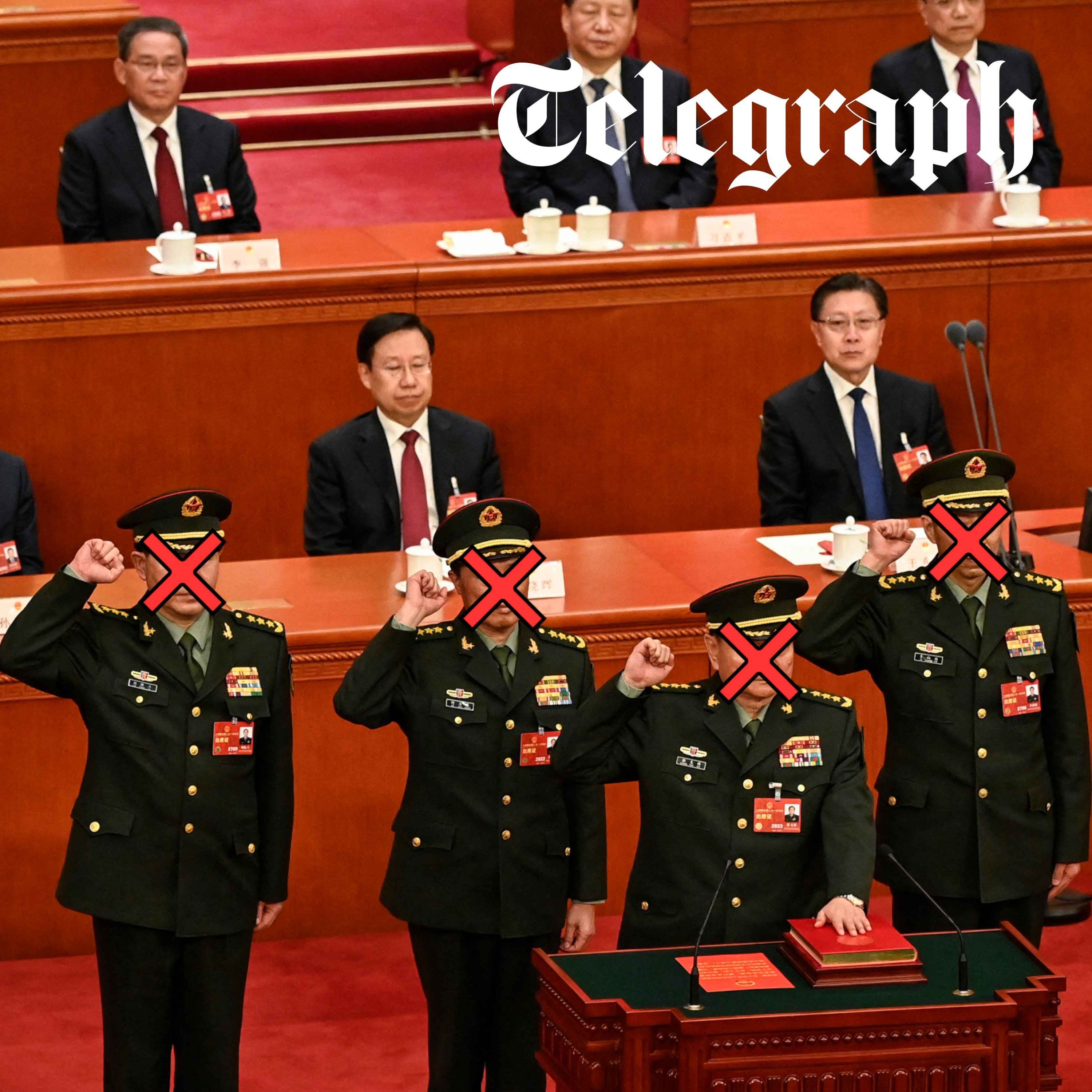
Welcome back. Now, as alluded to the other big China story this month that we have to discuss is the latest and most shocking chapter In Xi Jinping's unrelenting purge of the Chinese Armed Forces, General Zhang Yaosha was China's top commander and thought to be the President's most trusted military ally. But last week it was announced that he's been placed under investigation for quote unquote, serious violations of discipline and law. Essentially a euphemism for corruption. It's hard to overstate the significance of this development. As my colleague Colin Freeman put it in a Telegraph article, Zhang was the man most likely to be masterminding the purges, not falling victim to them. So what's going on and what does it mean for the Chinese Armed forces? To find out, I spoke to Oriana Skyla Mastro, the Director of the Indo Pacific Policy Lab at Stanford University's Freeman Spogli Institute for International Studies. She's also the author of How China Became a Great Power. I started by asking her to tell us a bit about who Jiang is.
- [34:46]
Oriana Skyla Mastro
General Zhang Youxia has been a well respected member of the Chinese military for some time. He is currently the first ranked Vice Chairman of the Central Military Commission. And this is the group that runs the military for China that has always had as its commander in chief, the head of the whole country, the head of the Communist Party, more often, in this case, Xi Jinping. He comes from a family of famous party leaders. He's the son of a general, General Zhang Zongshun, and he has served in a lot of trusted positions, even serving as an interlocutor with Americans in a lot of military to military exchanges. Which suggests that Xi Jinping has trusted not only his competence but also his loyalty to send him overseas.
- [35:31]
Venetia Rainey
He's also one of the few people in the PLA who has actual combat experience, right?
- [35:36]
Oriana Skyla Mastro
Correct. That is what is said. I will say that when senior leaders have risen to positions within the Central Military Commission, it has now become common to say that they had operational experience mostly in the war against Vietnam. But in many cases we can't independently verify whether that's the case. For me, as a military specialist, it's just interesting that now that serves as a source of credibility to say that you did have combat experience to highlight the fact that even though the Chinese military hasn't fought in many years, their leaders at least understand what war fighting is about. So that is a big part of his credibility. Though it's always hard to verify the roles that some of these senior leaders might have actually played in that failed conflict against the Vietnamese.
- [36:17]
Venetia Rainey
He was thought of as untouchable because he was this childhood friend of the President, and he'd survived many years and rounds of purges that we've recently seen. And we can go into that in a bit more detail shortly. But I want to get into this Wall Street Journal report that he'd been leaking nuclear secrets to the U.S. i'd love to get your gut instinct on that, because it seems, well, a little bit unlikely to me. For the Americans to have such a highly placed source would be incredible. And then for the Chinese to admit it is deeply embarrassing. So I'm curious as to what you think is going on there.
- [36:49]
Oriana Skyla Mastro
So this is purely speculation, but given that in China under Xi Jinping, there have been the passing of a number of laws saying basically, people aren't even allowed to talk about national security. We're talking about individuals like myself traveling to China and asking questions about it. I've been part of a lot of exchanges with people in China that have party connections. And in particular, particularly given the recent Chinese nuclear buildup, there's been a lot of discussion about what motivates the buildup. Why is China doing this? What does this mean for security? So if I had to purely speculate, I would say probably he was a part of some sort of exchange in which he was attempting to reassure the United States about Chinese intentions. And so he might have made some comments about the motivations. Anything in China, anything about national security is a state secret. And so when I hear that, I doubt it was some plans for silos somewhere or the level of secret that we referred to, but it could have been an attempt to lay out Chinese motivations for their nuclear program, nuclear buildup, whether or not they're gonna pursue certain types of capabilities. And that was seen as lack of loyalty to China for interacting with the Americans in that kind of frank and intimate matter.
- [38:00]
Venetia Rainey
This idea of loyalty seems to be at the heart of all of this. He was denounced. Zhang was denounced by a former manager of the China National Nucle Corporation, who is himself under investigation for corruption. It feels like a throwback to the times of Mao, doesn't it?
- [38:14]
Oriana Skyla Mastro
Well, what's really important is that the first anti corruption campaign that Xi Jinping undertook when he first came into power around 2013, it really was going after blatantly corrupt and incompetent members of the military. And as a military specialist, I will tell you that the military became a much more professionalized force thanks to that anti corruption campaign. So Xi Jinping got to throw out people who didn't support his desire to reform the military the way it needed to be reformed. So what to me is very significant about the second round is if it's not really about the sort of competency and we don't see this sort of blatant corruption of the military, running karaoke bars in towns to make money like we did pre the first corruption, then it does seem like it's personal and it's political. And so if I had to flip a coin, is this Xi Jinping getting increasingly worried, paranoid, or is this Zhang Yosha going off the reservation? I'd probably say it says more about Xi Jinping than it does about Zhang Youxia.
- [39:11]
Venetia Rainey
As you mentioned, this purge has been going on for a while. Since Xi came into power, he's dismissed at least 17 generals. And as you mentioned, we're sort of in the midst, or maybe this is the peak, who knows, of the second round. It sort of began in 2023. He kicked out two defence ministers one after another. He started purging the PLA rocket force, which does sound like it was a bit of a hotbed for corruption and mismanagement. Such huge budgets involved in the nuclear weapons that they were involved in taking charge of. And then we had, in 2024, Admiral Miao Hua was. And then last year, General He Weidong sort of went missing in March 2025. And then we heard later that year that he'd been formally expelled. You started to touch on it a bit there, but I'd love to get a more explicit answer. Do you think this is making the PLA stronger or fundamentally weaker?
- [39:54]
Oriana Skyla Mastro
Initially it made the PLA stronger because there were senior leaders that were trying to hold on to basically army control of the pla. And the military had to reform in a way that it could conduct operations in the air, at the sea, be able to conduct joint operations. Now we've reached this stage and Xi Jinping, his purges were very unique, not only in terms of scale, but as you referred to the level of leadership that was involved, which was something that he was very proud of and that would be publicly on the TV all the time about the fact that no one was safe if they were kind of stealing or acting inappropriately in the eyes of the Chinese people. But at this stage you have to ask yourself either is every Chinese high level General Admiral a a bad seat or is there a problem there? And I think at this stage the military is going to lack the type of leadership that they need to go into the next level. And it's always been a problem. Command and control is the number one problem that Xi Jinping faces right now. Not in terms of loyalty to the party, but between higher ranking officers and lower ranking officers enlisted in conscripts. And so if people who are at the lower ranks can have faith in the people that they're supposed to be serving under, this exacerbates issues of command and control. So that's a long way of saying that it's not always the case that these types of purges are going to hurt the readiness of the military. But I think at this stage, at this level of purges and how many people are being like thrown out, that at the very least there's going to be administrative delays associated with trying to get new people into positions and spun up, if not have an impact on the morale of people in the pla.
- [41:32]
Venetia Rainey
Because the Central Military Commission has been reduced to its smallest size in history. I think there were eight members and now only two, one of whom is Xi, and then the other is Zhang Shimin, the military's anti corruption watchdog. Some people have suggested that by cutting out the older generals who may or may not have combat experience, who can counter Xi's opinion, they might be replaced by wolf warriors, people who are more likely to take risks. There's some suggestion that Zhang was pushing back against the idea of taking, taking Taiwan and trying to sort of balance out how difficult it would be in reality and trying to make sure that China didn't get ahead of itself in that respect. Do you think that's a risk? And I'm thinking about Taiwan specifically and how it might sort of change their calculation for the west as to when China might be ready to try and take it militarily, if it feels that's necessary.
- [42:18]
Oriana Skyla Mastro
So I don't know where the speculation was that he was pushing back on the taking of Taiwan comes from. So I can't comment specifically on that. But in my interactions with the pla, I would be surprised if that was the problem. Because in the 15 years that I've been asking them about their capabilities to take Taiwan, I would say that they really offer realistic assessments, not only to me, but because Xi Jinping has been very clear that he wants reported failures to make sure that they're ready when they're ready. That has also been reported to xi Jinping since 2013, where that has been a focus of the relationship between the military and Xi. So earlier on it was very clear that people would tell me, no, this is not something we can do. But it's become very popular in recent years to say that while the United States still has superiority more broadly in Asia, local superiority over the Taiwan Strait has now gone to China. That doesn't mean the operation wouldn't be hard. But I'd be surprised if. Because right now there is no call to take Taiwan before 2027. I wonder what type of conversation would have come up that Zhang would say, listen, we're not ready to do this, and Xi Jinping would be like, I know you aren't right, because they haven't finished the modernization. So I find that kind of hard to believe. I think maybe that's wishful thinking on the part of the United States or US Commentators or others, that there are more moderate voices within the Chinese system that aren't as gung ho about Taiwan as Xi Jinping seems to be. But that, again, it's hard to read into a system that is so opaque.
- [43:43]
Venetia Rainey
What does this tell us about Xi's grip on power? If this isn't about rooting out incompetent officials and were circumspect about how much corruption there was or whether he was actually leaking nuclear secrets and it is personal, does it suggest that he got wind of a coup or that his grip on power is waning? What do you take from that?
- [44:01]
Oriana Skyla Mastro
So it's one of two things. Either there are realistic threats to Xi Jinping's hold on power and now he's trying to force people out in order to consolidate his role, or he's paranoid and that the years he's been into power has increased in his paranoia. These have very different implications for the type of China we have to deal with. Honestly speaking, if it is that there's been challenges to his power in some cases, that safer in terms of a global stability standpoint than if he sees threats where there are no threats. But it is really hard to tell which one of those two scenarios we are currently experiencing. He got rid of all the factions, like 10 years ago. So he's been able to do what he wants and everyone's been scared of him for a while. So I think that really does raise the question of, like, why was this so necessary?
- [44:46]
Venetia Rainey
We've got the British Prime Minister, Keir Starmer, in China this week. The whole world is tripping over themselves trying to figure out whether China is friend or foe. We had Mark Carney last week making the speech about middle powers sticking together, having to make pragmatic choices. We know he's striking a trade deal with China. How does the west navigate China?
- [45:03]
Oriana Skyla Mastro
That's a question for a whole book, and luckily I've written a whole book about that called Upstart How China became a great power that describes how we should deal with China. But the bottom line is we don't even have to kind of decide if it is an existential military threat or the key to hope, stability and prosperity in the world. One thing I think we know for sure based on Chinese behavior, discourse and capability, is that we have a lot of competing interests with China. When you say the west, at least in this case, since you mentioned the uk, I would say the United States and allies and partners. And as China becomes more powerful, it will look to coerce allies and partners of the United States to instead adhere to their preferences, which are against our interests. So the bottom line is it is much better for US Allies and partners for the United States to still play the dominant role in the international system. The question always remains how much better, because war is very costly. And so unfortunately with moves in the United States right now, it's unclear whether the benefits of US Leadership are going to remain and whether those benefits are waning themselves. And so then maybe the costs of confrontation with China in order to maintain our sovereignty at home might not be worth it. But that's a decision that every country has to make for themselves. How much do they want to live under the thumb of the Chinese Communist Party? And how much is it worth avoiding either economic punishment, which happens to a lot, or those who are closer to China, you know, military attack and invasion?
- [46:30]
Venetia Rainey
That was Orianna Skyler Mastro, Director of the Indo Pacific Policy Lab at Stanford University's Freeman Spogley Institute for International Studies Studies. That's all for today's episode of Battle Lines. We'll be back again on Monday. Until then, goodbye. Battle Lines is an original podcast from the Telegraph, created by David Knowles and hosted by me, Venetia Rainey and Roland Oliphant. If you appreciated this podcast, please consider following Battle Lines on your preferred podcast app and if you have a moment, leave a review as it really helps others find the show. To stay on top of all of our news, subscribe to the Telegraph, sign up to our Dispatchers newsletter or listen to our sister podcast Ukraine the latest. You can get in touch directly by emailing battlelinestelegraph.co.uk or contact us on X. You can find our handles in the show Notes. The producer is Peter Shevlin. The Executive producer is Louisa Wells.
- [47:29]
Grainger Advertiser
If you're an H Vac technician and a call comes in, Grainger knows that you need a partner that helps you find the right product fast and hassle free. And you know that when the first problem of the day is a clanking blower motor. There's no need to break a sweat. With Grainger's easy to use website and product details, you're confident you'll soon have everything humming right along. Call 1-800-GRAINGER click granger.com or just stop by Grainger for the ones who get it done.
- [47:59]
Tommy John Advertiser
Flowers die in three days. Matching underwear from me undies. That's a gift that lasts. Meundies creates matching prints for couples and friends. Same adorable designs and different cuts for each of you, all made from their signature ultramodal fabric that feels impossibly soft. With 30 million pairs sold and 90,000 five star reviews, MeUndies matching prints are the perfect gift. Valentine's Day is February 14th, so don't wait. Get exclusive deals up to 50% off at Meundies.com acast code acast that's Meundies.com acast Code acast.