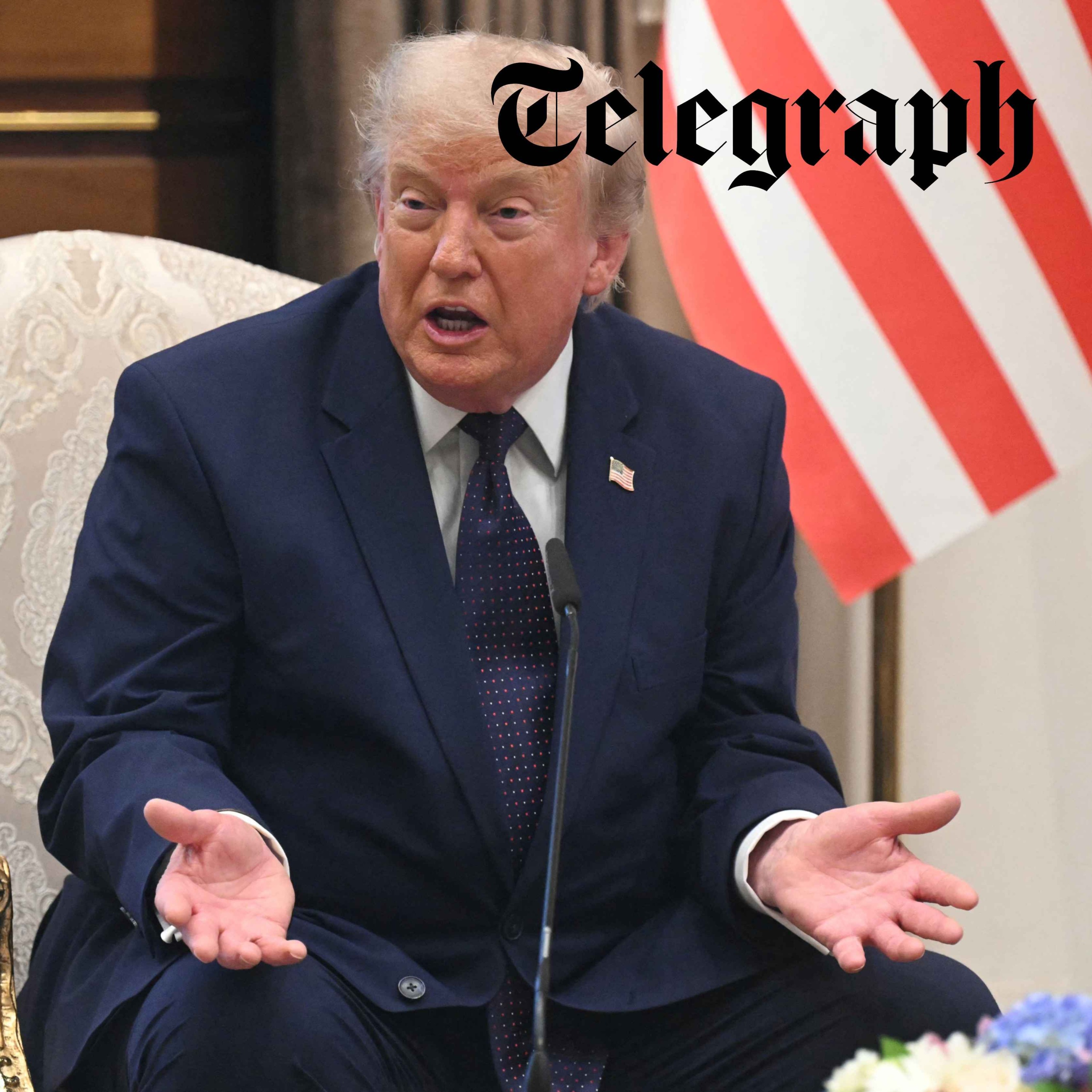
Loading summary
Transcript105 lines
- [00:04]
A
The telegraph. I'm Venetia Rainey and this is Iran. The latest. It's Tuesday, 7th of July, 2026, day 16 of the 60 day deadline to reach a peace deal between the US and Iran. On today's episode, we'll be covering another Iranian attack on shipping in the Strait of Hormuz and getting a dispatch from Roland about Trump's arrival at NATO. Plus, we'll be speaking to Al Khans, the recently resigned British Armed Forces Minister and ex soldier, about what is at stake at this key NATO summit and how he would approach the Iran war.
- [00:44]
B
A short time ago, the United States military began major combat operations in Iran.
- [00:52]
A
Today, President Trump says Iran's Supreme Leader,
- [00:54]
C
Ayatollah Ali Khamenei was killed in the attacks.
- [01:02]
B
The Pentagon is working a takeover of
- [01:05]
C
that island as a way to force
- [01:07]
B
the reopening of the Strait of Hormuz. Iran begged for this ceasefire and we all know it.
- [01:13]
C
This is a historic meeting.
- [01:15]
D
Never before has the Iranian and American leadership met at such a high level.
- [01:20]
C
Can we turn over a new leaf?
- [01:22]
D
Can we change relations in the Middle east permanently?
- [01:25]
C
Does anyone really think that someone can
- [01:27]
B
tell President Trump what to do?
- [01:30]
E
Come on.
- [01:31]
A
But first, over in Iran, it's day four of the public funeral assassinated Iranian Supreme Leader Ali Khamenei. His coffin is now in Qom and tomorrow it will be heading to Iraq ahead of it being brought back to Iran to be buried. But not everyone in Iran is focused on the funeral at the moment because down in the Strait of Hormuz, an oil tanker has been hit by an unknown projectile that started a fire on board the ship. This happened yesterday, Monday. There are no reports of casualties or environmental damage. It Iranian media claimed the ship was struck because it was planning to pass through the Omani route in the Strait of Hormuz with the support of the US Navy. Now, this is this southern route that we've been talking about repeatedly on the podcast. And an Iranian official has repeated the line that we've heard a lot over the last few weeks, that any action in the Strait of Hormuz without coordination with Iran is doomed to failure. So a reminder that Iran's military has said that ships transiting the waterway have to use the authorized northern route or they will face off from forceful response. Iran is currently in talks with Oman to try and charge fees for services in the waterway, but the US And Gulf Arab states say they oppose any transit fees there. Now, the memorandum of understanding between the US And Iran is supposed to try and deconflict this. There was supposed to be a kind of hotline to deal with incidents in the Strait of Hormuz. Whether that's happening in the background, we're not sure. But things are moving in the waters in the Strait of Hormuz. So according to data tracking company Kepler Horse, Hormuz weekend traffic has showed resilience. Between the 3rd and 5th of July, Strait of Hormuz traffic remained active. A total of 108 crossings across a wide range of vessel and cargo types, slightly weighted going east to west, but remained spread across this Iranian and Omani route. Some crossings continuing across this middle route. And there are still some sanctioned ships crossing the route as well. Well, this is probably as good as it's going to get for a while. In the Strait of Hormuz between Iran attacking boats and Trump threatening again to bomb Iran, the MoU, this memorandum of understanding is really just a bit of paper at the moment. Speaking to reporters in the Oval Office yesterday, Trump said, look, we're going to
- [03:46]
B
win one way or the other. We're either going to make a deal or we're going to finish the job. Okay? And it won't be tough to finish the job. I'd rather make a deal because I don't want to affect 91 million people. We can knock down their bridges in one hour. We can knock out their energy supply. All of those big plants that they built, big, beautiful modern plants, they had a lot of money. They don't have any money now. We haven't given them any money. But we can knock out their electricity and power generating plants. And I would say a small part of an afternoon, every plan will be gone.
- [04:25]
A
And they know that Iran has responded with predictable fury. Foreign Minister Abbas of Rajchi has said that negotiations on a final deal will not commence if these sorts of threats continue. Now, meanwhile, in Lebanon, there is ongoing military activity while the ceasefire is still holding. Let me just explain exactly how that's working. So Israel has been conducting airstrikes and demolishing some villages in southern Lebanon where it's maintaining a military presence. And the Israeli army has warned that it's ready to restart the war in full if Hezbollah violates this ceasefire. But that does appear to be more or less holding for now. I haven't seen that much about Hezbollah attacks. However, talks do seem to be progressing a bit more on this Lebanon front. We've got meetings coming up in the following weeks. Netanyahu wants to meet with Trump after the NATO summit, and the Lebanese president, Joseph Aoun, is set to meet with Trump later in July. There are also more direct talks between the Lebanese and Israeli ambassadors in, in Rome next week. So we'll see what comes out of that. Now, slightly separate from what we normally discuss, but still in the Middle east and completely fascinating. Hamas has dissolved its government in Gaza. This is the first time that this has ever happened. And it's part of the peace deal between Israel and Hamas and the US There. What was supposed to be happening is they were supposed to transfer power to the UN backed Palestinian technocratic committee called the National Committee for the Administration of Gaza. But that committee isn't in Gaza yet. It's actually stuck in Cairo because Israel has been preventing it from entering the Gaza Strip nearly six months after it was founded. Israel has called Hamas dissolving its government a media stunt and has pointed to the fact that Hamas has not actually disarmed yet. So, fascinating little nugget of development there, and we'll keep an eye on that. And just finally, one thing to flag that the French President, Emmanuel Macron, has been in Syria to meet with President Ahmed Al Shara. There have actually been explosions heard in Damascus today, but according to Macron, the visit is continuing and it's the first one by a European Union head of state since the fall of Bashar Al Assad. So that is quite significant. Okay, let's turn to the NATO summit now. Donald Trump has arrived, so the event is well and truly underway. This was him speaking earlier today.
- [06:29]
B
I was very disappointed with NATO and frankly, if it weren't held in Turkey, where my friend happens to be a very strong leader, a very strong person, it's possible that I wouldn't have attended. I felt I had to attend because of the fact that, you know, I know he's gone all out. It was a big thing to have NATO come to Turkey or anyplace else.
- [06:53]
C
It's a big thing.
- [06:55]
B
But we weren't treated well because we did something in Iran. We don't need anybody's help. I didn't even want their help. But before I asked, they said they wouldn't be there. And we've invested trillions of dollars in NATO. Why? To protect European countries. And in a way, I was testing people. I was testing to see whether or not they'd be there, because I've long said that we help them, but I'm not sure that they'd be there for us. And Italy turned us down, and Germany turned us down, and France turned us down, and it's okay, but, you know, why are we spending hundreds of billions of dollars and they're not there for us. We've always been there for them.
- [07:40]
A
My co host, Roland Oliphant, is on the ground in the summit in Ankara and has been watching everything. He sent us this dispatch.
- [07:46]
E
It's been a quite long day in Ankara. Things drawing to a close on the first day. Donald Trump has arrived and made his first remarks. The first kind of real big news signpost, I think, of the summit. He's just given a few comments to the press with President Erdogan, who he was meeting. What did he say? Well, I think the first headline is he signaled pretty strongly he is going to let Turkey have the F35, the program they were kicked out of in 2019 for buying air defense missiles from Russia. He, he talked, when he was asked about that, he basically talked about how, how great an ally Turkey is. He battered away questions about a third party maybe acquiring F35 technology. By that they mean Russia. And he talked about, you know, there's no point in having sanctions on our friends. So the Turks will be very pleased to hear that. That's something they've been pushing for a while. Other questions about Europe itself. Not, not, not very happy with his traditional allies. I suppose we were expecting that. He was asked if he's about a possible further troop drawdowns in Europe. He said, we're going to have to see. He said he probably wouldn't have shown up to this summit if it, it wasn't in Turkey and being held by his friend, President Erdogan. So, yeah, that whole question about whether he was looking to punish NATO for their. Well, in his view, failing to show up in the war with Iran is very much on the table. He didn't give us a firm answer, yes or no, how he's going to punish them or if he will. But Turkey, on the other hand, has been a great ally for us. They know Iran very well. Turkey could have got into the fight on the other side, he suggested, but they didn't. Maybe because of Donald Trump. Trump, I don't know. I don't know if Turkey was on the brink of getting involved in the war on either side, but there you go. So what else? He. He also praised President Erdogan for helping in the peace process in the Iran conflict, which he said, is not war, it's a, it's a, it's a military operation. Where have we heard that line before? It's a denuclearization, he said. Turning to the question of Ukraine, he claims, having spoken to both Vladimir Putin and Volodymyr Zelenskyy, in the past couple of days before coming here, that they both want to get it settled soon. So President Trump is very much signaling that he thinks that there is space for the Ukraine war to be brought to a close this year. Not much more detail on that, but that's pretty much the long and short of it. And then Greenland came up again. It always does, doesn't it? That real bone of contention between Europe and the United States. Donald Trump was asked whether he's satisfied with the way negotiations are playing out there or whether the US Will ultimately have to annex it. And this is what he said. That's what hurt my relationship with NATO, because Greenland doesn't help Denmark. Denmark doesn't spend money to help Greenland, but it's an important part of the United States and it's surrounded by Chinese ship and Russian ships. And that's not going to happen. And then he says it should be controlled by the United States, not by Denmark. With all the money we spend to help them with Russia and we don't have to spend any money, we could remove all of our soldiers out of Europe because you may have noticed Europe's a very different place than it was 20 years ago. So really kind of straight up ultimatum, give us Greenland or US Troops leave Europe. Whether that actually amounts to anything beyond some angry rhetoric, who knows? But once again, the Greenland question is back on the agenda. So that sets the tone for tomorrow. It looks like Turkey is going to get its jets. Good news for Erdogan. It looks like the Europeans are going to be treading on thin ice with Donald Trump, especially regarding American troop numbers in Europe, though he hasn't been specific about drawing that stuff down. Interestingly, I think for the Ukrainians in particular, he didn't talk much about the big Ukrainian ask, which is about air defense missiles, about getting hold of more Patriot interceptors. We know that the Ukrainians are going to be President Zelensky's here and he's going to be meeting Donald Trump tomorrow, I think to talk about that. No particular signal from the US President on that. We'll keep you updated. We've got telegraph correspondence in every possible part of this summit. Joe Barnes and Spiryan with us also. So check in with us tomorrow and we'll have more updates.
- [12:11]
A
That was Roland Oliphant on the ground in Ankara. We're going to take a short pause now. Coming up after the break, a former Labour minister on whether NATO has a future. Welcome back. You're listening to Iran. The latest with me, Vinny Shirani. Now, amid Trump's fury over Iran's war, the demands of the Ukraine war and the growing isolationist tendencies in Washington. Does NATO have a future? To answer all of that and more, my colleague Dom Nichols and I sat down with Al Kaanz. He's the former Armed Forces Minister for Labour under Keir Starmer. He resigned a few weeks ago, however, in anger over the lack of money being spent on defence. Here's our conversation. Al Khans, welcome to Iran, the latest. And Ukraine, the latest. A special joint interview episode with me and Dom Nichols. How worried are you about this NATO summit that's taking place right now about the future of the NATO alliance?
- [13:11]
C
So I would say I always sort of revert back to NATO as the most successful defensive alliance of all time. It will all be down to primarily what President Trump says and the tone and the sort of second, third order effects of what he says. I think he will continue on the same trajectory of saying Europe needs to spend more on defense, you need to move to meet your targets that he set previously. And I think you'll see an increasing pivot from an American perspective to what they would see as their major security concern in the Pacific.
- [13:41]
D
Do you think it's fair that he, Donald Trump, talks of consequences for NATO nations that don't meet their spending commitments when the US are not at 5% and have not in their national defence strategy, have not demonstrated a roadmap to 5% themselves?
- [13:55]
B
Yeah.
- [13:55]
C
So, I mean, I have an issue with the percentage points as a whole as a measure of effectiveness. What I would say is that I actually in a lot of cases agree with the Americans that they have underpinned European defense for a long time, and rightly so, because it was in the best interest, because they saw Russia as the major threat. Now that I think they perceive that as changing. From their perspective, they are shifting the resource elsewhere and they expect others to thicken out both their defense industrial base and their capabilities to protect your own borders. So I do agree with it. I perhaps disagree with the speed and the trajectory of change needs to be balanced to ensure Europe can build up particularly its defence industrial base fast enough to protect its own borders.
- [14:39]
D
And consequences. Isn't that a bit harsh?
- [14:41]
C
Well, what do you mean by consequences?
- [14:43]
A
I think withdrawing troops is what they've threatened.
- [14:45]
B
Right.
- [14:46]
C
Well, but they, you know, in some cases, the Americans, if they see the Pacific as a major threat, they need to rebalance their combat power. That's a basic military judgment that will be led, that will be messaged by politicians. And so if they need to rebalance their combat power to deal with what they perceive as their biggest threat, then that is a consequence. The consequence is that the west collectively needs to spend more on defense. And you know, if you look at Trump's first term to where he is now, Europe has picked up the pace. But is it picking up the pace fast enough and is it buying the right things to deter Russia in the future?
- [15:18]
A
That's the key question, right. Is Europe ready to take on its own security protection if America does start withdrawing a significant number of those 80,000 troops that we've currently got stationed in Europe? Do you think we are?
- [15:30]
C
Well, I mean, collectively, if you pull together all the troops in NATO, even without America, we massively outweigh Russia. My concern actually is that I don't think if Russia in any way, shape or form wants to challenge NATO as a collective. My concern is actually slightly more tactical, but has strategic implications. Let's take on the map in front of us here, one of the most effective Russian combat brigades. Take it off the front line and now move it and make it look over the border into Estonia, Latvia, Lithuania or Finland. If it doesn't see a force that looks like and feels like and has the capability of a Ukrainian brigade, what I'm talking about is thousands of drones, anti air drones, attack drones, medium range drones, long range drones, then it doesn't see a deterrence, it sees an opportunity. And that's my biggest concern. This why this is part of the defense investment plan. It's all about uncrewed systems. So NATO needs to really think about what it looks like, how it fights, learn lessons from Ukraine, ensure when Russia looks over the border, it goes. We're not going to touch that because it's going to cost us, as it has in Ukraine, 1.5 million casualties and we can't afford it. That's determin.
- [16:34]
D
Do you think Keir Starmer should take this opportunity in his last or major muscle move as pm, certainly his last NATO conference to deliver a few home truce to the Americans? Or would he be better just making sure that his success, whoever that may be, has a smooth run into the office.
- [16:51]
C
So I think Keir Starmer has done an exceptionally good job on the international stage. I think he's done a very good job of balancing American interests, European interests, UK interests and getting us to the right place. I think he will walk away from this NATO summit probably striking the right balance and making sure that our relationship stays intact, which is strategic both with the US but importantly with the Europeans as well. And we continue to act as that keystone between the two. I think that would be a good end state of the summit. But I also know that there will be some interesting moments when Trump speaks at the Ankara summit and I think he will continue on the same track to say, Europe, you need to spend more, you need to do more. We're not underpinning European security anymore.
- [17:31]
A
That's interesting, though. So do you think Starmer has dealt with Trump the right way over the Iran war? That he was right to let him use UK bases for defensive purposes only? A bit of a wibble at the beginning where he said, no, you can't use them at all, and then said you could use them defensively. Was that the right approach?
- [17:44]
C
I've always said three things before putting troops in harm's way, of which we have all been involved in in the past. A legal mandate. You need a plan and you need an end state.
- [17:54]
A
Didn't have any of those.
- [17:55]
C
You don't have those, then I'm not in. And I think Keir made the right decision. I fully support him in that decision. And, you know, everyone, everyone was sort of on the fence thinking what was right or wrong to do. But then let's, let's not shy away from the fact. Whilst the legality, the plan and perhaps the end state we weren't clear on, you know, Iran had enriched uranium multiple times the amount under jcpoa. It had been a sponsor of terrorism from Yemen to, you know, Hamas to Hezbollah. It had been sponsoring illegal finance and, you know, weapons sales into Russia for a long time. It's been, you know, for, for 30 years, it's been the sponsor of terrorism right across the Middle East. And so, you know, it needed to be dealt with in one way, shape or form. But I will go back to the legalities that, you know, you need a legal mandate, you need a plan and you need an end state. And if you don't have those, and I don't think you should be involved,
- [18:46]
D
you say it need to be dealt with one way or the other. Has it been dealt with? It looks like we are back to the start point of JCPOA. But having given us. Having given Iran $10 billion.
- [18:56]
C
Yeah. And therein lies my point. You need an end state. If an end state was to denuclearize Iran, have we achieved that? I would argue probably not. I'm not read into it, but probably not. If you look at the plan, did the plan go? The Americans wanted. We could all told you. I've been sat in planning teams when I was in The Navy or in the Marines. Looking at the Straits armor years, we knew the Iranians were developing multiple capabilities, multifaceted capability to block the straits on moves which would give them the political and military leverage to, to choke off one of the key waterways in the world. We knew this was going to happen.
- [19:28]
D
But you know better than both most that most wars these days aren't, aren't one where the enemy has been utterly vanquished. So looking at Iran now, this is, this is surely a strategic victory for Iran, is it not?
- [19:42]
C
Well, you know, Iran militarily has been knocked back five to 10 years, but
- [19:45]
D
they only need a couple of drone boats to threaten the Strait. The insurance companies say we're not going to do that.
- [19:49]
C
But militarily, as a comprehensive military capability, they've been knocked back five to 10 years. You're also seeing an arms race now in the Middle east of where, you know, very effective countries such as the UAE and Saudi are saying we'll never allow this to happen again. So they're building up capability to make sure that they can withstand any future Iranian aggression, but also retaliate. And I think that's a very wise strategy. And then what you're also seeing is people starting to sort of take note that whether we like it or not in the west, some of these foreign conflicts are a long way from home, can directly affect us. And we, you know, we still haven't felt the full weight of this blockage of Straits Hormuz. 8,000, probably 10,000 ships now haven't gone in or out of the Straits of Hormuz since the start of the conflict. I mean, it's having huge implications for the world markets. CO2, ammonia liquid, natural gas. It's huge.
- [20:39]
A
I mean, and that requires some kind of response. Right. We saw ships being attacked by Iran yesterday in the Strait of Hormuz, again because they're using this southern Omani route that the Iranians don't approve of. Mark Rutter speaking today said that Trump is right to be disappointed with his allies over their lack of involvement in the Iran war. NATO didn't get involved then. Should it be getting involved now to reopen the Strait of Hormuz with military escorts?
- [21:01]
C
I think what you've seen is the UK lead the way alongside France to build a multi national capability to go and protect the Straits of Hormuz. Last, last time we did this in 1987, I think it took an excess of 30 frigates and destroyers. Like it's a big operation if you do it inside a kinetic environment. So there needs to be an overarching peace envelope. And then even then you've got to clear the mines. And these are everything from acoustic mines to tethered mines to dumb mines and then all of the different asymmetric problems that Iran could throw. And this is going to go on and off. And this is my point about who has the upper hand, which I think you mentioned earlier. You know, Iran is within miles of the Straits or moves can open and close it as it. As it sees fit, with relatively limited capability of which it has learnt off of Ukraine and Russia during the conflict.
- [21:47]
D
And yet under previous administrations, Britain has removed the Royal Navy frigate that was permanently assigned to the Gulf region. The mine hunting squadron has also gone. That is surely demonstrating that we're not serious players when it comes to global security, despite the fact that we're a
- [22:04]
C
P5 nation, I think you're saying. I mean, we talked early on about America and balancing its security interests. What you're seeing is the UK in some cases do the same. We've seen a 30% increase in subsurface and surface activity in the North Atlantic from Russian capabilities. You've got a war on the eastern edge of Europe which cost 1.5 million casualties. Tank battles that you have seen in the Second World War. Of course we're going to have to reprioritize our capability. The reality is the conservative part disinvested in mine hunting in the Middle east because we're moving towards an autonomous capability of which you're now seeing has been tested and trialed off Gibraltar, ready to work in around the Straits or moves as required. And I think that's again learning lessons from Ukraine, which is a really good thing.
- [22:45]
D
Putin is now in a corner, going nowhere on the ground in Ukraine. All he's able to do, as he repeatedly does, is kill civilians from the air. Are you concerned that he's going to escalate either in conventional terms up to and maybe beyond the nuclear threshold, or Test NATO Article 5 elsewhere?
- [23:06]
C
Yeah. So I think. I think you're onto something here. I've actually just written a piece about escalation dominance, which is part of a broader set of Russian doctrine. If you. If Russia finds it can't move any further in Ukraine, it's really struggling and it's. And the cost is too much. 35 000. 30, 000 casualties a month. And then Ukraine is now unshackled perhaps from some of the. The US restrictions of deep targeting inside Russia. So you're seeing Moscow and St Petersburg now being hit. So The Russian elite, the Russian center, are now feeling the effects of this conflict and that will be reverberating all the way to Putin's office door, I can guarantee you. He needs to find a way to bring this conflict to an end before it turns relatively negative. And so he doesn't actually have a huge amount of options in Ukraine because Ukraine are doing so well, and then escalation, dominance come in where you escalate somewhere else to force the international community to come in to do a deal in Ukraine to de escalate an alternative problem. And so I would keep a very close eye on asymmetric threats, sabotage. I'd keep a very close eye on cyber influence operations of which linked to Iran we can talk about in a second. But also any issues you see around NATO's eastern flank outside of Ukraine.
- [24:22]
A
I just want to read you a quote. This is a critical moment in our national history and our politics should be reflecting the gravity of the situation. Every single party in Westminster should be talking about British national security. We're sending an outgoing Prime Minister who's completely powerless to the NATO summit and he's taking with him a defense investment plan which he knows is not fit for purpose, with barely half of the additional funding that our armed forces need. I don't think Vladimir Putin is going to be worried about Nigel Farage, and I don't think he's going to be worried about Andy Burnham. Do you agree with that?
- [24:48]
C
No.
- [24:49]
A
What bit don't you agree with that?
- [24:50]
C
Because we're a nuclear deterrent. We're nuclear power. We give our nuclear deterrent to NATO, we declare it to NATO. And so he definitely cares. I mean, we're Russia's number one bad guy in Europe and I think we should take great sort of privilege in that. I. E. We've stood up for Ukraine time and time again and called out Russian malign activity, usually leading Europe and supporting NATO in doing so. And I think I. I don't think in any way, shape or form, I think Russia sees us as the beacon of hope across the world for democratic nations. And so it's in his best interest to die the downplay us, divide us or break us apart. Can I give you a little vignette, which is quite interesting? You're like this because it connects the two.
- [25:27]
A
Wait, I'm just going to come back on that, because the point of that quote, and that was Kemi Badenoch, Leader of the Opposition, speaking this morning, which maybe you knew or maybe you didn't, was that Britain is not spending enough on Defence, which is exactly what you resigned over. You just said and we're taking the Defence Investment Plan to NATO. It's a bit embarrassing, isn't it? Are we really able to look our allies in the eyes and say that we're doing as much as say Poland, for example? I mean, this is the stuff that you resigned on. And I'm just saying you agree with the Leader of the Opposition, don't you,
- [25:51]
C
that we're not doing enough. I actually think whoever is the next Prime Minister, they will find the next spending round the money to close the gap step required for the Defense Investment Plan. What I would say is 28 billion was a lot of money based on the old capability set. And so I didn't agree with where the money was going in the first place. Do I think that we need a hundred plus tanks?
- [26:10]
A
No, but is 15 billion enough?
- [26:12]
C
But, well this is, this is the point. What is enough? Because the Defense Investment Plan need modernized to push forward a new revolution in warfare that we're seeing in Ukraine. And this isn't, this isn't small amounts of money. This isn't small percentage of the entire equipment plant. This is a rebalancing of the equipment plan to learn these lessons and make sure the applicable ones are employed within our armed forces. Let me give you a little story. I think it's quite interesting. So when American Israel struck Iran last year on Midnight Hammer, they destroyed a couple of targets outside Tehran. When they destroyed those targets overnight, circa 3% of Scottish independence media died. Completely died overnight. It's open source, you can check it out, like completely died. Why is Iran meddling in Scottish independence now? Iran's propaganda budget will be minuscule, like a needle in the haystack compared to Russia's. 1.5 billion a year they spend on propaganda. How much is Russia spending inside the UK to break apart social, religious, cultural ties? You know, really get amongst the, the gaps and push them apart between Scotland, Wales, Northern Ireland and England. Why did the Wales Welsh reform leader get 10 years in prison for taking Russian money? And let me extrapolate this out. If we end up with a. We'll see what Nigel has to say today. But if we, if we end up with a reform Conservative government in 2029, do you end up with Scottish independence by 2031? Because Scotland sees reform as an English nationalist party. Whose interest is it in to have Scottish independence and a breakup of the United Kingdom? I didn't fight for Scotland, Ireland, Wales or England. I fought for the United Kingdom. The world sees the United Kingdom as a beacon of hope and democracy. So if you don't need to sail a battleship, drop a bonfire bullet, you just need to drive a wedge between different parties, different groups within this country. And we'll eat ourselves alive, break the nation apart. And that's a UK order.
- [27:58]
D
All of which makes the Defence Investment Plan and the Strategic Defense Review that underpinned it all the more important. Sounds a little bit like you were saying that the STR needs to be reopened because what was in the dip was, was not in the str, not in its entirety, not the scale that the dip suggested.
- [28:14]
C
Well, you know, I again watched the SDR happen in parallel. The SDR was done by some very capable people, but in some cases, I don't think it jumped on the revolution of, of warfare or the changing character of conflict in Ukraine. I don't think you can, you've been to Ukraine. You can't really understand it until you've seen it. And it's a difference between a farmer in medieval times using a scythe and someone coming in with a combine harvester. 5,000 drones a day just in one section of the front line. 26,000 kilometers of fiber optic cable over Perkorsk, a village the size of Hereford. 12,000 drones in the air over a village the size of Hereford in one day. Like it is a different game altogether.
- [28:54]
A
Is Andy Burnham the man to lead us forward and kick our defense sector?
- [28:57]
C
Well, he's been really positive. Some of his comments he's made around defense, he's been, he's been given a difficult challenge to fill the financial bucket, but he said he will find the money for the defense investment plan.
- [29:08]
A
So where would you find the money?
- [29:10]
C
I think it's a combination of multiple factors. I think this trade off one or other, I think you can go. I think there's a couple of different areas in particular, I think we need more balance with our energy supply around net zero. But I think everybody goes, where's the trade off? Take the pound from the nurse to give it to the soldier.
- [29:26]
A
Welfare versus warfare, right. I mean, that's what the Tories want to.
- [29:29]
C
But let's just have a look at welfare versus warfare. You know, we spend 100. We have lost 110 million, 110 billion pounds on mental health alone over the last, you know, every year, take 10% off that. There's 18 billion pounds on re offenders in prison that go back into prison. That costs 18 billion. Take 10% off that. And people not in education, employment, trains. 125 billion a year take 10% off that. Go into variety of other areas across government and try and make the productivity a couple of percentage points better and you'll find you'll have savings and fiscal headroom to make. Well, fill both the defence budget and probably spend to save models elsewhere in government.
- [30:08]
A
So you would cut welfare.
- [30:10]
C
So you came up with a sort
- [30:11]
A
of Tory rough vision.
- [30:12]
C
I've always been really clear. Well, welfare reform and as motor of the Labour Party said, it does need consistent reform. It's got to become more efficient, it's got to be more hand up, not handouts, but people who need help that cannot work must get the support they require.
- [30:25]
A
Assuming he doesn't rip up the defence investment plan and doesn't add more than the 15 billion that we've got, would you join his cabinet?
- [30:32]
C
That'd be down to Andy.
- [30:34]
A
Would you though, if you were asked?
- [30:35]
C
Well, I mean, my job is to serve the country and so depending on the situation, I'll always, you know, jump
- [30:42]
D
at the
- [30:44]
C
opportunity to serve. The reality is I didn't resign in any way, shape or form for reward. I resigned on a matter of principle.
- [30:53]
A
Has that principle been sufficiently addressed for you to rejoin the cabinet? I guess that's what I'm asking. We've gone from 13.5 to 15, so not enough.
- [31:00]
C
Well, the other piece is Northern Ireland legacy. Remember, there was three things I resigned on. One was money. One was to do with the transformation nature of the defense investment plan, lessons from Ukraine. And the third one was Northern Ireland legacy to ensure that we came to amenable solution for truth reconciliation justice in Northern Ireland. And I didn't think that Bill was in any way, shape or form getting to the right place. It needs some changes and we can get there. I've been speaking to veterans and, you know, associations all the way through that process.
- [31:26]
A
Let's do some quick fire questions.
- [31:27]
D
Okay. And these are. We'll give you the opportunity to expand afterwards if you like, but they are yes no. I know you hate yes no's, but these are yes nos.
- [31:35]
C
It depends how rubbish your questions are.
- [31:38]
B
Okay, go.
- [31:38]
A
Should NATO let Ukraine join?
- [31:42]
C
Yes. In the future?
- [31:44]
D
Should there be a second referendum on Scottish independence?
- [31:48]
C
No.
- [31:49]
A
Should Israel withdraw from southern Lebanon?
- [31:53]
C
Yes.
- [31:54]
D
Should Ukraine be given air defence systems to deal with the Russian ballistic threat?
- [31:58]
C
Yes.
- [31:59]
A
Has Russia been too cosy with Trump?
- [32:01]
C
No.
- [32:02]
D
Do you think Palantir should be in the nhs?
- [32:05]
C
Need to look at the detail.
- [32:07]
D
Go on. Then you can have the coup de grace to the back of the head.
- [32:10]
A
Should FIFA have overturned the red card on us? Striker FOLERAN Balogun after Trump intervened.
- [32:14]
C
There's no way politicians should be interfering in sport.
- [32:17]
A
Solid answer. Al Khanz, thanks very much for joining us.
- [32:20]
C
Thank you, guys.
- [32:20]
A
On Iran, the latest in Ukraine, the latest.
- [32:22]
D
Thank you.
- [32:22]
C
That was great.
- [32:23]
A
That was me and my colleague Dom Nicholls speaking to former Armed Forces Minister Al Khans. We'd love to hear what you thought. And have you got any questions for our correspondents on the ground in Ankara at the NATO summit? You can drop us a comment underneath this episode on YouTube or Spotify, or send us an email. We're on battlelinestelegraph.co.uk. we've already had some lovely emails about last week's episode. One comment from our regular listener, Beth Anne Kruger. Hi, Beth, thank you for the interesting and informative interview with Sophia yan on the July 3rd around the latest episode. We appreciate her willingness to share her personal insights and views. Yeah, I thought that was a really interesting episode. Sophia very rarely talks about her personal backstory. She's a total professional journalist. So really interesting to hear about her mum's views on Trump and, you know, her upbringing and how her journalistic careers has shaped how she's experienced America from abroad. So do go back and listen to that episode if you missed it. That's all for today's episode of Iran the Latest. We'll be back again tomorrow. Until then, goodbye. Iran the Latest is an original podcast from the Telegraph, created by David Knowles and hosted by me, Venetia Rainey and Roland Oliphant. If you appreciated this podcast, please consider following around the latest on your preferred podcast app. And if you have a moment, leave us a review as it helps others find the show. To stay on top of all of our news, subscribe to the Telegraph, sign up to our Dispatchers newsletter or listen to our sister podcast, Ukraine the Latest. We're still on the same email address battle lineselegraph.co.uk or you can contact us on X. You can find our handles in the show Notes. The producer is Max Bauer. The executive producer is Louisa Wells.