Loading summary
Transcript114 lines
- [00:04]
Sasha Brookman
The telegraph.
- [00:10]
LifeLock Representative
Lifelock. How can I help?
- [00:11]
Customer/Client
The IRS said I filed my return.
- [00:13]
LifeLock Advertiser/Narrator
But I haven't One in four tax paying Americans has paid the price of identity fraud.
- [00:18]
Customer/Client
What do I do?
- [00:18]
Sasha Brookman
My refund though. I'm freaking out.
- [00:20]
LifeLock Representative
Don't worry, I can fix this.
- [00:22]
LifeLock Advertiser/Narrator
Lifelock fixes identity theft guaranteed and gets your money back with up to $3 million in coverage.
- [00:27]
Customer/Client
I'm so relieved. No problem.
- [00:29]
LifeLock Representative
I'll be with you every step of the way.
- [00:31]
LifeLock Advertiser/Narrator
One in four was a fraud paying American. Not anymore. Save up to 40% your first year. Visit lifelock.com Specialoffer terms apply.
- [00:39]
Acast Advertiser/Narrator
Influencer marketing isn't what it used to be. We're shifting from reach to resonance, from impressions to impact. It's no longer about how many people see your content, it's how deeply you connect with them. And nothing creates that connection quite like podcasts. Acast's podcast pulse 2025 report reveals how podcast creators are redefining influence through resonance, multi platform fandoms and their ability to shape culture. So if you're a marketer who's tired of vanity metrics and looking for meaningful results, podcasts are where you need to be. Download the full research free at podcastpulse2025.com.
- [01:21]
Sasha Brookman
We're seeing that the US Military isn't ready and it's still moving forces into the region. So we're still actually on high tension and this is going to explode quite literally at some point in the near future.
- [01:31]
Donald Trump
We will measure our not only by the battles we win, but also by the wars we end.
- [01:38]
Akhtar McCoy
Right now all eyes are on Washington, but who's actually watching Europe at the moment?
- [01:46]
Sasha Brookman
The deepening ties between China, Russia and North Korea would certainly have some in Washington concerned.
- [01:52]
Roland Oliphant
And then Daddy has to sometimes use strong language.
- [01:55]
Donald Trump
We're going to run the country until such time as we can do a safe place, proper and judicious transitions.
- [02:02]
Customer/Client
The IDF will continue to uphold the cease fire agreement and will respond firmly.
- [02:06]
Sasha Brookman
To any violation of it.
- [02:10]
Roland Oliphant
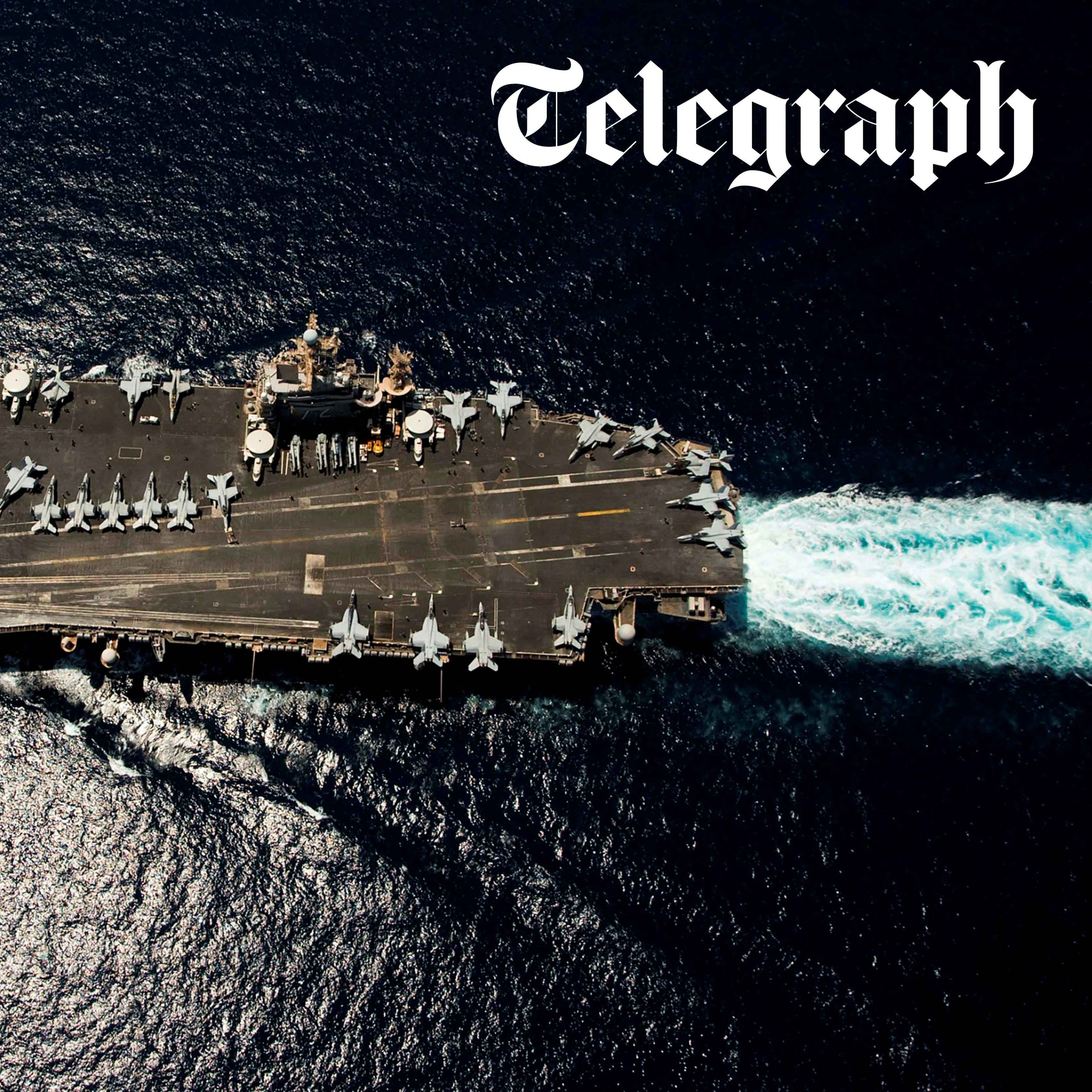
I'm Roland Oliphant and this is Battle Lines, the Telegraph's foreign policy and defense podcast. It's Monday, February 2, 2026. Last week Donald Trump moved a beautiful armada, including the USS Abraham Lincoln carrier strike group towards Iran in preparation for massive airstrikes to punish the Iranian regime for the massacre of of thousands of protesters last month.
- [02:34]
Donald Trump
We have a large armada flotilla, you can call it whatever you want, heading toward Iran right now, even larger than what we had in Venezuela. But we're now sending actually a larger number of ships to Iran, and hopefully we'll make a deal. If we do make a deal, that's good. If we don't make a deal, see what happens.
- [02:58]
Roland Oliphant
Here at the Telegraph, and I assume in newsrooms across Fleet street, we're on standby for our weekends to be interrupted. If the Americans dropped a bomb on Ayatollah Khamenei, it didn't happen. This morning we were told that the Americans and the Iranians are locked in serious talks to avert a war. Mr. Trump seems to have pivoted from regime change to using his armada as leverage for a new nuclear deal. Will be looking at how that diplomacy is progressing and whether the threat of war has passed. Meanwhile, inside Iran, political fractures over the killings are widening, with reformers distancing themselves from the government. And as the Internet blackout lifts, Iranians outside the country are beginning to learn just what happened to their friends and relatives. How many people killed, how many people survived, and what happened to those who were wounded today. To discuss all this, I'm joined by Sascha Bruckman, a research fellow for defence and military analysis at the International Institute for Strategic Studies, and the Telegraph's foreign correspondent, Akhtar McCoy. I began by asking Sasha to summarise where he thinks the military standoff is today.
- [04:07]
Sasha Brookman
I don't think the threat of war has passed yet. I'm of the year, watching how the military buildup has played out over the last couple of weeks. We've seen capabilities rushing into the region, but not at the capacity that would be needed. And thus, as we have been counting and trying to count, you know, how many escortons have moved, how many destroyers, how many airwings or how many escortons are on the Abraham Lincoln and what damage could they do? And where are the bombers? My conclusion still is we're still in heightened tension. The threat of war, of airstrikes against the regime, Khamenei decapitation, or against wider elements of their regime such as the igc, has not passed and we're still in the phase of military buildup.
- [04:47]
Roland Oliphant
And, Akhtar, I know you've been looking at what's been happening inside Iran and getting a sense of the voices emerging. Could you just give us a sense of how that picture is becoming clear and what is the latest from the ground inside the country?
- [05:01]
Akhtar McCoy
Yeah, as you said, Internet is slowly restoring across the country, and we are seeing a more clearer picture of the massacre and its aftermath. And across the country, in every corner of Iran now, we are seeing footage and clips are coming up. We see lots of people Thousands of those young people are getting buried in Iran. And there is a common sense of sadness across the country. And the language is still threatening from the Islamic Republic official. We had the armed forces chief of staff today saying, okay, we have changed our defensive doctrine to offensive, ready to war with Iran. Khamenei was saying yesterday any war with Iran would be a regional conflict, that the language is still threatening. And we are seeing more cliffs, more information, more details about what happened on January 9th and 8th.
- [05:48]
Roland Oliphant
Thank you, Akhtar. We'll come back to that. And I do want to share some testimony that's been shared with me from eyewitnesses from the massacre, which is pretty extraordinary stuff. Let's start then with the big geopolitical scene then. Sasha, you said that you don't believe we're out of the woods. The threat of war or the threat of a decapitation strike is still there. However, the Americans are now seem to be offering the regime a new nuclear deal instead. What do you think is the calculation and the rationale behind that?
- [06:23]
Sasha Brookman
The Americans for the last couple of weeks have told the regime that they want a new nuclear deal better than for Trump. This one has to be better than Obama's JCPOA for sure.
- [06:34]
Akhtar McCoy
But.
- [06:34]
Sasha Brookman
But they have also linked the conventional missile program and the proxy forces, the Iranian proxies in the Middle east, to that. And I think either of them or the three combined would be too much for the regime to give up. So I can't see with also the rhetoric of the regime coming out of the last couple of weeks that there's anyone in Tehran who is serious about giving up the nuclear program, the conventional ballistic missile program, or the proxies that they have groomed for half a century by now almost. So I think we're seeing delaying tactics on both sides where the Iranians are trying to find a way out to calm tensions and maybe to talk Trump off the ledge. Meanwhile, I think we're seeing that the US Military isn't ready and still moving forces into the region. So the talks and the actions on the ground, I don't think they match up. I'm worried that we're still actually on high tension and this is going to explode quite literally at some point in the near future.
- [07:29]
Roland Oliphant
Okay. So the diplomacy might just be cover, buying time while they move, move more forces into the region for an operation.
- [07:38]
Sasha Brookman
I think everyone is serious in trying to explore what is possible, but ultimately the positions are so far apart that at some point there will be the. I think Trump will make the determination that there is no sense in talking to the regime. As in the regime will not give up what he needs them to give up. And therefore at some point he'll come to the conclusion that violence is on the table.
- [07:57]
Roland Oliphant
Again, I just want to explore this because if he's asking them to give up their nuclear program, that kind of suggests that the bombing campaign last summer, which we're told just wrecked their main nuclear facilities, wasn't that successful. Therefore there's still things for the Iranian regime to give up or it was completely wrecked. But this is just some kind of gambit for some other reason. The Trump administration wants to offer this diplomatic opportunity. I'm wondering if you have any view on that. And what we know about what condition the nuclear program is, is in, does it still exist in, in any serious form?
- [08:36]
Sasha Brookman
I don't know for sure where the nuclear program stands. I think what we need to keep in mind, last year with Midnight Hammer, we were only talking about the tip of the pyramid. So we're talking about the free installations. Isahan, Fordo and Natanz, with Fordo being the one that everybody talked about with the bunker busters, with the massive ordinance penetrator. I think what was largely overlooked is also how much of let's say that nuclear industrial base was actually destroyed during the 12 day war. So from facilities that make carbon fiber heat resistant materials to the facilities that make some of the Iranian centrifuges, they were all hit. They were all struck. Now, I like my personal assessment, I know this has been hotly debated and disputed, is that nuclear program has taken some serious setbacks. But it's in a state where with enough time and money, the Iranians could restore it. And I think that is what is currently on the table. Diplomatically.
- [09:28]
Roland Oliphant
It's so difficult to marry these two parts of the story. On the one heart, you've got this international tensions and Trump's talking about the nuclear program again. And at the same time, there's this domestic thing going on in Iran and it's just getting those two things, maybe.
- [09:45]
Sasha Brookman
Think of that also, that there's a geopolitical opportunity. It is not just at the risk of war, but if you are a planner in the White House or in the Pentagon or, or even in Tel Aviv right now. Right. This is the opportunity to reverse the geopolitics of the Middle East. To flip has been as it is for the last 55 years. If Iran's regime were to fall, an entirely new geopolitical landscape emerges in the Middle East. And you will weigh these Risks versus the opportunity of becoming that president. Who has made that possible?
- [10:15]
Roland Oliphant
Right.
- [10:15]
Sasha Brookman
Iran since 1979 and started with the hostage crisis. Hezbollah burst into activity in 1982 by blowing up the US embassy. And from there on, we conflict ever since. And the entire geopolitical landscape is divided in that conflict, with the Iranians trying to, in their mind, I think, kick out the Americans and kill the Israelis, because that's what they think are the impediments to controlling the Middle East. A different regime would mean there are other opportunities for alliances and a new, completely new geopolitical structure in that. And that's, I think, also what people in the White House and in the Pentagon will be weighing.
- [10:52]
Roland Oliphant
So that that moment of opportunity is still there. That temptation to try to do something really grandiose has not gone away.
- [11:00]
Sasha Brookman
Whether the opportunity is still there because now you have to sync your military action with the protest. That is a difficult one. But can you resist that? That temptation, as you say, is there.
- [11:10]
Roland Oliphant
Aktar, is this a kind of conversation that's going on in Iran? They do worry about regime change. What can you tell us about the regime's attitude to all of this?
- [11:18]
Akhtar McCoy
The view from Tehran on this, the view from Tehran. Every time there are some protests or there is any threat coming from inside or outside the country, and when the regime survives, it feels more powerful, the crackdown would be even more severe. And you just talked about the foreign threats that the Islamic Republic has to deal with, the Americans and everything. But the Islamic Republic also has to deal with something else inside the country, the reformists and its former president, Hassan Rouhani, who was a president for eight years and then before that for 16 years, he was the secretary of Supreme National Security Council. He's directly criticizing the Islamic Republic's policies. He said there is a big change that is needed to be done by the authorities to listen to the people's demands. And his remarks were criticized again by hardliner politicians.
- [12:05]
Roland Oliphant
This is what over the weekend.
- [12:06]
Akhtar McCoy
Yeah, on Saturday. And then a hardliner MP said, okay, the biggest change, the best change the Islamic Reform, the Islamic Republic can have is to arrest Hassan Rouhani and execute him. And also on the front, the Reformers front, where Hassan Rouhani is coming from, dearest spokesperson said over the weekend that they can no longer justify the Islamic Republic crackdown. And they are distancing themselves from what the Islamic Republic did during the last month's protests. And also the other ones, Mir Hossein Mousavi and Karubi, the leaders of green movement in 2009. After the 2009 protest, they are also speaking out over the past few days.
- [12:43]
Roland Oliphant
These are the guys under house arrest or in Evin prison.
- [12:46]
Akhtar McCoy
Yeah, Mir Hossein has been under house arrest, mir Hossein, since 2011 and Mehdi Karabi was released conditionally last year. So they both said. Mr. Karabi said Ayatollah Khamenei has, like he is to be blamed for what the country is going through now. And Mir Hossein Mousavi asked on armed forces to lay down their guns against the people. So there is a sense of cracks within the. We don't really, we can't really say the reformists are a part of the Islamic Republic because they have been pushed since like after Rouhani was the president. They have been pushed aside and they were disqualified from running for parliament for president until Pezeshkian won. So there is like this sense of cracks that are beginning to appear within the Islamic Republic.
- [13:31]
Roland Oliphant
This is a movement that's already kind of marginalized within the political landscape.
- [13:36]
Akhtar McCoy
They are still now trying to distance from themselves from the regime's crackdown on protesters.
- [13:43]
Roland Oliphant
Sasha, there was talking about the great temptation before the Americans and the Israelis that actually maybe we could get rid of the Islamic Republic. This could be an opportunity and so on. And yet at the same time, the Americans are putting this proposal on the table. Come to the table, give up your nuclear program, limit your missiles. I suppose if I was Ali Khamenei, if I was in his position, I think I'd probably take that deal because my nuclear programs has been pulverized. I can't make a bomb soon anyway. It would take a long time to restore it and I would get sanctions relief with that, which means I would guarantee the survival of the Islamic Republic for many years because I would get a flood of money. Shouldn't he just take this deal? Will he take this deal?
- [14:26]
Akhtar McCoy
No. I mean, you said no. Yeah, you said no. Khamenei's mindset is a revolutionary mindset. If he comes to the deal with Americans, any sort of deals, which he has been talking against it for decades, it would show his weakness, his regime's weakness, and it is not what he would like to portray to his supporters. There might be some back channel talks through the Arabs in the Persian Gulf or through, I don't know, to anyone else. But officially on state television, on tv, Khamenei is not going to come and acknowledge any deal. He was criticizing for years, that 2015 nuclear deal, the JCPOA, and he has always pushed the government, any government power in Tehran, any administration, whether it's a reformer, whether it's hardliner to not talk to him, to not trust Americans. And he's now in a weaker position than previously, of course. But he wouldn't still go directly talk to Americans, say, okay, now let's have a deal. Let's have a handshake. A handshake with Americans is not something Khamenei would like you to see. There might be in the background in some way.
- [15:31]
Roland Oliphant
So even though giving up the nuclear program means giving up something that is basically a wreck anyway.
- [15:35]
Akhtar McCoy
Yeah, that's like giving up the nuclear program, giving up missile program. That's the face of the Islamic Republic. They won't just come and say, okay, we won't have anything with nuclear, we won't enrich uranium at any level. That's what Trump wants. And we won't have missiles. Which that means that the end of the Islamic Republic, that, like, revolutionary ideology of making the White House a Hosseini.
- [15:58]
Roland Oliphant
Area, even if it means sanctions relief, which would mean a lot of money, would mean kind of making your population happier, and it would mean more cash for the regime. Comedy survival.
- [16:08]
Akhtar McCoy
Yeah, but Khomeini is not Khomeini to drink the cup of poison. He may at some point, if, like.
- [16:14]
Roland Oliphant
In the background, this is the cup of poison. This is when Ayatollah Khomeini had to sign a peace deal with Iraq at the end of the war, and he really didn't want to do it.
- [16:22]
Akhtar McCoy
Yeah. So Khamenei may have to be forced through that. But he is also under pressure from a hardcore part of the IRGC to not give up. To not give up anything to the Americans, because giving up even a single centrifuge in somewhere in Tehran's research center or whatever, that means, okay, we are surrendering to Americans demand. Trump's demand. And he was explicitly talking against that yesterday, saying, okay, what happened during last month was just a coup designed by American and Israelis. And now if you say, okay, we talked with Americans and we have a deal, he may let the Foreign Ministry to do it. But officially, publicly, he would be criticizing it. He would be condemning his own Foreign Ministry saying, why did you. Okay, we had to deal with the Americans just because we were in a position to do that. He wouldn't officially say we were under pressure. He would say Americans were keep calling us, they were begging us for a deal. But Khamenei is not a man to surrender to any American deal to any Americans demands, even if his regime, his survival is in danger.
- [17:27]
Roland Oliphant
That sounds like diplomacy is futile then, in a way.
- [17:32]
Sasha Brookman
Not futile in a sense. It builds the backbone of future actions. Right. So Trump can say that he tried in earnest to negotiate about these things. But yeah, I totally agree with what has just been said. Like, you can't be a revolutionary regime and at the same time relinquish the levels of power that you used to maintain influence. Ultimately, the Islamic Republic is not aspiring to just occupy Iran. Its aspiration is to be the dominant Muslim power in the world. You can't do that without the levels of power. Those are military proxies and potentially nuclear weapons. What if there's another crisis? Now, you don't have missiles right now everybody is calculating how many destroyers, how many aircraft carriers, how many interceptors do we have in the region. If he relinquishes one of his levels of power, which are the ballistic missiles, for example, the next crisis, he'll be forced to acquiesce.
- [18:25]
Akhtar McCoy
Yeah. And there is also another chance that Hassan Rouhani and Ali Al Rajani, they could use their influence within the office of the Islamic Republic Supreme Leader, in the office of Ali Khamenei to convince him to give up something, whatever. I mean, not like just completely stopping enrichment. But there is always a chance of Hassan Rouhani and Ali Larijani using their influence to soften the regime's language and trying to interact with Washington. They tried that in June. War. Both people are mainly not concerned about the Islamic Republic survival. They might be, but they're more concerned about their own political, their own life post Khamenei, whenever Khamenei dies. So Rouhani would like to be the supreme leader. I mean, he has no chance at the time you're talking, but when you are talking and Larijani at the same. He wants to keep his family, his family's roots and influence. We shouldn't forget that Larry Janis have a, have a very big influence within Islam. The family has a big, very big influence within the regime. And if he wants to use that influence to interact with Americans, that could be an option. But convincing Khamenei to talk to Americans, to relinquish anything is a hard job.
- [19:40]
Roland Oliphant
Coming up, as Tehran lifts its Internet blackout, Iranians abroad are beginning to learn just what happened to their friends and family and at home, who died, who was arrested and who survived. Keep listening for some of their stories.
- [20:00]
LifeLock Representative
Lifelock, how can I help?
- [20:01]
Customer/Client
The IRS said I filed my return.
- [20:03]
LifeLock Advertiser/Narrator
But I haven't 1 in 4 tax paying Americans has paid the price of identity fraud.
- [20:07]
Customer/Client
What do I do?
- [20:08]
Sasha Brookman
My refund though. I'm freaking out.
- [20:10]
LifeLock Representative
Don't worry, I can fix this.
- [20:11]
LifeLock Advertiser/Narrator
LifeLock fixes identity theft guaranteed and gets your money back with up to $3 million in coverage.
- [20:17]
Customer/Client
I'm so relieved.
- [20:18]
Sasha Brookman
No problem.
- [20:18]
LifeLock Representative
I'll be with you every step of the way.
- [20:20]
LifeLock Advertiser/Narrator
One in four was a fraud. Paying American. Not anymore. Save up to 40% your first year. Visit lifelock.com Specialoffer terms apply.
- [20:29]
LifeLock Representative
Say hello to Samantha.
- [20:30]
Customer/Client
Hi there.
- [20:32]
LifeLock Representative
Samantha built a SaaS platform that helps small businesses manage their workflow. But she needed a smarter way to reach decision makers.
- [20:38]
Customer/Client
That's where ACAST came in. They helped me produce a professional audio ad which played to business owners and ops leads using their audience attributes targeting tools. Suddenly my platform was showing up in the ears of the exact people I needed to reach.
- [20:51]
LifeLock Representative
Now that's streamlined marketing. Samantha, what's your tip for scaling smart?
- [20:54]
Customer/Client
Solve a real problem and make sure the right people hear about it.
- [20:58]
LifeLock Representative
Promote your business with podcast ads on Acast. Get started at Go acast.com advertise.
- [21:12]
Roland Oliphant
Welcome back. You're listening to Battle Lines, the Telegraph's foreign policy and defense podcast with me, Roland Oliphant. In the studio with me is our foreign correspondent, Actar McCoy, and on the line is Sasha Brookman of the International Institute of Strategic Studies. We're talking about Iran. I want to bring up what's happening to ordinary Iranians just now. And the reason is an Iranian contact of mine has just been in touch with people on the ground sending voice notes and she shared several with me. I'm just going to read out verbatim. I'll let it speak for itself. So this is the account of a 23 year old man. By his account, it was his mother's birthday and he had gone to the shop to pick up a cake when he walked into protests. I'm not sure exactly in which town this is. This is what he said. The smell of blood was everywhere. I saw a father on his knees trying to keep his son alive. I stepped forward to help. I felt like someone kicked my leg. I turned my head and saw my leg wasn't there anymore. It was just hanging by a strip of skin below the knee. I collapsed onto the body of the boy. A security officer stood over me looking down. You're still alive? The officer asked. He was then thrown into the back of a van with dead bodies. I was struggling to breathe under the weight of the bodies. Every now and then I'd hear a moan from the pile. I still hear these moans today in that half awake state between dreams and reality. At the hospital, a nurse noticed him that he was breathing. She whispered to him, don't say anything. Let them think you're dead. She tied a tourniquet, zipped him into a body bag and sent him to the morgue. And again his voice. I don't know how long I was in there in the cold, among the dead. I would lose consciousness and wake up until I felt them moving me. When security units had finally cleared out of the hospital, the staff retrieved him and hid him in the maternity ward, the only place they thought the regime wouldn't look for a wounded man. They amputated my leg there. He says I left the house to buy my mother a birthday cake. I never made it back home. This is just one bit of eyewitness testimony which came out, I was told literally on Saturday night as the Internet opened up. Akhtyl does that, what do you make of that? Does that match with what you're hearing?
- [23:30]
Akhtar McCoy
Yeah, that's pretty much it. Now Internet is slowly restoring. It's not fully restored yet. And you see now the full scale of the massacre, the full scale of the crackdown is getting more clearer. And as I said, every corner of Iran there is a shared sense of sadness and grief. Across the country. There were comedy shows on Prague private platforms. They would release an episode every week, like once a week, and they all stopped. And with all of this you would assume that the state television would also be like in like moment of sadness or grief or whatever. But it was not. Over the weekend, on a state television program on Ofo channel, it presents a mocked the dead protesters which sparked a public anger. The channel's director was sacked. The channel itself, the judicial filed a case against it. And it's just against what's going on in the country, which is just. If you open Iranian social media, you would just see these new faces, these young faces dancing like enjoying their life. And now they are dead. So it's a shared sense of sadness across the country.
- [24:38]
Roland Oliphant
There are a lot of numbers being thrown around and I'm kind of loath to cite them because they seemed so unreliable. But do we have any idea how many thousands of people were killed?
- [24:49]
Akhtar McCoy
I mean the Islamic Republic says 3117. In reaction to this state television program, a newspaper affiliated with Imam Reza shrines, the Astan Quds Razawin Mashhad said was like, had a, like an opinion piece today about it saying, okay, if the regime is saying 3,000 people are killed. And if the opposition are saying 30,000 are killed, the number is between 3,000 and 30,000. And we had, like several of them. All of them were, whether they were protesters, whether they were security forces, they were Iranians, they were trained within the Ministry of Education of Iran. In the state media, though, even those who are very close to the regime, they're also giving you that 30,000 number and 3,000 number.
- [25:38]
Roland Oliphant
So it's a lot.
- [25:39]
Akhtar McCoy
Yeah, it's a lot.
- [25:40]
Roland Oliphant
All we know is it's a lot.
- [25:41]
Akhtar McCoy
Yeah, it's thousands. Like unprecedented within the Islamic Republic's history or in the Iranian history. Previous protests, we would have like 500 numbers, 1500, 300. But now we are talking about something between 3000 to 30,000, which is unprecedented.
- [25:56]
Roland Oliphant
It's unprecedented, yeah. Everything that Akhtar has just said and what we're hearing from the ground, which is horrific. And then there seems to be this kind of quite esoteric discussion on the outside about numbers of missiles or uranium enrichment and so on. Do you think the situation on the ground really cuts through to the Western decision makers, like to Donald Trump and so on, or do you think he's just not interested in that subject? I'm finding it very difficult to balance this because there seem to be almost two conversations going on.
- [26:27]
Sasha Brookman
Look at how hard it was to list the IAGC as a terrorist organization now in the European Union, how some countries were not in agreement until very, very recently. Until like two days ago, three days ago. Right. Only just recently happened. I think the debate in the UK is turning the same way. Watching protests in so many towns, seeing the violence and the crackdown in so many different towns in each of the 31 provinces, I find it hard to believe that it's only 3,100. I would say the plausible. It's plausible that the number is actually much higher. But you're right, it's a bit of an esoteric discussion on numbers. Either of missiles, highly enriched uranium, how many killers, or how many people were killed, they were slaughtered in the streets. I think, unfortunately, on balance, we're in a different world order right now. And what Trump, the White House, the Pentagon, Foggy Bottom will care about is the larger geopolitical framework, and that's China, Russia, Iran. North Korea is a fragile, but it's an alliance system. Iran has positioned itself as an enemy of the United States, as an enemy of Israel, and as an impediment to your stability and security in the world. And some is a spoiler that always draws American military assets back from the Indo Pacific and into the Middle East. And that is, on the long term, not sustainable. I think, unfortunately, it's the colder geopolitical assessments that will influence the decision making rather than whether it's been 3,000 or 30,000 people that have been killed in the street.
- [27:51]
Roland Oliphant
You were talking about how you were. I'm kind of going back to the outside esoteric discussion of numbers of tanks and jet fighters and so on, but you were talking about, you know, counting air defense systems and ships and so on. Could you give us a sense of what the Americans have got in the region? You think that there's still a chance of military action? If so, what do we think that looks like?
- [28:11]
Sasha Brookman
I think capabilities have moved in, but capacity is still too low. We have seen over the last couple of years that Central Command, so the US Command responsible for the Middle east has been. Has been thinned out to about 30 to 40,000 soldiers, largely being kind of what we say, fitted to receive those forces that are actually the air wings, the squadrons, the ships and the air defense systems. So they always have to be rushed in. And that's also what we saw in 2024, actually already October 7th year. So the first thing the Americans sent was an aircraft carrier. Maybe as a point of comparison, if you think about last year, June war, I think there were five missile destroyers alone on the eastern Mediterranean rim, so protecting Israel, five Aegis class destroyers. There were several in the Red Sea. There were two aircraft carrier groups, two carrier strike groups in the western Indian Ocean. Right now we only have one carrier strike group. So this is just. This is always the first thing that US Presidents rush to. The Abraham Lincoln has several air squadrons on One is an F35 squadron, so 10 to 12 planes. Three are F18s and then there's one EA18 Gravas. So they're like four strike squadrons and one that is electronic warfare. That would help with the radars basically kicking in the door, so to speak. That is not enough for a sustained campaign. I actually think there will have to be some support from bombers coming from either flying from the continental United States, like we saw last year, or from Diego Garcia, which has an overlay with the discussion of the UK and the US currently about Diego Garcia's legal status and political support for this. But the main point is all we saw last year, there was additional battery of thaad, the Terminal High Altitude Air Defense System. There were additional patriots. There were these five destroyers just to protect Israel. That just gives you an idea what is needed to defend a country that has its Own integrated air defense system with Arrow three, Arrow two, David Sling, and as a last resort, Iron Dome. And still interceptors were running low towards the end. I think that was. It's an underappreciated element to the end of the conflict in June. Now the Islamic Republic has fewer of these long range missiles that can reach Israel than it has of the shorter range missiles that can reach American bases on the Gulf and can hit American allies, Gulf allies. So the threat is actually bigger now. If the Iranian regime thinks its end time, it would lash out against allies, oil infrastructure and American interests in the region. And it has more missiles at its disposal against Israel. The estimates vary quite a bit, but let's say 500 plus were fired or made it to Israel. Probably about a thousand were kind of lost because the Israelis also took out some of the launchers on the ground. 500 made it to Israel last year during the war. And 50, just under 50 had effect in Israel. That's an 80 to 90% range. I don't think we'll see the same thing here with the shorter range ballistic missiles. So you need more and more assets. And there's just not the amount of destroyers with that Aegis system. There's just not enough air squadrons, there's just not enough that. And patriots in this area right now.
- [31:22]
Roland Oliphant
Realistically, we're a long way off military action or offensive military action, this can.
- [31:28]
Sasha Brookman
Rush in in a very short time. But yeah, it's just not. The math doesn't matter right now.
- [31:32]
Roland Oliphant
The Iranians announced over the weekend that they would hold live fire exercises in the Strait of Hormuz. They appear to have cancelled that now. But closing that strait has always been something of a, well, a metaphorically nuclear option for them. Is shutting down that key oil artery something you think they would contemplate?
- [31:55]
Sasha Brookman
I think the exercises were not only live firing exercises. There was also an element of. There was supposed to be in coordination with Russian and Chinese armed forces, which if you think where the most likely location of the carrier is, would probably also be interesting because maybe Russian Chinese ships would be able to spot the carrier. Then they were canceled after. I think CENTCOM had a very interesting tweet out saying any unprofessional behavior will basically be interpreted as a hostile act and will fire up on you. There was any close overflights, any rapid approaches by speedboats towards our ships or something like that will be interpreted as if you were going. So there was. CENTCOM actually raised the temperature there and I think that actually deterred them because in the End the option for the Iranian Navy. It's a very asymmetric force of mostly smaller boats. They can attack civilian ships, but they cannot stand against the US Navy for any meaningful time. Their best option is to mine the Strait of Hormuz because it's basically two narrow lines, I think two nautical miles wide or something like that. And then clearing the mines would take a long time, long enough to upset global oil markets. It wouldn't be, you know, to play with the word nuclear option. It wouldn't be the end of the world, but it would be long enough probably to cause quite a bit of upheaval in global stock markets. Inflation might spike all of the stuff that Western capitals would not like to see. But the price would probably be the destruction of the, of the Iranian navy. So this is, this is a one off in multiple ways. And I think the regime would only go with that if it thought it were falling, if it felt it would be terminally threatened.
- [33:38]
Roland Oliphant
I think I read somewhere that Iranian oil exports themselves rely pretty heavily on the Strait of Hormuz.
- [33:45]
Sasha Brookman
Yes. And it goes to China. So, you know, if you're in Washington again, the Iranians are threatening their own oil exports to your other adversary while you are producing more oil now than you've ever done before. We're actually at the point where US oil producers stop because the price is down by $60 per barrel, where some of their profits are going down. So it's in a vastly different world from 20 years ago when you would think of no blood for oil. Iraq 2003, we're in a complete reverse situation right now. The Iraqi, Iranian, Kuwaiti oil goes to China, to the geopolitical adversary.
- [34:16]
Roland Oliphant
I'm losing count of the weeks. Maybe two or three weeks ago. Donald Trump said in a statement to Iranian protests, stay on the streets, help is on the way. Which many people believed meant intervention. It didn't happen then, didn't happen that weekend. It hasn't happened this weekend. Sasha just described why we're not even, you know, they don't have the forces in place to act now. I'm wondering if you, if Iranians feel that they've been led up the garden path a bit by Donald Trump.
- [34:50]
Akhtar McCoy
Yeah, they pretty much do. We spoke with several of them, several protesters who are inside Iran and many who are crossing across the border into Turkey. They said, and Trump has blood on his hands because they were encouraged by the US President to go on these streets. And former Crown's Prince Reza Pari was encouraging protests to go and attack regime's Propaganda centers. So they're both men. Iranian protesters, many protesters are now saying they should also be blamed for the thousands who were killed. And when we look at the moment the Islamic Republic survived again and NES strikes, whether it's on nuclear site, whether that's just, just killing the supreme leader would not change the regime in Iran. It would just spark another civil war worse than what happened in Syria and Libya. Because what Iranians are saying, they said, okay, I mean first like we saw during the June war that many regime opponents who don't like the regime would, when there is a foreign intervention, they would be supporting the regime. We saw that in June. And now what they say, they say, okay, if there is a foreign intervention, any opposition group that comes should have international support, should have a five year plan for what they would do on the morning after the Islamic Republic. And that should have a support like from within the country. Because if, just imagine right now, Khamenei, the regime just collapses. So what comes up in the morning next, the next morning in Tehran? So for now, as we are seeing, as we are looking at it, the Islamic Republic has survived. There is a famous story in Shahnameh, the Persian book of kings. In that story there is a king called Zahak who ruled the world for 1000 years, who was brutal. Now some protesters are comparing Zahak had two snakes coming out of his shoulders and he would fed them with the brains of young men to survive because otherwise the snakes would eat him. So now many supporters are comparing Zahmani to Zahad, just using like killing young people to survive. What changed? Zahaq was someone called Goldismid who rose against the brutality of Zahaq and went and found someone whose fathers were previous king and then they started rebellion against the Zahaq and toppled them. At the moment, every single Iranian who came up to call for a change is a Kaaba. But we need a unifying figure, Kaveh the Goldersmith that every single Iranian supports.
- [37:22]
Roland Oliphant
The narrative that we're hearing is that Reza Paqlavi is that figure.
- [37:26]
Akhtar McCoy
No, he doesn't.
- [37:27]
Roland Oliphant
I don't believe he's not.
- [37:27]
Akhtar McCoy
He is definitely not even close to it. He is not. Maryam Rajavi is not.
- [37:33]
Roland Oliphant
I just think to be fair, I think we need to make a distinction here. So we're not saying that they are one and the same thing. No. Mariam Rajivi of the Mekhi, very separate to the Reza Paklavi's kind of monarchist movement. They don't like each other. And I think it's fair in saying that most Iranians will have more time for Reza Pahqlavi, whereas Maram Rajavi is regarded as basically a terrorist.
- [37:59]
Akhtar McCoy
Yeah. Isn't that fair? We both agree on that. But the Islamic Republic would be in power until there is that one unifying figure covered the goldsmith to rise up against the Islamic Republic with less foreign intervention. So Iranians historically do not like foreign intervention. They would like to change things by themselves, but they need that cover the goldsmith.
- [38:25]
Sasha Brookman
I totally agree. It's interesting to think about what would need to happen for the regime to fall first and foremost. Right. Because we're talking now already after the fact, the civil war or something. I haven't seen any meaningful defections inside. So there were incidents like individuals who might have defected from the police or that there were these two guys in the subway who were supposed to be Artesh. But I was watching very, very closely and trying to find anything on defections within the artes. So for the viewers, then, the regular conventional military force that is largely made up of conscripts, but historically speaking, the remnants of the Shah's army that wasn't trusted and the IAGC is kind of the counter coup force to that. And I haven't seen anything. And that's kind of what worries me. First and foremost, now Trump is too late. It's out of sync. Secondly, I also think a decapitation strike might not get the people back on the street for various reasons, including the external interference. And third, unfortunately, I doubt that there's enough defections and the level of friction in the regime. There is friction, but that that level crosses the threshold where we're talking regime disintegration. And you would need to see, I think, people with guns turning against Islamic Republic. I don't think it's in the IHSC because they are the ones who are, so to speak, in the money and whose life would be upended if the regime falls. But I also didn't see anything in the Faraja, so the uniformed police forces or in the attached, the regular armed forces. And that's kind of what worries me.
- [39:56]
Roland Oliphant
That is unfortunately, all we have time for on this edition of Battle Lines. Thank you to Sasha Brookman at the International Institute for Strategic Studies and the Telegraph's foreign correspondent, Akhtar McCoy. Tune in on Wednesday for Battle Lines Global Health with Venetia Rainey and Arthur Scott Geddes. Until then, that was Battle Lines. Goodbye. Battle Lines is an original podcast from the Telegraph, created by David Knowles and hosted by me, Roland Oliphant and Venetia Rainey. If you appreciated this podcast, please consider following Battle Lines on your preferred podcast app. And if you have a moment, leave a review as it helps others to find the show. To stay on top of all our news, subscribe to the Telegraph, sign up to our Dispatch's newsletter, or listen to our sister podcast Ukraine the Latest. You can also get in touch directly by emailing battlelinestelegraph.co.uk or contact us on X. You can find our handles in the show. Notes the producer is Peter Shevlin and the Executive Producer is Louisa Wells.
- [41:07]
LifeLock Advertiser/Narrator
It's tax season and at LifeLock we know you're tired of numbers, but here's a big one you need to hear. Billions. That's the amount of money in refunds the IRS has flagged for possible identity fraud. Now here's another big number. 100 million. That's how many data points LifeLock monitors every second. If your identity is stolen, we'll fix it.
- [41:27]
Akhtar McCoy
Guaranteed.
- [41:28]
LifeLock Advertiser/Narrator
One last big number. Save up to 40% your first year. Visit lifelock.com specialoffer for the threats you can't control. Terms apply.
- [41:37]
LifeLock Representative
Say hello to Mia hey there. Mia runs a pet grooming service in Chicago, but getting new clients was rough.
- [41:43]
Customer/Client
Until I started using Acast. I recorded my ad targeted pet owners in the area and let Acast do the rest of the now people all over the city know about my grooming services.
- [41:52]
LifeLock Representative
Mia's business is looking sharp. What's your secret for happy pets and happy clients?
- [41:56]
Customer/Client
A fresh cut, a friendly vibe and a well placed podcast ad.
- [42:00]
LifeLock Representative
Get the word out about your business through Acast. Visit go acast.com advertise to get started.