← Iran: The Latest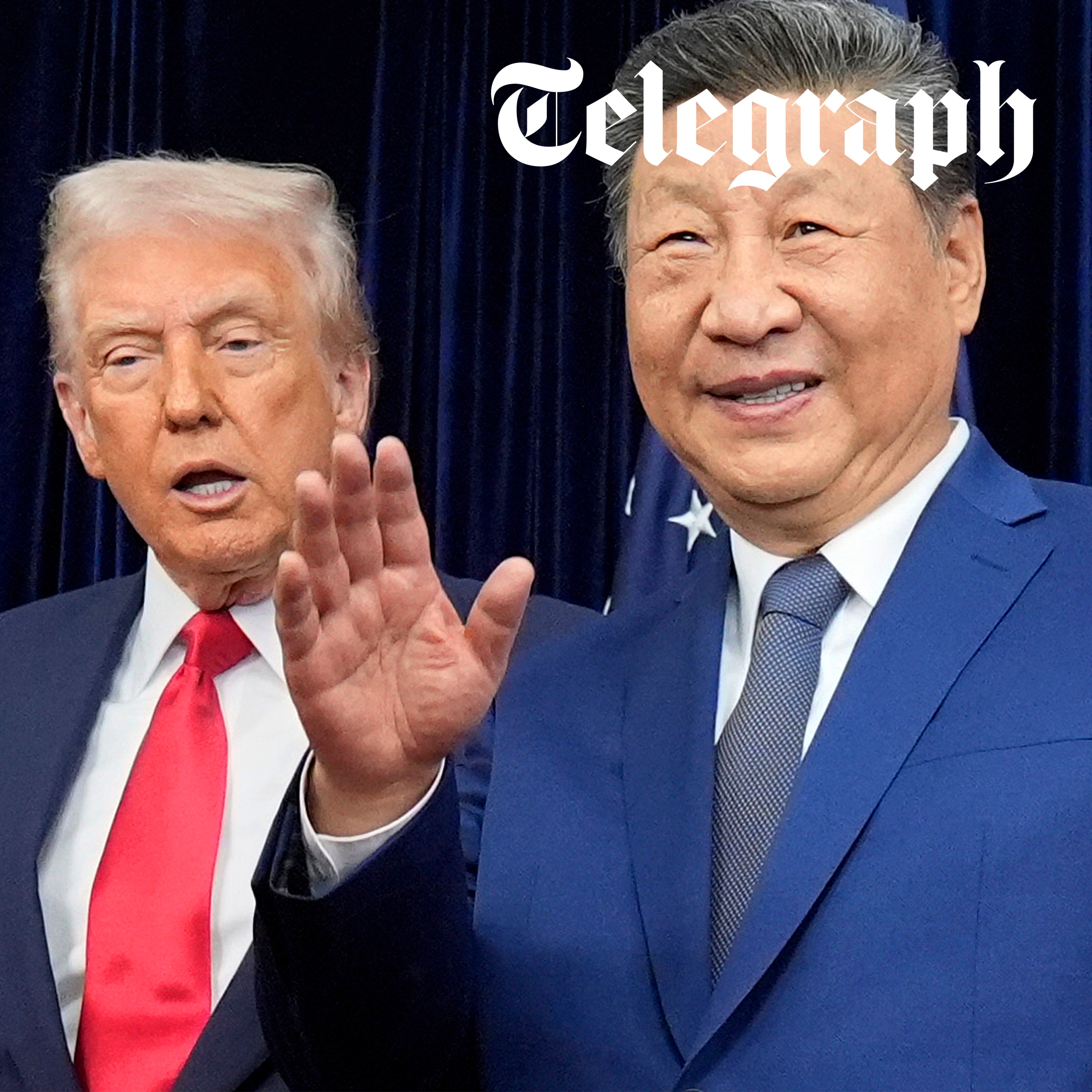
Loading summary
Transcript62 lines
- [00:04]
Xin Yi Pai
The telegraph.
- [00:09]
Paylocity Advertiser
When everything is moving all at once, your workforce, your tech stack, your business, you don't need more tools, you need one solution. That's why Paylocity built a single platform to connect hr, finance and IT with AI driven insights and automated workflows that simplify the complex and power what's next. Because when everything comes together in one place, growth comes easy experience. One place for all your HCM needs. Start now at paylocity.com One Premier hosts
- [00:40]
Premier Host Advertiser
on VRBO deliver quality vacation rental stays with fast responses and clear instructions so you don't have to worry about surprises.
- [00:47]
Xin Yi Pai
I asked our host a question about the house last night and he got back to me super quick.
- [00:52]
Premier Host Advertiser
See, that's a premier host move right there.
- [00:54]
Xin Yi Pai
I wish I had a premier group. Chad. I asked them where we should have dinner last night and they left me on red. I know you saw it. It says it.
- [01:01]
Premier Host Advertiser
Classic group chat move. Don't walk into a surprise. Book a top rated verbo. Stay with a premier host if you know you verbo.
- [01:24]
Donald Trump
A short time ago, the United States military began major combat operations in Iran.
- [01:32]
Xin Yi Pai
Today, President Trump says Iran's supreme Leader,
- [01:34]
Allegra Mendelssohn
Ayatollah Ali Khamenei, was killed in the attacks.
- [01:43]
Acast Advertiser
The Pentagon is weighing a takeover of that island as a way to force
- [01:47]
Roland Oliphant
the reopening of the Strait of Hormuz.
- [01:49]
Acast Advertiser
Iran begged for this ceasefire and we all know it.
- [01:54]
Roland Oliphant
Anyone really think that someone can tell
- [01:56]
Dr. Alessandro Arduino
President Trump what to do? Come on.
- [02:00]
Roland Oliphant
I'm Roland Oliphant and this is Iran. The Latest. It's Tuesday 12th May, 2026. 74 days since Israel and the United States launched a war against Iran and 35 days since they declared a ceasefire. That ceasefire is now officially, well, according to Donald Trump, at least on life support. The US President was scathing about Iran's latest terms and peace offer, which he called a piece of garbage. This is what he had to say speaking in the Oval Office yesterday evening.
- [02:32]
Donald Trump
Unbelievably weak, I would say. I would call it the weakest right now after reading that piece of garbage they sent us. I didn't even finish reading it. They said, I'm not going to waste my time reading it. I would say it's one of the weakest right now. It's on life support. They understand. These are all medical people. Dr. Oz, life support is not a good thing.
- [02:55]
Roland Oliphant
Do you agree?
- [02:56]
Donald Trump
Diagnostic? I would say the ceasefire is on massive life support, where the doctor walks in and says, sir, your loved one has approximately a 1% chance of living
- [03:10]
Roland Oliphant
a reminder that the president has rejected as totally unacceptable an Iranian counter proposal to his own 14 point proposal for a deal to end the war. We covered that in yesterday's podcast. Mohamed Baghr Gallabouf, the Iranian chief negotiator and the speaker of Iran's parliament, has doubled down. However, he says that Washington will have to accept Tehran's rights if it wanted to end more than two months of conflict. There is no alternative but to accept the rights of the Iranian people as laid out in the 14 point proposal. Any other approach will be completely inconclusive. Nothing but one failure after another, gallobaoff said in a post on X. The longer they drag their feet, the more more American taxpayers will pay for it. Meanwhile, at more or less the same time on Tuesday morning, Ibrahim Rezai, the Iranian parliamentary spokesman, said that the country could resume enrichment of uranium up to 90% purity if Iran is attacked again, a reminder that Iran is believed to have 60% enriched uranium, one level below that key 90% weapons grade. Here's what he said again, posting on X One of Iran's options in the event of another attack could be 90% enrichment. We will review it in the parliament, he said. He is the spokesman for the parliamentary National Security and Foreign Policy Commission. So that is the latest from the diplomatic deadlock. As David Blair explained on yesterday's podcast, Donald Trump is essentially facing a trilemma of options here. A quick and dirty peace deal or maintaining the blockade and the hope of a slower but better deal, or going back to war to force a quicker and better deal. All of them have considerable drawbacks. That's the metric at least I am going to be keeping in mind, I think, over the next few days as Donald Trump heads to Beijing for that meeting with Xi Jinping, where we think decisions may be made about going back to war or not. We'll be talking more about that later in the podcast. In the meantime, some other updates. It has emerged fascinatingly that the United Arab Emirates, Emirates, which officially was not part of the Israeli American war against Iran, also took part in carrying out strikes against the country. This is according to reports in the Wall Street Journal. It says military strikes, plural, but the only specific one it reports is one on an oil refinery or an oil target on Lavan island in the Persian Gulf, citing people familiar with the matter. That attack apparently took place in early April, around the same time Donald Trump announced the ceasefire, but the report didn't sp if it was before or after that declaration. UAE haven't officially commented on this report, but Iran did acknowledge at the time that that site had been attacked by an unspecified enemy. And it did respond at the time by firing missiles and drones at the UAE and Kuwait. An interesting bit of reporting which shed some more light on just how widespread the war was. I'd kind of put it in the same basket as the revelation over the weekend that the Israelis had set up a secret base inside IRA and then bombed Iraqi troops went to investigate it as part of the war. I think we're going to see more of this as the weeks roll on. More revelations about things that we were not aware of as we were reporting the conflict at the time. And there are more signs of that tightening security relationship between Israel and uae. Mike Huckabee, the US Ambassador to Israel, says that Israel has sent Iron Dome anti missile batteries and personnel to operate them in the United Arab Emirates to defend the country the Iran war. So more evidence emerging of UAE at least becoming much, much closer to the to the American Israeli alliance during the conflict. As we know, other regional powers, including Saudi Arabia, have done their best to distance themselves and keep out of the conflict. And lastly, a word on rearmament. Russia is seen to be expanding the world's largest Shahad style drone factory amid a surge of weapons exports to Iran, its military. This is the Alabuga Special Economic Zone in Tatastan on the Volga in central Russia. Moscow has apparently expanded the factory there by 340 hectares in the last year. This is based on satellite imagery which shows freshly constructed hangars sprawling across the northern sector of the area, while production facilities and residential quarters have seen extended Hindi central complex. You can read about this from my colleague Antonio Langford in Kyiv who's written this up for the pa. We will put a link to that story in the show. Notes. This came after Alexander Syrsky, Ukraine's most senior commander, said in January that Russia was planning to double production of suicide drones up to 1,000 a day. And US officials have told the New York Times that the Kremlin has been shipping drone components to Iran across the Caspian to rebuild Tehran's capabilities during the current cease fire. Now, the Caspian resupply route has worked both ways, of course, but one reason to flag it today is that we know that Donald Trump on his trip to China is going to we've been told or has been leaked by the White House that he will be pressing Xi Jinping to halt alleged resupply of various equipment to Iran. The allegation being that China is also through a third country supplying Iran with weaponry. And that brings us to our conversation with today's guest, Dr. Alessandro Arduino, Associate fellow for International Security at the Royal United Services Institute, and Allegra Mendelssohn, the Telegraph's Asia correspondent based in Taipei. Here's our conversation. Alessandro and Allegra, welcome to Iran. The latest. So I was really wondering if we could first get your either of your senses of maybe I could start with you, Alessandro, your sense of where the conflict is at this moment and what that means for this summit coming up on Thursday.
- [09:30]
Dr. Alessandro Arduino
I do believe that we are in a kind of limbo. Everything is frozen until President Trump is going to meet Presidency Jinping. Definitely the military option of an amphibious assault, especially on the island of Kashmir and the port city of Bandar Abbas in Iran, is still on the table. Quite remote in my opinion, but it's still there. We have seen there has been an increasing amount of troop moving from Ramstein Air Base, C17, C130 and so on. Therefore the option is there. I do believe that the crisis of Hormuz is one of the main issue that President Trump is going to discuss this Thursday when his hollow molog President Xi Jinping. There will be many issues that are going to be discussed ranging from Taiwan to energy security to trade sanctions to AI. But sure, Iran is on the table and probably it could be also a win win solution for both Beijing and for Washington.
- [10:33]
Roland Oliphant
Allegra, you are in, I think you're in Taiwan. Are you in Taiwan at the moment?
- [10:37]
Allegra Mendelssohn
Yes, in Taiwan.
- [10:38]
Roland Oliphant
You're around a lot. That's why I'm asking what can you tell us about, I mean, it's your job to cover China. So I'm wondering what you can tell us about the Chinese kind of view or asks or objectives going into the meeting on Thursday. But I suppose of course also what the kind of mood is about this in Taiwan itself because there has been some debate, some fears that maybe Donald Trump would offer up Taiwan to persuade Xi Jinping to lean on Iran for him.
- [11:07]
Allegra Mendelssohn
I think the consensus is broadly that as per usual, Taiwan will be high on China's list of priorities coming into this meeting. They've made no secret of the fact that they would like to see the US Change its language when it comes comes to Taiwan going as far as to even oppose Taiwan independence, which seems unlikely, but I think they would settle for just more sympathetic language generally. There's also been lots of talk about trying to convince the US to decrease its arms sales to Taiwan, which again is I think unlikely but likely to be something that is discussed between the two leaders. I Think in Taiwan there's some nerves, mainly because Trump can be an unpredictable character. But I think generally, generally there's cautious optimism that the US And Taiwan have a strong partnership and that will hold and there won't be any major shift in policy coming out of this summit.
- [12:06]
Roland Oliphant
Alex, you talked about a win win scenario for Xi and Trump there. What do you mean?
- [12:11]
Dr. Alessandro Arduino
Basically, Strait of Hormuts is closed by the Iranian blockade and by the counter blockade of the United States. And China is in their need to reopen it because more than 80%, almost 90% of the Iranian crude go direct directly to China. Therefore, it's important. It's a key component of the Belt and Road. Iran is a strategic partner and the Gulf, the opening of the Gulf is quite important not only for Chinese national energy security, but also for other components such as helium that China use for microchip production. Having said that, also the United States is in dire need to limit this kind of standoff. It costs a lot of money to keep the morgue machine in that region. Therefore, if Trump and Xi find a solution to open Hormuz in a way that let Iran find also a kind, let's say, of flexible engagement, let in Chinese and American cargo ship to move in the Gulf, that can show that Trump made a good deal and the Xi Jinping is portraying to the world China as a stabilization factor. Having said that, of course, I still believe we are in a world of a zero sum game. Therefore, who are the loser, first and foremost will be the Gulf monarchy and Europe after, because definitely Iran is looking at money for reconstruction. China could do something. But then Hormutz and the military pressure on the Gulf can still exact some kind of geopolitical money that has to be paid to Iran, and the Gulf is positioned to be on the losing end as well as Europe.
- [13:56]
Roland Oliphant
Are you suggesting a scenario in which American and Chinese ships are allowed to use this Strait of Hormuz but European ones have to pay?
- [14:03]
Dr. Alessandro Arduino
Definitely. Iran now realizes that the Strait of Hormuz is a huge point of pressure. And also there's another option. It's not only Hormuz is the Strait of Bab Al Mandeb on the Red Sea near the Gulf of Aden, which is controlled by a proxy of Dharan Ansar Allah, the Houthis. Therefore, if Iran want to close more the flux of energy and goods that is moving from the region between China and Europe, then it has another option that is also the one in Bab Al Mandeb. Therefore, yes, definitely, if US and China find an agreement that suits Iran. And we don't have to forget that the Iranian Foreign Affairs Minister, Abbas Argachi visited China just last week, meeting with Wang Yi, the Chinese top diplomat. Probably there is already some kind of solution. Of course, we don't have to think that China has an overwhelming pressure on Tehran. It's a strategic partner. But sometime Chinese sway on Iran diplomacy and on Iranian government has been overestimated in the past.
- [15:12]
Roland Oliphant
Allegra, is there any kind of indication from maybe from the Chinese press or media coverage or just statements in public about how willing the Chinese might be to cooperate in that way? Or is it, as so often, I suppose, with the Chinese government, they're kind of keeping their cards close to their chest.
- [15:31]
Allegra Mendelssohn
They're certainly keeping their cards close to their chest. But I think we can deduce in part what they probably would want. They also want to see the status quo return to normal. They would like to see their stream of oil return to normal. They've been more fortunate than others. I think they've made no secret that they want to see this conflict come to an end and things go back to the way they were. Because even though China has energy stockpiles and it's diversified its, its oil supply, if this conflict does drag on, you know, I've heard analysts say into June for instance, they will start to feel the impact more acutely and they will no longer be in the privileged position that they're in now.
- [16:12]
Roland Oliphant
There's some reporting, we've run it in our paper citing a source with knowledge of Donald Trump's preparations for the trip. So I'm assuming an American source basically saying that American intelligence reports indicate that Beijing is considering shipping air defense systems to Iran via other countries to mask its involvement. And apparently the ask one of Trump's asks of Xi Jinping will be to cut off arming and rearming the Iranians. They want any direct support to stop. Do we know anything else, either of you about that or about the depth of Chinese support for Iran?
- [16:49]
Dr. Alessandro Arduino
I believe China has been very careful in avoiding to cross direct red line. One that crossed was the one in using what the US called the Teapot refinery to get crude from Iran and to refine it. Now there is a legal battle just between the US and China into this but directly sending weapon system. At the moment I'm a bit skeptical. While at the same time we don't have to forget that modern warfare, especially drone warfare, rely on dual use goods that mostly arrive from China and other part of the world. It's not by chance that not long ago President Volodymyr Zelensky was mentioning that on the Garan 2 drone that Moscow use, it's mainly Iranian technology with Chinese technology, but with other country technology. Therefore one kind of support definitely is in term of dual use good that are used to product drone or chemical components that are used for rocket fuel. Having said that, I at the moment find quite difficult to say if there is any kind of direct involvement. Beside the fact that Trump mentioned that in one of the seized Iranian tanker the US Marine find something that was not good and he was going to talk with presidency during the meeting.
- [18:15]
Allegra Mendelssohn
I can add to that, I think the last time we spoke in April, there have been reports about China sending an anti air missile system known as a Manpad to Iran and Trump had threatened to respond with I believe 50% tariffs on Beijing. There's been no evidence that that sale ever actually went through or that shipment was ever made. So I would agree with Alex on that that I don't think there's been any kind of evidence to support claims that China is crossing that line and arming Iran. I do think that one way though Beijing has been supporting Tehran is by continuing to buy its oil. And last time I checked the data, I believe there was data the purchase of oil hadn't really been affected very much by the war. And so China was continuing to purchase the same amount or similar amounts of oil which is obviously being used to fund its military campaign.
- [19:06]
Roland Oliphant
And when these American sources talk about a third country China might use to funnel weapons to Iran, no guesses on who that might be that they're referring to in this respect.
- [19:16]
Dr. Alessandro Arduino
Again, we are talking about speculation. Something that is not speculation but is happening right now, and it's quite interesting in my opinion is to see Pakistan being not only a new diplomatic power broker instead of the older one in the region like Qatar and Oman, but Pakistan offering the new developed J17 fighter jet to Saudi Arabia that contains Chinese technology. And also we don't have to forget that China has been providing to the Kinnon, Saudi Arabia and other area in the Gulf advanced weapons system for really long time. At the time of the Iran Iraq war when there were Scud missiles flying all over from both sides. Kinongs have Saudi Arabia requested air defense system to the US it was not able to obtain it and therefore China was able to provide a Don Feng missile system to ksa. Therefore there is already this kind of military entanglement in the region. But the Gulf monarchy are always very careful to balance without Raptor because the elephant in the room is always there. The US Is the main security provider for that.
- [20:28]
Roland Oliphant
We're going to take a short break. When we come back, how China will put on a hell of a show for Donald Trump.
- [20:38]
Acast Advertiser
You've got social dialed in. Search is doing its thing. So why do your marketing results look the same as six months ago? That's because you're fishing in the same pond as everyone else. Podcast listeners are a different audience entirely, more engaged, harder to reach through traditional channels and ready to act when someone they trust makes a recommendation. We're Acast and we put them right in front of you. Browse thousands of the world's leading podcasts, book host, reads or run your own ads and track every conversion in real time. Same skills you already have. Brand new results. Acast.acast.com Advertisement Foreign.
- [21:21]
Roland Oliphant
Welcome back. You're listening to Iran the Latest with me, Roland Oliphant. I'm joined today by Dr. Alessandro Arduino of the Royal United Services Institute and Allegra Mendelssohn, the Telegraph's Asia correspondent in Taiwan. We are in this strange sense of what was it? Limbo. That was the word you used, Alex, wasn't it? And it is beginning to feel a bit like that. We were talking yesterday on the podcast about about how Donald Trump seems to be facing kind of a trilemma really. He seems to have three difficult options before him. One is do a quick and dirty deal with the Iranians to end the war, open the strait, get things back to normal. But it wouldn't be an ideal deal. He could maintain the blockade in the hope of forcing Iran to a better deal from his perspective, but that would take longer with all the economic associated economic costs. And the third option would be to go back to war to try to bomb his way to a quicker, better deal, which he seems reluctant to do. I wonder if either of you to see a fourth way or a way that maybe Xi Jinping could offer an alternative route to Donald Trump to help him out of this problem. Or do you think Xi Jinping might actually prefer one of those three options
- [22:35]
Dr. Alessandro Arduino
from a Chinese standpoint? Absolutely. The reopening of the strait or moose and stabilization is going to be the preferred one for a simple reason. Reason. China is an economic juggernaut, is increasing its sales of defense material outside China, but it's still limited compared to other countries, especially to Russia and the USA and even France and the United Kingdom. Therefore, peace and stability is the main priority because without that, business is not working and economic in China is just looking at the restart at the moment. But a crisis in Europe, an economic crisis in other parts of the world, especially Africa, will create problem back to Beijing. So therefore, I'm sure that Chinese diplomacy, starting with President Xi and Yi, will try to push for this solution. Having said that, in my opinion, the biggest obstacle between Tehran and Washington is that both sides believe that they are winning the war.
- [23:32]
Roland Oliphant
It's true. Allegra, any thoughts on that?
- [23:34]
Allegra Mendelssohn
We've already said that the war will inevitably come up during the summit between Trump and Xi, and I think Xi will certainly push for an end to the conflict. As Alex said, the priority for Beijing is to see the Strait of Hormuz reopened and Chinese oil shipments, receiving shipments from Iran go back to normal. I've heard from some analysts, however, that, you know, Trump cares a lot about optics and he would not want to be seen as, you know, begging China for support. He certainly wouldn't want Beijing to be credited with resolving this conflict. So there will most likely be conversations as to how this is depicted and what kind of concessions the US makes. And I think one other point in all of this that we haven't spoken about yet is China's monopoly over rare earth minerals. And that being also a topic of conversation at the summit, I would be surprised if the US didn't, you know, broach the subject and ask China for access. However, I think China's made it clear that if they do grant this access, there would be stipulations in place that would prevent these rare earth minerals from being used for any kind of defense related production.
- [24:39]
Roland Oliphant
You mentioned earlier that Iran is a fully signed up member of China's Belt and Road Initiative. I'm wondering what that means for Iranian Chinese relations and support and how the war has affected that. And also we think, correct us if I'm wrong, that there are a couple of railway lines linking Iran and China. Are they still running? What's the status of those that it's
- [25:00]
Dr. Alessandro Arduino
already for quite a long time China elevated at the highest level of diplomatic and commercial engagement the status with the Islamic Republic of Iran, with the strategic partnership. But at the same time, strategic partnership doesn't mean alliance, especially military alliance. Therefore, what we see now is an engagement that is related first and foremost to energy and then to provide to Iran an economic lifeline that has been going on for a really long time, even before the JCPOA in 2015, in which Iran was able to buy goods from China directly. But beside this economic lifeline and support to industrial development, I don't see anything new coming out for the simple fact that the Middle east is still considered by Chinese analysts as a quagmire and they advise China to deal very careful with whatever happen in the region. Having said that, something probably is going to change after Thursday with the meeting between presidency and President Trump. And China has all the cards to play from a geopolitical standpoint and a security one. Therefore we will see what is going to happen. And I strongly agree with what Allegra just mentioned. Rare art is one of the ace in the sleeve of Beijing, especially if we look at Gallium. US expended a ton of money in the first week of the war. We are talking 9 billion US dollar for the first week. And the weapon system are not only outrageously expensive, but it takes a long time to rebuild them, to resupply. And they need rare earth, especially this component gallium, for the radar system and for the missile system. Therefore, it's something that the United States is in dire need to produce back to resupply and to look at different theater that is not only the Middle east, but is Ukraine and is the Indo Pacific.
- [27:00]
Roland Oliphant
So Gallium, I've just looked it up. My geology isn't great, but it's a kind of silvery looking thing that's crucial, as you say, to semiconductors and other such things as certain weapon systems. Could you just flesh out what that would actually mean in terms of the potential diplomacy? Are you talking about about a direct quid pro quo? China says we will sell you a degree of Gallium for whatever purposes in exchange for something else?
- [27:25]
Dr. Alessandro Arduino
Yeah, definitely. It's a direct quid pro quo, but it's something that the art of deal of Donald Trump works well in this kind of setting because it will be something that will be discussed on the spot. While Chinese diplomacy prefer to deal before the meeting with everything and at the time the two leaders shake the hand, everything has been already discussed week, if not month before.
- [27:47]
Roland Oliphant
Allegra, since you're in Taiwan at the moment, you talked a little bit about the nerves around will Donald Trump perhaps sell out Taiwan a little bit to get something out of Xi Jinping and so on. We've read a lot about countries in Asia, the Asia Pacific being very badly affected by the shortages caused by the closure of the Strait of Hormuz. What have you seen there? Is it elsewhere in Asia with kind of four day weeks and schools being closed early and so on, or is life more, more or less toddling along?
- [28:19]
Allegra Mendelssohn
Broadly speaking, life is pretty much normal here. We're not seeing the impact that for instance, the Philippines I think has felt, and actually this morning, I think if not yesterday, Taiwan's economy minister announced that they'd secured fuel for June and July. So that sort of tempered nerves around that issue in case the conflict does drag on. There were also concerns initially that with the U.S. u.S. You know, expending its munitions in the war, would that create a further backlog for its weapons shipments to Taiwan? Authorities, however, continue to say no, that won't be an issue. Time will tell. Some of these systems are, you know, backlogged already for several years. It's already an issue that, that Taiwan officials are having to deal with. But in terms of the impact of the war, everyone seems to be again, cautiously optimistic. So I think time will take.
- [29:13]
Roland Oliphant
Last time we spoke and I mentioned the kind of the so called 2027 deadline for the Chinese PLA to be ready to invade Taiwan and you said officials there are kind of playing that down now. People are a lot more relaxed there than they are perhaps in the Western media about that. Does that remain the case?
- [29:30]
Allegra Mendelssohn
Yeah, that certainly remains the case. I mean, here everyone is hypervigilant. And I think when you speak to any defense officials, they will always err on the side of it's better to be prepared, it's better for us to build up our capabilities. I think what maybe changed the general temperament was when the US Intelligence report came out, I want to say a month ago and concluded more or less that they did not think it was likely that China would try to take Taiwan by force in 2027 and that Beijing was more inclined to try and use non forceful means to do so. And so that I think has sort of shifted the narrative somewhat in terms of kind of the general public.
- [30:10]
Roland Oliphant
What are you two going to be looking at when you're kind of judging the outcome of this summit, if you're like kind of going to referee it and say who won or maybe they can both win, you know, if we get to Friday, what would need to happen for Donald Trump to go, oh, that went well.
- [30:25]
Dr. Alessandro Arduino
Look, I'm not holding my breath on that for a simple reason that for the short term, if we are lucky, and I underline if the opening of Strato 4 Moats definitely would be good in a way for all the global economy and anyone can score the victory out of that. When I said I'm not holding my breath for a simple fact that Chinese diplomacy, as I mentioned earlier, is very hierarchical. It prepares everything in advance. There was a phone call between Secretary of State Rubio and top diplomat Wang Yi as well as other officials from both sides. They prepare everything and then just sign it when he Trump diplomacy is completely different, is more mercurial. It's just on the spot and therefore they can agree on something that he can change. On that one he is flying back home. That's why I think still we have to consider this kind of reality.
- [31:16]
Allegra Mendelssohn
I would agree with that as well. I think generally expectations are quite low. No one is anticipating any major breakthrough or any sort of tangible deliverables. But as Alex notes, progress in reopening the Strait of Hormuz I think is something we could see and something that I think many would point to as a victory out of the summit.
- [31:35]
Dr. Alessandro Arduino
I do believe that China is going to create an amazing show from a diplomatic point of view, something that will cater Trump ego. I've been living in China for more than 22 years. I saw many times when China was preparing visit of high level official and I'm sure this time they will go over and above to do something that will show to the world how China has become a modern country but also with a long historical heritage and power to put a great show for Trump. That is something that I'm really sure something that it will be even more than what Saudi Arabia did for welcoming Trump and it's something that worked well with him.
- [32:19]
Roland Oliphant
What do you think that might involve?
- [32:20]
Dr. Alessandro Arduino
Of course showing how China in the great hall of people and other place and see all the thousand year of empire and not only the power of the current Communist Party, it's going to be of paramount importance and it would show legacy something that it will work very well in the sense that it will stimulate Trump in trying to reciprocate at the same level.
- [32:44]
Allegra Mendelssohn
When he visited China last in 2017, it was a massive state banquet. I was reading an article earlier today about how he ate, you know, kung pao chicken and coconut soup and how they're trying to figure out the menu for this next visit and what to make for him that will kind of leave him speechless and just as impressed as he was the first time around. So I certainly think they'll pull out all the stops.
- [33:07]
Roland Oliphant
Alessandro Arduino and Allegra Mendelssohn, thank you very much for joining Iran. The Latest that's all for today's episode. I'll be back in the morning to record yet another bringing you the latest about this conflict and its impact on the globe. Until then, that was Iran the Latest. Goodbye Iran. The Latest is an original podcast from the Telegraph created by David Knowles and hosted by me Roland Olyphant and Venetia Rainey. If you appreciated this podcast, please consider following Iran, the latest in your preferred podcast app and if you have a moment, leave a review as it helps others find the show. For more from our foreign correspondents on the ground, sign up to our new daily newsletter Cables via our website or or listen to our sister podcast Ukraine for the latest. We are still on the same email address battlelinestelegraph.co.uk or you can contact us on X. You can find our handles in the show. Notes the producer is Peter Shevelin. The executive producers are Venetia Rainey and Louisa Wells.
- [34:18]
Acast Advertiser
Activecampaign is the marketing automation platform built for big swings and big dreams, generate ideas in seconds, import your brand and create full campaigns with simple prompts. Get started for free@activecampaign.com
- [34:35]
Roland Oliphant
Acast Powers the world's best podcasts. Here's a show that we recommend.
- [34:44]
Xin Yi Pai
Hi, I'm Xin Yi Pai. Five years ago I sat down in front of a microphone with a simple goal to share stories from the Asian American experience and to do that by talking about everyday objects. Now 10,000 Things is headed into its fifth and final season and we've got a new set of stories about coming fully into oneself, weird and wild and inspired. Tune in to the final season of 10,000 things from Acast Creative Studios, a podcast about modern day artifacts of Asian American life and the stories they reveal. Listen on Apple Podcasts, Spotify, Amazon Music or wherever you get your podcasts.
- [35:33]
Roland Oliphant
Acast helps creators launch, grow and monetize their podcast cast everywhere Acast. Com.